
Jing Ji Ri Bao

Search documents
重庆合川:盘活资产做强产业
Jing Ji Ri Bao· 2026-01-08 03:10
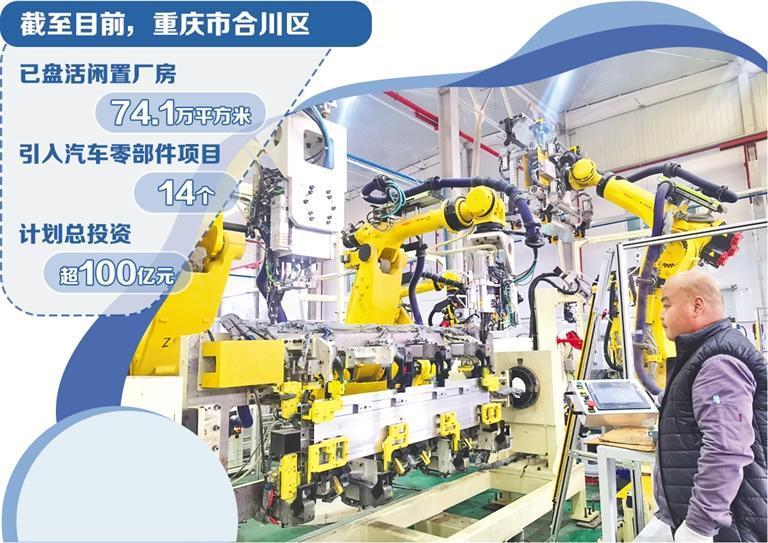
Core Viewpoint - The revitalization of idle land and factory spaces in Hechuan District has led to significant growth in the automotive parts industry, attracting numerous companies and fostering a collaborative industrial ecosystem [2][5][6] Group 1: Company Developments - Yunqi Automotive Systems Co., Ltd. established operations in Hechuan District in October 2025, utilizing over 60,000 square meters of idle factory space to set up four cold stamping production lines, which are expected to produce approximately 10 million stamped parts annually [1] - Hechuan District has successfully attracted 14 automotive parts projects with a total planned investment exceeding 10 billion yuan, revitalizing 741,000 square meters of idle factory space [5] - Chongqing Jianya Automotive Parts Co., Ltd. plans to invest an additional 2 billion yuan in idle factory space to establish a super chassis and production project for 1 million automotive parts, which is projected to generate an annual output value of 3 billion yuan upon reaching full production [5] Group 2: Industry Strategy and Growth - The district has positioned the intelligent connected new energy vehicle parts industry as a leading sector, creating Chongqing's first industrial park for this purpose and implementing a strategy of "revitalizing stock to gain development increment" [2][4] - Over 80% of the idle factories are ready for quick delivery before the investment, saving over six months in construction time for incoming enterprises [2] - A project service team has been established to ensure that enterprises can quickly settle, build, and stabilize production, while also facilitating market expansion and talent development [6]

培育绿色消费新增长点 九部门明确七方面20项举措
Jing Ji Ri Bao· 2026-01-08 02:48
Group 1 - The core viewpoint of the article emphasizes the importance of promoting green consumption as a key strategy for achieving green low-carbon development and enhancing economic transformation in China [1] - The Ministry of Commerce announced that from 2024 to 2025, China aims to implement a vehicle trade-in program for 18.3 million cars, with nearly 60% being new energy vehicles [1] - The old-for-new appliance program is expected to replace 192 million units, with over 90% being of first-level energy efficiency, leading to a total sales increase of 3.92 trillion yuan and benefiting 494 million consumers [1] Group 2 - The Ministry of Agriculture and Rural Affairs highlighted the rapid growth in demand for high-quality green agricultural products, which is driving the upgrade of the agricultural supply system [2] - Initiatives include establishing a platform for green agricultural product sales and organizing events to promote local specialties in major consumption areas [2] - The Ministry of Commerce is focusing on green supply chain development and promoting high-quality logistics, including the use of recyclable packaging materials [2] Group 3 - The Ministry of Ecology and Environment is working on turning waste materials into valuable resources through the "waste-free city" initiative, enhancing the recycling system for discarded consumer goods [3] - By 2024, over 11,000 smart community recycling facilities are expected to be added nationwide, supporting the recycling of approximately 100 million old appliances with a financial investment of 5 billion yuan [3] - The State Administration for Market Regulation plans to strengthen the regulatory framework for green consumption, including updating national standards and enhancing enforcement against violations in green product labeling and food waste [3] Group 4 - The Ministry of Commerce will coordinate with relevant departments to refine and implement measures that promote the greening of production and consumption, aiming to inject green momentum into high-quality economic development [4]
金观平:构建共赢生态是平台经济必答题
Jing Ji Ri Bao· 2026-01-08 02:07
Group 1 - The platform economy has become an integral part of daily life, providing employment for millions and driving economic growth, necessitating a broader evaluation beyond mere financial metrics [1] - Recent central economic work conferences have emphasized the importance of platform enterprises aligning their development with the aspirations of the people for a better life, indicating a shift in policy focus [1][2] - The new mission of the platform economy is to integrate social responsibility into business models, ensuring the protection of laborers' rights and fostering sustainable development [2] Group 2 - The Chinese government is enhancing the support system for the platform economy, with initiatives like occupational injury insurance trials expanding to include more platform workers [2] - Policies addressing issues such as high traffic costs, "ghost deliveries," and price transparency are being implemented to create a fairer and higher-quality labor and consumer environment [2] - Companies like Meituan and Taobao are taking concrete actions, such as providing social security subsidies for delivery workers, reflecting a shift towards long-term partnerships with laborers [2][3] Group 3 - Various support programs are being launched by platform companies, such as Pinduoduo offering ongoing traffic support to agricultural merchants, which helps reduce operational costs for business operators [3] - The reduction of pressure on operators can enhance their entrepreneurial spirit, while improved security for laborers can elevate service quality and stability, ultimately benefiting consumers and market vitality [3] - The evolving role of the platform economy is transitioning from an innovator to a stabilizer of employment, now focusing on fostering win-win development among all stakeholders [3]
2025年我国邮政行业寄递业务量逾2000亿件 同比增长11.5%
Jing Ji Ri Bao· 2026-01-08 01:35
Core Insights - The core viewpoint of the article highlights the robust growth and expansion of China's postal industry, particularly in the express delivery sector, with significant increases in both volume and revenue projected for 2025 [1] Group 1: Business Volume and Growth - By 2025, the total volume of postal delivery services in China is expected to reach 216.5 billion items, representing a year-on-year growth of 11.5% [1] - The express delivery volume is projected to reach 199 billion items, with a year-on-year increase of 13.7% [1] Group 2: Revenue Growth - The total business revenue of the postal industry in China is anticipated to reach 1.8 trillion yuan by 2025, reflecting a year-on-year growth of 6.4% [1] - Revenue from express delivery services is expected to hit 1.5 trillion yuan, with a year-on-year growth of 6.5% [1] Group 3: Infrastructure Development - During the 14th Five-Year Plan period, China aims to establish the largest and most widely beneficial delivery network globally, with significant expansion into rural areas [1] - The number of postal outlets in rural and border areas has increased by nearly 1.5 times compared to five years ago, ensuring that all border villages have postal services [1] - The international delivery logistics system is being rapidly developed, with a total of 374 overseas warehouses established, including 41 new ones added in 2024, covering an additional area of 1.22 million square meters [1] Group 4: Future Outlook - The head of the State Post Bureau, Zhao Chongjiu, indicated that the industry is expected to maintain a steady upward trend in 2026, focusing on high-quality development and the promotion of new productive forces [1] - The industry aims to support the construction of a unified national market while emphasizing reforms, stable growth, improved services, and risk prevention to ensure effective qualitative and reasonable quantitative growth [1]
经济日报:新型工业化持续走深走实
Jing Ji Ri Bao· 2026-01-08 01:04
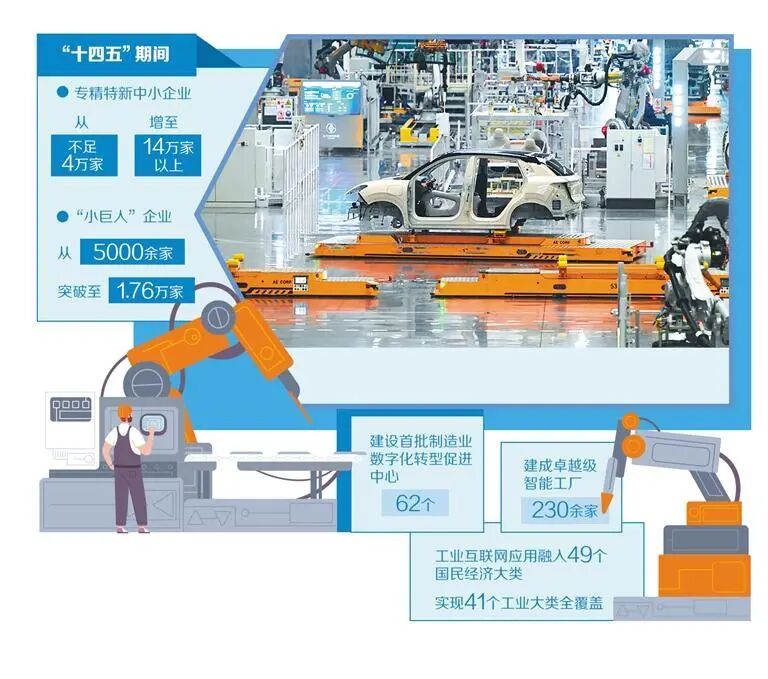
Core Insights - The modernization of industry is identified as the most crucial foundation and core of a modern industrial system, with a focus on strengthening the real economy and promoting technological innovation and digital transformation across various regions [1] Group 1: Industrial Development and Innovation - The Ministry of Industry and Information Technology (MIIT) has been advancing new industrialization since the 14th Five-Year Plan, enhancing the overall strength, quality, efficiency, innovation, competitiveness, and risk resistance of the industry [1] - Significant achievements have been made in various sectors, including integrated circuits, biomedicine, and AI-driven manufacturing, with a focus on creating a modern industrial system centered around advanced manufacturing [2] - The number of specialized and innovative small and medium-sized enterprises has increased from less than 40,000 to over 140,000 during the 14th Five-Year Plan, while "little giant" enterprises have grown from over 5,000 to 17,600 [3] Group 2: Industrial Clusters and Ecosystems - Industrial clusters are essential for high-quality development and transformation of manufacturing enterprises, with efforts to create specialized parks and ecosystems to enhance resource allocation and innovation collaboration [4] - The Hunan Medical Device Industrial Park serves as a successful example of rapid growth in the medical device sector, achieving explosive growth in just four years by attracting various upstream and downstream enterprises [4] Group 3: Digital Transformation - Traditional industries such as steel and machinery are accelerating their digital transformation, with companies like Shandong Haihua Group leveraging AI to enhance operational efficiency and safety [7] - The MIIT is implementing a digital transformation action plan for the manufacturing sector, establishing 62 digital transformation promotion centers and over 230 exemplary smart factories [9] - The next steps include further advancing the construction of a modern industrial system centered on advanced manufacturing and promoting industrial upgrades [9]
全球能源竞争 太空光伏技术能飞多高?
Jing Ji Ri Bao· 2026-01-08 01:01
Core Viewpoint - The article discusses the emerging focus on space photovoltaic technology, highlighting its potential to meet the energy demands of future space exploration and artificial intelligence applications, as well as the strategic importance of this technology for energy security and technological advancement [2][4]. Group 1: Space Photovoltaic Technology Overview - Space photovoltaic refers to solar power systems installed on spacecraft or satellites, which can provide continuous energy supply by harnessing solar energy in space and transmitting it back to Earth [2]. - The technology has historical roots, with its first applications in aerospace due to high costs, and has evolved to become a critical component in modern space missions [2][3]. Group 2: Advantages of Space Photovoltaic - Space photovoltaic systems can generate energy without the limitations of weather and day-night cycles, offering a more efficient and stable power source compared to ground-based solar systems [3]. - The theoretical efficiency of space photovoltaic systems is significantly higher than that of terrestrial systems, making them essential for supporting deep space exploration and artificial intelligence computing needs [3]. Group 3: Challenges Facing Space Photovoltaic - The technology faces significant challenges, including the need for materials that can withstand extreme space conditions, high deployment and maintenance costs, and an immature supply chain for space-grade photovoltaic components [3][4]. - There is also a need for advancements in wireless energy transmission efficiency and precision for future energy transfer from space to Earth [3]. Group 4: Strategic Importance and Future Development - Space photovoltaic technology holds the potential to transform global energy supply structures and contribute to carbon neutrality goals, thereby enhancing national energy security [4]. - The development of this technology could drive innovations in various fields, including lightweight materials and robotics, creating a positive feedback loop that promotes industrial upgrades [4]. - Countries are increasingly recognizing the importance of space resource development, making early investments in space photovoltaic infrastructure crucial for future economic competition [4][5]. Group 5: Development Pathway - The commercialization of space photovoltaic technology is expected to be a gradual process, starting with energy supply for specific space facilities, progressing to support low Earth orbit satellite constellations, and eventually enabling large-scale energy transmission to Earth [5]. - For China, leveraging institutional advantages and fostering collaboration between public and private sectors in the photovoltaic and aerospace industries is essential for overcoming technical challenges and achieving breakthroughs [5].


竞争力重塑 传统产业转型集中发力
Jing Ji Ri Bao· 2026-01-08 01:01
Group 1: Core Insights - Traditional industries are the backbone of China's manufacturing sector, accounting for approximately 80% of key indicators such as value added and employment [1] - The transformation of traditional industries towards high-end, intelligent, and green development is essential for building a modern industrial system [1] Group 2: Cost Reduction and Efficiency Improvement - In Zhengzhou, the use of intelligent manufacturing systems has led to a 10% to 15% increase in production efficiency and a 5% to 10% reduction in delivery cycles, with overall costs decreasing by 3% to 5% [2] - Traditional industries are shifting from relying on scale and experience to a data-driven approach that integrates hardware and software ecosystems [2] Group 3: Smart Factory Development - Over 35,000 basic-level and more than 7,000 advanced-level smart factories have been established since the start of the 14th Five-Year Plan, significantly enhancing production efficiency and reducing costs [3] - Continuous investment in new technology and the application of AI and smart technologies are crucial for traditional industries to enhance their high-end and intelligent capabilities [3] Group 4: Green Development Opportunities - The "dual carbon" goals are driving traditional industries to transition from resource dependency to technology value addition, creating new growth opportunities through smart and green technologies [4] - By 2024, the utilization of recycled resources such as waste steel and waste copper is expected to exceed 400 million tons, highlighting the push for industrial decarbonization and green growth [4] Group 5: Energy Transition and Circular Economy - Traditional energy companies are encouraged to explore clean energy development, while steel companies can utilize recycled materials to reduce costs and emissions [5] - The development of carbon trading markets presents opportunities for traditional industries to profit from energy-saving and emission-reduction efforts [5] Group 6: Consumer Market Dynamics - The expanding consumer market is providing new opportunities for traditional industries, emphasizing the need for precise alignment of production with consumer preferences [7] - The demand for higher quality and diverse products is driving traditional industries to innovate and enhance product offerings [8] Group 7: Value Enhancement Challenges - The ultimate goal for traditional industries is to address the challenge of value enhancement through technological innovation and brand building [9] - Improving product quality and brand premium capabilities are essential for driving value enhancement in traditional enterprises [9]
经济日报金观平:因地制宜推进节能降碳
Jing Ji Ri Bao· 2026-01-08 00:58
Group 1 - The State Council has emphasized the importance of energy conservation and carbon reduction, aiming for higher quality and level in these efforts, while promoting green transformation in economic development [1] - Energy conservation and carbon reduction are key to achieving carbon peak and carbon neutrality goals, with significant progress made since the 14th Five-Year Plan, including an average energy consumption growth rate of 3.3% supporting a 6.1% economic growth [1] - China has established the world's largest and most complete new energy industry chain, providing 80% of global photovoltaic components and 70% of wind power equipment, contributing significantly to global energy transition [1] Group 2 - The strategy focuses on both increasing new green low-carbon industries and phasing out inefficient capacities, particularly in high carbon emission sectors like steel, cement, and refining, with energy efficiency benchmarks improving by an average of 6 percentage points since the 14th Five-Year Plan [2] - Specific measures include enhancing energy conservation reviews for new projects, optimizing existing facilities, and improving the recovery and utilization of waste heat in rapidly growing energy-consuming sectors like computing facilities [2] Group 3 - The transition to energy conservation and carbon reduction requires participation from all sectors of society, with a need to strengthen the internal motivation for green low-carbon development and optimize the market mechanisms for carbon emissions and resource rights [3] - The approach to energy conservation and carbon reduction must be tailored to local conditions, ensuring a coordinated national strategy while allowing for local initiatives to drive progress [3]
现代化铁路网加快成形 营运里程16.5万公里
Jing Ji Ri Bao· 2026-01-08 00:46
Core Insights - The article highlights the significant growth and development of China's railway network during the "14th Five-Year Plan" period, with a focus on the expansion of high-speed rail and the overall modernization of the railway system [1][3]. Group 1: Railway Network Expansion - By the end of 2025, the total railway operating mileage reached 165,000 kilometers, with high-speed rail exceeding 50,000 kilometers, marking a year-on-year growth of 12.8% and 32.98% respectively [1][3]. - The railway network is projected to reach approximately 180,000 kilometers by 2030, with high-speed rail expected to cover around 60,000 kilometers [3]. Group 2: Investment and Infrastructure Development - In 2025, the national railway completed fixed asset investments of 901.5 billion yuan, a year-on-year increase of 6%, and put into operation 3,109 kilometers of new lines, including 2,862 kilometers of high-speed rail [2]. - The China National Railway Group is focusing on 102 major railway projects and enhancing logistics infrastructure, with 52 dedicated railway lines completed [2]. Group 3: Passenger and Freight Transport Growth - In 2025, the national railway achieved a passenger volume of 4.255 billion, a year-on-year increase of 4.2%, and a freight volume of 4.066 billion tons, marking a continuous growth for nine years [4][5]. - The peak daily passenger volume reached 23.132 million, setting a new historical record [4]. Group 4: Logistics and Cost Reduction - The logistics total package volume reached 1.12 billion tons, accounting for 27.5% of the national railway freight volume, with a year-on-year increase of 20.6 percentage points [6]. - Container transport volume reached 41.883 million TEUs, with a year-on-year growth of 14.2% [6]. Group 5: Technological Innovation - The CR450 high-speed train, capable of reaching speeds of 450 kilometers per hour, represents a significant technological advancement in China's railway sector [7]. - The railway sector is advancing in areas such as autonomous driving technology and artificial intelligence applications, aiming to enhance operational efficiency and service quality [7].
中经评论:太空光伏能飞多高
Jing Ji Ri Bao· 2026-01-08 00:06
全球能源竞争的赛场,正从地球表面延伸至浩瀚星空。近期,美国企业家埃隆·马斯克公开表示, 计划未来每年向太空部署1亿千瓦太阳能人工智能卫星能源网络。在太平洋的这一侧,晶科能源和天合 光能两家中国光伏龙头企业,先后在新年致辞中将太空光伏列为重要发展方向。什么是太空光伏?为何 太空光伏会成为头部企业前瞻布局的焦点? 太空光伏面临的挑战也很突出。首先,极端环境适应性要求高,太空环境中无大气层保护,虽然避 免了困扰光伏组件的水氧侵蚀,但太空辐射强、温差大,太空极端环境下的材料可靠性仍需提升。其 次,设备成本居高不下,远超地面光伏电站,大规模太空光伏电站在轨部署、长期维护成本依旧高昂。 再次,产业链配套尚未成熟,新一代光伏电池的地面应用尚未实现规模化放量,航天级定制化产能和供 应链配套缺失。如果考虑未来对地传输能量,还需提高无线能量传输效率和控制精度。 挑战虽多,却无法掩盖太空光伏的深远战略价值。从能源安全看,太空光伏蕴含巨大清洁能源潜 力,若实现规模化对地供电,将彻底改变地球能源供给结构,为碳中和目标提供全新方案,筑牢国家能 源安全新防线;从科技牵引看,太空光伏研发攻关,将倒逼超轻新材料、无线能量传输、航天制造、在 轨 ...