
Xin Hua Cai Jing

Search documents
信达期货:情绪退潮 贵金属市场剧烈调整
Xin Hua Cai Jing· 2026-02-02 09:26
Group 1 - The core viewpoint of the articles indicates that the recent sharp decline in gold and silver prices is driven by a combination of factors, including changes in monetary policy expectations, persistent inflation signals, and technical corrections due to crowded positions in the market [1][2][3] - Kevin Warsh, a potential candidate for the next Federal Reserve Chair, has a hawkish reputation and advocates for a return to the Fed's core role as a "lender of last resort," emphasizing the need to separate fiscal and monetary policies while actively reducing the balance sheet [2] - The long-term bullish trend for gold is supported by the ongoing deterioration of the U.S. fiscal deficit, weakened governance, and the erosion of the dollar's dominance as a global reserve currency, leading to strategic gold purchases by central banks [3][4] Group 2 - The long-term upward trend in gold prices will only be disrupted if major global central banks cease strategic gold purchases and if the U.S. effectively addresses its debt sustainability and financial stability issues, which are unlikely in the foreseeable future [4] - The transition period between the "twilight of the old order" and the "dawn of a new credit system" suggests that while short-term volatility may present opportunities for investment, the long-term trend for gold remains clear as it is being historically re-evaluated as a super-sovereign value anchor [4]
比亚迪全新子品牌领汇汽车正式官宣亮相
Xin Hua Cai Jing· 2026-02-02 09:26
Group 1 - BYD's new sub-brand, Linghui Auto, officially announced its launch on February 2, positioning itself as a "super value mobility practitioner" with a vision to "redefine mobility through technological innovation" [1] - The brand emphasizes "uncompromising technology and more affordable prices" [1] - Linghui Auto will feature advanced systems such as the "Tianshen Eye" driver assistance system and the Yunlian intelligent body control system, integrating resources from the e-platform 3.0 and fifth-generation DM technology for future vehicle models [1]

一周流动性观察 | 春节临近取现需求上升 央行呵护信号显著 资金面大概率维持平稳
Xin Hua Cai Jing· 2026-02-02 09:08
Group 1 - The People's Bank of China (PBOC) conducted a 750 billion yuan reverse repurchase operation with a rate of 1.40%, maintaining the previous level, resulting in a net withdrawal of 755 billion yuan due to 1,505 billion yuan of reverse repos maturing on the same day [1] - In the previous week, the PBOC's reverse repos totaled a net injection of 5,805 billion yuan, with 2,000 billion yuan of Medium-term Lending Facility (MLF) maturing on Monday and 1,500 billion yuan of 1-month treasury cash deposits conducted by the Ministry of Finance on Wednesday [1] - The overall overnight funding rate increased compared to December 2022, with R001 and DR001 average monthly rates rising by 4.7 and 5.5 basis points to 1.41% and 1.34%, respectively [1] Group 2 - According to analysts, the stability in the funding environment in January was supported by the PBOC's relatively generous liquidity provision, releasing a total of 1 trillion yuan in medium- and long-term funds, equivalent to a 0.5 percentage point reserve requirement cut [2] - The upcoming week will see a total of 17,615 billion yuan in 7-day reverse repos maturing, with an expected increase in cash withdrawal demand as the Spring Festival approaches [2] - Analysts expect the PBOC to maintain a loose monetary policy, potentially using various tools such as 7-day or 14-day reverse repos to stabilize liquidity before and after the Spring Festival [3] Group 3 - The PBOC's clear supportive stance on liquidity is expected to continue, with anticipated liquidity injections of around 30,000 to 35,000 billion yuan before the Spring Festival, aiming to ensure a stable funding environment [3] - The issuance of government bonds is expected to remain high to meet funding needs for key projects, which may introduce additional liquidity pressures [3] - Despite potential short-term tightening, the overall funding environment is expected to remain stable, with reduced volatility in both DR007 and DR001 compared to previous years [3]
未来智造局|“百万token一分钱” 推理GPU驱动大模型下半场发展
Xin Hua Cai Jing· 2026-02-02 08:51
Core Insights - The AI industry is transitioning from a "training-driven" phase to a "reasoning-driven" phase, with reasoning computing power becoming the core element for the commercialization of AI [1][2] - Sunrise, a domestic AI chip company, has launched its new generation reasoning GPU chip, the Qihang S3, aiming for a target of "one cent per million tokens" [1][5] - The next decade will see reasoning infrastructure as the foundational base for China's AI era, emphasizing the need for cost-effective and scalable reasoning capabilities [1][9] Group 1: Reasoning Computing Power - Reasoning computing power is essential for the practical application of AI, with predictions indicating that by 2026, reasoning computing will account for 66% of AI computing, surpassing training computing for the first time [2][4] - The shift towards reasoning-driven AI is crucial for enhancing the efficiency of AI services in the real economy [2][3] Group 2: Sunrise's Innovations - Sunrise is the first company in China to focus on reasoning GPUs, having developed its first chip, Qihang S1, in 2018, and has since released the Qihang S2 and Qihang S3, which are optimized for large model reasoning scenarios [3][5] - The Qihang S3 chip aims to achieve over ten times improvement in reasoning cost-effectiveness, with current costs at approximately 0.57 yuan per million tokens, better than the market average [5][6] Group 3: Industry Challenges and Solutions - The industry faces challenges such as low resource utilization, insufficient adaptation efficiency, and complex operations, with over 40% GPU idle rates under traditional architectures [6][8] - Sunrise is collaborating with partners to create a reasoning system-level solution that optimizes both hardware and software to address these challenges and improve computing efficiency [6][8] Group 4: Market Potential and Future Trends - The demand for reasoning tokens is expected to grow exponentially, with a significant market opportunity for specialized reasoning GPUs [6][9] - The reduction of reasoning costs is projected to lead to a massive increase in AI applications, with estimates suggesting that a 50% cost reduction could trigger widespread adoption [8][9]
【环球财经】东京股市下跌 日经225指数跌1.25%
Xin Hua Cai Jing· 2026-02-02 08:23
Core Viewpoint - The Tokyo stock market experienced a decline on February 2, with the Nikkei 225 index falling by 1.25% and the Tokyo Stock Exchange index dropping by 0.85% due to a weak yen and external market influences [1][2]. Group 1: Market Performance - The Nikkei index closed down by 667.67 points at 52,655.18 points, while the Tokyo Stock Exchange index fell by 30.19 points to 3,536.13 points [2]. - Most of the 33 industry sectors on the Tokyo Stock Exchange saw declines, particularly in securities and commodity futures trading, mining, and banking, which experienced significant drops [2]. Group 2: Influencing Factors - The Tokyo stock market opened higher due to a weaker yen against the US dollar, but gains were not sustained [1]. - Reports of the ruling Liberal Democratic Party's dominance in the Japanese House of Representatives elections initially boosted the market, but this momentum did not last [1]. - The decline in the semiconductor sector on the New York stock market last Friday negatively impacted Asian markets, leading to a sell-off in Asian tech stocks, which further affected Tokyo's semiconductor-related stocks [1].
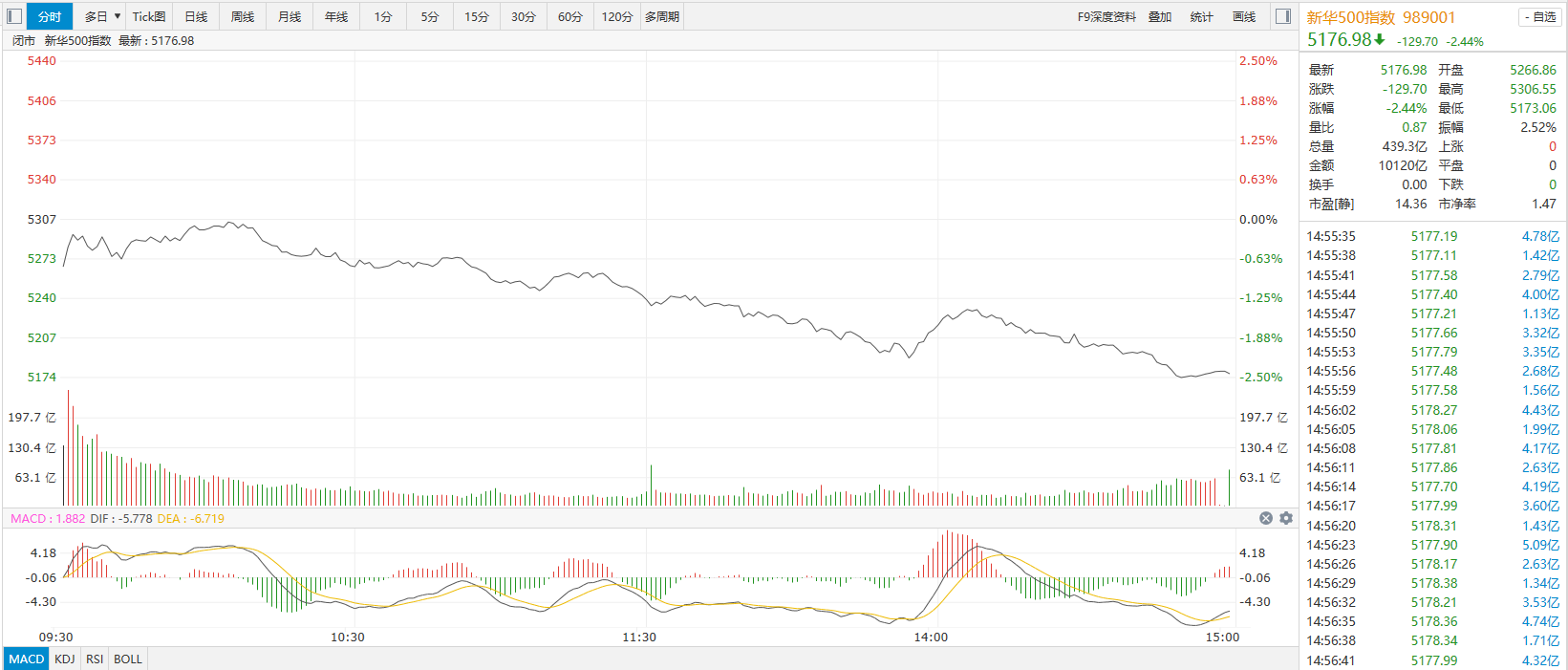
【新华500】新华500指数(989001)2日跌2.44%
Xin Hua Cai Jing· 2026-02-02 08:08
Core Viewpoint - The Xinhua 500 Index (989001) closed at 5176.98 points on February 2, with a decline of 2.44% [1]. Group 1: Index Performance - The Xinhua 500 Index experienced a volatile trading session on February 2, ultimately falling over 2% [3]. - The index reached a high of 5306.55 points and a low of 5173.06 points during the trading day [3]. - The total trading volume of constituent stocks for the day was reported at 10,120 billion yuan [3]. Group 2: Constituent Stocks - Water Well Square (水井坊) led the gainers among constituent stocks with an increase of 7.44% [3]. - Other notable gainers included Huaxi Biological (华熙生物) and Jiu Gui Jiu (酒鬼酒) [3]. - Beijing Junzheng (北京君正) was the biggest loser, dropping 11.06%, followed by Shenxinfu (深信服) and Tongling Nonferrous Metals (铜陵有色) with significant declines [3].

债市日报:2月2日
Xin Hua Cai Jing· 2026-02-02 08:06
Core Viewpoint - The bond market is experiencing consolidation, with fluctuations in the context of equity market adjustments, and the focus is on the central bank's operations and liquidity conditions ahead of the Spring Festival [1] Market Performance - The majority of government bond futures closed lower, with the 30-year main contract up 0.18% at 112.06, while the 10-year main contract fell 0.03% to 108.25 [2] - The 30-year government bond yield decreased by 0.8 basis points to 2.252%, while the 10-year government bond yield increased by 0.15 basis points to 1.8115% [2] - The China Convertible Bond Index fell by 2.39%, with 194 convertible bonds dropping over 2%, while a few saw gains exceeding 2% [2] Overseas Bond Market - In the Eurozone, 10-year bond yields decreased, with French yields down 0.9 basis points to 3.417% and German yields down 1.8 basis points to 2.838% [3] - In North America, 10-year U.S. Treasury yields rose by 0.62 basis points to 4.237%, while 2-year yields fell by 2.85 basis points to 3.522% [3] Primary Market - Agricultural Development Bank's financial bonds were issued with yields below market estimates, with 1-year, 3-year, and 10-year yields at 1.4719%, 1.5418%, and 1.9599% respectively [4] Liquidity Conditions - The central bank conducted a 750 billion yuan reverse repurchase operation at a rate of 1.40%, resulting in a net withdrawal of 755 billion yuan for the day [5] - Short-term Shibor rates mostly declined, with the overnight rate rising by 3.7 basis points to 1.365% [5] Economic Indicators - The manufacturing PMI, non-manufacturing business activity index, and composite PMI output index were reported at 49.3%, 49.4%, and 49.8%, indicating a decline in economic activity [6] Institutional Views - Huatai Fixed Income suggests that the traditional strategy of "watching stocks or commodities to trade bonds" is failing due to commodity price volatility and increased demand for dividend insurance, leading to a "stock-bond co-temperature" [8] - Huachuang Securities notes that the January PMI's unexpected decline reflects a weak economic reality, with caution advised regarding upstream price increases affecting downstream demand [8] - Jianghai Securities indicates that while caution is warranted regarding low bond yields, the risk of rising rates is limited, with recent market performance showing strength amid easing concerns [8]
收评:三大指数均跌超2% 电网设备板块逆势走强
Xin Hua Cai Jing· 2026-02-02 07:45
Market Overview - The A-share market experienced a decline on Monday, with all three major indices falling over 2%. The Shanghai Composite Index closed at 4015.75 points, down 2.48%, the Shenzhen Component Index at 13824.35 points, down 2.69%, and the ChiNext Index at 3264.11 points, down 2.46% [1] - The total trading volume in the Shanghai and Shenzhen markets was 2.58 trillion yuan, a decrease of 250.8 billion yuan compared to the previous trading day [1] Sector Performance - The electric grid equipment and liquor sectors showed strong performance, with stocks like Huan Tai Liquor and Jin Hui Liquor experiencing multiple days of gains, while Water Well Liquor hit the daily limit [2] - Conversely, resource cyclical sectors such as metals, oil and gas, chemicals, coal, and steel faced significant declines [1][2] Individual Stocks - Over 4600 stocks in the market experienced declines, indicating a broad-based sell-off [3] Institutional Insights - According to Jifeng Investment Advisory, the market is currently in a correction phase, but the overall trend remains upward. They suggest focusing on leading companies in previously popular sectors that have seen price corrections [4] - CITIC Securities noted that the price of Moutai has continued to rise, with expectations for the liquor sector to perform well around the Spring Festival. They believe the sector is currently undervalued and presents a strong bottom-fishing opportunity [4] - According to招商证券, the market is expected to remain volatile in February, particularly due to the upcoming Spring Festival, which may lead to decreased market activity [4] Industry Data - The Ministry of Industry and Information Technology projected that by 2025, the added value of the electronic information manufacturing industry will grow by 10.6% year-on-year, outpacing the overall industrial and high-tech manufacturing growth rates [6] - In December, the added value of the electronic information manufacturing industry increased by 11.8% year-on-year, with specific product outputs showing varied trends, such as a 5.8% decline in mobile phone production [6] Policy Developments - The Guangdong Provincial Development and Reform Commission announced a plan to support the construction of a carbon emissions trading market and the potential introduction of carbon emission-related futures products [7]
科创板收盘播报:科创50指数跌3.88% 电气设备股表现活跃
Xin Hua Cai Jing· 2026-02-02 07:34
Core Viewpoint - The ChiNext 50 Index experienced a significant decline on February 2, closing at 1450.9 points, down 3.88%, with a trading volume of approximately 866 billion yuan [1] Group 1: Index Performance - The ChiNext Composite Index fell by 3.95%, ending at 1760.23 points, with a total trading volume of about 2715 billion yuan [1] - Excluding the suspended stock Evert, the remaining 600 stocks on the ChiNext board mostly declined, with an average drop of 3.41% and an average turnover rate of 3.34% [1] Group 2: Sector Performance - Most sectors showed a general decline, with only a few stocks in the electrical equipment and specialized machinery sectors performing actively, while some healthcare and environmental protection stocks saw slight increases [1] Group 3: Individual Stock Performance - Ruijie Technology reached the daily limit up, showing the highest increase [2] - Aerospace Hongtu experienced the largest decline, falling by 3.41% [2] Group 4: Trading Volume - Lanke Technology had the highest trading volume at 137.7 billion yuan, while ST Pava had the lowest at 1.409 million yuan [3] Group 5: Turnover Rate - Sikan Technology led with a turnover rate of 24.9%, while Bairen Medical had the lowest turnover rate at 0.23% [4]
情绪退潮 贵金属市场剧烈调整
Xin Hua Cai Jing· 2026-02-02 07:34
Group 1 - The core viewpoint of the articles indicates that the recent sharp decline in gold and silver prices is driven by emotional clearing rather than a fundamental reversal, influenced by three main factors: Trump's nomination of Kevin Warsh for the next Fed chair, higher-than-expected PPI data, and a crowded long position in gold [1][2][3] - Warsh's policy stance is characterized by a structural approach that supports interest rate cuts while opposing unrestrained balance sheet expansion, advocating for a new paradigm of "rate cuts + balance sheet reduction" to combat inflation [2] - The long-term bullish logic for gold remains intact despite short-term adjustments, driven by the strategic restructuring of the global monetary credit system, with ongoing U.S. fiscal deficits and weakening dollar dominance undermining its status as the core reserve currency [3][4] Group 2 - The long-term bullish trend for gold will only be invalidated if major global central banks cease strategic gold purchases and the U.S. effectively addresses debt sustainability and financial stability issues, both of which are unlikely in the foreseeable future [4] - The fundamental risk for gold in the medium to long term lies in the uncertainty of its pricing mechanism, as it is still predominantly priced in U.S. dollars, which could lead to volatility if the dollar's credibility collapses without a credible alternative currency [4] - The current period is seen as a transition between the "twilight of the old order" and the "dawn of a new credit system," with short-term fluctuations providing opportunities for allocation while the long-term trend for gold as a sovereign value anchor is being historically reassessed [4]