Guan Cha Zhe Wang

Search documents
5年增资6次,腾讯旗下小贷注册资本增至150亿,行业第二仅次于字节系
Guan Cha Zhe Wang· 2025-11-25 08:15
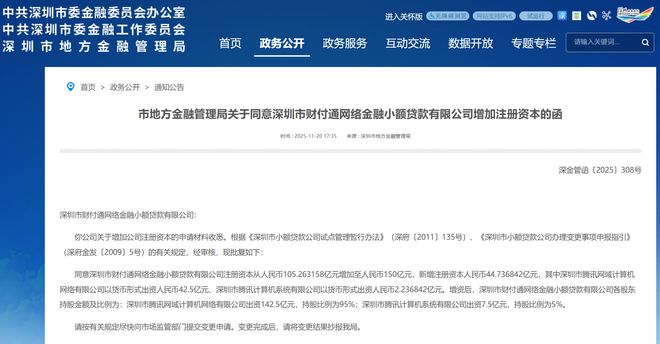
Core Points - Shenzhen Financial Management Bureau approved the increase of registered capital for Shenzhen Tencent Financial Technology Microloan Co., Ltd. from RMB 10.5263158 billion to RMB 15 billion, with an additional capital of RMB 4.4736842 billion [1] - Tencent's two subsidiaries contributed to the capital increase, with Shenzhen Tencent Network Co., Ltd. investing RMB 4.25 billion and Shenzhen Tencent Computer Systems Co., Ltd. investing RMB 223.6842 million [1] - Since 2020, Tencent's microloan company has undergone five capital increases, growing from an initial RMB 300 million to RMB 15 billion, representing a 50-fold increase in five years [1] Industry Overview - Nearly 30 microloan companies have increased their capital this year, with notable examples including Ping An's Jinlian Yuntong Microloan increasing from RMB 5 billion to RMB 10 billion [2] - The top three microloan companies by registered capital are ByteDance's Zhongrong Microloan (RMB 19 billion), Tencent's Financial Technology Microloan (RMB 15 billion), and Ping An's Jinlian Yuntong Microloan (RMB 10 billion) [2] - As of September 2025, the number of microloan companies in China decreased to 4,863 from 5,257 at the end of 2024, indicating a trend of consolidation in the industry [2] - Tencent does not hold a consumer finance license, despite being a major player in the microloan sector [2] - Other significant players in the internet microloan space include JD's Jingdong Shengji (RMB 8 billion) and Baidu's Du Xiaoman (RMB 7.4 billion) [2]


“美政府想减少对华供应链依赖,药商和患者却可能愈发依赖中国药”
Guan Cha Zhe Wang· 2025-11-25 06:36
Core Insights - The Chinese pharmaceutical industry is at a pivotal moment for global expansion, with rapid advancements in new drug development, clinical trials, and international collaborations [1] - Despite the U.S. efforts to reduce reliance on Chinese supply chains, American manufacturers and patients may increasingly depend on Chinese innovations [2] Group 1: Industry Growth and Innovation - China has become the second-largest innovator in drug development globally, conducting about one-third of global clinical trials last year, up from just 5% a decade ago [1] - The stock prices of Chinese biotech companies have surged by 110% this year, more than three times that of their U.S. counterparts [1] - Major Western pharmaceutical companies are facing a "patent cliff," with over $300 billion in revenue-generating drugs losing patent protection by 2030, leading them to seek potential drug molecules from China [1] Group 2: Strategic Collaborations - Significant collaborations between U.S. and Chinese companies are emerging, such as Pfizer's agreement with a Chinese biotech firm for a potential $1.25 billion deal for an experimental cancer drug [3] - In another instance, GlaxoSmithKline partnered with a Chinese company for a $500 million deal, highlighting the increasing importance of Chinese firms in the global pharmaceutical landscape [3][5] Group 3: Regulatory and Developmental Advancements - The Chinese pharmaceutical industry has undergone significant reforms, including streamlined approval processes and alignment with international regulatory standards, resulting in a dramatic increase in new drug approvals [5] - The time required for clinical trial approvals has decreased from 501 days to 87 days, with the number of new treatment approvals rising from 11 in 2015 to an expected 93 by 2024, 42% of which are domestically developed [5] Group 4: Market Dynamics and Challenges - Despite being the second-largest pharmaceutical market, China faces challenges in profitability, with prescription drug sales projected at $125 billion in 2023, only one-sixth of the U.S. market [9] - The majority of sales still come from generic drugs, with new drugs accounting for only one-fifth of sales, although this is expected to rise to one-third by 2028 [9] Group 5: Global Market Aspirations - Chinese companies are increasingly targeting overseas markets, often through licensing agreements with Western firms, and are exploring new business models to enhance their market presence [10] - The valuation of Chinese biotech firms is significantly lower than their U.S. counterparts, making them attractive to Western investors [10] - The rise of Chinese pharmaceutical companies could lead to more affordable therapies, particularly benefiting patients in underdeveloped countries [10]
部分SSD产线暂时关闭?长江存储致态辟谣
Guan Cha Zhe Wang· 2025-11-25 05:22
Core Viewpoint - Yangtze Memory Technologies Co. (YMTC) has issued a clarification regarding a maliciously fabricated announcement circulating on the internet, asserting that the information is false and that no such announcement has been made by the company or its retail brand Zhitai [1] Group 1: Company Developments - YMTC's Zhitai brand has publicly denied the existence of a false announcement that was misattributed to them, urging the public not to believe or spread the misinformation [1] - The company has successfully scaled the production of its 232-layer 3D NAND flash memory chips, which are recognized as the most advanced in the industry [1] Group 2: Industry Insights - At the 2025 Data Storage Industry Conference, Ni Guangnan, an academician of the Chinese Academy of Engineering, highlighted that China's data storage industry possesses key core technologies and sufficient industrial scale [1] - The emergence of domestic SSD controller manufacturers has been rapid, with over a dozen companies successfully developing and commercializing SSD controller chips, leading to positive user experiences [1]
逸语道破:中美元首通话,重创了蠢蠢欲动的日本右翼和“台独”
Guan Cha Zhe Wang· 2025-11-25 05:03
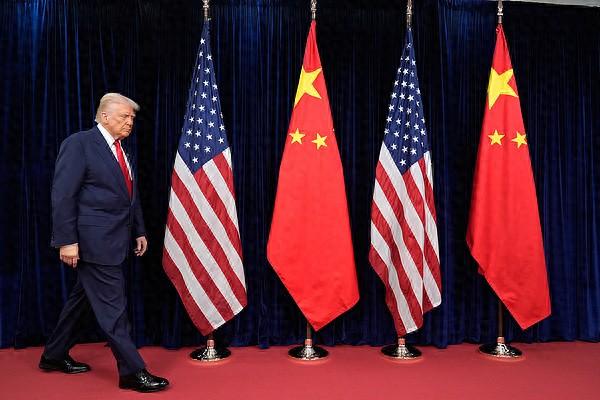
Group 1 - The core viewpoint of the article emphasizes that the recent phone call between the Chinese and American leaders marks a new phase in Sino-U.S. relations characterized by mutual achievement and common prosperity [1][2][3] - The first part of the Chinese memorandum assesses the recent bilateral meeting in Busan, highlighting the importance of maintaining momentum and expanding cooperation while minimizing issues [2][3] - The second part addresses the Taiwan issue, with China reiterating its stance that Taiwan's return is a crucial component of the post-war international order [2][8] Group 2 - The U.S. response during the call indicated a positive reception, with President Trump acknowledging the importance of China's role in World War II and expressing understanding of Taiwan's significance to China [2][9] - The discussion also touched on the Ukraine crisis, with China supporting peace efforts and advocating for a fair and lasting resolution [2][3] - The call demonstrated the strategic role of leader diplomacy in stabilizing Sino-U.S. relations during turbulent times, providing guidance for future interactions [3][5] Group 3 - The timing of the call was significant, as it countered rising provocations from Japan regarding Taiwan, effectively signaling a halt to Japan's aggressive posturing [6][10] - The conversation reinforced the notion that any external interference in Taiwan's affairs would not be tolerated, emphasizing the importance of maintaining the post-war order [9][11] - The call illustrated a new characteristic of Sino-U.S. relations, focusing on mutual respect and cooperation to address global challenges, moving beyond traditional zero-sum competition [14][15] Group 4 - Economic cooperation is highlighted as a stabilizing force in Sino-U.S. relations, with both sides committed to implementing agreements to alleviate trade tensions [13][14] - The relationship is evolving towards a more mature and rational competition, with both nations recognizing the potential for mutual development [13][15] - There is an increasing willingness to collaborate on non-traditional security issues, reflecting a broader scope for cooperation that benefits both countries and the international community [14][15]
第一次应急发射任务,圆满成功!
Guan Cha Zhe Wang· 2025-11-25 05:02
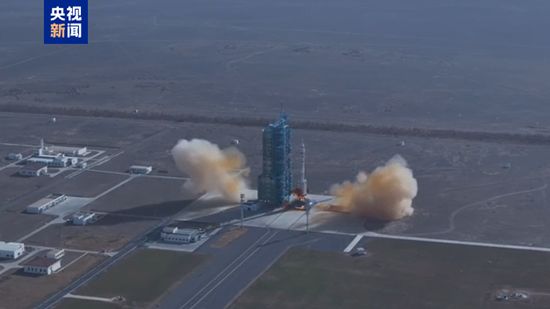
Core Points - The Shenzhou-22 spacecraft was successfully launched on November 25, 2025, marking a significant milestone in China's manned space program [1] - This mission is the 38th launch since the initiation of China's manned space program and the 610th flight of the Long March series of rockets [1] - The Shenzhou-22 mission is notable as it is the first emergency launch task in China's manned space program [1] Mission Details - The Shenzhou-22 spacecraft was launched aboard the Long March 2F rocket from the Jiuquan Satellite Launch Center [1] - Approximately 10 minutes after launch, the spacecraft successfully separated from the rocket and entered its designated orbit [1] - The spacecraft is unmanned and carries supplies including space food, medicine, fresh fruits and vegetables, a device for addressing window cracks on the Shenzhou-20 spacecraft, and necessary spare parts for the space station [1] Significance - The successful launch and mission execution demonstrate advancements in China's space capabilities and readiness for future manned missions [1] - The mission's emergency nature highlights the preparedness of China's space program to respond to unforeseen circumstances [1]
“中国已转向研发下一代燃料船舶,日本落后了”
Guan Cha Zhe Wang· 2025-11-25 04:22
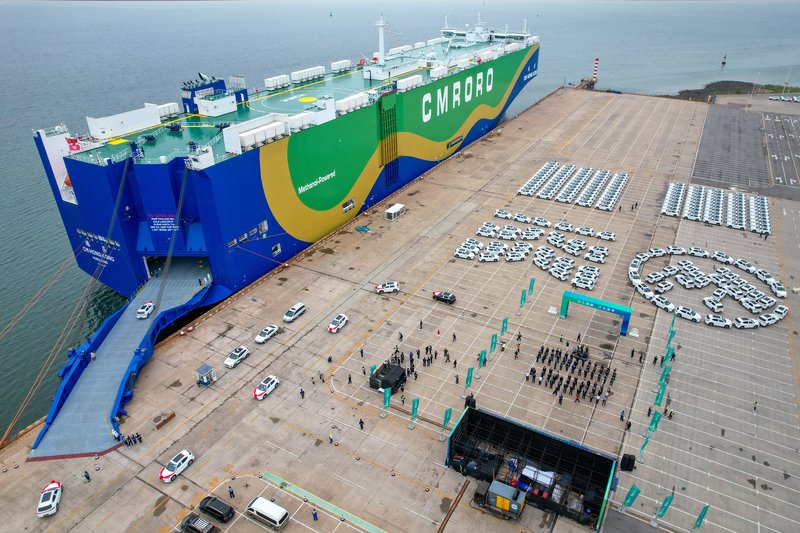
Core Viewpoint - China's shipbuilding industry is becoming a crucial partner for global shipowners in their transition to green development, raising concerns among Japanese counterparts about falling behind [1][3]. Group 1: Industry Developments - Japanese shipping industry representatives are calling for enhanced collaboration to tackle new technologies, focusing on the development of next-generation fuel-powered vessels such as hydrogen and ammonia [1][3]. - The establishment of the "Green Ship Planning and Design Center (GSC)" by Japanese shipbuilding and shipping companies aims to target the research and development of new green power vessels [1][3]. - Japan's shipbuilding industry is facing significant pressure from Chinese and South Korean competitors, leading to the exit of several large Japanese shipbuilding firms from the market [6]. Group 2: Market Trends - As of June this year, China has secured nearly 70% of global green ship orders, achieving full coverage of mainstream ship types, with over 80% of orders at Hudong-Zhonghua Shipbuilding being green vessels [7][8]. - By the end of 2024, China's market share of new orders for green power vessels is projected to reach 78.5%, maintaining over two-thirds in the first half of 2025 [7][8]. Group 3: Strategic Insights - The shift from traditional fuels to alternative fuels in the shipping industry is seen as an unstoppable trend, necessitating that Japanese shipbuilding companies prepare adequately [1][4]. - Historical lessons indicate that insufficient capital investment and technological development can lead to a loss of leadership in the shipbuilding sector, as seen in the UK's transition from coal to oil [4][6]. - Japan's reliance on imports for critical resources emphasizes the need for domestic shipbuilding capabilities to ensure economic security [6].
涉6.12亿欠款股权再被冻结,顾家家居原大股东破产重整获准
Guan Cha Zhe Wang· 2025-11-25 03:04
Core Viewpoint - The company is undergoing significant changes in its ownership structure, with the former controlling shareholder entering bankruptcy restructuring while a new major shareholder has recently invested in the company [1][2]. Group 1: Bankruptcy Restructuring - Hangzhou Deyejiajun Enterprise Management Co., Ltd., a major shareholder of Gujia Home Furnishing, has filed for bankruptcy restructuring due to its inability to repay debts and insufficient assets to cover all liabilities, which has been accepted by the court [1]. - The restructuring is seen as having potential value and feasibility, indicating a possible path for the company to address its financial difficulties [1]. Group 2: Shareholding Changes - The current major shareholder of Gujia Home Furnishing is Ningbo Yingfeng Ruihe Investment Management Co., Ltd., controlled by He Jianfeng, while Hangzhou Deyejiajun still holds a 10.77% stake, making it the second-largest shareholder [1][2]. - Following a recent capital increase by He Jianfeng's group, the Gu family’s stake in Gujia Home Furnishing is expected to decrease from 15.78% to 12.32% [2]. Group 3: Debt Pressure and Historical Context - The Gu family's debt issues stem from aggressive expansion plans initiated in 2018, which included acquisitions of international brands totaling nearly 3 billion yuan, leading to financial strain due to underperforming assets [3]. - The Gu family has faced multiple legal challenges, including lawsuits and arbitration claims totaling significant amounts, contributing to their current financial distress [3]. Group 4: Implications of Restructuring - The bankruptcy restructuring may provide the Gu family with a temporary respite to negotiate with creditors and avoid further dilution of their ownership through ongoing share auctions [4]. - If the restructuring fails, the continued auctioning of shares could lead to a detrimental outcome for the Gu family, creditors, and the new major shareholder [4].


特朗普:将于明年4月访华
Guan Cha Zhe Wang· 2025-11-25 03:03
Core Points - The phone call between Chinese President Xi Jinping and U.S. President Donald Trump lasted for one hour and covered topics such as China-U.S. trade, the Russia-Ukraine conflict, and Taiwan [1] - Trump described the call as "very good" and mentioned discussions on soybean and other agricultural product purchases, as well as efforts to curb illegal fentanyl trafficking [1] - Trump announced plans to visit China in April next year and expressed optimism about the strengthening relationship between the two countries [1] Summary by Categories Trade Relations - The discussion included agricultural purchases, specifically mentioning soybeans and other products [1] - There has been "significant progress" in ensuring the relevance and accuracy of bilateral agreements since the successful meeting in South Korea [1] Geopolitical Issues - The call addressed the ongoing Russia-Ukraine conflict and the situation in Taiwan, indicating a broad range of geopolitical concerns [1] Future Engagement - Trump plans to visit China in April 2024, signaling ongoing diplomatic engagement [1]
沃尔玛中国的双面:山姆狂奔藏隐忧,超市转型谋新路
Guan Cha Zhe Wang· 2025-11-25 02:48
Core Insights - Walmart Group reported strong financial results for Q3 of FY2026, with total revenue reaching $179.5 billion, a year-on-year increase of 5.8% [1] - Walmart China led global growth with net sales of $6.1 billion, up 21.8%, and comparable sales growth of 13.8% [1][3] - E-commerce sales grew by 32%, accounting for over 50% of total sales, becoming a key driver of growth for the group [1] Revenue and Profit Performance - Total revenue for Q3 was $179.5 billion, with a 5.8% year-on-year increase; adjusted operating profit was $7.2 billion, up 8.0% [1] - Membership fee income globally increased by 16.7%, with international markets seeing a 34% rise, largely due to the expansion of Sam's Club in China [3] Sam's Club Expansion and Challenges - Sam's Club is identified as the strongest growth engine for Walmart in China, with plans to open 10 new stores in 2025, significantly increasing from the previous rate of 6-7 stores per year [6] - Despite rapid expansion, Sam's Club faces challenges including product selection issues and quality control crises, which have led to customer complaints [6][9] - Recent management changes have raised concerns among members about the potential dilution of quality and brand integrity [9][10] Strategic Restructuring and Community Stores - Walmart is undergoing a strategic restructuring to address the decline of traditional hypermarkets, with a focus on community stores to capture the market left by shrinking big-box stores [11][12] - Community stores are characterized by smaller sizes (around 500 square meters) and a focus on high-frequency shopping needs, aiming to be within a 10-minute walking distance for consumers [12] - The new community store strategy is complemented by the upgrade of Walmart's private label "沃集鲜," which aims to provide high-quality products at stable prices [16][17] Competitive Landscape and Future Outlook - The dual strategy of rapid expansion of Sam's Club and the transformation of Walmart supermarkets is seen as a dual engine for growth in the Chinese market [17] - The competitive landscape remains challenging with rivals like Hema and Ole' accelerating their market presence, necessitating Walmart to address quality control and brand perception issues [17]

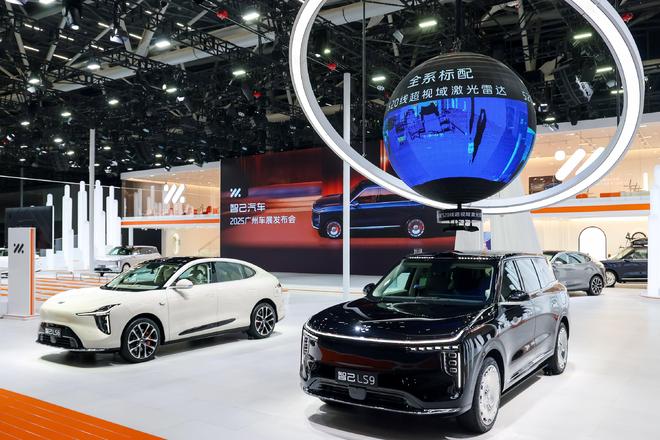
智己LS9正式开启交付,上汽集团品牌向上正在起势
Guan Cha Zhe Wang· 2025-11-25 01:49
Core Insights - The Guangzhou Auto Show 2025 showcased the newly launched six-seater SUV, the Zhiji LS9, and the next-generation Zhiji LS6, with Zhiji Auto achieving over 10,000 units sold for two consecutive months following their launches [1][3] - The Zhiji LS9 has officially commenced nationwide user deliveries, while Zhiji Auto has partnered with CATL to add production lines for the 66-degree Super Xiaoyao MAX battery to accelerate delivery [1][3] - The LS9 is equipped with advanced features such as the "Lingxi Digital Chassis 3.0," vector four-wheel drive system, and a starting price of 322,800 yuan, competing against models like Zeekr 9X and Li Auto L9 [3][4] - The LS6, priced from 197,900 yuan, boasts the largest CATL 66-degree Super Xiaoyao MAX battery, offering a range of 450 km and ultra-fast charging capabilities, addressing industry pain points with a combined fuel consumption of 2.07L per 100 km [3] - As the premium electric vehicle brand of SAIC Group, Zhiji faces intense market competition and has introduced the Stellar Super Range Extender technology, marking its entry into the plug-in hybrid segment with the LS6 [3][4] - The LS9 represents Zhiji's first model in the range extender category and is positioned as the flagship model within SAIC's product lineup, aimed at enhancing brand positioning and expanding market share in the high-end segment [4]