
Guo Ji Jin Rong Bao

Search documents
东方财富证券:践行“五要五不”, 厚植中国特色金融文化根基
Guo Ji Jin Rong Bao· 2025-12-26 10:28
东方财富证券深入贯彻党的二十大和二十届历次全会精神,认真落实《关于进一步发挥交易所功能引导 行业践行中国特色金融文化的行动方案》,深刻把握中国特色金融文化的内涵要义,将之与企业使命、 愿景、发展战略有机融合、有效联动,积极弘扬践行中国特色金融文化、服务乡村振兴战略,为公司高 质量发展提供坚实的思想保证、价值引领和精神力量。 培育中国特色金融文化,融入公司发展全过程 公司坚持党对金融工作的领导,深入学习贯彻党的二十大和二十届三中、四中全会精神,及时开展专题 学习,党委成员带头讲党课,通过专家辅导讲座学习,在媒体发表学习体会文章等方式,推动系列中央 重要会议精神在公司落地生根。同时,公司将中国特色金融文化及其"五要五不"要求深度融入公司制 度、发展战略、经营管理、队伍建设、评估考核、文化建设等,通过完善内控治理、加强组织保障、强 化员工管理、完善考核等举措,确保"五要"成为员工行为指南,"五不"成为不可逾越的红线,进一步 将"五要五不"要求落实于公司治理的各个环节。 稳健审慎,筑牢金融安全屏障。稳健审慎,是防范和化解金融风险的必然要求。东方财富证券积极践行 合规稳健经营理念,树立正确的经营观、业绩观和风险观,营业 ...

国网英大:全资子公司拟11.29亿元出售英大期货100%股权
Guo Ji Jin Rong Bao· 2025-12-26 10:11
国网英大公告,全资子公司英大证券拟将其持有的英大期货100%股权以人民币11.29亿元的价格出售给 中油资本有限。本次交易由沃克森(北京)国际资产评估有限公司进行评估,评估价值为11.29亿元,增值 率8.31%。交易价格已获国有资产监督管理部门备案确认。本次交易尚需取得国有资产监督管理部门的 批准,中油资本有限作为英大期货控股股东的资格尚需获得中国证监会的核准。交易完成后,英大期货 将不再纳入公司合并报表范围。 ...

私募信用五大关键趋势
Guo Ji Jin Rong Bao· 2025-12-26 10:08
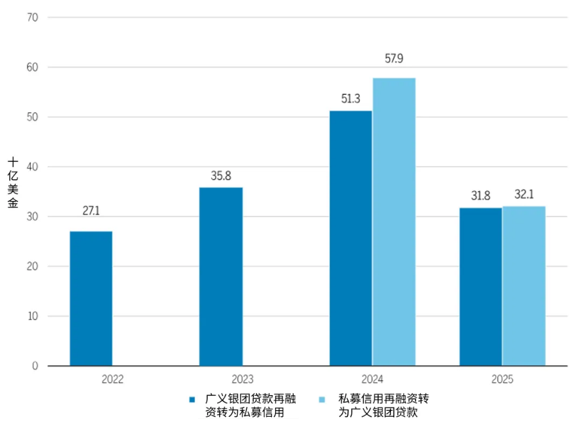
Core Insights - Private credit has become one of the most dynamic sectors in financial markets, with expectations for its role as a mainstream financing solution to deepen by 2026, evolving beyond traditional middle-market direct lending into a more diversified toolkit [1] Group 1: Expanding Opportunities - The potential investable market size for private credit exceeds $30 trillion, spanning various asset classes, with significant portions not belonging to traditional leveraged corporate debt [3] - Investors who can broaden their private credit perspectives and grasp market trends may find substantial opportunities to create value for clients [3] Group 2: Convergence of Public and Private Markets - The lines between public and private markets are increasingly blurred, creating ongoing opportunities as issuers utilize both markets to meet complex capital needs [4] - Notable examples include commercial real estate debt and large-scale data center financing, where issuers seek funds from both public and private markets, indicating a trend towards innovative financing solutions [4] Group 3: Changes in Credit Conditions - The convergence of public and private markets may intensify competition in certain areas, potentially impacting credit conditions, particularly in middle-market direct lending and broadly syndicated loan markets [5] - Over the past decade, middle-market direct lending has grown at a rate approximately five times that of the broader leveraged credit market, leading to increased competition [5] Group 4: Growth in Retail and Wealth Investor Demand - Asset owners are diversifying their public market risk exposure and capturing potential premiums from the illiquidity and complexity of the private credit market, with U.S. retail investor allocations currently around $100 billion, projected to grow to $2.4 trillion by 2030 at an annualized growth rate of nearly 80% [8] - Interval funds are expected to reach nearly $450 billion by mid-2025, with credit-focused strategies remaining the most popular allocation direction [8] Group 5: Evolution of Bank Roles - Due to tighter regulations, banks are reshaping their balance sheets, with disintermediation becoming a long-term trend in the credit market, although their role remains crucial [13] - Banks are increasingly partnering with market-based lenders, facilitating private credit growth through various collaborations, including financing and distribution of private credit products [13] - Recent data shows steady growth in loans to non-depository financial institutions, highlighting the evolving role of banks in the credit market [13]

产业创新是建构中国经济增长新的核心支柱
Guo Ji Jin Rong Bao· 2025-12-26 10:08
Core Insights - The upcoming year 2026 marks the start of China's 15th Five-Year Plan, emphasizing the implementation of industrial innovation projects to enhance the country's industrial structure and establish a modern industrial system with global competitiveness [1] Group 1: Industrial Innovation Strategy - China aims to create emerging pillar industries and strategically position future industries, focusing on sectors like new energy, aerospace, and quantum technology, which are characterized by long-term and dynamic features [3] - The strategy includes a new national system to concentrate resources on technological advancements and infrastructure, leveraging the complete industrial system and vast market advantages to facilitate the commercialization of new technologies [4] Group 2: Global Innovation Standing - According to the 2025 Global Innovation Index, China ranks 4th globally, achieving its highest position ever, while also being the second in key technology fields like biotechnology and quantum technology, closing the gap with the U.S. [5] - China has 24 of the world's top 100 innovation clusters, with the Shenzhen-Hong Kong-Guangzhou cluster now ranked first globally, surpassing the Tokyo-Yokohama cluster [5] Group 3: Policy and Financial Support - Various government departments have issued guidelines to promote strategic emerging industries, emphasizing the need for comprehensive financial services throughout the innovation lifecycle [6] - The government is focusing on creating application scenarios in digital economy and AI, aiming to build a robust ecosystem for emerging and future industries [6] Group 4: Industry Development and Collaboration - China has seen the emergence of around 350 companies in the brain-computer interface sector, and has established the largest solar panel production base globally, showcasing a collaborative approach to industrial innovation [7] - The government is promoting a systematic approach to accelerate the development of industrial clusters, emphasizing the integration of infrastructure, technology research, and market needs [9] Group 5: Future Industry Challenges and Strategies - Future industries face more complex risks, necessitating a diversified technological approach and the establishment of pilot application scenarios to foster innovation [10] - Regulatory frameworks are evolving to support innovation, including the introduction of "regulatory sandboxes" and a focus on digital regulation to create a conducive environment for future industries [11] Group 6: Investment and Risk Management - Establishing a risk-sharing mechanism is crucial for future industry development, with a focus on a tiered layout system and government-market collaboration to attract investment [12] - Innovative financial tools are being developed to support long-term investments in future industries, including insurance products tailored for technology transfer and key equipment development [12] Group 7: Talent and Innovation Ecosystem - Cultivating a high-level innovation ecosystem is essential, with initiatives to support leading enterprises and foster new entities in future industries [13] - There is a shared policy focus on enhancing infrastructure, original innovation, and the integration of technology and industry to strengthen the overall innovation capacity [13]
人民币汇率“破7”背后
Guo Ji Jin Rong Bao· 2025-12-26 10:08
Core Viewpoint - The offshore RMB exchange rate against the US dollar breaking the 7.0 mark is a significant signal of structural changes in the international financial system, indicating a profound reshaping of the dollar-centric international monetary order [1]. Group 1: Dollar Dominance and Its Challenges - The dollar-dominated international monetary system, established post-World War II, is experiencing a decline, with its share in global foreign exchange reserves dropping from 72% at the beginning of the century to 58% by Q3 2025 [3]. - The dollar's influence is maintained through three core mechanisms: pricing of commodities in dollars, dollar settlements in global trade, and dollar valuation of financial assets. Despite a decrease from approximately 55% in 2015, the dollar still accounted for 46% of global trade settlements in 2024 [3]. - The dollar index has fallen over 10% since 2025, marking its worst performance since 1973, highlighting the structural pressures facing the dollar system [3]. Group 2: Political and Economic Factors - The politicization of dollar credit, particularly through direct interventions in monetary policy, has undermined confidence in the independence of the US Federal Reserve, prompting a reassessment of the safety and reliability of dollar assets [4]. - The restructuring of global supply chains is diminishing the material foundation of the dollar system, with the proportion of intra-ASEAN trade settled in local currencies rising from 23% in 2018 to 34% in 2024 [4]. - Central banks are increasing their gold reserves to the highest levels since 1990, and the share of RMB loans from the New Development Bank has risen to 38%, indicating a search for alternatives to the dollar [4]. Group 3: RMB Internationalization - The RMB's exchange rate breaking the 7.0 mark reflects a significant step in its internationalization, supported by ongoing reforms in the RMB exchange rate formation mechanism since the 2015 reform [6]. - The share of RMB in global payments reached 4.5% in 2023, nearly tripling over five years, while China has signed bilateral currency swap agreements with over 40 countries, totaling more than 4 trillion RMB [6]. - The initial formation of a "petro-RMB" system is changing the pricing and settlement landscape for global commodities, with approximately 18% of China's crude oil imports settled in RMB in 2023, up from less than 5% in 2020 [6]. Group 4: Shift Towards Multipolar Currency System - The global trade settlement system is transitioning from a "dollar monopoly" to a "multilateral coexistence" model, with the proportion of intra-BRIC trade settled in local currencies increasing from 19% in 2017 to 35% in 2024 [7]. - Adjustments in the Special Drawing Rights (SDR) currency basket reflect structural changes in the international monetary system, with the RMB's weight in the SDR increasing from 10.92% to 12.28% in 2022, making it the third-largest currency [7]. - Emerging multilateral development institutions are increasing local currency financing, reducing reliance on the dollar, and promoting financial cooperation models that favor de-dollarization [7]. Group 5: Broader Implications - The RMB's exchange rate breaking the 7.0 mark is merely an external manifestation of deeper changes occurring in international settlement systems, reserve asset structures, and financial infrastructure [8]. - As a multipolar currency system gradually replaces the unipolar dominance, the global economy is expected to gain a more stable institutional foundation, with the direction of this structural change becoming increasingly clear [8].
银行业金融机构应从三方面协同发力提振消费
Guo Ji Jin Rong Bao· 2025-12-26 10:08
Core Viewpoint - The joint issuance of the "Notice on Strengthening Business and Financial Coordination to Boost Consumption" by the Ministry of Commerce, the People's Bank of China, and the National Financial Regulatory Administration aims to enhance consumption through 11 policy measures across key areas such as goods consumption, service consumption, and new consumption types, emphasizing the need for collaboration between banking institutions and business departments to effectively implement these policies [1][2]. Group 1: Policy Measures - The notice outlines three main areas of focus with 11 specific policy measures to support consumption, emphasizing the importance of collaboration between financial institutions and local business departments [1]. - Financial institutions are encouraged to establish regular coordination mechanisms with local governments to enhance communication and tailor implementation details to local conditions, ensuring effective policy execution [1][2]. Group 2: Financial Services Innovation - Financial institutions should innovate their service offerings to better support consumption, particularly in areas such as durable goods, digital products, and service consumption, by providing flexible financing options like installment payments and credit cards [3][4]. - There is a call for financial institutions to explore new financing models that cater to emerging consumption trends, including green consumption and digital consumption, while ensuring risk control and sustainability [5][6]. Group 3: Collaboration and Support - Strengthening cooperation with key enterprises and platforms is essential for providing comprehensive financial support, including cross-border supply chain financing and facilitating domestic and international trade [2][4]. - Financial institutions are urged to actively participate in consumption promotion activities organized by business departments, offering tailored financial solutions to enhance the efficiency of subsidy distribution [4][5]. Group 4: Targeted Financial Solutions - The development of differentiated financial services that cater to new consumption patterns and business models is crucial, with a focus on supporting small and medium-sized enterprises and individual operators [5][6]. - Financial institutions should leverage digital tools to integrate subsidies and consumption vouchers with consumer spending, ensuring precise alignment with consumption scenarios [5][6].
招商积余:挂牌转让控股子公司衡阳中航地产60%股权已完成
Guo Ji Jin Rong Bao· 2025-12-26 10:07
Core Viewpoint - The company has completed the transaction of transferring 60% equity of its subsidiary, Hengyang Zhonghang Real Estate Co., Ltd., to Hengyang High-tech Investment and Development Co., Ltd., which is expected to enhance asset quality and release development resources [1] Group 1 - The transaction was formalized through a property rights transaction contract signed on December 25, 2025 [1] - The transfer price was set at 1.6756 million yuan, matching the listing price [1] - Following the completion of the transaction, the company will no longer hold equity in Hengyang Zhonghang, and it will be excluded from the company's consolidated financial statements [1] Group 2 - The transaction is anticipated to result in a one-time reduction of approximately 264 million yuan in the company's net profit attributable to shareholders for the fiscal year 2025 [1]

传艺科技:控股股东邹伟民股票质押延期至2026年12月
Guo Ji Jin Rong Bao· 2025-12-26 09:39
传艺科技公告,公司控股股东、实际控制人邹伟民将已质押给东吴证券的2300万股办理股票质押式回购 延期购回,占其持股16.37%、占公司总股本7.94%。质押起始日2024年1月15日,原到期日2026年1月14 日,延期后到期日2026年12月25日,用途为个人资金需求。截至公告披露日,其累计质押股份2300万 股,占持股16.37%、占公司总股本7.94%。 ...

京源环保:公司存在违规使用募集资金支付非募投项目费用 收到江苏证监局行政监管措施决定书
Guo Ji Jin Rong Bao· 2025-12-26 09:37
Core Viewpoint - The company has received an administrative regulatory decision from the Jiangsu Securities Regulatory Bureau, indicating violations in the use of raised funds for non-project expenses and inaccurate disclosures in fundraising reports [1] Group 1: Regulatory Findings - The company was found to have improperly used raised funds to pay for expenses not related to the fundraising projects [1] - There was a failure to accurately disclose this information in the fundraising special reports and other announcements [1] - The governance status disclosed in the 2024 annual report does not match the actual situation [1] Group 2: Regulatory Actions - The company and related personnel will face corrective orders and warning letters as part of the administrative regulatory measures [1] - These actions will be recorded in the integrity archives of the securities and futures market [1] - The company and related personnel are required to strictly follow the corrective measures and submit a written report within the specified timeframe [1]

英伟达和谷歌2026年还会是美股“领头羊”吗?
Guo Ji Jin Rong Bao· 2025-12-26 09:35
Group 1 - The two best-performing stocks among the "Seven Giants" as of December 24 are Nvidia and Alphabet, with Nvidia's stock up approximately 36% to $188 and Alphabet's stock up about 65% to $315 [1] - Optimists believe that the tech stocks in the US will not experience a bubble in 2026, with an expected overall increase of over 20%, particularly for Nvidia and Alphabet, which have projected P/E ratios of 23x and 27x respectively [1] - Nvidia's stock has faced pressure due to a slowdown in AI spending and competition, but market confidence remains high despite these challenges [1] Group 2 - Nvidia's recent Blackwell chip and the upcoming Rubin chip are highly anticipated, with expectations that OpenAI will release the next-generation GPT model early next year, which may be trained using Blackwell [2] - The export outlook for Nvidia's GPUs to the Chinese market is more optimistic than before, with the H200 chip expected to bring additional benefits in 2026 [2] - Alphabet's Gemini 3.0 model, trained on custom chips developed with Broadcom, has drawn investor attention, but the market's focus is more on competition with OpenAI rather than direct threats to Nvidia's GPUs [2] Group 3 - Alphabet has developed its own custom AI chips (TPUs) over the past decade, which provide cost advantages in cloud computing and enhance the training of the Gemini large language model [3] - Gemini's market share is expected to grow rapidly in 2025, increasing from nearly zero to 13%, contributing to a significant rise in Alphabet's stock price [3] - Morgan Stanley estimates that deploying 500,000 TPUs could generate approximately $13 billion in annual revenue for Alphabet, with expectations of renting out 5 million TPUs by 2027 and 7 million by 2028 [3]
