
Guo Ji Jin Rong Bao

Search documents
贵金属“狂欢”
Guo Ji Jin Rong Bao· 2025-12-27 04:51
Core Insights - The global precious metals market is experiencing a historic surge, with gold prices surpassing $4500 per ounce and silver prices exceeding $72 per ounce, marking significant annual increases [1] - Economic concerns are rising as the dollar's credit system faces severe challenges, highlighted by the rare phenomenon of silver being more expensive than oil, which has not occurred in 45 years [1] Supply and Demand Imbalance - Gold has become a key asset in global portfolios amid geopolitical risks and macroeconomic uncertainties, with central bank purchases supporting its price [2] - Silver prices have tripled since their 2022 low, driven by industrial demand from sectors like solar energy and electric vehicles, alongside a persistent supply shortage [3] Platinum and Palladium Market Dynamics - Platinum has shown remarkable performance, with prices increasing over 150% this year, driven by demand from the hydrogen energy sector [4] - Palladium is also facing supply constraints, with a projected shortfall of approximately 200,000 ounces by 2025, further supporting its price [4] Copper Price Surge - Copper prices have reached historical highs, driven by strong demand from energy transition and infrastructure investments, while supply disruptions have tightened the market [5] Dollar Credibility Concerns - The rise in precious metal prices reflects a shift in investor confidence regarding the stability of traditional currency systems, particularly the dollar [7] - Concerns over U.S. government debt, which has exceeded $38.5 trillion, are prompting investors to seek refuge in physical assets like gold [8] Economic Crisis Signals - The current ratio of silver to oil prices has reached its highest level since 1990, often indicating impending economic crises [10] - Historical patterns suggest that significant disparities between silver and oil prices can signal structural economic risks [11] Regulatory and Market Dynamics - The potential for regulatory interventions, such as increased margin requirements for silver trading, could lead to significant price corrections [12] - The current market environment mirrors past crises, raising concerns about the sustainability of price increases in precious metals [12]
公募ETF多元化时代在路上
Guo Ji Jin Rong Bao· 2025-12-27 03:56
Core Insights - The market recognition of index investment has significantly increased this year, with public ETFs experiencing substantial growth in both product quantity and scale, driven by heightened market attention and innovation from fund companies [1] Group 1: Market Trends - The ETF market is witnessing structural differentiation, particularly highlighted by the explosive growth of bond ETFs, which saw a net inflow of 418.9 billion yuan from April 15 to December 15, 2025, indicating a strong underlying demand [3] - The current market is characterized by a preference for technology growth styles, with industry and thematic ETFs expanding rapidly while broad-based ETFs are experiencing net outflows [3] Group 2: Competitive Landscape - The ETF market is becoming increasingly competitive, with numerous companies filing for similar products, leading to a saturation of ETF offerings [5] - Fund companies are focusing on quality competition, enhancing liquidity for smaller products and innovating service offerings to provide comprehensive support for investors [5] Group 3: Future Innovations - The diversification of ETF products is expected to increase, catering to various investor needs, including those focused on emerging industries and specific investment strategies [7] - Potential future innovations in ETFs may include leveraging new industries or themes, expanding into emerging markets, and introducing leveraged, inverse, or actively managed ETFs [8]
数字金融“由大到强”的中国路径
Guo Ji Jin Rong Bao· 2025-12-27 03:56
Core Insights - Digital finance is a key component of China's financial power blueprint, with a complete structure already formed. The core industry value added of the digital economy grew by 9.2% year-on-year in the first three quarters of 2025, and the banking sector's digital investment accounted for 15.3% [1] Group 1: Structural Challenges - Structural contradictions are evident, including lagging institutional supply, with regulatory sandboxes covering only 8.7% of prefecture-level cities, and limited promotion of cross-border innovative products [1] - Data factor allocation is inefficient, with less than 30% of quality data, leading to difficulties in rights confirmation and token circulation, creating "data islands" [1] - Cross-border scenarios are insufficiently penetrated, with digital RMB cross-border transactions accounting for only 3.2%, and reliance on the SWIFT system limiting currency diversity [1] - Financing obstacles exist for small and medium-sized tech enterprises, which often have data without assets or assets without financing, resulting in inadequate valuation and risk control systems [1] Group 2: Proposed Solutions - To break the deadlock, it is suggested to open up the system by establishing a nationwide unified regulatory sandbox, covering core cities in 31 provinces by the end of 2026, led by the National Financial Regulatory Administration [1] - Aiming for full coverage of public data rights confirmation by 2026, a national unified registration platform will be built, clarifying data ownership and processing rights for enterprises and operational rights for personal data after desensitization [2] - A three-dimensional valuation model will be developed to assess "data quality + scenario value + market demand," and the entire pledge registration process will be streamlined to three working days [2] Group 3: Cross-Border Enhancements - The digital RMB's cross-border application will be deepened, with plans to connect with over 10 payment systems of economic entities by 2027, enabling multi-currency real-time settlement [3] - A cross-border data trusted exchange system will be established, breaking the reliance on SWIFT, with 29 countries connected to CIPS [3] - The establishment of offshore RMB bonds and core scenarios for cross-border supply chain finance will be concentrated in Hainan Free Trade Port and Shanghai Free Trade Zone by 2028 [3] Group 4: Collaborative Mechanisms - A joint inter-ministerial meeting will be established to coordinate cross-departmental regulation and data sharing, with biannual meetings [3] - Policy support will be provided for financing related to IoT and blockchain verification, with risk compensation up to 50% modeled after the US SBA [3] - Talent cultivation will be enhanced by adding courses on data compliance and offshore finance in universities, along with tax and housing guarantees for high-end talent [3] Group 5: Strategic Transition - China's digital finance is transitioning from "scale expansion" to "structural optimization," focusing on institutional innovation to resolve bottlenecks, empowering potential through data, and expanding space through cross-border breakthroughs [4]
省国资委入主!国盛证券实控人变更
Guo Ji Jin Rong Bao· 2025-12-27 03:53
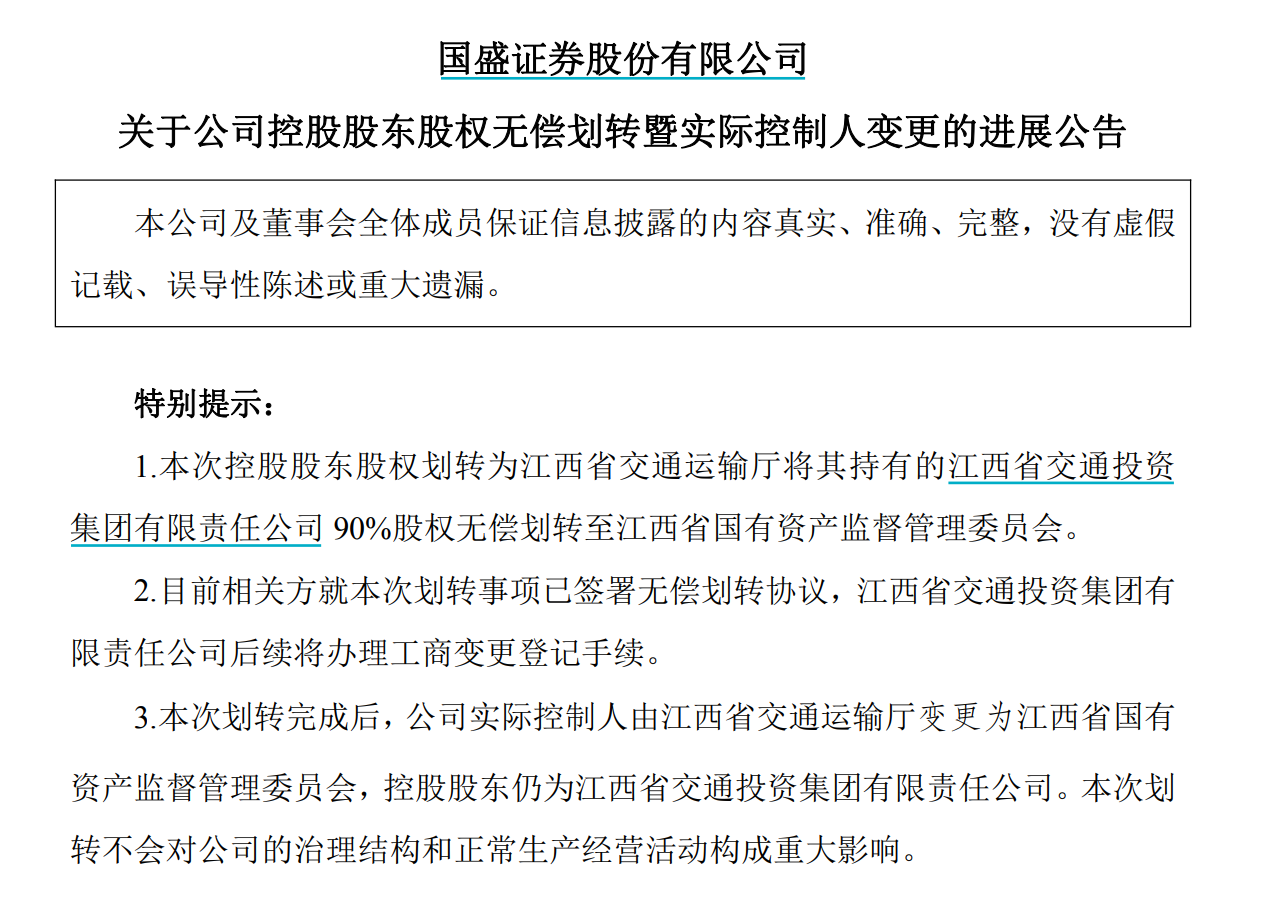
Group 1 - The core point of the news is the significant progress in the change of the actual controller of Guosheng Securities, with the Jiangxi Provincial State-owned Assets Supervision and Administration Commission (SASAC) taking over from the Jiangxi Provincial Department of Transportation [1][5] - On December 25, Guosheng Securities announced that a non-compensatory transfer agreement regarding the equity transfer of Jiangxi Transportation Investment Group Co., Ltd. (Jiangxi Jiao Tou) was signed, indicating a shift in control [1][5] - After the transfer, Jiangxi Jiao Tou will still be the controlling shareholder of Guosheng Securities, but the actual controller will change to Jiangxi SASAC [1][5] Group 2 - Guosheng Securities emphasized that the change in the controlling shareholder and actual controller is in accordance with government-approved procedures and will not significantly impact the company's governance or operations [5] - Prior to this, on November 19, Guosheng Securities had already issued a notice regarding the planned transfer of 90% of Jiangxi Jiao Tou's shares directly to Jiangxi SASAC [5] - Before the transfer, Jiangxi Jiao Tou held 494 million shares of Guosheng Securities, accounting for 25.52% of the total share capital, and through Jiangxi Ganyue Expressway Co., Ltd., it indirectly held an additional 78.5 million shares [5] Group 3 - Guosheng Securities is the only securities company under Jiangxi Province and is listed on the Shenzhen Stock Exchange, with a registered capital of 1.935 billion yuan and total assets of 48.8 billion yuan as of September 30, 2025 [6] - The change in actual controller is part of a broader trend of local state-owned asset integration, with Guosheng Securities undergoing significant identity restructuring throughout the year [6] - The company has recently completed a name change and other administrative updates, reflecting its new identity in the industry [6] Group 4 - Financial commentators suggest that the change in actual controller will help optimize the equity structure and improve resource coordination, enhancing the company's competitiveness and decision-making efficiency [7] - The transition is viewed as a vertical optimization adjustment within the same provincial state-owned asset system, maintaining the state-owned nature of the controlling stake [7] - Although there may be a transitional period for governance adaptation, the long-term outlook is positive for the company's core competitiveness and industry position, with a focus on enhancing capital operation efficiency and resource integration [7]


中保协连续十年发布保险行业人力资源报告
Guo Ji Jin Rong Bao· 2025-12-27 03:37
12月26日,在中国保险行业协会人力资源专委会、教育培训专委会常务委员会议上,《2024年中国 保险行业人力资源报告》(下称《报告》)正式发布,这也是中国保险行业协会连续第10年发布的系列 成果。 作为全面反映行业人才发展动态的权威成果,《报告》汇集118家保险机构及地方协会调研数据、 覆盖超6.4万名保险从业者样本。以大量行业公司一手详实数据为支撑,通过系统统计分析与历年数据 对比,对行业人力资源现状进行全方位深度摸底,系统呈现了保险行业人员配置现状及人力资源管理实 践全景图,为行业高质量发展提供坚实人才支撑。 据介绍,《报告》采用"主报告+子报告"系统架构,在原有基础上新增《人工智能在培训领域的应 用课题研究报告》《保险行业新三支人才队伍建设课题研究报告》两份子报告,二者各有侧重、互为补 充,共同丰富报告研究维度。 主报告延续成熟分析框架,重点优化中国保险行业人力资源发展指数,进一步提升对行业人力资源 发展动态与趋势刻画的精准度。内容上,既覆盖人员配置、人才供需、流动特征、绩效薪酬管理、组织 效能、员工发展、企业文化等核心维度,全面呈现行业人力资源现状;又聚焦营销员队伍、分公司负责 人、精算人员等关键群体 ...
金监总局:原则上不得调整业绩比较基准 全面规范资管产品信披要求
Guo Ji Jin Rong Bao· 2025-12-27 03:37
Core Viewpoint - The Financial Regulatory Bureau has issued the "Management Measures for Information Disclosure of Asset Management Products by Banking and Insurance Institutions," aiming to standardize information disclosure for asset management trust products, wealth management products, and insurance asset management products, ensuring investor rights and obligations are met [1][2]. Group 1: General Regulations - The Measures establish general provisions for information disclosure, including channels, responsibilities, methods, prohibited behaviors, and text requirements [2]. - Prohibited behaviors include making unauthorized profit promises, predicting actual investment performance, using incomparable or inaccurate data for performance comparison, and disparaging other asset management products or institutions [2]. Group 2: Disclosure Requirements - The Measures comprehensively regulate the information disclosure requirements throughout the product lifecycle, covering aspects such as product offering information, periodic disclosures, temporary disclosures, and termination disclosures [2]. - Specific requirements are set for product prospectuses, performance benchmarks, issuance announcements, periodic reports, net value disclosures, past performance, and temporary disclosures [2]. Group 3: Performance Benchmark Adjustments - Product managers are generally not allowed to adjust performance benchmarks; any necessary adjustments must follow strict internal approval processes and be disclosed in periodic reports and updated product prospectuses [2][3]. Group 4: Differentiation Between Public and Private Products - The Measures differentiate between public and private products, imposing stricter disclosure requirements on public products due to their broader audience and lower investor thresholds [3]. - Public product information must be disclosed through unified industry channels, while private products can use agreed-upon disclosure channels [3]. Group 5: Self-Regulatory Norms - The Measures call for the establishment of self-regulatory norms for each product type, with relevant associations collaborating to create a detailed "1+3" information disclosure rule system [4].
上海旅超AI音乐赛携手AI开放麦,创新打造文旅宣推新范式
Guo Ji Jin Rong Bao· 2025-12-27 02:25
Core Insights - The first Shanghai Tourism Strategy Super Competition has received enthusiastic responses, with over 10,000 participants, aiming to empower market entities and promote multi-day tourism [1] - The event has launched the Shanghai Travel Super AI Music Competition, which has garnered over 1.8 million views and produced more than 1,300 AI songs, showcasing a blend of Shanghai's characteristics and AI creativity [1][3] Group 1: Event Overview - The Shanghai Travel Super AI Music Competition is a significant upgrade to the Shanghai Travel Super Competition, focusing on the integration of music, tourism, and technology [3] - The competition aims to stimulate public enthusiasm for sharing urban life and exploring high-quality development opportunities in the cultural tourism sector through AI [3][4] Group 2: AI Music Competition Impact - The AI music competition lowers the barriers to music creation, encouraging participants to explore and promote Shanghai's cultural tourism features [3][4] - Various districts in Shanghai have launched AI songs that reflect their unique cultural tourism resources, creating a collaborative ecosystem [3][4] Group 3: Marketing and Engagement Strategies - The competition seeks to transform quality AI music content into promotional tools for urban tourism, enhancing interactive marketing strategies [3][4] - It aims to establish a long-term traffic generation mechanism through media platforms, promoting continuous dissemination and engagement [3] Group 4: Broader Implications for the Industry - The AI music competition serves as a pioneering example for the application of AI in the cultural tourism sector, providing replicable experiences for industry stakeholders [4] - The initiative aims to embed local cultural elements into music, enhancing public awareness and interest in visiting Shanghai [4]

小贷行业“大清退”|回顾展望
Guo Ji Jin Rong Bao· 2025-12-27 01:37
Core Viewpoint - The small loan industry is undergoing a significant restructuring, marked by the issuance of new guidelines that limit annualized comprehensive financing costs to no more than 24% and aim to reduce these costs to within four times the one-year Loan Prime Rate (LPR) by the end of 2027 [1][4]. Group 1: Industry Restructuring - The issuance of the guidelines is seen as a catalyst for a "massive exit" from the small loan market, with several major players, including state-owned enterprises and internet giants, withdrawing from the industry [4][5]. - The trend of "clearing stock and optimizing structure" is evident, driven by stringent regulations, interest rate reductions, and market pressures, leading to a significant reduction in the number of small loan institutions [2][8]. - As of September 2025, there were 4,863 small loan companies in China, with a total loan balance of 7,229 billion yuan, reflecting a decrease of 319 billion yuan in the first three quarters of the year [7]. Group 2: Market Dynamics - The exit of companies such as Renbao Small Loan and Jin Tong Small Loan, which had a registered capital of 8.989 billion yuan, indicates a shift in the market landscape, with a focus on compliance and professional development [2][5]. - The number of small loan companies is expected to continue decreasing, with a concentration of resources towards compliant, well-capitalized institutions with technological capabilities [8][12]. - The regulatory environment is pushing small loan institutions to increase their capital to enhance risk resistance, as seen with companies like Tencent's financial subsidiary increasing its registered capital from 10.526 billion yuan to 15 billion yuan [10][11]. Group 3: Future Outlook - The industry is likely to see a "stronger stronger" dynamic, where leading institutions will continue to consolidate their positions through capital increases, while smaller firms face greater capital pressures [13][14]. - The focus for surviving institutions will shift towards specialization, compliance, and technological empowerment, moving away from traditional expansion models [14]. - The anticipated regulatory tightening will further compress the survival space for smaller institutions, leading to increased industry consolidation and a more rational approach to capital increases [13][14].
信用卡App逐步关停!银行线上渠道加速整合
Guo Ji Jin Rong Bao· 2025-12-27 01:25
Core Viewpoint - The trend of integrating credit card apps into main banking apps is gaining momentum among Chinese banks, with Postal Savings Bank being the second state-owned bank to announce the closure of its independent credit card app, following Bank of China [1][3][4]. Group 1: Bank Actions - Postal Savings Bank announced the integration of its "Postal Credit Card App" services into the "Postal Bank App," ceasing the use of the independent app [3]. - Bank of China previously announced a similar move, planning to migrate services from its "Bountiful Life" app to the main "Bank of China" app [3]. - Over the past two years, more than ten banks, including Beijing Rural Commercial Bank and Shanghai Rural Commercial Bank, have also closed or merged their credit card app services [3]. Group 2: Market Trends - Experts indicate that the closure of independent credit card apps reflects a broader trend in the banking industry aimed at reducing costs and improving efficiency [4][8]. - The integration of apps is seen as a response to the declining profitability and operational costs associated with maintaining separate credit card apps [4][8]. - The digital transformation in banking is shifting focus from standalone functionalities to a more integrated and user-friendly experience through main banking apps [6]. Group 3: Strategic Considerations - Different types of banks have varying motivations for app integration; state-owned banks focus on creating a unified ecosystem, while joint-stock banks aim for differentiated competitive advantages [7]. - Smaller banks prioritize efficiency and survival, using app integration primarily to reduce costs and enhance local service offerings [7]. - The operational burden of maintaining multiple apps, including development and maintenance costs, is a significant factor driving this trend [8]. Group 4: Future Outlook - The future of credit card services may not be limited to main banking apps, as new service formats like mini-programs and embedded lifestyle platforms could emerge [8]. - Banks are encouraged to strengthen their "one bank" digital strategy, enhancing online integration based on business characteristics and user preferences to improve user experience [8].


小贷行业“大清退”
Guo Ji Jin Rong Bao· 2025-12-27 01:11
小额贷款行业深度洗牌在年底正式开始! 12月24日,记者获悉,《小额贷款公司综合融资成本管理工作指引》(下称《指引》)正式在小贷行业 内部下发,明确不得新发综合融资成本年化超过24%的贷款,要求将新发贷款综合融资成本逐步降至1 年期贷款市场报价利率(LPR)的4倍以内。 一位小贷机构高管对记者表示,"边走边看,真的执行了,做不下去就只能退出(小贷行业)。" 事实上,早有苗头预示着小贷行业进入深度洗牌时期。12月以来,人保集团旗下重庆人保小额贷款有限 责任公司(下称"人保小贷")以及注册资本曾位居全国前列、高达89.89亿元的南宁市金通小额贷款有 限公司(下称"金通小贷")正式退出行业。稍早前,搜狐旗下狐狸互联网小额贷款(宁波)有限公司 (下称"狐狸小贷")被注销试点资格,浙江阿里巴巴小额贷款股份有限公司(下称"阿里小贷")完成注 销。 回望小贷行业的2025年,清理、整顿贯穿始终,"存量出清、结构优化"的趋势显著,是监管全面收紧、 行业加速洗牌的一年,也是行业合规化、专业化发展的重要转折点。在监管趋严、利率压降、市场挤压 的共同作用下,小贷行业的分化格局将加剧,机构数量将进一步缩减。 市场化"大清退"启幕 对 ...