
Jin Rong Shi Bao

Search documents
金融护航民营经济“枝繁叶茂”
Jin Rong Shi Bao· 2025-11-21 00:15
Core Insights - The article highlights the significant role of private enterprises in China's economic development, emphasizing their contribution to job creation, market prosperity, and improved living standards [1][2][3] - It discusses the financial support provided by banks to private enterprises, showcasing the growth in loans and the establishment of specialized financial services to meet the unique needs of these businesses [2][6] Group 1: Financial Support for Private Enterprises - As of September 2025, the balance of inclusive micro and small loans reached 36.1 trillion yuan, a year-on-year increase of 12.2%, while loans to the private economy totaled 71.1 trillion yuan, growing by 5.4% [1] - Major state-owned banks have significantly increased their lending to private enterprises, with Agricultural Bank of China reporting a loan balance of 7.51 trillion yuan, an increase of 973.6 billion yuan, reflecting a growth rate of 14.9% [2] - The banking sector is actively customizing financial products to address the diverse needs of private small and micro enterprises, moving away from traditional lending models [3][6] Group 2: Innovative Financial Solutions - Agricultural Bank of China has developed a "five-special" mechanism to enhance its service to private enterprises, optimizing the policy environment for their support [2] - Zhejiang Agricultural Bank utilized a "government-bank-guarantee" model to facilitate a 10 million yuan loan for a biotechnology company, aiding in prototype testing and platform development [4] - Zhejiang Merchants Bank has implemented a financial advisor system and "Zhejiang Silver Good Standard" to improve the quality and efficiency of services for private enterprises [5] Group 3: Addressing Financing Challenges - Despite improvements, challenges remain in financing for private enterprises, with issues such as high costs and mismatched repayment terms still prevalent [3][6] - The State Council has issued measures to promote private investment, emphasizing the need for banks to set annual service goals for private enterprises and to implement a system of due diligence exemption [6][7] - Financial management departments are encouraged to relax certain requirements for small and micro enterprises to facilitate better lending practices [8]


“软硬结合”筑牢根基 “两重”建设落子新棋局
Jin Rong Shi Bao· 2025-11-21 00:15
Core Insights - The "Two Heavy" construction is positioned as a crucial initiative for high-quality development during the "14th Five-Year Plan" period, focusing on strategic, forward-looking, and holistic requirements [3][4][5] - The initiative aims to enhance national strategic capabilities and address internal development imbalances, thereby reinforcing China's long-term economic growth [3][6] Group 1: Strategic Importance - The "Two Heavy" construction is seen as a key measure to solidify development foundations and seize competitive advantages during critical periods [2] - It is expected to play a central role in supporting China's modernization efforts and responding to complex international challenges [3][6] Group 2: Soft and Hard Integration - The initiative emphasizes the integration of "hard investments" in physical projects with "soft constructions" involving institutional reforms, creating a synergistic effect [5][6] - Key projects include major infrastructure developments such as high-speed railways and agricultural advancements, which are essential for strategic implementation [6] Group 3: Funding Mechanisms - The "Two Heavy" construction requires substantial financial support beyond central government funding, necessitating the involvement of private capital and financial institutions [7][8] - Strategies include issuing long-term special government bonds and leveraging policy-based financial tools to attract diverse funding sources [7][8]
“村改支”浪潮来袭!村镇银行加速“离场”,银行业开启减量提质新阶段
Jin Rong Shi Bao· 2025-11-20 13:07
Core Viewpoint - The recent approvals by the National Financial Supervision Administration for several banks to acquire their affiliated rural banks and convert them into direct branches signify a shift from quantity expansion to quality enhancement in the rural banking sector [1][2]. Group 1: Recent Developments - Multiple cases of "village to branch" transformations have been approved, indicating a significant acceleration in the reform and restructuring of small and medium-sized banks [2]. - In November, Shanghai Pudong Development Bank successfully acquired two rural banks, converting them into branches, showcasing a trend among various banking institutions to engage in mergers and acquisitions of rural banks [2]. - The restructuring methods "village to branch" and "village to division" are becoming mainstream, allowing banks to absorb rural banks and enhance their operational capabilities [2][3]. Group 2: Strategic Implications - The absorption of rural banks into larger banking institutions enhances service capabilities and risk resilience for rural banking services [3]. - For the parent banks, the restructuring expands their business scope and allows for the potential establishment of new branches in areas where they previously had no presence [3]. Group 3: Policy and Market Dynamics - The acceleration of rural bank integration aligns with regulatory directives aimed at reducing the number of financial institutions while improving service quality [4]. - As of mid-2025, the number of rural banks is projected to decrease to 1,440, reflecting a significant reduction in the sector, which is part of a broader strategy to enhance service quality through consolidation [4]. - The integration of rural banks is not merely about reducing the number of branches but represents a strategic shift towards more focused and quality-driven financial services [4].

金融监管总局批复,同意收购!
Jin Rong Shi Bao· 2025-11-20 12:48
Core Viewpoint - The recent approvals by the National Financial Supervision Administration for several banks, including SPDB and Zhengzhou Bank, to acquire their affiliated rural banks and convert them into direct branches indicate a shift from quantity expansion to quality improvement in rural banking services [1][2]. Group 1: Recent Developments - Multiple cases of "village to branch" transformations have been approved in various regions, including Zhejiang and Inner Mongolia, reflecting a significant acceleration in the reform and restructuring of small and medium-sized banks [2]. - SPDB successfully acquired Zezhou Rural Bank and established it as a branch, marking its second acquisition of a rural bank in November [2]. - Zhengzhou Bank announced plans to acquire shares from other shareholders of Xun County Rural Bank and convert it into a branch, showcasing the trend of "village to branch" and "village to division" as mainstream methods of restructuring [2]. Group 2: Strategic Implications - The absorption and conversion of rural banks into branches enhance service capabilities and risk resilience for the main banks, while also broadening their operational scope [3]. - The restructuring aligns with regulatory goals to reduce the number of financial institutions while improving service quality, as evidenced by a reduction in the number of rural banks from 1,440 by mid-2025, down from 1,538 at the end of 2024 [4]. - The integration of rural banks is not merely about reducing the number of branches but represents a strategic shift towards more refined financial services and diversified product offerings to meet varied customer needs [4].
英伟达“神话”继续
Jin Rong Shi Bao· 2025-11-20 08:43
Core Viewpoint - Concerns about an AI bubble have intensified among investors, yet Nvidia continues to demonstrate remarkable financial performance, positioning itself as a benchmark in the AI sector [1][2] Financial Performance - Nvidia reported record revenue of $57 billion for Q3 of fiscal year 2026, marking a 62% year-over-year increase and a 22% quarter-over-quarter increase [1] - The company's net profit reached approximately $31.9 billion, reflecting a 65% year-over-year growth and a 21% quarter-over-quarter growth [1] - Nvidia's data center revenue also hit a record high of $51.2 billion, with a 66% year-over-year increase and a 25% quarter-over-quarter increase [1] Market Position - Nvidia holds about 90% of the global market share for core AI chips, establishing itself as a leader in the AI boom [1] - The company is viewed as a "bellwether" for global AI-related investments and development prospects [1] CEO's Perspective - Nvidia's CEO Jensen Huang refuted the AI bubble narrative, emphasizing the unique capabilities of Nvidia's accelerators and the rapid global expansion of the AI ecosystem [2] - The company anticipates revenue of approximately $65 billion for Q4 of fiscal year 2026 [2] Stock Market Reaction - Following Nvidia's impressive earnings report, its stock price surged nearly 6% in after-hours trading, alleviating some market concerns regarding the AI bubble [2] - Despite earlier declines of nearly 10% since November due to AI bubble fears and hedge fund sell-offs, Nvidia's stock remains a focal point for investors [2] Broader Market Concerns - Since the rise of AI three years ago, Nvidia's stock has increased approximately 11 times, significantly outperforming the S&P 500 index, which rose by 70% during the same period [3] - Concerns about a potential AI bubble have been echoed by industry leaders, including Bill Gates, who warned of excessive investments exceeding actual demand [3][4] - Analysts from major investment banks like Goldman Sachs and Morgan Stanley have issued warnings about potential market corrections of 10% to 20% in the coming months [4]

67家财险公司车均保费均值超2000元 新能源车险成决定价格走势关键变量
Jin Rong Shi Bao· 2025-11-20 08:22
Core Insights - The average car insurance premium among 67 companies for the first three quarters is 2079 yuan, with a median of 1836.89 yuan, indicating significant structural differentiation in pricing strategies across different insurers [2][4] - The highest car insurance premium reported is 5700 yuan by Modern Insurance, while the lowest is 850 yuan by Dubang Insurance, reflecting a competitive market with a concentration of premiums between 1000 yuan and 3000 yuan, accounting for 74.7% of the total [1][2] - The future pricing trends in the car insurance market are expected to be influenced significantly by the development of new energy vehicle (NEV) insurance, as the market adapts to changing costs and risk management technologies [1][4] Premium Distribution - Among the 67 insurers, 28 have premiums above the industry average, with 12 companies, including Modern Insurance and BYD Insurance, having premiums of 3000 yuan or more [2] - A total of 6 companies reported premiums below 1000 yuan, with Dubang Insurance having the lowest at 850 yuan [2] - Year-on-year comparisons show that 25 companies experienced premium growth, while 36 saw declines, indicating varied performance across the sector [2] New Energy Vehicle Insurance - NEV insurance is becoming a core business for leading insurers, with premiums significantly higher than the industry average, such as 5700 yuan for Modern Insurance and 4046.58 yuan for BYD Insurance [4] - The rapid increase in NEV ownership, reaching 36.89 million vehicles by mid-2025, is driving demand for NEV insurance, although high repair costs and accident rates are pushing premiums up [4][6] - The insurance industry is currently facing challenges with NEV insurance profitability, as evidenced by a reported underwriting loss of 5.7 billion yuan in 2024, necessitating higher premiums to cover costs [4][6] Regulatory and Market Developments - Recent regulatory changes aim to enhance the quality and efficiency of NEV insurance, promoting collaboration between car manufacturers and insurers to improve risk pricing [5][6] - Leading insurers have begun to report profitability in NEV insurance, with significant growth in the number of insured vehicles and premium income, indicating a potential turning point for the sector [6] - The ongoing evolution in technology, data accumulation, and changes in consumer behavior are expected to improve the profitability of NEV insurance in the future [6]


事关降息!美联储透露关键信息
Jin Rong Shi Bao· 2025-11-20 03:18
Core Viewpoint - The Federal Reserve's October monetary policy meeting minutes reveal significant internal divisions regarding the appropriateness of further rate cuts in December, leading to a cooling of market expectations for a rate cut in December [1][2]. Group 1: Internal Divisions - Most participants believe that a more neutral policy stance may warrant further rate cuts, while some do not agree that a 25 basis point cut is appropriate at the December meeting [1][2]. - Several officials express that maintaining rates unchanged for the remainder of the year may be suitable based on their economic outlook [1]. - Notably, two officials opposed the 25 basis point cut in October, with one advocating for a 50 basis point cut and the other against any cut [1]. Group 2: Individual Perspectives - San Francisco Fed President Daly states it is too early to determine if a rate cut will occur in December, emphasizing the need to wait for more data [2]. - Minneapolis Fed President Kashkari expresses a wait-and-see approach due to economic resilience, while Cleveland Fed President Mester worries that continued cuts may undermine confidence in achieving the 2% inflation target [2]. - Fed Vice Chair Jefferson adopts a cautious stance, noting increased downside risks to employment and a slight decrease in inflation risks, advocating for caution as rates approach neutral levels [2]. Group 3: Data Dependency - All participants agree that monetary policy is not predetermined but influenced by the latest data and changing economic conditions [3]. - The upcoming December meeting will occur without the October employment report due to the government shutdown, adding uncertainty to the Fed's decision-making process [3].
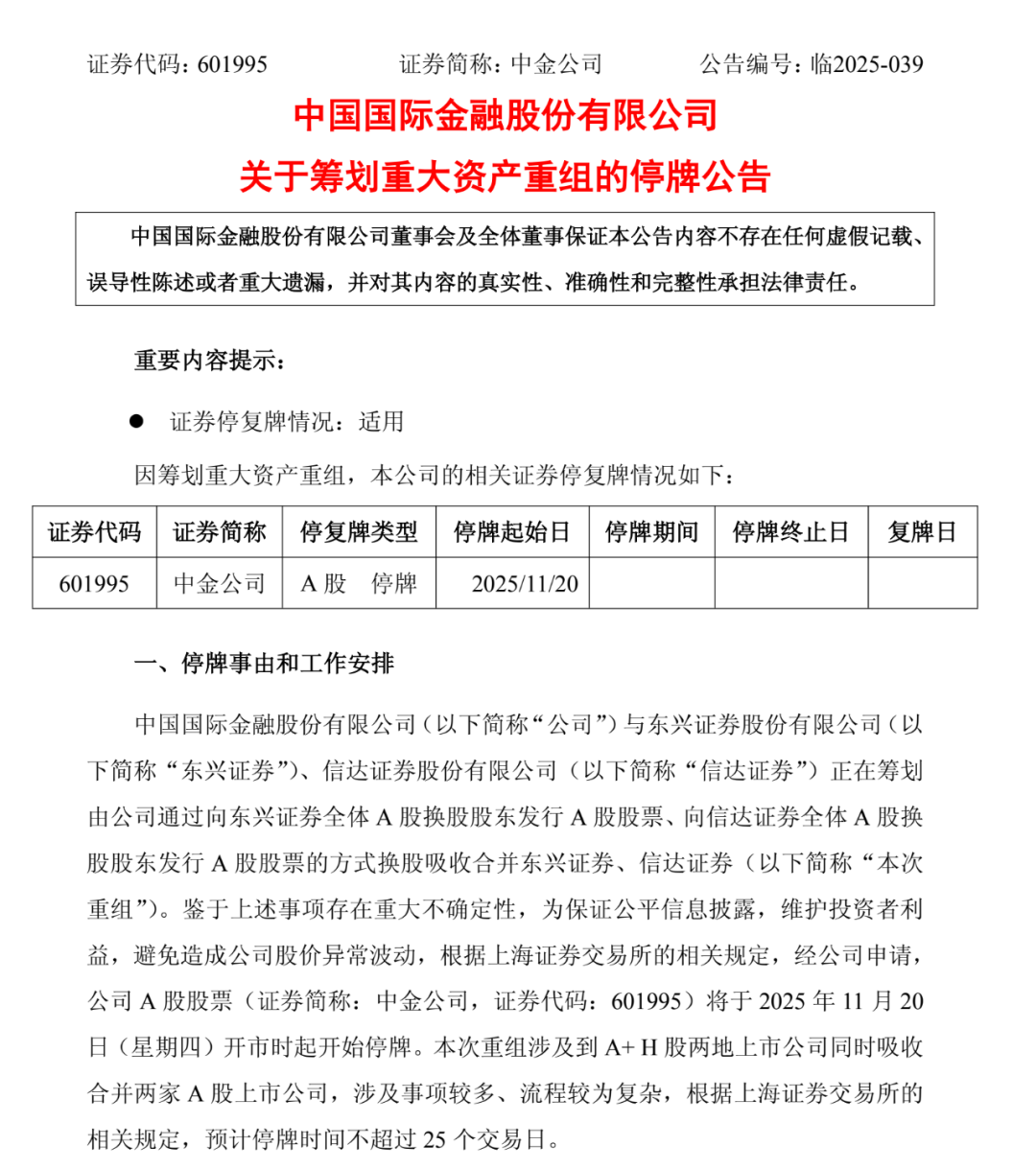
中金公司大动作!拟吸并两家券商
Jin Rong Shi Bao· 2025-11-20 02:26
Core Viewpoint - The announcement of a major asset restructuring plan by China International Capital Corporation (CICC), Dongxing Securities, and Xinda Securities indicates a significant consolidation trend in the securities industry, aiming to enhance competitive advantages and operational efficiency through a share swap merger [1][5][9]. Group 1: Restructuring Announcement - CICC, Dongxing Securities, and Xinda Securities have announced a suspension of trading due to a planned major asset restructuring involving a share swap merger [1][4]. - The trading suspension for these companies will begin on November 20, 2025, and is expected to last no more than 25 trading days [4]. Group 2: Financial Metrics - As of the third quarter of 2025, the total assets of CICC, Dongxing Securities, and Xinda Securities are reported to be 764.94 billion, 116.39 billion, and 128.25 billion respectively, with combined revenues and net profits placing them third and sixth in the industry [7][8]. - The total market capitalization of CICC is 134.9 billion, while Dongxing Securities and Xinda Securities together exceed 100 billion [6]. Group 3: Strategic Advantages - The merger is expected to create complementary advantages, with CICC's investment banking and wealth management capabilities enhancing Dongxing and Xinda's retail brokerage and asset management strengths [8][9]. - The combined entity aims to improve capital strength, integrate customer resources, and enhance service capabilities to support national strategies and economic development [9].



“投资者+运营商”模式: 战略赋能医疗健康行业发展的康桥实践
Jin Rong Shi Bao· 2025-11-20 02:11
Core Insights - Stark, a leading global hearing aid technology developer and manufacturer, has officially signed a contract to establish a high-end hearing aid industrialization project in Suzhou Kangqiao Wuzhong Life Science Park, with an expected annual revenue of 350 million yuan upon reaching full production [1] - The decision to set up a global manufacturing center in Suzhou is part of Stark's strategic expansion in China, benefiting from a favorable business environment, mature supply chains, and competitive labor costs [2] Group 1: Company Expansion and Strategy - Stark has grown significantly since its establishment in 1967, becoming a leader in hearing solutions, with its first wholly-owned enterprise in China established in Suzhou in 1995 [2] - The company has expanded from a 4,500 square meter facility to over 400 employees, achieving multiple international medical device registrations and certifications [2] - Stark's investment in smart manufacturing in Suzhou has positioned it as a benchmark within the group, contributing to the sustainable development of the company [2] Group 2: Collaboration with CBC Group - The partnership with CBC Group's CBC Healthcare Infrastructure Platform (CBC HIP) is strategic, providing Stark with essential infrastructure, localized financing, and a supportive healthcare ecosystem [3] - CBC HIP's capital expenditure to operating expenditure (Capex to Opex) model supports Stark's capacity expansion by alleviating cash flow pressures during the initial investment phase [3][6] - CBC HIP assists Stark in evaluating site utilization and layout, ensuring rapid implementation of the new facility's renovation plans [3] Group 3: Infrastructure and Financing Solutions - CBC HIP focuses on providing customized infrastructure solutions tailored to the specific needs of healthcare technology companies, enhancing operational efficiency and optimizing capital structure [4][5] - The platform offers flexible space design and specialized facilities to meet international standards, facilitating various stages of production from R&D to large-scale manufacturing [5] - CBC HIP's financing support includes connecting companies with capital institutions and providing tailored funding solutions to ease early-stage cash flow pressures [6] Group 4: Sustainable Development and Industry Leadership - CBC HIP emphasizes ecological sustainability and energy efficiency in its projects, creating a conducive working environment for researchers [7] - The platform has received top ratings in global sustainability assessments, highlighting its leadership in responsible investment and sustainable development within the life sciences sector [7] - CBC HIP's projects have achieved LEED certification, showcasing its commitment to environmentally friendly practices and innovation in the life sciences industry [7]
李强出席上海合作组织成员国 政府首脑(总理)理事会第二十四次会议
Jin Rong Shi Bao· 2025-11-20 02:08
Core Points - The meeting highlighted the importance of the Shanghai Cooperation Organization (SCO) in global governance and its role in addressing pressing global challenges [1][2] - China emphasized the need for cooperation in development and security, proposing initiatives such as the establishment of the SCO Development Bank and a cooperation center for metabolic diseases [2][3] - The leaders agreed on the significance of enhancing regional integration and promoting a multipolar world, committing to implement the outcomes of the Tianjin Summit [3] Group 1 - The SCO is positioned as a key player in global governance, leveraging its unique advantages and rich practical experience to contribute to building a community with a shared future for mankind [1][2] - China aims to strengthen cooperation in development strategies, maintain global supply chain stability, and promote an open and inclusive world economy [2] - The focus on innovation and transformation includes collaboration in technology and energy sectors, with initiatives for solar and wind energy projects [2] Group 2 - The meeting resulted in the signing of a joint communiqué and cooperation documents in various fields, including trade, railways, and social development [3] - The leaders reaffirmed their commitment to multilateralism and the central role of the United Nations in global governance [3] - The SCO's future development strategy for 2026-2035 was approved, emphasizing strategic coordination and enhanced organizational effectiveness [2][3]