
Jin Rong Shi Bao

Search documents
分红超450亿元!这类产品何以成为“分红大户”?
Jin Rong Shi Bao· 2026-01-07 09:49
Core Insights - In 2025, China's ETF market experienced significant growth, with total product scale surpassing 6 trillion yuan and total dividend distribution reaching a record high of 45.013 billion yuan, a 113% increase from 2024 [1] Group 1: ETF Dividend Growth - The total dividend amount for ETFs in 2025 reached 45.013 billion yuan, marking a historic high and a 113% increase from 2024 [1] - Broad-based ETFs contributed significantly to this growth, accounting for 31.288 billion yuan, or 69.51% of total ETF dividends, up from approximately 55% in 2024 [2] - Several core broad-based ETFs saw their annual dividends exceed 1 billion yuan, with notable increases: Huatai-PB CSI 300 ETF at 8.394 billion yuan (up 236%), E Fund CSI 300 ETF at 7.15 billion yuan (up 260%), and others also showing substantial growth [2][3] Group 2: Concentration of Dividends - The concentration of dividends among leading fund companies increased, with top firms raising both the frequency and amount of ETF dividends to attract long-term investors [4] - In 2025, major fund companies like Huaxia Fund, Huatai-PB Fund, and E Fund reported significant increases in ETF dividends, with Huaxia Fund distributing 10.131 billion yuan (up 161%) and Huatai-PB Fund distributing 9.599 billion yuan (up 196%) [4][5] - The top five fund companies collectively distributed 38.174 billion yuan, representing 84.8% of total ETF dividends, indicating a growing dominance in the ETF market [5] Group 3: Future Outlook - The future of ETF dividends is expected to improve further due to enhanced awareness of dividend policies among listed companies and innovations in ETF products [5] - As the dividend capabilities of ETFs increase, they are anticipated to become a more important market allocation tool, enhancing the investment experience for investors [5]
新年大动作:人事“换血”资本“补血”,释放什么信号?
Jin Rong Shi Bao· 2026-01-07 09:19
Group 1 - The core viewpoint of the articles highlights significant movements in the consumer finance sector, driven by new policies and organizational changes aimed at enhancing compliance and governance [1][4] - A new round of national subsidies has been initiated, with the Ministry of Commerce, the People's Bank of China, and the financial regulatory authority issuing a notice to boost consumption through financial collaboration [1] - Several consumer finance companies, including Jianxin Consumer Finance and Ping An Consumer Finance, have received approval for amendments to their company charters, indicating a focus on regulatory compliance and high-quality development [1] Group 2 - Recent personnel changes in consumer finance companies reflect a broader trend of leadership turnover, with notable adjustments at JD Consumer Finance, where the former chairman was replaced by a vice president from JD Group [2] - The restructuring at JD Consumer Finance, which includes changes in senior management and governance, marks the completion of a year-long integration process [2] - Other licensed "bank-affiliated" consumer finance companies have also seen changes in leadership, with approvals granted for new chairpersons at Harbin Hain Consumer Finance and Shengyin Consumer Finance [3] Group 3 - The turnover of chairpersons in the consumer finance industry is indicative of a significant leadership shift expected by 2025, with over half of the 31 consumer finance companies undergoing changes in their core management teams [4] - Industry experts suggest that these leadership changes are a response to the need for strategic realignment in the face of diminishing industry growth and a shift towards high-quality development [4] - The restructuring in the consumer finance sector is not limited to personnel changes but is also reflected in capital movements, with major institutions increasing their registered capital [4] Group 4 - On January 4, Beiyin Consumer Finance received approval to increase its registered capital by 150 million, raising it from 850 million to 1 billion, meeting regulatory requirements [5] - Earlier, Nanyin Fabao Consumer Finance also completed a significant capital increase, raising its registered capital from 5.215 billion to 6 billion, positioning it as the fourth largest in the industry [5] - The trend of capital increases continues, with Changsha Bank announcing plans to inject up to 1.55 billion into Changyin Wubai Consumer Finance, enhancing its risk resilience and operational stability [6]
国际黄金市场,火热开年!
Jin Rong Shi Bao· 2026-01-07 08:15
在当前的市场环境下,国际金价大概率将保持高位震荡。若全球经济出现明显放缓,美联储以更大的幅 度降息,或者地缘政治风险加剧,国际金价或将迎来更强的上行动力。如果在特朗普政府关税政策影响 下,通胀再度走高,作为抗通胀资产的黄金有望迎来助力。但与此同时,需要注意的是,通胀走高可能 会促使美联储收紧货币政策,伴随着美元走强,这将在一定程度上打压国际金价。 总体而言,当前的地缘政治环境以及利率环境对国际黄金市场的影响是积极的。摩根士丹利预计,到今 年第四季度,黄金价格将达到4800美元/盎司的新高。不过,由于全球经济金融环境瞬息万变,未来国 际金价是否还能维持上扬走势,还需要谨慎观察,根据具体情况而定。 在2025年12月的货币政策会议上,美联储理事米兰投下反对票,反对降息25个基点。他认为美联储应该 一次性降息50个基点。进入2026年,一直坚持要更大幅度降息的美联储理事米兰,继续保持其"鸽"派态 度。米兰日前表示,数据趋势可能支持进一步降息。美联储2026年的降息幅度累计应该超过100个基 点。美联储目前的货币政策是限制性的,正在拖累美国经济。不过,根据早前的计划,作为临时理事的 米兰,其任期将在今年1月结束。 相 ...
外资独资保险资管公司接连落地
Jin Rong Shi Bao· 2026-01-07 07:52
Core Viewpoint - The approval of two foreign-owned insurance asset management companies, AIA Asset Management and Holland Insurance Asset Management, marks a significant step in China's financial sector opening up and reflects international institutions' continued confidence in the Chinese market [1][2]. Group 1: Company Information - AIA Asset Management has a registered capital of 100 million yuan, fully subscribed by AIA Life Insurance Company, with Zhang Xiaoyu as the chairman [1]. - Holland Insurance Asset Management, registered in Shanghai, has a registered capital of 250 million yuan, fully funded by the Dutch Global Life Insurance Group, with Zhang Mengjiao as the chairman [1]. - Prudential Asset Management, the first foreign-funded insurance asset management company established in Beijing, has a registered capital of 20 million USD, fully subscribed by Prudential Financial, Inc. [1][2]. Group 2: Industry Context - The establishment of these foreign-owned companies is driven by confidence in China's long-term economic development and aligns with the policy direction of deepening financial market openness [2]. - The insurance asset management industry in China is experiencing robust growth, with total managed funds reaching 33.30 trillion yuan by the end of 2024, reflecting a year-on-year increase of 10.60% [3]. - The entry of foreign institutions into China's insurance asset management market is expected to enhance product innovation, risk governance, and technological empowerment, contributing to higher quality and sustainable industry development [4].
新华保险发布2025年理赔报告:赔付147亿元 服务501万件
Jin Rong Shi Bao· 2026-01-07 07:52
Group 1 - The core point of the article highlights the significant achievements of Xinhua Insurance in claims processing and service efficiency in 2025, with total claims amounting to 14.7 billion yuan and an average daily payout of 40.29 million yuan [1] - In 2025, Xinhua Insurance processed a total of 5.01 million claims, averaging 14,000 claims settled daily, with a premium waiver of 810 million yuan affecting 21,000 policies [1] - The structure of claims shows that critical illness insurance accounted for 6.13 billion yuan, representing over 40% of total payouts [1] Group 2 - In terms of inclusive finance, Xinhua Insurance paid out 3.3 billion yuan to rural populations, benefiting 387,000 individuals, and 1 billion yuan to the elderly, benefiting 948,000 individuals [2] - The company undertook 55 public welfare insurance projects across 22 branches, with total payouts exceeding 46 million yuan [2] - The company provided 29.25 million yuan in medical advance payment services, a 155% increase year-on-year, supporting 573 individuals [2] Group 3 - Based on the 2025 claims data, Xinhua Insurance issued health risk warnings, emphasizing the need for minors to guard against respiratory diseases and accidents, while middle-aged individuals should be aware of cancer risks [3] - The number of claims for severe Alzheimer's disease and serious brain injuries among the elderly increased by 100% and 50%, respectively, suggesting the importance of early planning for critical illness and long-term care insurance [3]

业内:2026年上市险企将迎资产负债共振“黄金时代”
Jin Rong Shi Bao· 2026-01-07 07:46
Core Viewpoint - The insurance industry is expected to enter a recovery and growth phase by 2026, marking a "golden era" for companies with strong insurance operational capabilities [1][3]. Group 1: Industry Outlook - Multiple institutions, including CICC, Founder Securities, and CITIC Securities, have released reports expressing optimism about the insurance industry's recovery and growth prospects by 2026 [1]. - The industry is anticipated to transition from a "scale-driven" model to a "management-driven" approach, with a focus on enhancing operational capabilities and sustainable business models [2]. - The insurance sector is at the beginning of a new development cycle, coinciding with the end of the "14th Five-Year Plan" and the start of the "15th Five-Year Plan" [1]. Group 2: Life Insurance Sector - CICC predicts that the life insurance sector will experience rapid growth in new business, with a more diversified product structure and a significant improvement in the quality of new business [2]. - The competitive landscape is shifting towards companies with strong life insurance operational capabilities, indicating a move towards high-quality development in the life insurance industry [2][3]. Group 3: Property Insurance Sector - In the property insurance sector, CICC forecasts a slow growth in auto insurance premiums, while head companies are expected to improve underwriting profitability through business structure optimization [2]. - Health insurance is projected to become a significant growth driver, with the implementation of the "reporting and operation integration" policy expected to enhance underwriting profitability for large companies [2]. Group 4: Financial Dynamics - The concept of "value return" is emerging, with the life insurance industry moving from a phase of "short-term equity elasticity" to a "mid-term value recovery" phase [4]. - The sales cycle for participating insurance products has shown a positive trend, with a significant portion of new business sales from participating insurance products [4]. Group 5: Capital Market Role - Insurance funds are expected to play a clearer role as long-term investors in the capital market, with an estimated incremental capital of over 6 trillion yuan expected to flow into the equity market over the next five years [6]. - The regulatory environment is encouraging insurance capital to increase allocations in A-shares, which is expected to provide policy benefits and support the stable development of China's capital market [6].


当人工智能遇上健康管理 健康险风险减量能否破局
Jin Rong Shi Bao· 2026-01-07 07:33
Core Insights - The insurance industry is transitioning from traditional financial compensation models to a customer-centric service model, focusing on risk reduction through proactive health management [1][4] - The establishment of the Ping An Health Management Company marks a significant step in integrating health management services with health insurance, aiming to enhance customer engagement and reduce claims [1][2] Group 1: Industry Trends - The aging population and diverse health needs are driving the transformation of traditional insurance models, necessitating a shift towards proactive health management [1][4] - Health management services are becoming standard in health insurance products, even in basic insurance offerings, indicating a broader industry trend towards integrated health services [2][3] Group 2: Company Developments - In the first half of 2025, Ping An Health's health management services generated service revenue of 159 million yuan, serving over 4.8 million clients, reflecting a year-on-year growth of 21.4% [2] - China Pacific Insurance established a subsidiary focused on health management, aiming to meet the needs of high-end clients through innovative health services [3] Group 3: Challenges and Opportunities - The transition from passive claims to active health management is crucial for the sustainability of health insurance, with a focus on reducing claim rates and increasing customer retention [4][5] - Despite the recognized importance of health management, low user awareness and service utilization rates remain significant challenges for the industry [5][6] Group 4: Technological Integration - The integration of artificial intelligence (AI) in health management is seen as a key driver for improving service delivery and efficiency, with potential applications in personalized health interventions [6][7] - The Chinese government is promoting the use of AI in health management to enhance service capabilities and improve public health outcomes [6][7]
牛脸能贷款,海域有“身份证”?广西这样唤醒“沉睡资产”→
Jin Rong Shi Bao· 2026-01-07 04:56
Core Insights - The article highlights the transformation of rural assets in Guangxi, China, through innovative financial practices that awaken dormant resources and stimulate economic growth [1] Group 1: Challenges Faced by Rural Industries - Rural industries in Guangxi face multiple challenges, including the difficulty of asset realization and the lack of standardized valuation systems for livestock, which limits access to financing [2][3] - Natural disasters and market volatility pose significant risks to agricultural production, making it difficult for farmers to sustain their livelihoods [4] Group 2: Financial Innovations and Solutions - Innovative financial practices, such as the issuance of property rights certificates for aquaculture, have enabled farmers to secure loans by transforming previously unrecognized assets into collateral [5][6] - The introduction of technology, such as AI-based identification systems for livestock, has improved the efficiency of insurance and financing processes, allowing for better risk management [6][12] Group 3: Integration of Financial Services - The development of supply chain finance and tailored credit products has facilitated better access to funding for rural enterprises, addressing issues of weak collateral and fragmented supply chains [7][8] - Collaborative efforts between banks, insurance companies, and local governments have created a supportive ecosystem for agricultural financing, enhancing the resilience and sustainability of rural economies [10][11] Group 4: Systematic Approach to Rural Development - Guangxi has shifted from targeted assistance to a more systematic approach in promoting rural development, with policies that encourage financial resources to flow into agriculture [10][12] - The establishment of digital credit profiles for farmers has enabled the provision of unsecured loans, fostering financial inclusion and supporting agricultural growth [11][13]

16倍“牛股”遭监管警示
Jin Rong Shi Bao· 2026-01-07 03:58
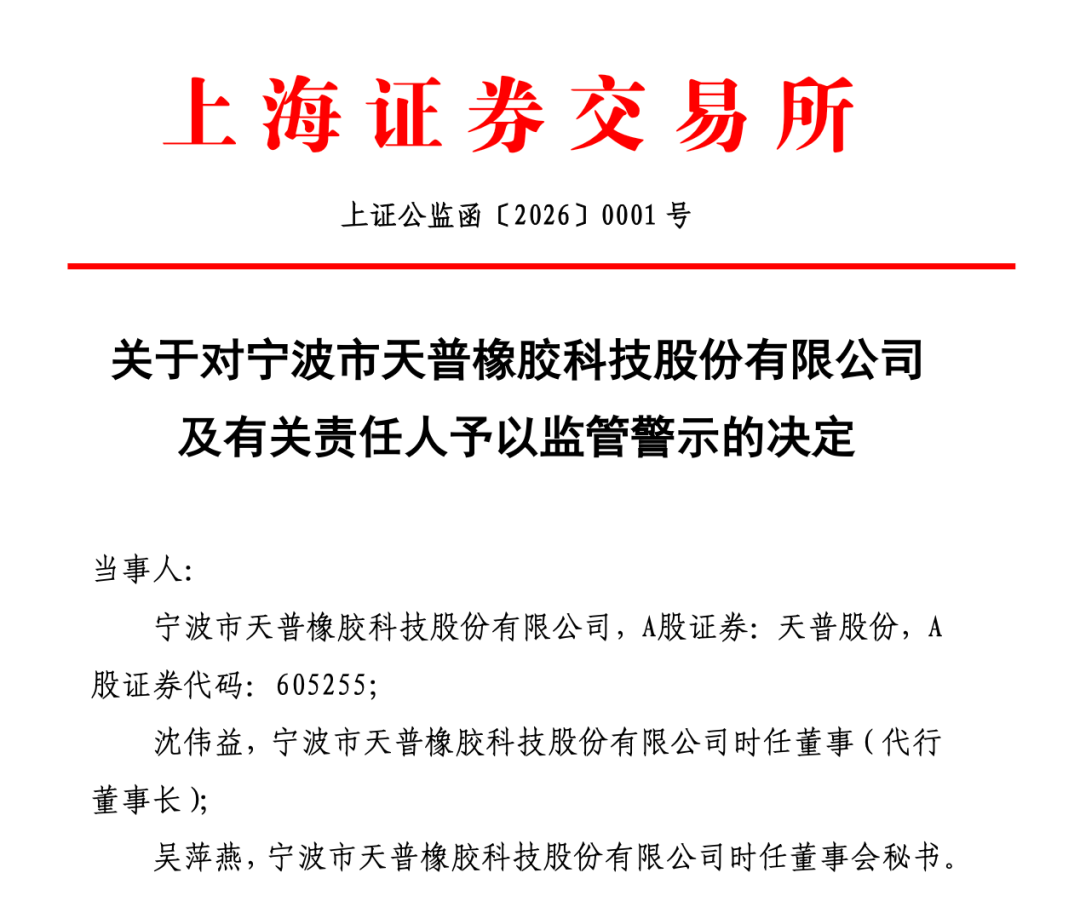
正处于第五次停牌核查期间的天普股份(605255),在董事会换届前夕,收到了监管开出的警示函。 1月5日晚间,天普股份及时任董事(代行董事长)沈伟益、董秘吴萍燕,因利用子公司经营范围炒作"人工智能"热点概念,引发市场猜测和股价异动后未及 时进行针对性说明澄清与风险提示,信息披露不准确、不完整,被上交所予以监管警示。 被监管质疑明知故犯 2025年12月29日、12月30日,天普股份股价连续两个交易日涨停,并于12月29日触及异常波动标准;12月30日、12月31日,天普股份分别披露股票交易异 常波动、股票停牌核查相关公告,均声称"截至目前,公司无开展人工智能相关业务的计划,不存在应披露而未披露的重大信息"。 那么,是什么引起的两个涨停板呢?经查明,天普股份于2025年12月26日完成全资子公司杭州天普欣才科技有限公司(以下简称"天普欣才")的工商设立登 记手续。据工商登记信息,天普欣才主要经营范围涵盖集成电路芯片设计及服务、人工智能理论与算法软件开发、人工智能行业应用系统集成服务及集成 电路芯片及产品销售等。 上述监管措施一经发布,让这只本就饱受争议的16倍"大牛股",再度置身于舆论的风口浪尖。 此后,天普股 ...


坚定功能定位 走好中国特色金融发展之路 访中信集团党委委员、副总经理兼中信金融资产党委书记、董事长刘正均
Jin Rong Shi Bao· 2026-01-07 03:41
Core Insights - The 20th Central Committee's Fourth Plenary Session outlines a blueprint for China's development over the next five years, emphasizing the importance of financial asset management companies in risk prevention and supporting the real economy [1][2]. Group 1: Understanding the Significance of the Plenary Session - The plenary session addresses major issues for the "14th Five-Year Plan" period, providing fundamental guidance for financial work in the new era [1][2]. - Financial asset management companies must grasp the session's significance and contribute positively to the construction of a financial power [1][2]. Group 2: Implementation of the Plenary Session's Spirit - The session emphasizes the need for financial asset management companies to accurately position themselves and actively play their unique roles in the broader context [2]. - Companies are required to enhance their risk management capabilities and act as stabilizers in the financial system, ensuring high-quality development [2][5]. Group 3: Focus Areas for Financial Asset Management Companies - Companies are tasked with advancing five key areas: technology finance, green finance, inclusive finance, pension finance, and digital finance, aligning with national strategic needs [3][4][5]. - Over the past three years, the company has invested a total of 107.7 billion yuan in these five areas, demonstrating its commitment to fulfilling its responsibilities [2][3]. Group 4: Specific Strategies and Innovations - In technology finance, the company aims to support enterprises in overcoming innovation challenges and optimizing governance [3]. - In green finance, the focus is on supporting the transition to a clean and low-carbon energy system, including investments in major energy projects [3]. - Inclusive finance efforts include addressing risks in the economy and providing targeted financial solutions to small and medium-sized banks [3][4]. Group 5: Addressing Aging Population and Digital Transformation - The company is actively engaging in pension finance to address the needs of an aging population, exploring sustainable business models in the healthcare sector [4]. - In digital finance, the company is promoting digital transformation and exploring innovative applications of artificial intelligence in asset management [5]. Group 6: Future Development Plans - The company plans to enhance its role in stabilizing the economy and supporting the real economy during the "14th Five-Year Plan" period, utilizing various financial tools to assist struggling enterprises [5][6]. - The focus will also be on revitalizing existing assets and addressing risks in key sectors, particularly in the real estate market [6].