Qian Zhan Wang

Search documents
【智能物流装备】行业市场规模:2024年中国智能物流装备行业市场规模约1100亿元 智能仓储装备市场占比约36%
Qian Zhan Wang· 2025-04-29 06:39
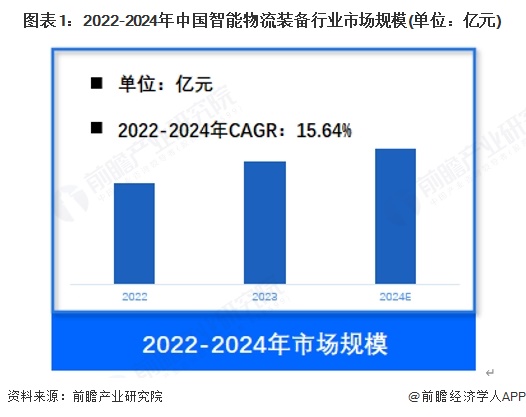
Core Insights - The Chinese smart logistics equipment industry is projected to reach a market size of approximately 110 billion yuan in 2024, with a compound annual growth rate (CAGR) of 15.64% over the past two years [1][3]. Market Segmentation - The smart logistics equipment market is divided into four main segments: smart warehousing equipment, smart sorting equipment, smart handling equipment, and logistics robots. In 2023, smart warehousing and smart sorting equipment accounted for the largest shares of the market, with 36% and 33% respectively [3]. Industry Competition - Leading companies in the Chinese smart logistics equipment sector include Dongjie Intelligent, Nuoli Co., and Dematech. Their specific business focuses and layouts are as follows: - **Dongjie Intelligent**: Focuses on enhancing value creation for manufacturing enterprises through smart logistics equipment, integrating advanced technologies such as 5G and big data [6]. - **Nuoli Co.**: A leading provider of smart logistics system solutions, specializing in the design, manufacturing, and technical services of intelligent warehousing logistics equipment [6]. - **Dematech**: A technology innovation enterprise across the entire smart logistics equipment industry chain, providing automated logistics solutions widely used in various sectors including e-commerce and retail [6]. - **Lanjian Intelligent**: Offers a comprehensive smart logistics system solution, including consulting, software development, and equipment manufacturing, with a focus on warehouse automation technology [6]. - **Jintian International**: A high-tech logistics technology company that integrates logistics solutions, technical transformation, and system integration [6].


【最全】2025年智能电视行业上市公司全方位对比(附业务布局汇总、业绩对比、业务规划等)
Qian Zhan Wang· 2025-04-29 06:08
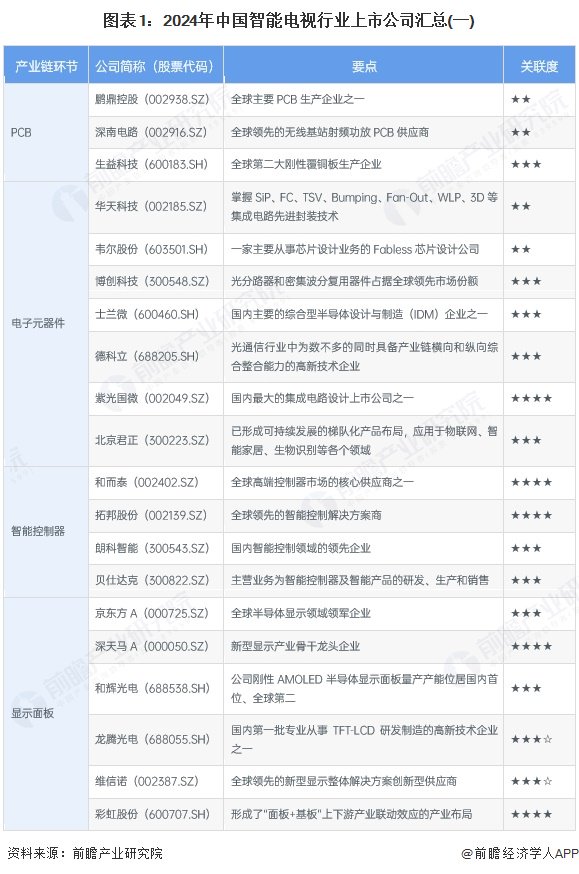
Industry Overview - The rise of smart TVs has revitalized the television market, integrating traditional functions with internet connectivity for multimedia playback, app downloads, and online interaction, making smart TVs a crucial link between home entertainment and the internet [1] - The number of listed companies in China's smart TV industry is significant, primarily distributed across the upstream and midstream of the industry chain [1] Company Summaries - Major listed companies in the smart TV sector include TCL Technology (000100.SZ), Hisense Visual (600060.SH), Haier Smart Home (600690.SH), Skyworth Digital (000810.SZ), Shenzhen Konka (000016.SZ), Sichuan Changhong (600839.SH), and Xiaomi Group (1810.HK) [1][2] - TCL Technology and Xiaomi Group reported substantial revenues from their smart TV businesses, with TCL generating 498.77 billion and Xiaomi 471.34 billion in the first half of 2024 [17] - Haier Smart Home leads in gross margin for smart TV business at 30.61% in the first half of 2024 [17] Financial Performance - The financial performance of listed companies in the smart TV industry shows a diverse range of revenues, with TCL Technology leading in revenue generation [4][5] - The revenue figures for the first half of 2024 for key companies include: - TCL Technology: 498.77 billion - Hisense Visual: 201.46 billion - Haier Smart Home: 1356.23 billion - Xiaomi Group: 1643.95 billion [17] Business Layout and Strategy - Most companies have a high proportion of their business focused on smart TVs, with Hisense Visual and Skyworth Digital exceeding 70% [15] - Companies are expanding their overseas markets, with Hisense Visual, Haier Smart Home, and Xiaomi Group having over 45% of their business from international markets [15] - Companies are focusing on consolidating their existing product advantages, increasing R&D investment, and embracing artificial intelligence in their business strategies [18] Competitive Landscape - The competitive landscape shows that TCL Technology and Xiaomi Group are significant players in terms of revenue, while Haier Smart Home has the highest gross margin [17] - Companies are leveraging technological innovations and market expansion strategies to enhance their competitive positions [18] Key Metrics and Rankings - TCL Technology has the highest registered capital among listed companies at approximately 1.88 billion [9] - Haier Smart Home has the largest employee count at 112,458 [11] - The number of bidding information is highest for Hisense Visual and Sichuan Changhong, each exceeding 1,000 entries [8]





【干货】2025年可控核聚变产业链全景梳理及区域热力地图
Qian Zhan Wang· 2025-04-29 05:08
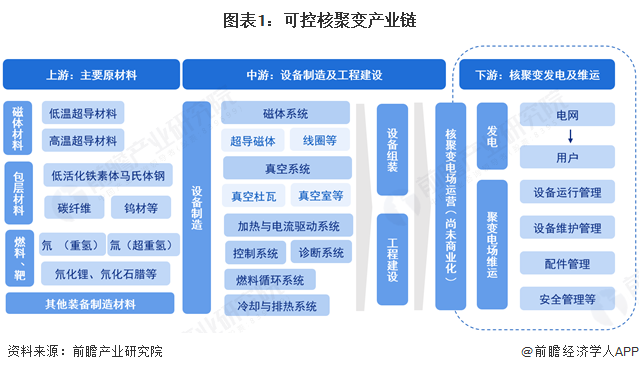
Core Insights - The controllable nuclear fusion industry chain is characterized by high technical content, with downstream applications not yet commercialized [1] Group 1: Industry Chain Overview - The upstream of the controllable nuclear fusion industry includes various raw materials such as superconducting magnet materials, rare metals like tungsten and tantalum, special steel, and fuels like deuterium and tritium [1] - The midstream involves equipment and reactor engineering construction, with common devices including tokamak fusion experimental devices, magnetic systems, vacuum systems, heating and current drive systems, and other essential equipment [1] - The downstream primarily focuses on nuclear power plant operations for research and power generation [1] Group 2: Key Enterprises in Upstream and Midstream - Key upstream companies providing superconducting magnet materials include Jiuli New Materials, Shanghai Superconductor, and Lianchuang Superconductor; companies producing cladding materials include Zhangyuan Tungsten and Chujian New Materials [2] - In the midstream equipment manufacturing sector, West Superconductor's Nb3Sn superconducting wire is widely adopted; Antai Technology's low-noise antenna tungsten string limiter is used in the EAST superconducting tokamak fusion experimental device [2] - China National Nuclear Corporation is a major player in the engineering construction of controllable nuclear fusion, with significant advancements in its fusion device, "China Circulation No. 3" [2] Group 3: Downstream Applications and Current Status - Controllable nuclear fusion is still in the critical technology research phase and has not yet achieved commercial power generation; current projects include the China Fusion Engineering Test Reactor (CFETR) and the Compact Fusion Energy Experimental Device (BEST) [3] - Ongoing technological breakthroughs and experimental validations are expected to provide solid technical support for future clean energy supply and enhance the industry chain layout [3] Group 4: Regional Distribution of the Industry - As of March 25, 2025, there are 170 institutions related to controllable nuclear fusion in China, with the highest concentration in Anhui Province (24 institutions), followed by Guangdong (19) and Beijing (17) [7] - The distribution of listed companies related to controllable nuclear fusion includes 47 companies across 15 provinces, with Jiangsu Province having the most at 8 companies, including Yongding Co., Ltd. [9] - A significant industrial cluster is forming around Hefei and Shanghai, with a focus on the Jiangsu-Zhejiang-Shanghai-Huai region and Chengdu and Xi'an as key areas for fusion equipment [10]





投资深圳 | 一文看懂深圳市人工智能产业发展现状与投资机会前瞻
Qian Zhan Wang· 2025-04-28 13:20
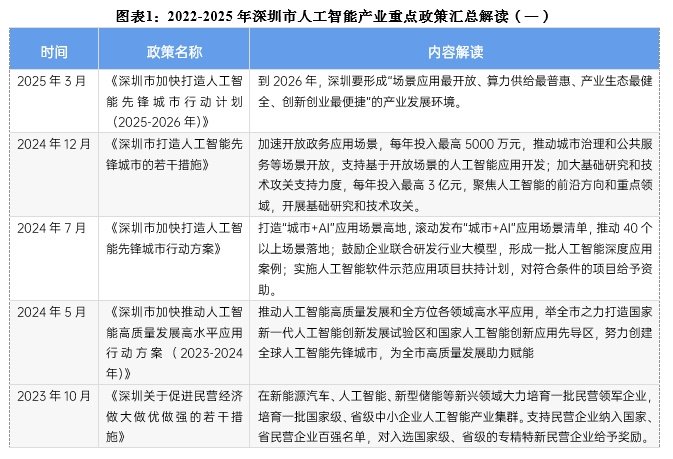
人工智能产业,作为新一轮科技革命与产业变革的核心引擎,正以颠覆性力量重塑全球发展格局。其意 义不仅在于技术迭代,更关乎人类文明迈向智能时代的关键跨越。 | 时间 | 政策名称 | 内容解读 | | --- | --- | --- | | 2023年8月 | 《深圳市优化国际化营商 | 支持企业主导或者参与制定新一代移动通信技术、人工智能、云计算与边 | | | 环境工作方案(2023- | 缘计算等领域国际标准。 | | | 2025年)》 | | | 2023年5月 | 《深圳市智能建造试点城 | 围绕"设计大数据、人工智能算法、云服务、软件平台"成链,细分领域包 | | | 市建设工作方案》 | 括人工智能设计软件、人工智能审图平台、仿真模拟软件、数字设计平台 | | | | 等。 | | 2023年1月 | 《深圳市现代时尚产业集 | 运用云计算、物联网、大数据、人工智能、区块链等核心技术能力、为企业 | | | 群数字化转型实施方案 | 提供有针对性的数字化转型诊断和解决方案 | | | (2023-2025年)》 | | | 2022年11月 | 《深圳经济特区人工智能 | 从深圳人工智能产业发展实 ...

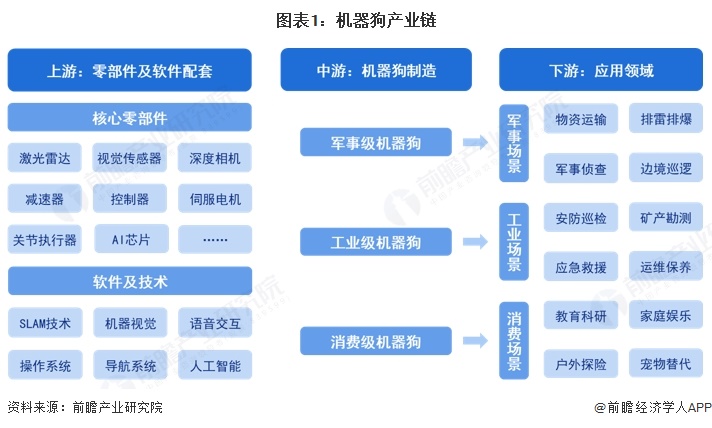
2025年中国机器狗核心零部件方案对比 多传感器融合为重要趋势(组图)
Qian Zhan Wang· 2025-04-28 10:27
Industry Overview - The machine dog industry can be divided into upstream core components and software system development, midstream manufacturing of machine dogs, and downstream personal consumers and various application scenario commercial users [1] - The industry chain involves high-tech fields such as communication and artificial intelligence, with high technical barriers at each link [1] Upstream Components - Upstream components include sensors, reducers, motors, controllers, and joint actuators, as well as software and technologies like SLAM, machine vision, voice interaction, and operating systems [1] - The most commonly used reducers in machine dogs are harmonic reducers and planetary gear reducers, with planetary reducers being the preferred choice due to their compact structure, high reduction ratio, high torque transmission efficiency, and reliability [3][5] Midstream Manufacturing - Midstream manufacturing of machine dogs is categorized into military-grade, industrial-grade, and consumer-grade robots [1] Downstream Applications - Downstream applications include education, healthcare, security, reconnaissance, firefighting, and personal consumers [1] Sensor Technology - Environmental perception is crucial for machine dogs to achieve autonomy and adapt to complex environments, with multi-sensor fusion technology becoming an important trend [5][6] - Machine dogs require high perception capabilities, covering visual, tactile, auditory, and force perception [6] Sensor Types - Visual sensors utilize camera hardware and algorithms for environmental perception, with various types including structured light, ToF, and laser scanning [8] - LiDAR provides precise distance measurement and is effective in low-light or adverse weather conditions, making it essential for obstacle avoidance [8][9] - Ultrasonic sensors are cost-effective for long-distance obstacle detection but have limitations in detecting small or sound-absorbing objects [8] - Infrared sensors are compact and low-cost but can be affected by environmental light conditions [8] - Auditory sensors simulate human hearing for sound signal recognition [8] - Force/torque sensors monitor contact forces and joint stresses for dynamic balance and movement efficiency [8] - Inertial sensors (IMU) track the position and motion trajectory of machine dogs [8] Perception Technology Routes - The perception technology routes for machine dogs are divided into pure visual perception and LiDAR-based perception, with each having its advantages and disadvantages [11] - Multi-sensor fusion is a significant trend in sensor design for machine dogs to meet various downstream application needs, with high-end products using LiDAR and cost-effective products using ToF and cameras [12]



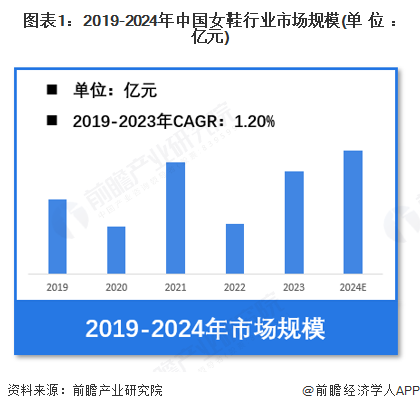
【女鞋】行业市场规模:2024年中国女鞋行业市场规模超过2200亿元 美低帮鞋市场份额占比超45%
Qian Zhan Wang· 2025-04-28 08:26
Core Insights - The Chinese women's footwear market is projected to exceed 220 billion yuan in 2024, following a market size of over 215 billion yuan in 2023, with a compound annual growth rate of 1.20% over the past four years [1][3]. Market Overview - The women's footwear industry includes products made from leather, synthetic leather, textile materials, and rubber, categorized into men's, women's, and children's shoes [1]. - Low-top shoes and boots are the primary consumer products in the Chinese women's footwear market, with low-top shoes accounting for over 45% of the market share in 2023 [3]. Competitive Landscape - The domestic women's footwear market is highly competitive, featuring numerous brands, including both global and local players such as Red Dragonfly, Qianbaidu, Daphne, and Belle [4]. - Most domestic fashion and casual brands focus on diversified business strategies, covering high heels, sports shoes, and casual shoes, while sports brands primarily emphasize sports shoes and extend into casual and flip-flop segments [4].


【干货】饲料行业产业链全景梳理及区域热力地图
Qian Zhan Wang· 2025-04-28 07:44
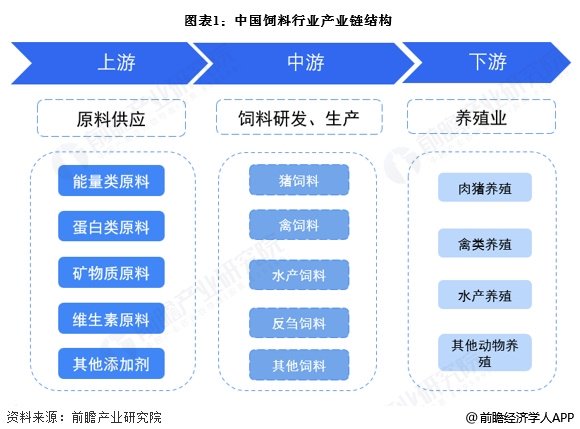
Core Insights - The article discusses the structure and dynamics of the feed industry in China, highlighting the upstream raw materials, midstream production, and downstream demand from farming and aquaculture sectors [1][4][6]. Industry Chain Overview - The feed industry chain consists of three segments: upstream raw materials (energy, protein, and microbial sources), midstream feed product development and production (including pig, poultry, ruminant, and aquaculture feeds), and downstream demand primarily from farmers and aquaculture enterprises [1]. - Recent government initiatives aim to reduce reliance on imported corn and soybean meal, leading to a gradual establishment of domestic raw material sources and improved stability [1]. - Midstream companies are enhancing innovation capabilities and accelerating new product development, with increasing vertical integration between midstream and upstream/downstream sectors [1]. - Rising meat consumption levels in China are expected to boost the scale of downstream aquaculture and livestock farming [1]. Regional Distribution - Upstream raw material suppliers are mainly located in Inner Mongolia, Guangdong, Fujian, and Beijing, while feed production companies are concentrated in Guangdong and Sichuan [6]. - The majority of downstream aquaculture companies are found in Guangdong, Jiangsu, and Henan provinces [6]. Company Developments - Major feed companies in China, such as New Hope, Haida Group, and Tongwei, have reported feed revenues exceeding 30 billion yuan, with some companies like Dabeinong and Jingji Zhino achieving gross margins above 11% [9]. - Haida Group and New Hope have high feed production and sales volumes, each exceeding 20 million tons [9]. - Investment activities in 2023 include establishing subsidiaries, new projects, and increasing capital in existing subsidiaries by leading feed companies [10].




2025年中国混合动力汽车行业科学研究现状 近年来研究热度有所下降【组图】
Qian Zhan Wang· 2025-04-27 10:00
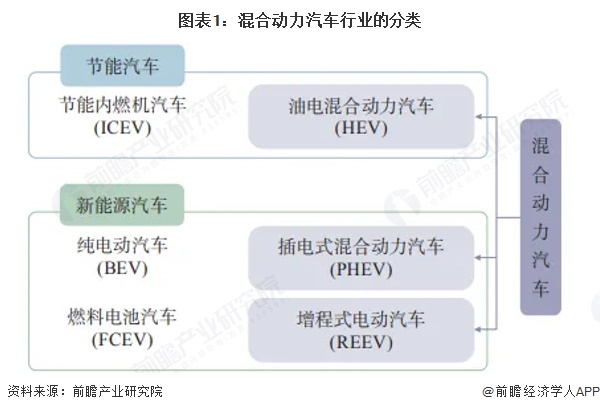
Core Viewpoint - The research on hybrid vehicles in China has shown a declining trend in the number of related academic papers from 2016 to 2024, with a projected total of 272 papers in 2024, indicating a decrease in research interest in this field [3]. Group 1: Definition and Market Trends - Hybrid vehicles are defined as vehicles that utilize two or more power sources, specifically combining traditional internal combustion engines with electric power sources [1]. - The increasing environmental awareness and rising fuel prices have led to a growing consumer preference for hybrid vehicles, which are categorized into three main types: Plug-in Hybrid Electric Vehicles (PHEV), Hybrid Electric Vehicles (HEV), and Range-Extended Electric Vehicles (REEV) [1]. Group 2: Research Output and Institutions - Higher education institutions are the primary contributors to the literature on hybrid vehicles, with Jilin University leading by publishing 410 related papers [5]. - The overall research output in the hybrid vehicle sector has been declining, with a notable drop in the number of papers published in recent years [3]. Group 3: Research Themes and Disciplines - Hybrid technology is identified as a popular research theme within the hybrid vehicle sector, alongside control strategies and HEV-related studies [8]. - The automotive industry is recognized as a key research discipline in the hybrid vehicle field, with significant contributions also coming from industrial economics and electric power industries [9].






美的人形机器人投入应用:5月份进厂打工,下半年进入线下门店,专家:距离产业化仍需3-5年时间【附人形机器人行业发展趋势】
Qian Zhan Wang· 2025-04-27 09:54
(图片来源:摄图网) 据智通财经4月27日报道,美的在机器人领域又有新动作,其自主研发的类人形机器人即将投入实际应用。5 月份将正式进驻湖北荆州的洗衣机工厂,承担机器运维、设备检测和搬运等工作;到今年下半年,它们还会 陆续现身线下门店,为顾客提供商业导览、制作咖啡等服务。 美的中央研究院智能技术与应用研究所所长、人形机器人创新中心负责人奚伟透露,今年美的主要聚焦于全 人形以及类人形机器人产品迭代,通过产品迭代去解决电池续航、数据采集和仿真、关节轻量化等问题。不 过,奚伟也坦言,人形机器人真正实现产业化,可能还需要3 - 5年时间。 美的早在2015年就开始布局机器人产业,并于2017年收购了德国库卡(KUKA),成为全球工业机器人"四大家 族"之一。库卡拥有超过50年的机器人制造经验和技术积累,特别是在高精度运动控制、多轴协同算法等核 心技术方面具有优势。美的通过整合库卡的技术资源,成立了中央研究院具身智能研发团队,专注于人形机 器人核心零部件的研发。 人形机器人及相关产业被列为"颠覆性产业",是未来科技的重要发展方向,具有巨大的市场潜力。美的提前 布局人形机器人领域,无疑是一场具有深远战略意义的"豪赌"。 ...


2025年全球印制电路板(PCB)市场现状分析 中国是全球最大的PCB制造基地(组图)
Qian Zhan Wang· 2025-04-27 09:32
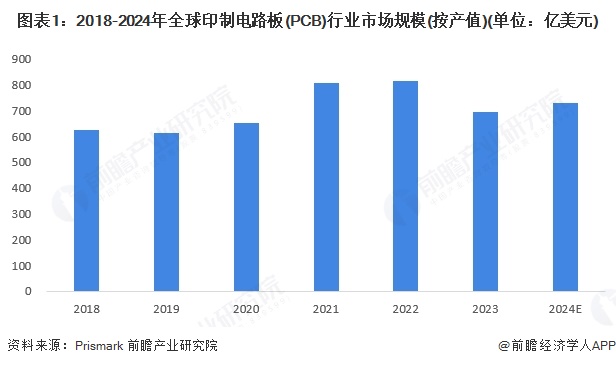
Group 1: Market Overview - The global PCB market experienced fluctuating growth from 2016 to 2023, with a significant decline in 2023 due to the retreat of the home economy and global high inflation, resulting in a 15% year-on-year decrease in market value to $69.5 billion [1] - A recovery is expected in 2024, with the market projected to reach $72.97 billion, reflecting a year-on-year growth of 4.97% as terminal demand recovers and inventory levels normalize [1] Group 2: Production Landscape - China has become the largest PCB production base globally, surpassing Japan in 2006, with its production value maintaining around 50% of the global total from 2016 to 2023, increasing to nearly 55% by 2023 [4] - The shift of global electronic manufacturing capacity towards Asia, particularly mainland China, has established a new manufacturing center in the region [2] Group 3: Product Structure - Rigid boards remain the dominant product type in the global PCB market, with multi-layer boards accounting for approximately 38% and single/double-sided boards for about 11% in 2023, together making up nearly half of the market [6] Group 4: Application Areas - The primary application areas for PCBs include communication, computing, and automotive electronics, with communication and computing accounting for 31.8% and 30.7% of the market share, respectively, followed by automotive electronics at 13.1% in 2023 [10]