
Di Yi Cai Jing Zi Xun

Search documents
“i茅台”上新首日,2299元的精品茅台也秒空
Di Yi Cai Jing Zi Xun· 2026-01-09 02:21
Core Insights - The "i Maotai" platform has expanded its product offerings, including premium Maotai and kilogram Maotai, following the rapid sell-out of the 1499 yuan regular Maotai [2] - The premium Maotai was sold out on its first day of availability, indicating strong demand [2] - The pricing strategy for premium Maotai on "i Maotai" aligns with market prices, set at 2299 yuan per bottle, which is consistent with the average market price of around 2250 yuan per bottle [2] Product Launch and Sales - Starting January 9, consumers can purchase 500ml premium Guizhou Maotai at 53% vol, with a limit of 6 bottles per user per day [2] - From January 10, additional products including 1L and 100ml gift sets of Guizhou Maotai will also be available for purchase [2] - The premium Maotai is considered a core product within the Maotai product line, referred to as the "waist" of the product hierarchy [2] Market Dynamics - The decision to price premium Maotai at market levels reflects a strategy to allow product prices to align with market demand, as discussed in a recent distributor conference [2] - The demand for premium Maotai is noted to be less than that for regular Maotai, suggesting a more niche market [2] - For genuine buyers, purchasing at market price offers assurance of authenticity, while it poses higher risks for ordinary speculators [2]



2025年CPI数据发布
Di Yi Cai Jing Zi Xun· 2026-01-09 02:08
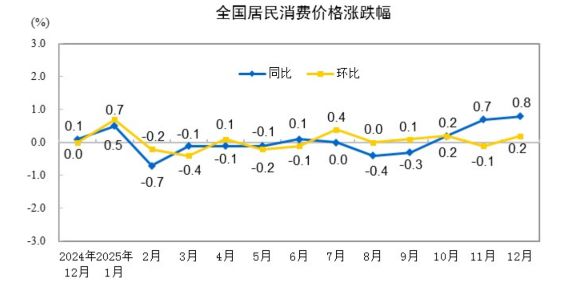
Core Viewpoint - In December 2025, the Consumer Price Index (CPI) increased by 0.8% year-on-year, with urban areas rising by 0.9% and rural areas by 0.6%, indicating a steady increase in consumer prices driven by food and non-food price changes [1][4][6]. CPI Summary - The CPI rose by 0.2% month-on-month in December, reversing a previous decline of 0.1% [5]. - Core CPI, excluding food and energy, increased by 1.2% year-on-year, maintaining a growth rate above 1% for four consecutive months [6]. - Food prices rose by 1.1% year-on-year, with significant increases in fresh vegetables (18.2%) and fresh fruits (4.4%), contributing to the overall CPI increase [6][8]. - Energy prices decreased by 3.8% year-on-year, with gasoline prices dropping by 8.4% [6]. PPI Summary - The Producer Price Index (PPI) increased by 0.2% month-on-month, marking three consecutive months of growth [8]. - Year-on-year, the PPI decreased by 1.9%, but the decline was less severe than in previous months, indicating some stabilization in industrial prices [9]. - Key industries such as coal mining and lithium-ion battery manufacturing saw price increases, reflecting improved supply-demand dynamics [8][9]. - Input factors like international commodity prices influenced the price trends in domestic industries, with non-ferrous metal prices rising due to global market conditions [8][9].
A股指数多数低开,中国石化竞价涨停
Di Yi Cai Jing Zi Xun· 2026-01-09 02:02
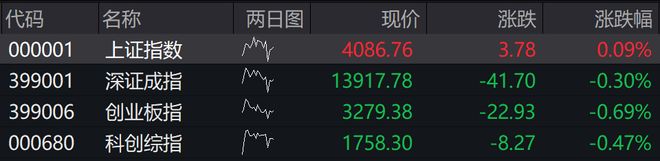
2026.01.09 本文字数:675,阅读时长大约1分钟 作者 |一财阿驴 09:28商业航天板块再度高开,远东股份4连板,中国一重3连板,中衡设计、盛洋科技、巨力索具2连 板。消息面上,广州提出到2035年,打造具有全球影响力的中国商业航天新一极。 09:25 A股开盘丨沪指高开0.09% 沪指高开0.09%,深成指低开0.30%,创业板指低开0.69%,科创综指低开0.47%。 | | 6.68 +0.61 +10.05% | | | 中国石化 1 立即 600028 交易 | | | | --- | --- | --- | --- | --- | --- | --- | | | SSE CNY 9:25:02 交易中 查看L2全景 | | | 好似成持受限 通 品 √ ○ + | | | | 港(0386) | 4.750(+1.71%) H/A:-36.02% | | Wind ESG评级A | | | 详情 | | 委托 | -84.26% 委差 | -93598 | रेस | 8.09% 120日 | | 17.86% | | 或五 | | | 5日 | 8.09% 250日 | | 4.54 ...

MiniMax上市首日大涨
Di Yi Cai Jing Zi Xun· 2026-01-09 01:49
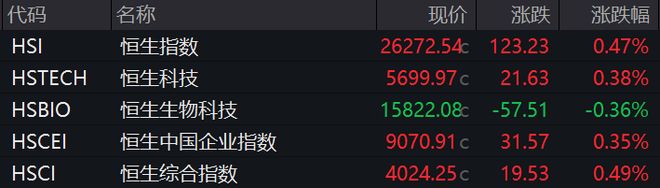
1月9日,香港恒生指数开盘涨0.47%,恒生科技指数涨0.38%。 | 代码 | 名称 | 现价 | 涨跌 | 涨跌幅 | | --- | --- | --- | --- | --- | | əsindən fəsiləsinin cinsinə aid bitki | 恒生指数 | 26272.54c | 123.23 | 0.47% | | HSTECH | 恒生科技 | 5699.97 c | 21.63 | 0.38% | | HSBIO | 恒生生物科技 | 15822.08c | -57.51 | -0.36% | | HSCEI | 恒生中国企业指数 | 9070.91 c | 31.57 | 0.35% | | HSCI | 恒生综合指数 | 4024.25 c | 19.53 | 0.49% | 家电、传媒、国防军工、银行等板块涨幅居前,电气设备、造纸、煤炭、医药生物等板块下跌。 科网股多数上涨,阿里巴巴、京东集团涨逾3%,哔哩哔哩、腾讯音乐、阿里健康涨逾2%;百度集团跌 超2%。 | < w | 恒生科技(HSTECH) | | a | | --- | --- | --- | --- | ...
“全球矿业巨头”与力拓进行早期收购谈判
Di Yi Cai Jing Zi Xun· 2026-01-08 23:45
全球矿业巨头嘉能可周四确认,正就被力拓收购的可能性进行早期谈判。若交易达成,将打造全球规模 最大的矿业公司。嘉能可表示,相关讨论仍处于初步阶段,尚未达成任何具有约束力的协议。此次接触 是双方继2024年短暂沟通后,再度探讨潜在合并事宜。 ...


盘前必读丨广州力争成为中国商业航天新一极;两大能源央企实施重组
Di Yi Cai Jing Zi Xun· 2026-01-08 23:25
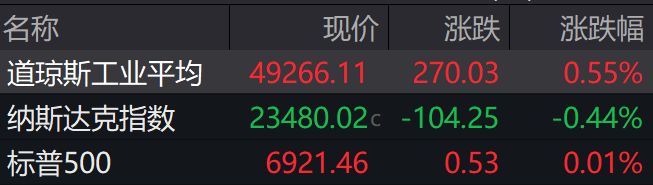
Market Performance - The US stock market showed mixed performance, with the Dow Jones Industrial Average rising by 0.55% to close at 49,266.11, while the S&P 500 saw a slight increase of 0.01% to 6,921.46, and the Nasdaq Composite fell by 0.44% to 23,480.02 [1] - Major tech stocks experienced a pullback, with Broadcom down 3.21%, Nvidia down 2.19%, and Apple declining for the seventh consecutive trading day, down 0.5% [1] - Conversely, some large tech stocks rose, including Amazon up 1.96%, Alphabet up 1.1%, and Tesla up 1.02% [2] Chinese Market Insights - The Nasdaq China Golden Dragon Index increased by 1.09%, with Alibaba rising by 5.29%, JD.com by 2.20%, and Pinduoduo by 0.52%, while Baidu fell by 3.78% [3] Commodity Prices - WTI crude oil for February delivery rose by $1.77 to $57.76 per barrel, marking a 3.16% increase [4] - Gold prices remained stable, with spot gold at $4,452.64 per ounce and futures gold slightly down to $4,460.70 [5] Regulatory Developments - The Chinese market regulator held discussions with major photovoltaic companies regarding monopoly risks and required them to submit written rectification measures by January 20 [6] - The Guangzhou government issued a plan to accelerate the development of advanced manufacturing, focusing on low-altitude economy and commercial aerospace, aiming to establish a series of launch vehicle industry bases [7] Corporate Actions - China Petroleum and Chemical Corporation is undergoing a restructuring with China Aviation Oil [7] - Notable corporate announcements include Vanke A's executive retirement, and several companies reporting significant expected losses or restructuring plans [7]
多家外资机构看好2026年中国市场表现
Di Yi Cai Jing Zi Xun· 2026-01-08 15:52
Group 1 - The A-share market has shown a strong start in 2026, with the Shanghai Composite Index remaining above 4000 points for four consecutive trading days [2] - UBS and Goldman Sachs have expressed optimism about the Chinese market in 2026, highlighting that the current valuation levels are not overheated and that the market is driven by long-term investment rather than speculative trading [2][6] - UBS predicts a 14% or higher earnings growth for the MSCI China Index in 2026, driven by sectors such as internet platforms, high-end manufacturing, and companies with global expansion capabilities [4] Group 2 - In 2025, the A-share market outperformed expectations, with major indices showing significant increases: the Shanghai Composite Index rose by 18.41%, the Shenzhen Component Index by 29.87%, and the ChiNext Index by 49.57% [3] - The valuation of the MSCI China Index is approximately 13 times earnings, slightly above the ten-year average, indicating room for growth [3] - International investors have shifted from a passive to an active approach in the Chinese market, with a notable increase in capital inflow [4] Group 3 - Goldman Sachs forecasts a 20% increase in the MSCI China Index and a 12% increase in the CSI 300 Index for 2026, with growth driven by earnings rather than valuation expansion [6] - The technology, media, and telecommunications (TMT) sector is expected to see a profit growth of around 20% in 2026, supported by artificial intelligence and corporate strategies [6] - High levels of interest from foreign investors in Chinese technology and AI companies are noted, with a significant gap in valuation compared to similar U.S. firms [5][6] Group 4 - Goldman Sachs anticipates record net inflows of $200 billion from southbound capital in 2026, alongside a potential 3 trillion RMB increase in domestic asset reallocation [7] - Investment themes to focus on include companies benefiting from AI development, export leaders, and those with substantial shareholder returns [7] - High valuations are seen in sectors such as technology hardware, insurance, materials, media/entertainment, and internet retail, which are rated as overweight by Goldman Sachs [7]



多家互联网大厂集聚“大模型第一股”
Di Yi Cai Jing Zi Xun· 2026-01-08 13:38
Core Viewpoint - The successful IPO of Zhiyu (02513.HK) on January 8, 2026, marks it as the first global stock focused on general artificial intelligence (AGI) models, with a closing price of 131.50 HKD, up 13.16% from the issue price, and a market capitalization nearing 58 billion HKD, providing substantial returns for early investors [3][4]. Capital Landscape - Zhiyu raised over 4.3 billion HKD through its IPO, with an opening price of 120 HKD and a market cap of approximately 52.8 billion HKD at that time [4]. - The company has seen a nearly 130% increase in public market valuation compared to its post-B6 round valuation of approximately 24.4 billion RMB in May 2025 [4]. - Since 2022, Zhiyu has completed eight rounds of financing, raising a total of about 8.36 billion RMB, primarily directed towards AGI model training, multi-modal technology development, and computing infrastructure [4]. Shareholder Structure - Strategic investors include major internet companies, venture capital/private equity firms, and state-owned enterprises [5][6]. - Notable shareholders include Meituan, Ant Group, and various VC/PE firms like Junlian Capital, which has significant holdings [6][8]. Financial Performance - Zhiyu's revenue is heavily reliant on privatized deployment projects, with 95.5% of its revenue coming from this source in 2022, decreasing to 69.4% in the first half of 2025, but still representing over half of total revenue [12]. - The company has experienced rapid revenue growth, with projections showing an increase from 57.41 million RMB in 2022 to 312 million RMB in 2024, and a 300% year-on-year growth in the first half of 2025 [11]. - However, the company faces challenges with high customer concentration, as revenue from its top five clients accounted for 55.4%, 61.5%, and 45.5% of total revenue from 2022 to 2024 [13]. R&D and Losses - R&D expenditures have surged from 84.4 million RMB in 2022 to 2.195 billion RMB in 2024, leading to increasing net losses, which reached 2.143 billion RMB in 2024 and 2.351 billion RMB in the first half of 2025 [13]. - The company’s business model is heavily B-end focused, which raises concerns about customer stability and the sustainability of its revenue streams [11][12]. Market Reaction and Future Outlook - The stock experienced volatility on its first trading day, reflecting market speculation and concerns over high valuations and ongoing losses [10][14]. - The IPO is seen as a potential catalyst for a wave of listings in the AI sector, with other companies like MiniMax and Biran Technology also preparing for public offerings [15][16]. - Market analysts suggest that the future performance of Zhiyu and similar companies will depend on their ability to establish sustainable competitive advantages and improve profitability [16].

非法金融App诈骗频发,揭秘“高收益”外衣下的常见套路
Di Yi Cai Jing Zi Xun· 2026-01-08 12:05
随着农历新年临近,各类投资理财活动日益活跃,然而伴随而来的,还有非法金融App诈骗案件的高 发。近日,上海市嘉定区发生的一起案件引发关注,当事人季女士在骗子客服反复劝导下,差点按 照"正规证券App"指示,提取50万元现金进行所谓"线下交易"。 此类案件揭示了当前非法金融App的新型套路:先通过仿冒知名券商或银行App制造虚假盈利,诱导投 资者持续充值,再以"账户冻结""对冲认证"等理由要求线下交付现金或实物,形成"线上诈骗、线下送 钱"的模式。 各地监管部门近期纷纷发布风险提示,警示公众警惕非法金融App。业内人士提醒,投资应通过正规渠 道,资金应进入对公账户,凡涉及私人账户或线下交付的行为,几乎可判定为诈骗。 从"假App盈利"到"线下送钱" "只要完成对冲认证,资金马上就能解冻到账。"在骗子客服的反复催促下,家住上海的季女士一度坚 信,自己下载并使用的是一款"正规的证券交易软件"。2025年12月,季女士按照对方要求前往银行提取 50万元现金,准备进行所谓的"线下交易"。所幸,银行柜员察觉异常并及时报警,在警方连续两个多小 时的耐心劝阻下,这笔现金最终没有交到骗子手中。 多地监管密集发声 近期,各地监管 ...
外滩FTC:在历史金融地标上,黄浦区如何重塑金融科技“策源地”
Di Yi Cai Jing Zi Xun· 2026-01-08 12:05
Core Insights - Shanghai is accelerating its development as a world-class financial technology center, with Huangpu District leading innovative practices that integrate historical significance with modern financial technology [1][9] - The FinTech Community (FTC) at the Bund is set to begin substantial operations by 2025, focusing on the integration of finance and technology to create a replicable model for global financial technology development [1][9] Group 1: Historical and Spatial Transformation - The FTC is located in the renovated Gu Xiang Building, which previously served traditional office functions but lacked modern relevance [2] - The renovation follows a "light modification" principle, maintaining the building's original structure while introducing new financial technology and content creation functions [2] - The redesigned FTC features a vertical ecological community layout, including public spaces, offices, and event areas, promoting flexible use of space [2] Group 2: Operational Mechanisms and Models - The establishment of the Shanghai Bund FinTech Economic Development Co., Ltd. marks the transition of FTC to a professional and market-oriented operational phase [3][4] - The operational model emphasizes a dual empowerment approach of "finance + technology" and "content + technology," creating an integrated ecosystem for incubation, investment, and industry collaboration [3][4] Group 3: Industry and Ecosystem Development - The FTC has quickly demonstrated its industry aggregation effects, attracting numerous financial technology companies and content creators since its trial operation [5][6] - By December 2025, 74 companies and over 1,670 content creators are expected to be engaged, forming a diverse network of technology firms, content creators, financial institutions, and service providers [7][8] Group 4: Service and Empowerment - The FTC is developing a comprehensive service system that covers the entire lifecycle of enterprises, providing integrated services such as market registration and financial support [8] - The initiative includes the establishment of a digital platform for content creators and businesses, facilitating resource matching and community interaction [8] Group 5: Broader Implications and Future Goals - The FTC's model offers a solution for urban areas to foster high-level financial technology innovation without relying on large-scale land development [9][10] - Future goals include collaboration with top universities and research institutions to extend financial technology innovation into cutting-edge fields and enhance global connectivity [11][12]