
Zhong Guo Huan Jing Bao

Search documents
钟寰平:坚定不移走好低碳发展之路
Zhong Guo Huan Jing Bao· 2025-06-25 02:07
6月25日是今年的全国低碳日,主题是"碳路先锋、绿动未来"。各地区各部门围绕主题开展丰富多彩的 实践活动和科普宣传,让低碳理念进一步深入人心,营造出全社会践行绿色低碳生产生活方式的良好氛 围。 习近平总书记指出,推动经济社会发展绿色化、低碳化是实现高质量发展的关键环节。党的十八大以 来,我国绿色低碳发展取得历史性成就。建成全球最大、最完整的新能源产业链;大力发展非化石能 源,煤炭消费比重由2012年的68.5%下降到2023年的55.3%;推动实施"两新"政策,2023年单位国内生 产总值碳排放强度比2012年下降超过35%;实施积极应对气候变化国家战略,扎实推进碳达峰碳中 和……一系列实践证明,绿色低碳是可感知、可践行的生产和生活方式,是我们通过每一步努力都能不 断靠近并最终抵达的现实。 紧盯重点领域,厚植绿色低碳发展优势。当前,我国生态文明建设进入以"降碳"为重点战略方向的新阶 段,要从经济社会发展实际出发,围绕加快形成符合绿色低碳要求的空间格局、产业结构、生产方式、 生活方式,大力发展新质生产力,深入推进能源、交通运输、城乡建设等相关重点领域绿色转型。 广泛凝聚合力,形成绿色低碳发展共识。从"光盘行动" ...
高质量的环评报告是这样出炉的
Zhong Guo Huan Jing Bao· 2025-06-25 01:44
如何编制高质量的环评报告?笔者认为必须做到"六个遵循":一是遵循《环境影响评价分类管理名 录》,准确界定项目应编制环境影响报告书还是报告表;二是遵循《建设项目环境影响评价技术导则》 《建设项目环境影响报告表编制技术指南》等技术规范,确保报告的内容完整和深度适合;三是遵循区 域环境特征,科学合理确定保护目标和评价范围;四是遵循项目特点,针对项目具体产污的环节、性质 和数量,制定有效、可行的污染防治措施;五是遵循《建设项目环境影响评价文件审批原则》,落实其 各项环境管理要求;六是遵循《建设项目环境影响报告书(表)编制监督管理办法》,确保报告不出现 质量问题。唯有将生态环境分区管控、规划、政策、技术(工艺技术、治理技术、编写技术)、项目特 点和环境特征深度融合,才能编制出真正高质量的环评报告。 日前印发的《广西壮族自治区建设项目环境影响评价文件分级审批管理办法(2025年修订版)》中,将 火电、钢铁、有色金属冶炼、石化、煤化工、水泥、平板玻璃等"两高"项目,以及尾矿库、危险废物处 置等生态环境影响重大项目的环评审批权限上收至省级生态环境部门。此举严格落实了生态环境分区管 控、遏制"两高"项目盲目发展等要求,可有效避 ...
企业减排方案“一键抄作业”,怎么做到的?
Zhong Guo Huan Jing Bao· 2025-06-25 00:17
Group 1 - The Chengdu Ecological Environment Bureau has launched a one-click generation function for the "one factory, one policy" emergency reduction plan to support enterprises in managing pollution during heavy smog events [1] - The system utilizes information from the Chengdu Air Pollution Source Emission Inventory Management System, allowing companies to quickly compile and export their reduction plans by inputting necessary data and selecting corresponding measures [1] - The "one factory, one policy" template covers 49 industries and includes various reduction measures that enterprises should implement during heavy pollution weather alerts, aiming for operational, monitorable, and verifiable goals [1] Group 2 - The industrial structure in China is stable, allowing similar enterprises to make minor adjustments based on established practices, facilitating the sharing of solutions for common issues [2] - There is an emphasis on organizing efforts to tackle common technical problems and promptly disseminating results to ensure compliance among relevant enterprises [2] - The approach of demonstration and guidance is highlighted as a key method, aiming for institutionalization and standardization to ensure quality and reduce overall social costs [2]
新能源汽车动力电池或将大量退役,综合利用如何规范发展?
Zhong Guo Huan Jing Bao· 2025-06-24 23:10
Core Viewpoint - The implementation of the "Interim Measures for the Recycling and Utilization of Waste Power Batteries for New Energy Vehicles in Sichuan Province" marks a significant step in regulating the recycling of power batteries, addressing the urgent need for a structured approach to handle the anticipated surge in retired batteries as the number of new energy vehicles increases [1][3]. Group 1: Current Situation and Challenges - As of the end of 2024, Sichuan Province is expected to have 1.402 million new energy vehicles, a year-on-year increase of 56.4%, leading to a potential first wave of retired power batteries in the next 2-3 years [1]. - The current recycling landscape is characterized by a lack of a high-value comprehensive utilization industry, with many batteries flowing into informal "small workshops," which undermines the operations of legitimate recycling enterprises [1][2]. - The total amount of retired power batteries in China exceeded 580,000 tons in 2023, with projections of 1.04 million tons by 2025 and 3.5 million tons by 2030, while the standardized recycling rate remains below 25% as of the end of 2023 [2]. Group 2: Policy and Regulatory Framework - The "Measures" provide institutional support for establishing a closed-loop recycling system for power batteries throughout their lifecycle, focusing on regional center construction, recycling norms, supportive measures, supervision, and legal responsibilities [2][3]. - The national-level "Action Plan for Improving the Recycling and Utilization System for New Energy Vehicle Power Batteries" and the revised "Industry Norms for the Comprehensive Utilization of Waste Power Batteries" aim to enhance the regulatory framework, but local adaptations are necessary for effective implementation [3]. Group 3: Future Directions and Opportunities - The government and industry should collaborate to seize the development opportunities in the retired battery recycling sector, establishing mandatory recycling mechanisms and providing incentives for compliant enterprises while cracking down on illegal activities [4]. - Companies are encouraged to innovate in recycling, disassembly, and remanufacturing processes to improve resource recovery rates and reduce energy consumption, positioning themselves as leaders in technology and standards within the industry [4]. - The true maturity of the new energy vehicle industry will be reflected not only in production and sales growth but also in the enhancement of lifecycle management, with Sichuan's regulatory innovations serving as a model for other regions [4].
宿迁以流程再造为抓手,构建生态环境全链条执法体系
Zhong Guo Huan Jing Bao· 2025-06-24 03:18
Group 1 - The article emphasizes the importance of standardized ecological environment law enforcement inspections as a key mechanism for environmental regulation, which directly impacts enforcement effectiveness and corporate perception [1] - The Suqian Ecological Environment Comprehensive Administrative Law Enforcement Bureau has restructured its processes to create a comprehensive enforcement system that balances ecological protection with economic development [1] - The enforcement system includes three types of inspections: daily checks, case-specific checks, and special inspections, aimed at ensuring precise regulation and efficient problem resolution [1][2][3] Group 2 - Daily inspections are considered the foundational defense of ecological law enforcement, utilizing a "double random" mechanism to ensure fairness and randomness in inspections [2] - The case-specific inspection process focuses on particular environmental issues, ensuring timely and standardized responses to complaints and emergencies, while also providing proactive support to businesses [2] - Special inspections are designed to address specific environmental issues during designated periods, ensuring transparency and efficiency while minimizing the burden on enterprises [3]
推进美丽乡村建设关键在因地制宜
Zhong Guo Huan Jing Bao· 2025-06-24 01:46
Core Viewpoint - The construction of beautiful rural areas in China has made significant progress, with over 50,000 unique rural areas built, but there is still a need to improve coverage and construction levels to meet the strategic goals for agricultural modernization by 2035 [1][2]. Group 1: Strategies for Beautiful Rural Construction - Tailored approaches should be adopted based on local conditions, with differentiated strategies for beautiful rural areas, focusing on ecological protection in key ecological function areas, modern agricultural development in major agricultural production areas, and urban-rural integration in coordinated development areas [1][2]. - Beautiful rural areas should serve as demonstration zones for ecological improvement and high-quality agricultural development, leading the way in optimizing rural industrial development and enhancing the quality of rural living environments [2][3]. - A comprehensive planning and collaborative approach is essential for the construction of beautiful rural areas, involving multiple departments and integrating various agricultural funds to ensure effective project support [2][4]. Group 2: Cultural and Technological Aspects - Preserving local culture and history is crucial, with an emphasis on developing unique agricultural products and enhancing brand value, while also promoting the integration of agriculture, culture, and tourism [3][4]. - Technological innovation should focus on environmental management in rural areas, with the development of practical technologies for waste management and the establishment of a digital governance system for beautiful rural areas [3][4]. Group 3: Mechanisms for Sustainable Development - Establishing a county-level work promotion mechanism is vital for the construction of beautiful rural areas, with clear annual goals and task lists, and the need for financial support from higher levels of government [4][5]. - Long-term mechanisms should be developed to ensure the sustainable operation of rural environmental infrastructure, with policies promoting green and low-carbon agriculture to guide farmers in resource utilization [4].
山塘古桥见证金嘉平五年共治共享共美
Zhong Guo Huan Jing Bao· 2025-06-24 01:40
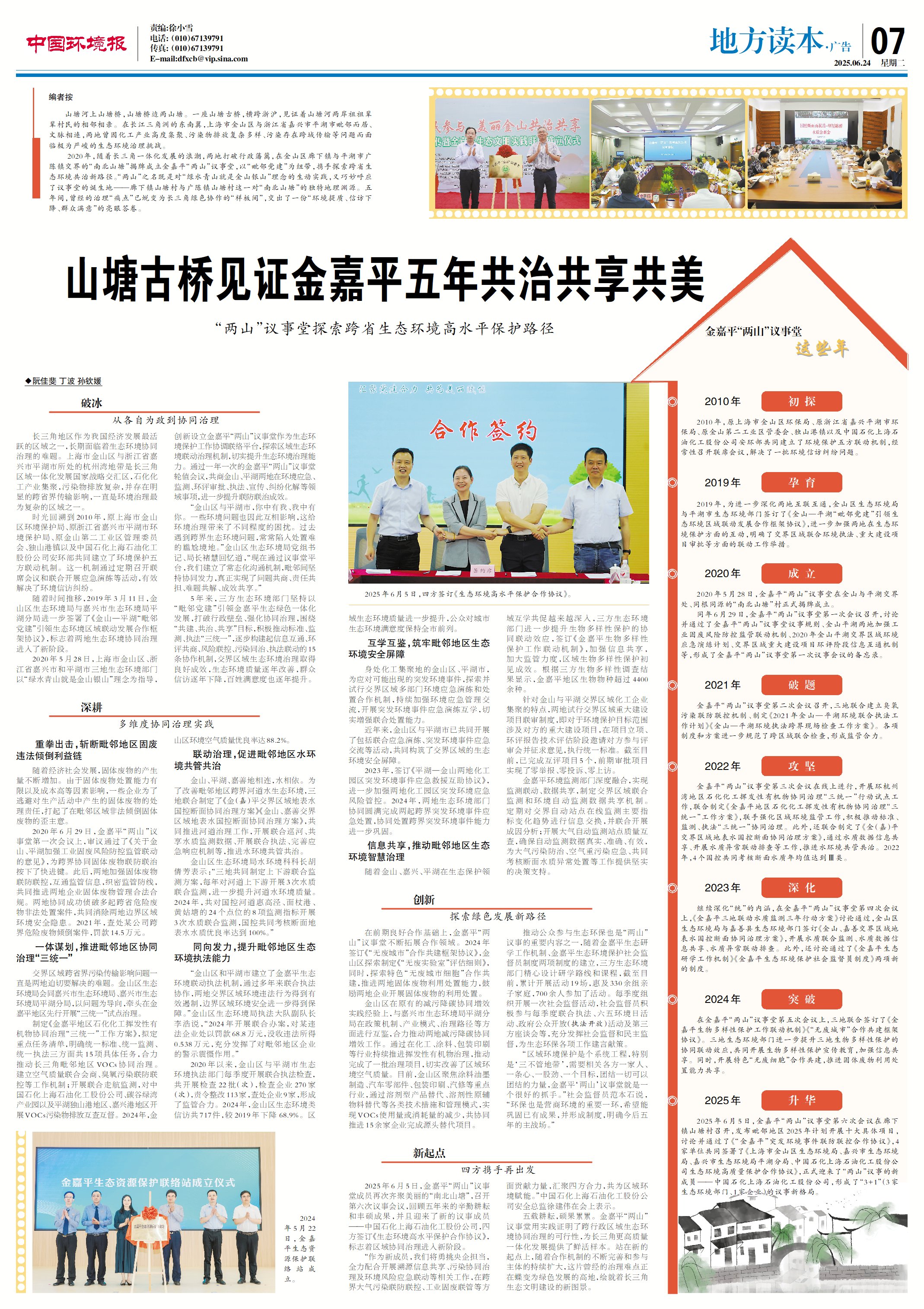
Core Viewpoint - The establishment of the Jinjiaping "Two Mountains" Council has transformed the ecological governance challenges faced by Shanghai's Jinshan District and Zhejiang's Pinghu City into a model of green cooperation in the Yangtze River Delta region, demonstrating effective cross-province environmental management and improved public satisfaction [20][39]. Group 1: Background and Initiatives - The Jinshan District and Pinghu City, located in the Hangzhou Bay area, have historically faced severe ecological challenges due to the concentration of the petrochemical industry and complex pollutant emissions [4][21]. - In 2010, a five-party environmental protection mechanism was established to address environmental disputes through regular meetings and joint emergency drills [4][40]. - The "Two Mountains" Council was officially established on May 28, 2020, to enhance ecological governance capabilities and facilitate cooperation among the three regions [22][42]. Group 2: Achievements and Mechanisms - Over five years, the three ecological departments have implemented 15 collaborative mechanisms focusing on information sharing, joint assessments, risk control, pollution management, and coordinated law enforcement, leading to improved environmental quality and reduced public complaints [5][22][28]. - The air quality in Jinshan District is projected to reach an excellent rate of 88.2% by 2024, reflecting the success of the collaborative efforts in managing volatile organic compounds (VOCs) [24]. - The joint enforcement mechanism has effectively curtailed environmental violations in border areas, with significant penalties imposed on non-compliant enterprises [26][28]. Group 3: Future Directions - The signing of the "High-Level Ecological Environment Protection Cooperation Agreement" with China Petrochemical Corporation marks a new phase in regional collaborative governance, emphasizing shared responsibilities in pollution control and emergency response [38][50]. - The council plans to implement ten specific projects in 2025, focusing on enhancing environmental safety and sustainability in the region [50]. - The ongoing initiatives aim to further integrate ecological protection efforts, including biodiversity conservation and waste management strategies, to foster a sustainable development model in the Yangtze River Delta [30][33].

从灰氢到绿氢,如何以氢能发展赋能“双碳”战略目标实现?
Zhong Guo Huan Jing Bao· 2025-06-24 00:21
国家能源局《中国氢能发展报告(2025)》显示,2024年我国氢能生产消费规模达3650万吨,位居全球 首位,可再生能源制氢产能占全球50%以上,这标志着我国正从氢能技术的追随者逐步向全球产业的引 领者跨越。 然而,当前氢能仍面临产业链需协同深入推进碳减排、成本高企、基础设施建设滞后、技术创新不足等 诸多挑战。亟须强化政策支持、加快基础设施建设、突破核心技术瓶颈以及深化国际合作与交流,真正 为"双碳"目标的实现提供强大动能。 成本高企制约市场推广。我国氢能的生产成本主要受制氢方式的影响。传统的化石能源制氢虽然技术成 熟,但随着环保要求的不断提高,其面临的碳排放成本逐渐上升,同时,化石能源的价格波动也会影响 制氢成本的稳定性。可再生能源制氢虽然具有零碳排放的优势,但设备投资大、制氢效率低,导致成本 居高不下。此外,氢能的储存和运输成本也较高,一定程度上限制了氢能的运输距离和市场范围。高昂 的成本使得氢能在与传统能源的竞争中处于劣势,严重制约了其市场推广和应用。如何降低氢能全产业 链成本,成为氢能产业发展的重要瓶颈。 同时,氢能是保障能源安全的战略选择。我国能源结构长期呈现"富煤、缺油、少气"的资源禀赋特征, 这 ...
加快建立符合国情的产品碳足迹分级管理制度
Zhong Guo Huan Jing Bao· 2025-06-23 23:13
Core Viewpoint - The establishment of a product carbon footprint grading management system is crucial for China's carbon footprint management framework, aimed at evaluating and categorizing product carbon emissions to promote reductions in carbon footprints [1] Domestic and International Carbon Footprint Management Policies - Major countries and regions are implementing diverse carbon footprint grading policies to drive green and low-carbon transitions, with the EU mandating lifecycle grading for batteries under the new battery law [2] - The US employs a Climate Conscious labeling system to guide low-carbon consumption, categorizing products into gold, silver, and bronze based on their total lifecycle carbon emissions [2] - France requires environmental labels to display carbon footprint scores for textiles, with a grading system from A to E [2] - China, the US, and Singapore are leading in carbon footprint grading management in the automotive sector, with China establishing standards for battery emissions [3] - Other countries like South Korea and Thailand are also developing carbon footprint grading systems for various products [3] Challenges in Establishing China's Product Carbon Footprint Grading Management System - There is a lack of a unified and comprehensive management mechanism in China, with current efforts being limited and lacking systematic design compared to developed countries [4] - The foundation for accounting standards and factor data is weak, with many product categories lacking established carbon footprint factors [4][5] - Market participation is uneven, with insufficient incentives for companies to engage in carbon footprint grading, particularly affecting small and medium-sized enterprises [5] - There is a shortage of technology and talent in carbon footprint accounting, with existing tools not meeting market demands [5] Recommendations for Accelerating the Establishment of China's Product Carbon Footprint Grading Management System - A top-level institutional framework should be established to enhance the grading management policies, setting clear goals and implementation paths [6] - A robust standard and factor data foundation should be developed, creating a comprehensive carbon footprint accounting standard system [6][7] - An incentive and constraint market mechanism should be constructed, linking carbon footprint grades to market access and providing financial incentives for low-carbon products [7] - International recognition should be promoted to enhance China's influence in carbon footprint management, tracking global trends and engaging in international cooperation [7]
绍兴首创排污许可“续证帮扶”机制,为企业发展保驾护航
Zhong Guo Huan Jing Bao· 2025-06-23 01:39
实施排污许可融合改革。绍兴市实施环评审批与排污许可证发放衔接、印染行业环境统计与排污许可管 理融合两项改革。整合分析环评审批和排污许可证两套名录,编制污染影响类建设项目环境影响报告书 编制技术要点,在环评编制阶段增加排污许可证分析内容,有序推进环评与排污许可"一次审批"改革试 点、非重大变动豁免环评审批管理工作。构建排污许可和生态环境统计一体化应用平台,汇总排污许可 证、在线监测、环境统计等系统数据约5700万条,推动实现固定污染源排污许可全要素、全联动、全周 期管理。 推行排污许可证续证提前帮扶。根据日常工作和环境管理经验,制定出台《绍兴市生态环境局关于试行 开展排污许可证续证技术帮扶的通知》,为2025年辖区内75家持有重点管理类排污许可证且需要续证的 企业提前提供技术帮扶。结合各行业排污许可证申请与核发技术规范、自行监测技术指南、环评文件及 相关环境管理要求,提前6个月对企业现场情况与排污许可证载明内容的合规性、真实性、完整性、规 范性、准确性等进行核对,提出帮扶指导意见,避免企业在正式申领排污许可证时存在不合规问题,影 响正常生产。 今年以来,浙江省绍兴市锚定全面实行排污许可制改革目标,从深化排污许可 ...