
Guo Jia Tong Ji Ju

Search documents
9月化学原料和化学原料制造业增加值同比增长9.0%
Guo Jia Tong Ji Ju· 2025-10-22 00:41
国家统计局10月20日发布数据显示,9月份,规模以上工业增加值同比实际增长6.5%,环比增长 0.64%。其中,石油和天然气开采业增长8.9%,化学原料和化学制品制造业增长9.0%,橡胶和塑料制品 业增长5.3%。 分三大门类看,9月份,采矿业增加值同比增长6.4%,制造业增长7.3%,电力、热力、燃气及水生 产和供应业增长0.6%。 分经济类型看,9月份,国有控股企业增加值同比增长6.5%;股份制企业增长6.8%,外商及港澳台 投资企业增长5.8%;私营企业增长4.6%。 分行业看,9月份,41个大类行业中有36个行业增加值保持同比增长。其中,煤炭开采和洗选业增 长6.4%,石油和天然气开采业增长8.9%,农副食品加工业增长6.0%,酒、饮料和精制茶制造业增长 0.8%,纺织业增长2.2%,化学原料和化学制品制造业增长9.0%,非金属矿物制品业增长0.2%,黑色金 属冶炼和压延加工业增长2.2%,有色金属冶炼和压延加工业增长8.4%,通用设备制造业增长9.3%,专 用设备制造业增长5.4%,汽车制造业增长16.0%,铁路、船舶、航空航天和其他运输设备制造业增长 10.3%,电气机械和器材制造业增长7.9%, ...
2025年1-9月份全国固定资产投资基本情况
Guo Jia Tong Ji Ju· 2025-10-21 06:28
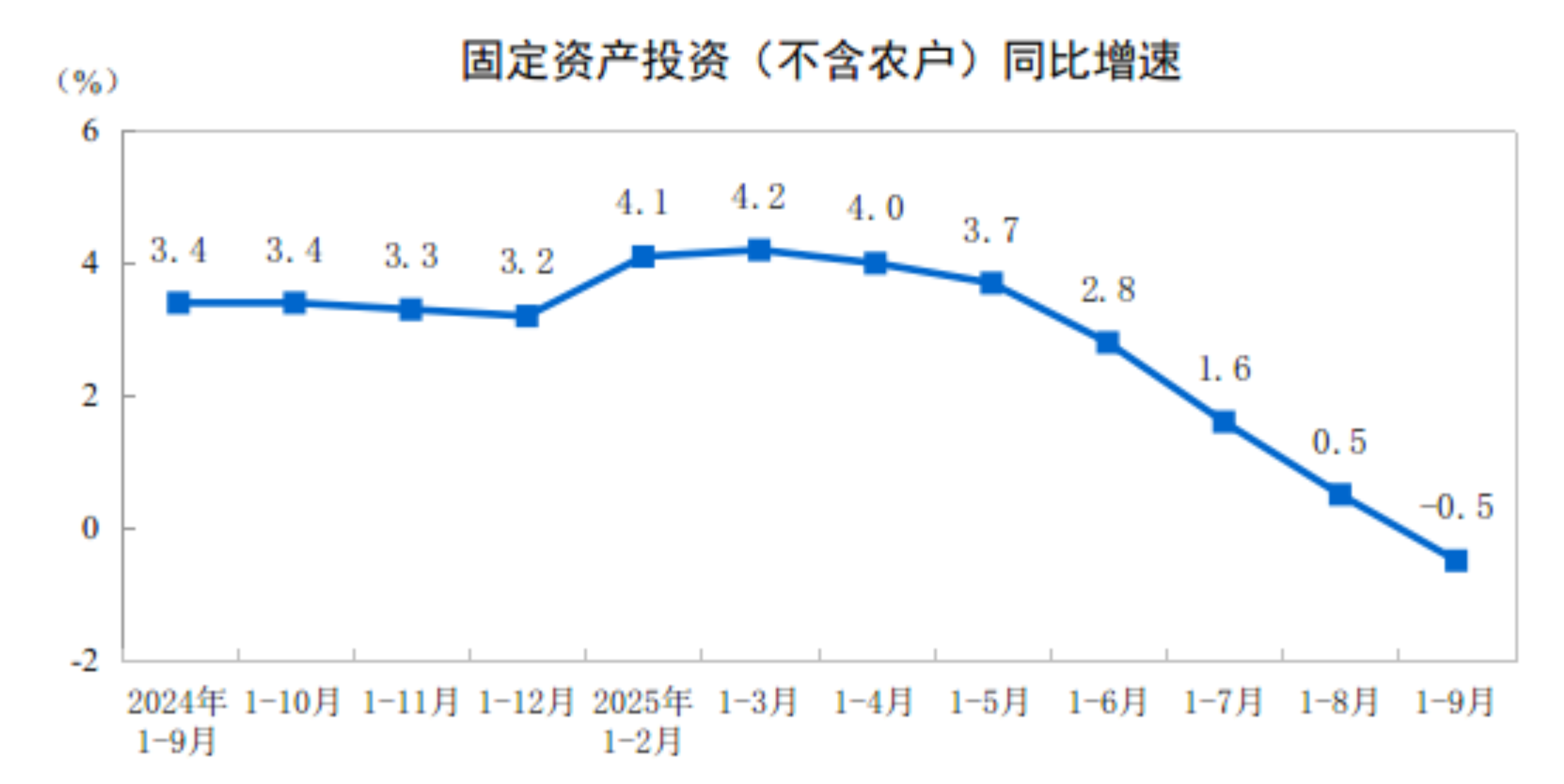
Core Insights - National fixed asset investment (excluding rural households) reached 371,535 billion yuan from January to September 2025, showing a year-on-year decline of 0.5% [1] - Private fixed asset investment decreased by 3.1% year-on-year [1] Investment by Industry - First industry investment totaled 7,344 billion yuan, with a year-on-year growth of 4.6% [3] - Second industry investment was 134,063 billion yuan, growing by 6.3% year-on-year, with industrial investment specifically increasing by 6.4% [3] - Within the second industry, mining investment grew by 3.7%, manufacturing investment by 4.0%, and investment in electricity, heat, gas, and water production and supply surged by 15.3% [3] - Third industry investment reached 230,128 billion yuan, declining by 4.3% year-on-year, with infrastructure investment (excluding electricity, heat, gas, and water production and supply) increasing by 1.1% [3] Regional Investment Trends - Eastern region investment fell by 4.5% year-on-year, while central and western regions both saw a growth of 1.5% [3] - Northeast region investment decreased by 8.4% [3] Investment by Registration Type - Domestic enterprises' fixed asset investment declined by 0.6% year-on-year, while investment from Hong Kong, Macau, and Taiwan enterprises fell by 0.3% [3] - Foreign enterprises' fixed asset investment saw a significant drop of 12.6% [3]

2025年1-9月份全国房地产市场基本情况
Guo Jia Tong Ji Ju· 2025-10-21 06:28
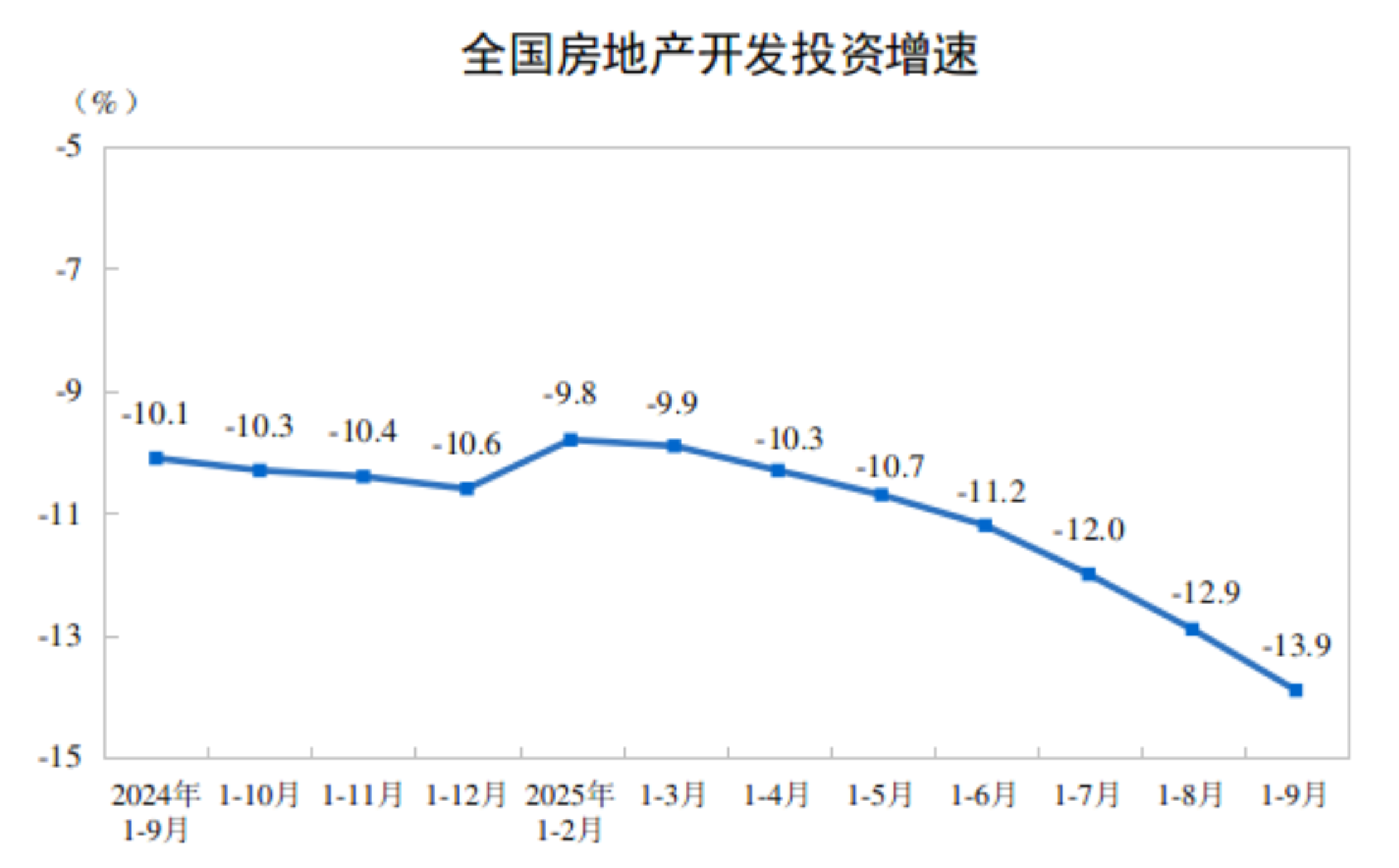
Core Insights - The real estate development investment in China for the first nine months reached 67,706 billion yuan, reflecting a year-on-year decline of 13.9% [1][13] - Residential investment totaled 52,046 billion yuan, down 12.9% compared to the previous year [1][13] - The overall construction area for real estate development decreased by 9.4% year-on-year, with residential construction area down by 9.7% [3][13] Investment and Construction Data - The new construction area for buildings was 45,399 million square meters, a significant drop of 18.9%, with residential new construction area falling by 18.3% [3][13] - The completion area for buildings was 31,129 million square meters, down 15.3%, with residential completion area decreasing by 17.1% [3][13] Sales Performance - The sales area of newly built commercial housing was 65,835 million square meters, down 5.5% year-on-year, with residential sales area declining by 5.6% [4][15] - The sales revenue from newly built commercial housing reached 63,040 billion yuan, a decrease of 7.9%, with residential sales revenue down by 7.6% [4][15] Inventory and Funding Situation - As of the end of September, the unsold commercial housing area was 75,928 million square meters, a reduction of 241 million square meters from the end of August, with residential unsold area decreasing by 292 million square meters [7] - The total funds available for real estate development enterprises amounted to 72,299 billion yuan, down 8.4% year-on-year, with various funding sources such as domestic loans and personal mortgage loans also experiencing declines [8][13] Market Sentiment - The real estate development prosperity index stood at 92.78 in September, indicating a continued downturn in the sector [10]
2025年三季度全国煤炭开采和洗选业产能利用率为68.9%
Guo Jia Tong Ji Ju· 2025-10-21 02:20
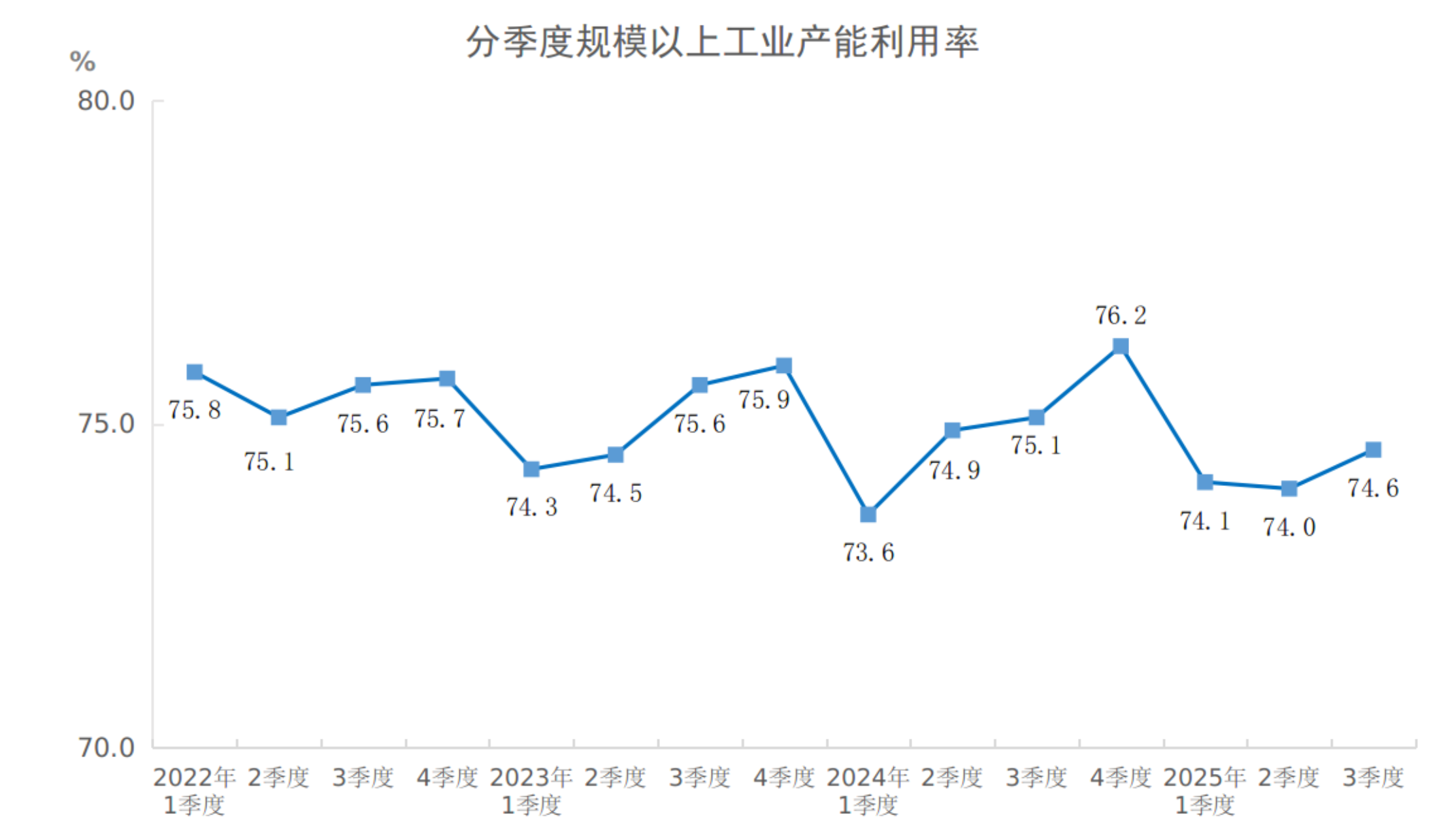
Core Insights - The overall industrial capacity utilization rate for Q3 2025 is reported at 74.6%, showing a decrease of 0.5 percentage points compared to the same period last year [2] - The mining industry has a capacity utilization rate of 72.5%, down by 2.1 percentage points year-on-year [2] - The manufacturing sector's capacity utilization rate stands at 74.8%, reflecting a decline of 0.4 percentage points from the previous year [3] Industry Breakdown - Mining Industry: Capacity utilization at 72.5%, down 2.1 percentage points from last year [2] - Manufacturing Sector: Capacity utilization at 74.8%, down 0.4 percentage points year-on-year [3] - Electricity, Heat, Gas, and Water Production and Supply: Capacity utilization at 74.3%, unchanged from the previous year [3] Specific Industries - Coal Mining and Washing: 68.9%, down 3.8 percentage points [3] - Food Manufacturing: 70.1%, down 0.6 percentage points [3] - Textile Industry: 77.2%, down 0.7 percentage points [3] - Chemical Raw Materials and Products: 72.5%, down 3.5 percentage points [3] - Non-Metallic Mineral Products: 62.0%, up 0.3 percentage points [3] - Black Metal Smelting and Rolling: 80.1%, up 2.7 percentage points [3] - Non-Ferrous Metal Smelting and Rolling: 77.8%, down 0.6 percentage points [3] - General Equipment Manufacturing: 78.9%, up 0.2 percentage points [3] - Specialized Equipment Manufacturing: 75.5%, down 0.3 percentage points [3] - Automobile Manufacturing: 73.3%, up 0.1 percentage points [3] - Electrical Machinery and Equipment Manufacturing: 74.9%, down 0.7 percentage points [3] - Computer, Communication, and Other Electronic Equipment Manufacturing: 79.0%, up 1.1 percentage points [3]
国家统计局胡汉舟:前三季度规模以上工业核电、风电和太阳能发电分别增长9.2%、10.1%、24.2%
Guo Jia Tong Ji Ju· 2025-10-21 02:02
Core Insights - China's economy has shown stable growth in the first three quarters, with energy consumption growth remaining steady and a significant increase in the share of non-fossil energy consumption [1] Group 1: Energy Production - Energy production has steadily increased, with major energy products such as coal, oil, gas, and electricity showing growth. The industrial raw coal output reached 3.57 billion tons, a year-on-year increase of 2.0% [2] - Crude oil production was 160 million tons, up 1.7% year-on-year, while natural gas production hit 194.9 billion cubic meters, marking a historical high with a growth of 6.4% [2] - Electricity generation totaled 7.3 trillion kilowatt-hours, reflecting a 1.6% year-on-year increase, with significant growth in nuclear, wind, and solar power generation [2] Group 2: Supply Security - Domestic coal supply has been sufficient, leading to a decrease in energy imports. Coal imports fell to 35 million tons, down 11.1% year-on-year, while crude oil imports increased by 2.6% to 42 million tons [3] - Natural gas imports decreased to 9.286 million tons, a decline of 6.2% year-on-year, indicating improved energy self-sufficiency and security [3] - The power supply has been robust, with record-high electricity loads due to sustained high temperatures, enhancing the coordination of power sources and ensuring stable supply for economic and social operations [3] Group 3: Green and Low-Carbon Transition - Energy consumption in the first three quarters grew by 3.7%, with a notable shift towards greener energy consumption structures. The share of non-fossil energy in total energy consumption increased by 1.7 percentage points compared to the previous year [4] - The proportion of clean energy generation from hydropower, nuclear power, wind power, and solar power reached 35.3%, an increase of 1.9 percentage points year-on-year, indicating accelerated green transition in the energy sector [4]

国家统计局:前三季度太阳能电池产量14.0%
Guo Jia Tong Ji Ju· 2025-10-21 02:00
Economic Performance Overview - China's GDP growth for the first three quarters of 2023 was 5.2%, an increase of 0.2 and 0.4 percentage points compared to the previous year and the same period last year, respectively, with an economic increment of 39,679 billion yuan, which is 1,368 billion yuan more than last year [2][6] - The urban unemployment rate averaged 5.2% in the first three quarters, remaining stable compared to the first half of the year, while the Consumer Price Index (CPI) slightly decreased by 0.1% year-on-year, but the core CPI, excluding food and energy, rose by 0.6% [2][6] - The foreign trade sector showed resilience, with the total import and export volume reaching a historical high for the same period, and foreign exchange reserves maintained above 3.3 trillion USD [2][4] High-Quality Development - The proportion of added value from high-tech manufacturing and equipment manufacturing in the total industrial added value reached 16.7% and 35.9%, respectively, indicating a shift towards high-quality development [3][15] - Non-fossil energy consumption as a percentage of total energy consumption increased by approximately 1.7 percentage points year-on-year, reflecting progress in green and low-carbon transformation [3][22] - The export of new products, referred to as "new three items," experienced double-digit growth, supporting the diversification of markets [3][4] Economic Resilience and Potential - Despite global economic challenges, China achieved a 5.2% GDP growth, showcasing its strong resilience and adaptability in uncertain environments [4][5] - The economic growth rate of 5.2% ranks among the highest among major economies, highlighting China's role as a stable and reliable driver of global economic growth [4][5] Macroeconomic Policies and Effects - The implementation of proactive macroeconomic policies has effectively stabilized the economy, with consumer spending contributing 53.5% to economic growth, an increase of 9.0 percentage points from the previous year [10][11] - Investment in equipment and tools increased by 14.0% year-on-year, significantly contributing to overall investment growth [11][12] - The manufacturing sector saw significant growth in new energy products, with lithium-ion battery manufacturing increasing by 29.8% and electric vehicle production rising by 29.7% [12][16] New Quality Productivity - R&D expenditure increased by 8.9% year-on-year, with a notable rise in investment in emerging fields, leading to significant advancements in innovation [14][19] - The added value of high-tech manufacturing grew by 9.6%, with substantial increases in the production of industrial robots and 3D printing equipment [15][16] - The transition to green energy is evident, with significant growth in the production of renewable energy products, including a 46.9% increase in lithium-ion batteries [16][22]
国家统计局:2025年前三季度规模以上锂离子电池制造行业增加值同比增长29.8%
Guo Jia Tong Ji Ju· 2025-10-21 01:53
Economic Overview - The GDP growth for the first three quarters of 2023 was 5.2%, an increase of 0.2 and 0.4 percentage points compared to the previous year and the same period last year, respectively, with an economic increment of 39,679 billion yuan, which is 1,368 billion yuan more year-on-year [2][6] - The urban unemployment rate averaged 5.2% in the first three quarters, remaining stable compared to the first half of the year, while the Consumer Price Index (CPI) slightly decreased by 0.1% year-on-year, but the core CPI, excluding food and energy, rose by 0.6% [2][7] Industry Performance - The manufacturing value added of lithium-ion batteries, shipbuilding and related equipment, and electric motors increased by 29.8%, 22.9%, and 17.1% year-on-year, respectively [11] - The production of new energy vehicles, electric bicycles, and tablet computers grew by 29.7%, 27.1%, and 9.5%, respectively [11] - The production of wind and solar power saw double-digit growth year-on-year in the first three quarters [11][15] High-Quality Development - The proportion of value added from equipment manufacturing and high-tech manufacturing reached 35.9% and 16.7% of the total industrial value added, respectively [3] - Non-fossil energy consumption accounted for approximately 1.7 percentage points more of the total energy consumption compared to the previous year [3] New Energy and Technology - The production of lithium-ion power batteries for automobiles increased by 46.9% year-on-year [15] - The production of solar batteries grew by 14.0% year-on-year [15] Policy Impact - The implementation of macroeconomic policies has effectively supported economic stability, with a focus on expanding domestic demand and enhancing market vitality [10][12] - The final consumption expenditure contributed 53.5% to economic growth in the first three quarters, an increase of 9.0 percentage points compared to the previous year [10] Innovation and R&D - R&D expenditure increased by 8.9% compared to the previous year, with a notable rise in the number of R&D personnel [13][17] - The value added of high-tech manufacturing increased by 9.6% year-on-year, with significant growth in integrated circuit manufacturing and electronic materials [14] Green Development - The production of renewable energy products, including new energy vehicles and solar batteries, showed significant growth, with new energy vehicle production increasing by 29.7% [15][20] - The comprehensive utilization of waste resources increased by 14.4% in the first three quarters [15]
1-9月全国焦炭产量同比增长3.5%
Guo Jia Tong Ji Ju· 2025-10-21 01:34
Core Viewpoint - The production of coke and steel in China showed a year-on-year increase in the first nine months of 2025, while the output of crude steel and pig iron continued to decline [1] Group 1: Coke Production - In the first nine months of 2025, the national coke production reached 37.716 million tons, representing a year-on-year increase of 3.5% [1] - In September 2025, the coke production was 4.256 million tons, showing a year-on-year increase of 8.0% but a month-on-month decrease of 0.1% [1] - The average daily coke production in September was estimated at 1.42 million tons, reflecting a month-on-month increase of 3.2% [1] Group 2: Pig Iron Production - The national pig iron production in the first nine months of 2025 totaled 64.586 million tons, which is a year-on-year decrease of 1.1% [1] - In September 2025, the pig iron production was 6.605 million tons, down 2.4% year-on-year and 5.4% month-on-month, marking the fourth consecutive month of decline [1] - The average daily pig iron production in September was estimated at 2.2 million tons, showing a month-on-month decrease of 2.2% [1] Group 3: Crude Steel Production - The crude steel production in the first nine months of 2025 was 74.625 million tons, reflecting a year-on-year decline of 2.9% [1] - In September 2025, the crude steel production was 7.349 million tons, which is a year-on-year decrease of 4.6% and a month-on-month decrease of 5.0%, continuing a downward trend for the fourth consecutive month [1] - The average daily crude steel production in September was estimated at 2.45 million tons, indicating a month-on-month decrease of 1.8% [1] Group 4: Steel Production - The total steel production in the first nine months of 2025 reached 110.385 million tons, showing a year-on-year increase of 5.4% [1] - In September 2025, the steel production was 12.421 million tons, which is a year-on-year increase of 5.1% and a month-on-month increase of 1.2% [1] - The average daily steel production in September was estimated at 4.14 million tons, reflecting a month-on-month increase of 4.5% [1]
9月全国电力生产平稳增长 同比增长1.5%
Guo Jia Tong Ji Ju· 2025-10-21 01:34
Core Insights - The latest data from the National Bureau of Statistics indicates stable growth in industrial electricity production in China, with a year-on-year increase of 1.5% in September and 1.6% from January to September [1][2] Group 1: September Performance - In September, the total industrial electricity generation reached 826.2 billion kilowatt-hours, with an average daily generation of 27.54 billion kilowatt-hours [1] - By category, thermal power generation decreased by 5.4%, while hydropower increased by 31.9%, nuclear power growth slowed to 1.6%, wind power fell by 7.6%, and solar power generation accelerated to a growth of 21.1% [1] - The absolute generation figures for September included 517.5 billion kilowatt-hours from thermal power, 158.9 billion kilowatt-hours from hydropower, 36.2 billion kilowatt-hours from nuclear power, 67.2 billion kilowatt-hours from wind power, and 46.5 billion kilowatt-hours from solar power [1] Group 2: Year-to-Date Performance - From January to September, the total industrial electricity generation was 7,255.7 billion kilowatt-hours, reflecting a year-on-year increase of 1.6% [1] - In the same period, thermal power generation totaled 4,696.9 billion kilowatt-hours, down by 1.2%, hydropower generation was 997.1 billion kilowatt-hours, down by 1.1%, nuclear power generation reached 358.1 billion kilowatt-hours, up by 9.2%, wind power generation was 767.3 billion kilowatt-hours, up by 10.1%, and solar power generation was 436.3 billion kilowatt-hours, up by 24.2% [2]
2025年三季度国内生产总值初步核算结果
Guo Jia Tong Ji Ju· 2025-10-21 01:30
Core Points - The preliminary GDP results for the third quarter of 2025 indicate a GDP of 354,500 billion with a year-on-year growth of 4.8% and a growth of 5.2% for the first three quarters [8][5][4] - The primary industry grew by 4.0%, the secondary industry by 4.2%, and the tertiary industry by 5.4% in the third quarter [8][5] - The manufacturing sector showed a robust growth of 6.3%, while the construction industry faced a decline of 2.3% [8][5] GDP Growth Rates - Year-on-year growth rates for GDP from 2020 to 2025 show fluctuations, with 2025 projected to have a growth of 5.4% in Q1, 5.2% in Q2, and 4.8% in Q3 [5][4] - The quarterly growth rates indicate a consistent recovery post-pandemic, with 2023 showing a growth of 4.7% in Q1 and 6.5% in Q2 [5][4] Industry Performance - The agricultural sector (including forestry, animal husbandry, and fishery) reported a growth of 4.1% in Q3 2025 [8] - The industrial sector, particularly manufacturing, continues to be a strong contributor to GDP, with a growth rate of 6.3% [8] - The financial sector also showed positive growth at 5.2%, while the real estate sector faced challenges with a slight decline of 0.2% [8] Data Sources and Methodology - The GDP data is calculated using the production method, which reflects the value added by various industries [12][11] - The classification of industries follows the national standards set by the National Bureau of Statistics, ensuring consistency in reporting [22][23] - The GDP figures are subject to revisions as more comprehensive data becomes available, ensuring accuracy in reflecting economic conditions [33][34]