Jing Ji Wang

Search documents
星巴克中国2025财年收入增长5%,董事长回应出售中国业务股权
Jing Ji Wang· 2025-10-31 07:52
Core Insights - Starbucks reported a 6% year-over-year revenue growth in China for Q4 FY2025, reaching $831.6 million (approximately RMB 5.913 billion) [1] - For the full fiscal year 2025, Starbucks China revenue increased by 5% to $3.105 billion (approximately RMB 22.077 billion) [1] - The company opened 183 new stores in Q4 FY2025, entering 47 new county-level markets, with a total of 415 new stores added throughout the fiscal year [1] Financial Performance - Q4 FY2025 revenue for Starbucks China was $831.6 million, marking a 6% increase year-over-year [1] - Full fiscal year 2025 revenue reached $3.105 billion, reflecting a 5% growth compared to the previous year [1] Market Expansion - Starbucks continues to focus on penetrating lower-tier markets in China, with a total of 8,011 stores across 1,091 county-level cities by the end of FY2025 [1] - New stores have maintained a high level of profitability, contributing above-average same-store sales growth [1] Strategic Partnerships - Starbucks CEO expressed confidence in retaining significant equity in its China operations while exploring partnerships to unlock future growth potential [2] - The company is focused on finding suitable partners to enhance its growth trajectory in China, emphasizing the value of future investments and royalty payments [2] Product Innovation - The company highlighted successful product innovations, particularly the tea latte series, and the rapid growth of its delivery service as key drivers of performance [2] - Continuous optimization of product offerings and pricing strategies is being implemented to adapt to the fast-changing market [2]

城市商业高质量发展路线图出炉
Jing Ji Wang· 2025-10-31 03:03
Core Insights - The Ministry of Commerce and five other departments issued the "Urban Commercial Quality Improvement Action Plan," aiming to promote high-quality urban commercial development with a clear roadmap [1] - The plan emphasizes an "in-depth development" approach, focusing on creating a commercial system led by national demonstration pedestrian streets, supported by characteristic commercial districts, and based on a 15-minute convenient living circle [1] Summary by Categories Integration Aspects - The plan features four integration aspects: merging commercial development with urban construction, aligning with people's needs, integrating with urban operations, and fostering open exchanges [2] - It aims to innovate business formats, enrich supply, and improve services to meet diverse consumer demands, creating high-quality pedestrian streets and unique commercial districts [2] Network Layout and Business Upgrades - The plan promotes the renovation of pedestrian street facilities and business upgrades, expanding the 15-minute convenient living circle and innovating characteristic commercial districts [3] - It focuses on cultivating quality business formats and enhancing online-offline integration to meet various consumer needs [3] Supply and Operational Support - The plan aims to strengthen the supply chain for essential goods and improve public infrastructure for business, while optimizing space utilization through tailored strategies for existing commercial facilities [3] - It emphasizes the importance of dynamic planning and coordination among multiple departments to enhance the management system [3] Role of Pedestrian Streets and Commercial Circles - The Ministry of Commerce has recognized 19 national demonstration pedestrian streets and 20 smart commercial circles, which are crucial for high-quality economic development [4] - In 2024, these pedestrian streets are expected to achieve over 400 billion visits and generate over 500 billion yuan in revenue, creating over 800,000 jobs [4] Cultural and Tourism Integration - The plan supports the integration of commerce with tourism and culture, encouraging collaboration between commercial facilities and tourist attractions [5] - The Ministry of Culture and Tourism has identified 345 national-level night cultural and tourism consumption clusters, showcasing the trend of cultural and commercial integration [5][6] Future Development Directions - The plan outlines future initiatives to foster innovative development in characteristic commercial streets, creative districts, and night-time cultural consumption areas [7] - It aims to support the development of large commercial complexes that integrate cultural experiences, tourism, and commercial consumption [7]
5000亿元“准财政”工具资金全部到位
Jing Ji Wang· 2025-10-31 02:13
Core Insights - A total of 500 billion yuan in new policy-based financial instruments has been fully allocated within a month, with major banks announcing their contributions [1] - The new policy-based financial instruments are viewed as "quasi-fiscal" tools, expected to drive a total project investment of 7.08 trillion yuan [1] Group 1: Financial Instrument Allocation - The National Development Bank, Agricultural Development Bank, and Export-Import Bank have completed the allocation of 2.5 billion, 1.5 billion, and 1 billion yuan respectively [1] - The funds are primarily directed towards key economic provinces, with the National Development Bank investing 1,949.5 billion yuan in 690 projects across 12 provinces [1] - The Agricultural Development Bank has supported 667 projects with a total of 1,087.23 billion yuan in 12 provinces [1] Group 2: Impact on Private Investment - The quasi-fiscal tools have a significant leverage effect on private investment, with the National Development Bank supporting 128 private investment projects totaling 685.9 billion yuan [2] - The Agricultural Development Bank has focused on 52 key private investment projects amounting to 155.33 billion yuan [2] - The Export-Import Bank has facilitated over 100 private investment projects, with more than 30% of the funding allocated to these initiatives [2] Group 3: Focus on Key Sectors - The National Development Bank has supported 317 projects in digital economy, artificial intelligence, and consumer sectors, investing 980.2 billion yuan [2] - The Agricultural Development Bank has allocated 1,500 billion yuan to 881 projects in these critical areas [2] - The Export-Import Bank has promoted over 150 projects in digital economy and artificial intelligence, with funding accounting for over 40% of the total [2] Group 4: Expert Insights - Analysts suggest that the new policy-based financial instruments will enhance foundational platforms in emerging industries such as digital economy and artificial intelligence [2] - The potential for fiscal subsidies on these instruments could lower financing costs, reflecting a coordinated fiscal and financial policy approach [2] - This strategy is expected to accelerate project implementation and increase tangible investment outcomes [2]
酒价持续下跌!茅台,重大变化
Jing Ji Wang· 2025-10-31 02:07
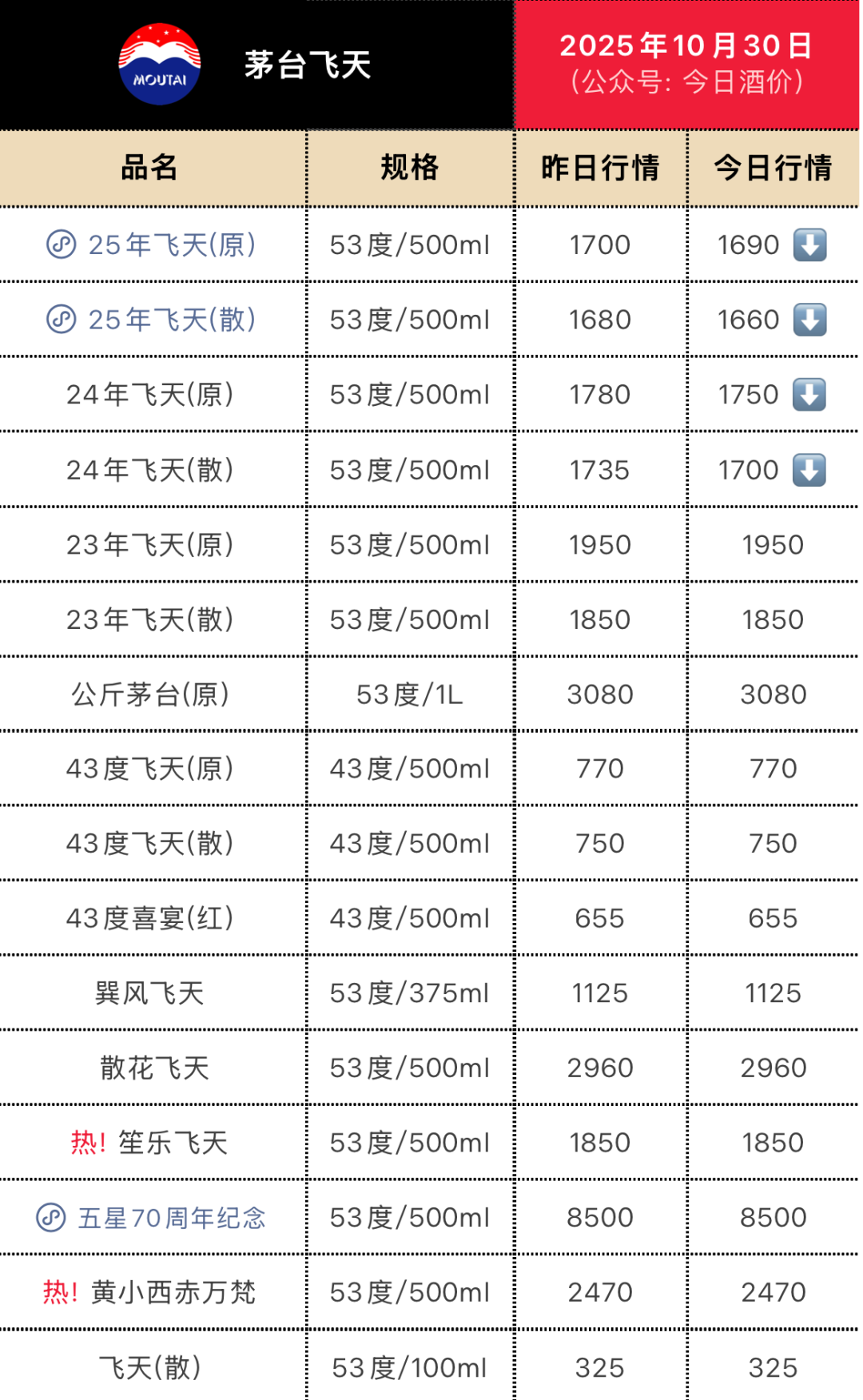
Core Viewpoint - The price of Moutai liquor continues to decline, with specific price drops reported for various products, while the company shows slight revenue growth despite industry challenges [1][4]. Price Trends - The price of 25-year Flying Moutai original box decreased by 10 yuan to 1690 yuan per bottle, and the scattered bottle dropped by 20 yuan to 1660 yuan [1][2]. - The price of 24-year Flying Moutai original box fell by 30 yuan to 1750 yuan, while the scattered bottle decreased by 35 yuan to 1700 yuan [1][2]. - The price of 23-year Flying Moutai remained unchanged at 1950 yuan for the original and 1850 yuan for the scattered bottle [2]. Financial Performance - In the first three quarters of the year, Moutai achieved revenue of 1284.54 billion yuan, a year-on-year increase of 6.36%, and a net profit of 646.27 billion yuan, up 6.25% [4]. - Moutai liquor generated revenue of 1105.14 billion yuan, reflecting a 9.28% increase, while series liquor revenue was 178.84 billion yuan [4]. - Direct sales channel revenue reached 555.55 billion yuan, and wholesale channel revenue was 728.42 billion yuan [4]. Distributor and Contract Liabilities - As of the end of Q3, Moutai had 2325 domestic distributors, an increase of 182 from the beginning of the year, and 121 international distributors, up by 17 [4]. - Contract liabilities amounted to 77.49 billion yuan, down from 95.92 billion yuan at the beginning of the year but up from 55.07 billion yuan at the end of Q2 [4]. Market Challenges and Strategic Focus - The company acknowledges the challenges in the current market, emphasizing the need for a resilient ecosystem centered on consumer needs and market demand [5]. - The management highlighted the importance of channel health and product adaptation in the face of market pressures [5]. Leadership Changes - Recent leadership changes include the resignation of Chairman Zhang Deqin, with Chen Hua being recommended as the new chairman [7]. Industry Context - The broader liquor industry is facing pressure, with 14 out of 21 listed companies experiencing declines in both revenue and net profit in the first half of the year [8]. - The industry is undergoing a transformation from "scale expansion" to "value elevation," with a focus on consumer and cultural reconstruction [8].


盈峰环境三季报发布,年累计营收达95.44亿元
Jing Ji Wang· 2025-10-30 09:36
Core Insights - The company reported a total cash collection of 9.92 billion yuan for the year, representing a year-on-year increase of 21.44% [1] - The total operating revenue reached 9.544 billion yuan, with a year-on-year growth of 2.87% [1] - The company led the development of the ISO international standard for garbage trucks, marking a significant achievement in the sanitation vehicle manufacturing industry in China [1] Financial Performance - Total cash collection for the year was 9.92 billion yuan, up 21.44% year-on-year [1] - Total operating revenue for the year was 9.544 billion yuan, reflecting a 2.87% increase compared to the previous year [1] Industry Standards and Innovations - The company successfully published the ISO standard for garbage truck terminology and specifications, addressing industry challenges related to terminology confusion and inconsistent standards [1] - The development involved collaboration with experts from Germany, Italy, and Japan over three years [1] Market Position and Product Offering - The company maintains a leading position in the environmental equipment sector, holding an 18.8% market share and demonstrating strong market pricing power and product competitiveness [1] - The company has developed a product matrix covering over 500 models for various scenarios [1] Global Expansion and Customization - The company has established a localized manufacturing network in Thailand and Italy, enabling it to serve Southeast Asia and Europe effectively [1] - Recent successful deliveries include electric dust suppression vehicles in Thailand and customized sanitation equipment in Vietnam, showcasing the company's adaptability to local market needs [2] Employee Engagement and Incentives - The company approved a third employee stock ownership plan covering 165 core employees, with a total amount of 400 million yuan, emphasizing long-term commitment and shared growth opportunities [2]

抢占亚洲电子市场高地!风华高科亮相韩国首尔消费电子展览会
Jing Ji Wang· 2025-10-30 09:04
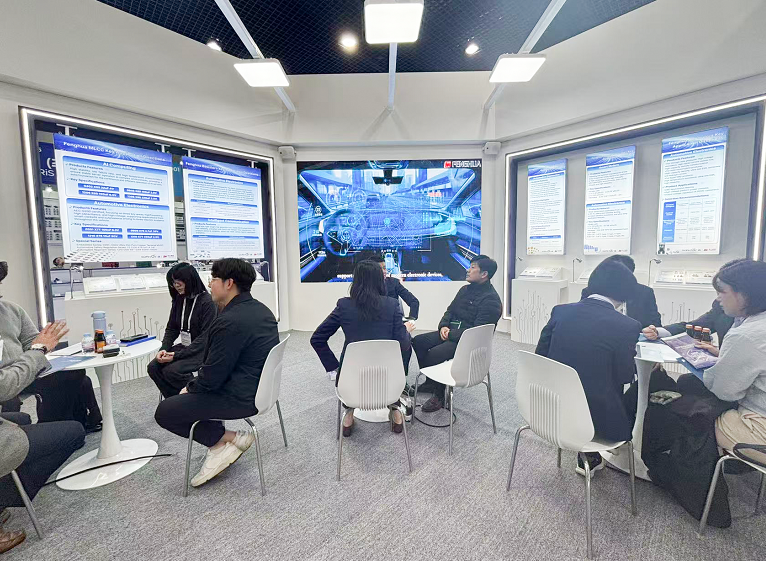
Core Insights - The 2025 Korea Electronics Show (KES) took place from October 21 to 24, showcasing cutting-edge products and solutions from the electronics industry, with a focus on high-end passive components [1][3] - The event attracted over 3,000 exhibitors and more than 80,000 professional visitors, making it a key platform for insights into the Asian electronics industry and international collaboration [3] Group 1: Company Strategy and Market Positioning - The company showcased its global strategy and commitment to expanding its presence in the Asia-Pacific market through participation in KES, aiming to strengthen its brand foundation in the region [1] - The company accurately identified the specific demands of the Japanese and Korean markets for high-end passive components, focusing on three core scenarios: automotive electronics, AI computing, and consumer electronics [3] Group 2: Product Innovations and Applications - The company presented innovative products addressing industry pain points, including the AV series automotive-grade resistors and AHP series PoC inductors, designed for high-pressure and high-frequency applications in electric vehicles [4] - New products for smart green home applications were introduced, such as surface-mounted ceramic capacitors that save over 30% PCB space while maintaining high standards of stability and insulation [4] Group 3: AI and Advanced Technologies - The company displayed a full range of MLCCs tailored for the AI computing market, emphasizing high reliability and performance for applications in AI servers, industrial power supplies, and new energy vehicles [7] - Breakthrough innovations in manufacturing processes, such as ultra-thin film technology and low-temperature co-firing techniques, were highlighted to enhance the production quality and efficiency of AI-compatible components [7] Group 4: Industry Leadership and Collaboration - As a leading enterprise in Guangdong's basic electronic components industry, the company aims to drive collaborative upgrades within the Chinese electronics industry, addressing global technological bottlenecks [8] - The company is making significant strides in emerging markets such as new energy vehicles, AI computing, and robotics, accelerating the localization of its products [9] Group 5: Global Strategy and Sustainability - The company is enhancing its global strategy by establishing a localized service and overseas marketing response system to improve international market service efficiency [10] - Investments in smart manufacturing and green production are being prioritized to meet international environmental standards and enhance global competitiveness [10]

天下秀财报:2025年前三季度营收27.34亿元,技术创新驱动营销生态升级
Jing Ji Wang· 2025-10-30 08:44
Core Insights - The company reported a total revenue of 2.734 billion yuan and a net profit attributable to shareholders of 36 million yuan for the first three quarters of 2025 [1] Group 1: WEIQ Platform Development - The WEIQ platform has successfully integrated with various APIs, including Xiaohongshu and Douyin, creating a comprehensive ecosystem that enhances marketing efficiency [3] - The launch of WEIQ BOSS marks a shift from experience-driven to data-driven influencer marketing, utilizing AI to generate advertising plans in seconds [3] - The upgraded WEIQ platform offers three core capabilities: automated campaign generation, intelligent account targeting, and transparent monitoring throughout the advertising process [3] Group 2: AIGC Platform "Linggan Island" - The AIGC platform "Linggan Island" has transitioned from a single tool to a comprehensive marketing ecosystem, providing SaaS solutions across various industries [5] - The platform has expanded its influence through partnerships and participation in international events, enhancing its brand presence [5] - The company aims to establish a global marketing team with offices in Tokyo, Singapore, and Kuala Lumpur, offering full-service solutions across major social media platforms [5] Group 3: Future Strategy - The company has outlined a strategic focus on deepening its presence in influencer marketing and enhancing AI capabilities for overseas expansion [6] - Plans include leveraging the WEIQ platform and expanding the MCN matrix to strengthen ecosystem advantages [6] - The company is also working on the Tokyo AI Innovation Incubator and aims to integrate multilingual platforms and social media resources for cross-border services [6]

收评:三大指数全天震荡调整 锂电概念逆市活跃
Jing Ji Wang· 2025-10-30 08:24
Core Points - The Shanghai Composite Index closed at 3986.90 points, down 0.73%, with a trading volume of 1,070.059 billion yuan [1] - The Shenzhen Component Index closed at 13,532.13 points, down 1.16%, with a trading volume of 1,351.618 billion yuan [1] - The ChiNext Index closed at 3,263.02 points, down 1.84%, with a trading volume of 641.419 billion yuan [1] Sector Performance - Sectors such as coal, brokerage, semiconductor, oil, real estate, and pharmaceuticals experienced declines [1] - Conversely, the steel and non-ferrous metals sectors saw gains despite the overall market downturn [1] - The banking sector showed an upward trend, while lithium battery and quantum technology concepts remained active [1]
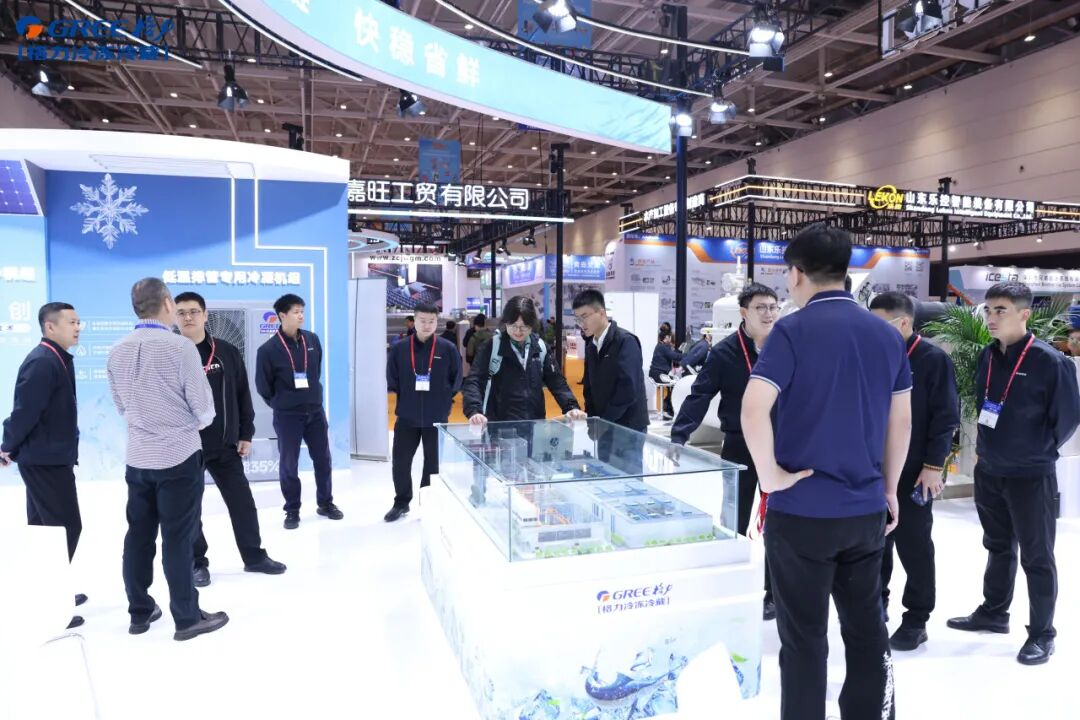
格力携“快稳省鲜”冷链亮相青岛渔博会,赋能水产业全链升级
Jing Ji Wang· 2025-10-30 08:01
Core Viewpoint - Gree showcased its comprehensive cold chain solutions at the 28th China International Fisheries Expo, emphasizing efficiency, safety, and energy-saving equipment for the aquaculture industry [1] Group 1: Product Innovations - Gree presented several advanced refrigeration units, including a 320 dual-stage screw unit designed for ultra-low temperature environments, achieving a COP improvement of 44% [3] - The open screw compressor features a compression ratio of up to 5.7, exceeding the industry standard, with an overall efficiency increase of over 15% [3] - Gree's low-temperature pipe unit maintains temperature fluctuations within ±1℃, optimizing storage conditions for products [3] Group 2: System Solutions - Gree's cold chain solutions encompass small cold storage and fishery processing, demonstrating its technical capabilities in refrigeration [5] - The small cold storage solution utilizes photovoltaic direct current variable frequency refrigeration units, enhancing conversion efficiency by 8% [5] - The fishery processing solution includes temperature control systems tailored for various processing areas, achieving energy savings of 15% to 25% annually [5] Group 3: Environmental and Smart Technology - Gree highlighted its commitment to "green refrigeration," with products like the heat pump defrosting refrigeration unit recognized in the national industrial environmental protection catalog [7] - The centralized controller can network 2 to 50 units, providing fault alerts and automatic backup activation to maintain optimal temperature conditions [7] - Gree plans to continue investing in R&D to develop innovative and high-quality refrigeration products to meet growing consumer demands [7]

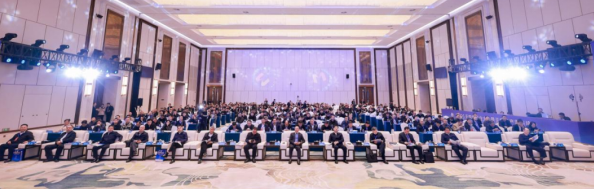
2025无烟煤产业大会暨无烟煤产需衔接会在山西晋城开幕
Jing Ji Wang· 2025-10-30 08:01
Core Viewpoint - The 2025 Smokeless Coal Industry Conference and Supply-Demand Connection Meeting was held in Jincheng, Shanxi Province, emphasizing the importance of technological innovation and green low-carbon development in the smokeless coal industry [4][5]. Group 1: Industry Insights - The smokeless coal market is undergoing profound changes, with future trends to be understood through consumption, production, imports, and prices [6]. - The power and steel industries remain the core support for demand, accounting for half and a quarter of consumption, respectively, with a projected national consumption growth rate of 0.9% from 2025 to 2026 [6]. - Emerging fields such as negative electrode materials present new opportunities for green transformation [6]. Group 2: Supply Dynamics - The supply side is showing a trend of "stable but weak, with increased concentration," as domestic production gradually concentrates in Shanxi and large enterprises [6]. - The production volume is expected to reach 395 million tons by 2026, with an additional 18 million tons imported, leading to a total supply of approximately 413 million tons [6]. - With consumption slightly rising to 408 million tons, the market is expected to enter a relatively balanced and slightly tightening state, with the price center for smokeless coal in 2026 likely to be higher than this year [6]. Group 3: Conference Highlights - The conference was hosted by the China Coal Transportation and Marketing Association, with the theme "Gathering Industry Confidence, Cooperating for a Win-Win Future" [6]. - The event included keynote speeches from industry experts and specialized promotional and exhibition activities [6].