
Jin Tou Wang

Search documents
不锈钢:盘面窄幅震荡为主 成本和供需博弈
Jin Tou Wang· 2026-01-20 01:56
Core Insights - The stainless steel market is experiencing price fluctuations, with recent data indicating a decline in cold-rolled stainless steel prices in Wuxi and Foshan [1] - Nickel ore prices are on the rise, particularly in the Philippines and Indonesia, with significant increases in benchmark prices [1][3] - Domestic stainless steel production is expected to increase in January, driven by improved profit margins for steel mills [2] Supply - In December, the crude steel output from 43 domestic stainless steel mills was 3.2605 million tons, a month-on-month decrease of 232,600 tons (6.7%) and a year-on-year decrease of 5.3% [2] - January's stainless steel crude steel output is projected to be 3.4065 million tons, reflecting a month-on-month increase of 4.48% and a year-on-year increase of 19.05% [2] - The production of the 300 series is expected to rise to 1.7632 million tons in January, with a month-on-month increase of 0.92% and a year-on-year increase of 12.58% [2] Inventory - Social inventory is continuing to decrease, although the pace of reduction has slowed compared to the previous week [2] - As of January 16, social inventory for the 300 series in Wuxi and Foshan was 450,700 tons, a week-on-week decrease of 6,700 tons [2] - The Shanghai Futures Exchange's stainless steel futures inventory was 46,118 tons, down 911 tons week-on-week [2] Market Dynamics - The stainless steel market is currently experiencing narrow fluctuations, influenced by nickel ore news and cautious purchasing behavior [3] - The People's Bank of China has lowered the re-lending and rediscount rates by 0.25 percentage points, creating space for further interest rate cuts [3] - Expectations of tightened nickel ore supply from Indonesia and rising prices in the Philippines are contributing to market sentiment [3] Price Trends - The market price for high-nickel pig iron has risen, with the negotiation range moving up to 1,020-1,030 yuan per nickel [3] - Retail prices for ferrochrome remain strong due to limited resource circulation and a slowdown in supply growth [3] - Overall, while cost support is strengthening, the combination of ample supply and weak demand is limiting upward price movement, with short-term expectations of price fluctuations in the range of 13,800-14,600 yuan [3]
天津六福黄金价格
Jin Tou Wang· 2026-01-19 13:25
Core Viewpoint - Tianjin Luk Fook Group is focused on expanding its presence in the international market while adhering to its core brand philosophy of "International Interpretation" [2] Group 1: Business Operations - The company engages in the procurement, retail, and wholesale of various gold jewelry, gold decorative items, gemstone jewelry, and other accessories [2] - Tianjin Luk Fook Group aims to provide customers with value-for-money products and attentive service [2] Group 2: Market Positioning - The group is committed to exploring new areas across its business sectors to strengthen its leadership position in the jewelry industry in Hong Kong, mainland China, and overseas [2]


邢台金融监管分局同意平安产险巨鹿支公司营业场所变更
Jin Tou Wang· 2026-01-19 13:16
2026年1月12日,邢台金融监管分局发布批复称,《关于变更中国平安财产保险股份有限公司巨鹿支公 司营业场所的请示》(平保产冀分发〔2025〕151号)收悉。经审核,现批复如下: 一、同意中国平安财产保险股份有限公司巨鹿支公司营业场所变更为:邢台市巨鹿县黄巾大道以北、定 魏线东侧(万润国际商业区)5号商业104铺二层。 二、中国平安财产保险股份有限公司应按照有关规定及时办理变更及许可证换领事宜。 ...

全球贸易“颠簸”,中国港口却在“刷新”记录
Jin Tou Wang· 2026-01-19 12:24
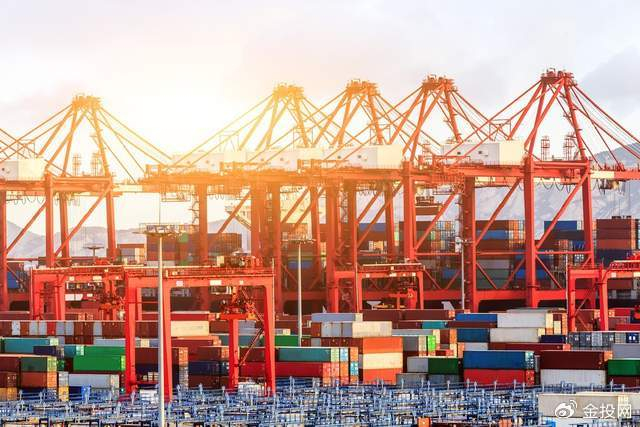
Core Insights - China's major ports have shown significant growth in container throughput, with a year-on-year increase of 9.5% in the first 11 months of 2025, reaching 320 million TEUs, contributing to a record trade surplus of $1.19 trillion for the year [1][3] Group 1: Port Performance - Shanghai Port's container throughput exceeded 50 million TEUs in the first 11 months of 2025, surpassing the total for 2024 and likely setting a new annual record [3] - Ningbo-Zhoushan Port's container throughput surpassed 40 million TEUs by early December, making it the third port globally to reach this milestone after Shanghai and Singapore [3] - China's total export value for 2025 is projected to grow by 5.5% year-on-year, reaching $3.77 trillion, indicating strong export performance despite a shift towards a consumption-driven growth model [3] Group 2: Investment and Expansion - China is heavily investing in port expansion, with Qingdao Port Authority announcing a total investment of 77 billion yuan for 15 projects, including the construction of two new terminals by 2029 [5] - The rationale behind continued expansion amidst global trade uncertainties is to address the imbalance in container transport demand, which is growing faster than traditional bulk transport [5] - Port consolidation is a trend, with Shandong Province successfully integrating seven ports into a unified Shandong Port Group, increasing total throughput from 1.32 billion tons in 2019 to over 1.9 billion tons by 2025 [5] Group 3: Future Goals - China's next objective is to establish itself as a global logistics hub, with plans to develop world-class port clusters, each achieving throughput levels of over 100 million tons or 10 million TEUs, equipped with digital and green technologies [5][6] - The stability and resilience of foreign trade and ports continue to play a crucial role in supporting China's economic vitality and its connection to the global market [6]
无人机培训行业大洗牌,机构锐减!选对靠谱平台才是关键!
Jin Tou Wang· 2026-01-19 09:43
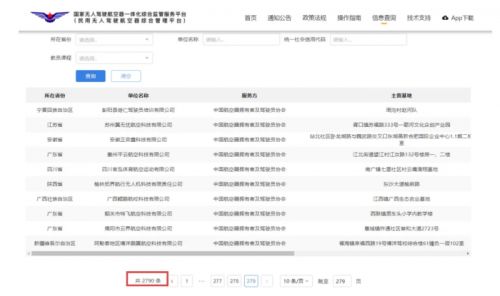
Industry Overview - As of January 2026, the number of drone training institutions in China has decreased from over 4,000 at its peak to 2,790, and this number continues to decline [1] - The professional talent gap in the drone sector is projected to exceed one million by 2025, with certified drone pilots earning a stable monthly salary ranging from 8,000 to 15,000 yuan [2] Company Profile - Nengfei Aviation Technology Development Co., Ltd. is a comprehensive enterprise involved in drone R&D, production, sales, industry application services, and low-altitude talent training [3] - Nengfei Aviation is one of the first officially certified drone training institutions in China, having trained over 90,000 low-altitude talents nationwide [3] - The training facility spans over 30,000 square meters of indoor office and teaching space, with more than 500 acres of practical training grounds and a B-class general airport runway measuring 800 meters by 40 meters [3] Training and Employment - Nengfei Aviation has a teaching team of 150 experienced professionals, ensuring high pass rates in national examinations and cultivating versatile elite talents for various industries [3] - The company maintains dozens of training drones, over 2,000 spare parts, and more than 80 fast-charging battery groups to ensure quality training and practical experience for students [3] - Nengfei Aviation has established an employment guidance center staffed by over 10 career education experts, collaborating with more than 5,000 recruiting companies [5] Industry Impact - Nengfei Aviation has been a key player in hosting various provincial and national competitions organized by the Ministry of Human Resources and Social Security and the Ministry of Education, contributing to the selection of skilled drone professionals and promoting knowledge sharing and technical exchange within the industry [5] - The company aims to lead the industry by continuously developing a professional teaching system to cultivate more skilled drone professionals in response to the expanding talent gap in the low-altitude economy [5]
避险狂潮,黄金又爆了!
Jin Tou Wang· 2026-01-19 09:42
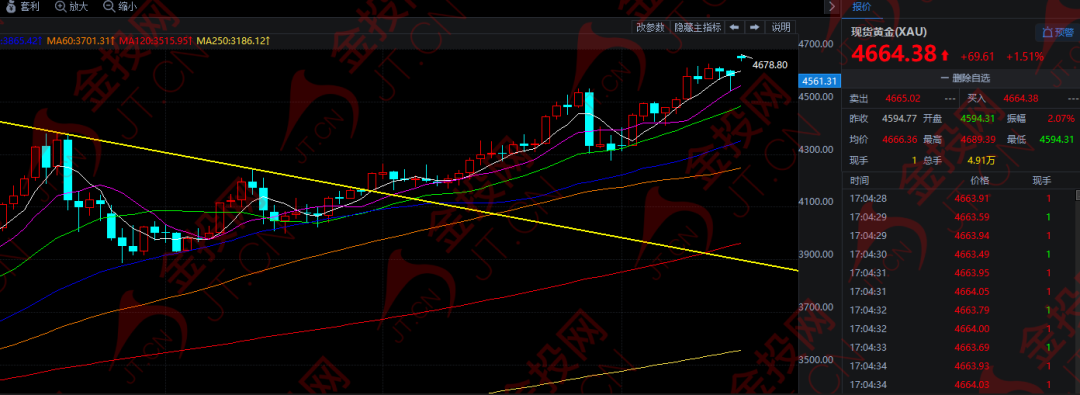
Group 1: Gold and Silver Market - Spot gold prices surged nearly $100, reaching a historical high of $4689.39, currently hovering around $4669 [1] - Spot silver also experienced a significant increase of over 4%, peaking at $94.070, and is currently around $93.430 [1] Group 2: U.S. Stock Market - The three major U.S. stock indices experienced slight declines, with the Dow Jones down 0.17%, S&P 500 down 0.06%, and Nasdaq down 0.06% [2] Group 3: Federal Reserve Leadership - Speculation around the next Federal Reserve Chair has intensified, with potential candidates being Kevin Hassett and Kevin Warsh, while Rick Reeder and Christopher Waller have been ruled out due to loyalty concerns [3] - Current indications suggest that Kevin Warsh is likely to be the final choice for the position [3] Group 4: Tariff Policies - President Trump announced a 10% tariff on imports from Denmark, Norway, Sweden, France, Germany, the UK, the Netherlands, and Finland, effective February 1, with plans to increase it to 25% by June 1 [7] - The EU is considering retaliatory tariffs on $930 billion worth of U.S. goods in response to these tariffs, with potential implementation starting February 6 if no agreement is reached [7] Group 5: Economic Indicators - Investors are focused on the upcoming U.S. Core PCE price index report, which is expected to be a key indicator of inflation trends [8][9] - Morgan Stanley has warned that the PCE index could rebound significantly to 0.46%, which would impact market expectations regarding Federal Reserve rate cuts [10] Group 6: International Relations and Military Movements - European countries, including Norway, Sweden, France, Germany, the UK, the Netherlands, and Finland, have sent troops to Greenland for military exercises, raising tensions with the U.S. [12] - The U.S. military recently conducted an operation in Syria, killing a leader of the Al-Qaeda organization, indicating ongoing military engagement in the region [13]
1月19日金市晚评:达沃斯美强推议程引全球博弈 黄金沿通道上行剑指4700
Jin Tou Wang· 2026-01-19 09:42
摘要北京时间周一(1月19日)欧洲时段,美元指数高位震荡,交投于99.171附近,金价目前交投于 4663.26美元/盎司,涨幅1.49%,最高触及4689.39美元/盎司,最低触及4594.31美元/盎司。 北京时间周一(1月19日)欧洲时段,美元指数高位震荡,交投于99.171附近,金价目前交投于4663.26美 元/盎司,涨幅1.49%,最高触及4689.39美元/盎司,最低触及4594.31美元/盎司。 今日黄金价格最新查询(2026年1月19日) | 名称 | 最新价 | 单位 | | --- | --- | --- | | 现货黄金 | 4663.26 | 美元/盎司 | | 黄金t+d | 1045.00 | 元/克 | | 纸黄金 | 1043.80 | 元/克 | | 沪金主力 | 1048.88 | 元/克 | 【基本面解析】 国际社会反击升温:央行行长罕见联合声援美联储独立性,北约、欧盟领导人抵达沃斯倡自由贸易;欧 洲抵制美对乌不利和平方案。美国2026财年国防预算破1.01万亿美元(冷战后最大增幅),推高全球军费 至2.7万亿美元(+9.4%),成"地缘经济对抗"主推手。 尽管美国以" ...
伦敦金持续关注4600支撑位 加征关税或对经济影响有限
Jin Tou Wang· 2026-01-19 09:42
【要闻速递】 美国总统特朗普威胁要对八个欧洲国家加征关税,试图"吞并"格陵兰岛,即便付诸实施,其经济影响也 十分有限,但却会带来更为严重的政治和地缘政治后果。 首席经济学家尼尔.谢林表示,此类关税的法律依据尚不明确,并指出特朗普此前并未兑现其他类似威 胁。任何关税都将导致欧盟内部贸易转移。英国和德国是美国最大的出口市场,因此受到的冲击最大。 10%的关税将使两国GDP下降约0.1%,而25%的关税则会使GDP下降0.2%至0.3%。美国通胀率可能上升 0.1%至0.2%,但这可能会被其他因素抵消。 然而,任何吞并格陵兰岛的行为都可能对北约造成不可挽回的损害。 【最新伦敦金行情解析】 摘要周一(1月19日)欧盘时段,伦敦金目前交投于4664.53一线上方,截至发稿,伦敦金暂报4672.41美元/ 盎司,上涨1.69%,最高触及4689.39美元/盎司,最低下探4594.31美元/盎司。目前来看,伦敦金短线偏 向看涨走势。 周一(1月19日)欧盘时段,伦敦金目前交投于4664.53一线上方,截至发稿,伦敦金暂报4672.41美元/盎 司,上涨1.69%,最高触及4689.39美元/盎司,最低下探4594.31美元 ...
大有期货:美元走强与降息预期延后施压 贵金属板块或迎调整
Jin Tou Wang· 2026-01-19 09:32
Macro News - On February 1, Trump announced a 10% tariff on all goods exported to the U.S. from eight European countries (Denmark, Norway, Sweden, France, Germany, the UK, the Netherlands, and Finland), with a 25% tariff to follow on June 1 [1] - In response, the EU is preparing to impose tariffs amounting to €93 billion, as a countermeasure to Trump's threats regarding Greenland [1] Institutional Viewpoints - The precious metals sector is likely to face pressure and adjustments due to the continued strength of the U.S. dollar index and expectations for a delayed first interest rate cut by the Federal Reserve, which diminishes the appeal of holding non-yielding assets like gold [1] - Global macroeconomic data shows resilience, particularly in U.S. manufacturing and employment, which temporarily reduces the safe-haven demand for precious metals [1] - Despite geopolitical risks providing some bottom support, gold prices may enter a phase of high-level fluctuations, while industrial metals like silver, platinum, and palladium may experience more significant adjustment pressures due to slowing global industrial growth and weak demand in the automotive sector [1]
1月19日上期所沪金期货仓单较上一日减少63千克
Jin Tou Wang· 2026-01-19 09:32
上海期货交易所黄金期货仓单日报(单位:千克) | 上期所指定交割金库 | 期货 | 增减 | | --- | --- | --- | | | 99990 | -63 | 鉴于此次调查,两名共和党参议员宣布,将投票反对任何特朗普提名的美联储人选,包括新美联储主 席。调查引发市场对美联储独立性的严重担忧,"抛售美国"交易卷土重来,避险情绪推动现货黄金一度 站上4600美元/盎司关口。 上海期货交易所指定交割仓库期货周一(1月19日)仓单日报显示,黄金期货总计99990千克,今日仓单 较上一日减少63千克。 沪金主力盘内高位回落,周一(1月19日)黄金期货开盘价1032.64元/克,截至目前最高1050.40元/克, 最低1018.78元/克。截止发稿报1048.88元/克,涨幅1.54%,成交量为155786手,持仓为84463手,日持 仓减少2835手。 美国司法部已就美联储总部翻修相关事宜,对美联储主席鲍威尔启动刑事调查。鲍威尔对此回应称,此 举史无前例,应结合特朗普政府对美联储的持续威胁这一背景来看待,目的是就降息问题进一步向他施 压。但美国总统特朗普表示,对鲍威尔接受调查"一无所知"。 ...