3 6 Ke

Search documents
阿里前高管创业,要用AI重做一遍海外电商|36氪专访
3 6 Ke· 2026-02-06 01:46
Core Insights - The article discusses the innovative approach of Alvin's Club, an AI-driven e-commerce platform founded by former Alibaba executive Tang Xing, which aims to revolutionize the e-commerce industry by utilizing AI to handle over 90% of decision-making processes [1][2][3] Group 1: Business Model and Strategy - Alvin's Club is positioned as an "international version of Taobao" targeting overseas middle-class consumers, leveraging China's supply chain advantages and focusing on non-standard and long-tail products [3][5] - The platform operates on a service fee model, charging approximately 10% of the total cost of goods and shipping, avoiding traditional advertising fees [16][10] - The company aims to create a closed-loop system where AI manages the entire process from product selection to delivery, differentiating itself from traditional e-commerce platforms that primarily focus on traffic distribution and recommendations [4][11] Group 2: Technology and AI Integration - The platform employs three core models: user model, product model, and expert model, which work together to automate the understanding of user preferences and execute transactions [14] - AI is expected to significantly reduce operational costs, allowing Alvin's Club to manage millions of SKUs with just five employees, compared to traditional e-commerce platforms that require thousands [17] - The accuracy of AI in various processes is improving, with text generation being nearly flawless, while video generation still requires human intervention [13] Group 3: Market Potential and Growth - Tang predicts that the next 3-5 years will be a period of explosive growth for AI-driven e-commerce, with advancements occurring at a pace faster than that of mobile internet [7][32] - The company plans to focus on user growth through social media and content platforms rather than traditional advertising, with expectations of significant increases in monthly order volume [27][33] - Alvin's Club will initially target markets in North America, Europe, and Australia due to high AI acceptance and significant price advantages stemming from currency differences [19][20] Group 4: Competitive Landscape - The platform aims to avoid direct competition with Amazon by focusing on non-standard and long-tail products, where it can establish a differentiated advantage [5][21] - While initially seen as complementary to Amazon's strengths in standard products, the rise of AI-driven e-commerce may lead to a shift in market dynamics over time [21]



车市开年波动?政策火速落地,超20省市突击补贴,最高2万
3 6 Ke· 2026-02-06 01:40
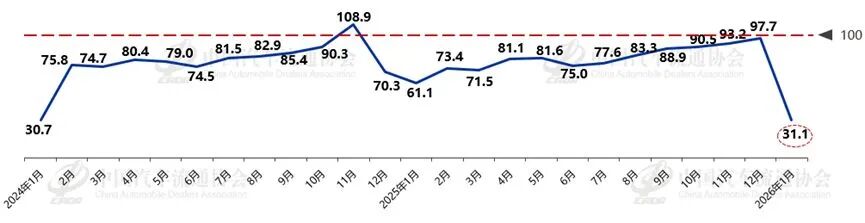
Core Viewpoint - The automotive market in January 2026 showed a trend of year-on-year sales growth but a month-on-month decline, with expectations of further decreases in February due to the impact of the Spring Festival holiday [1][9]. Group 1: Sales Performance - In January 2026, the automotive consumption index dropped to 31.1, significantly lower than the previous month's 97.7, indicating a weakening market [1]. - Retail sales of passenger vehicles from January 1 to January 18 were 679,000 units, a year-on-year decrease of 28% and a month-on-month decrease of 37% [9]. - Wholesale sales from manufacturers reached 740,000 units, reflecting a year-on-year decline of 35% and a month-on-month decline of 30% [9]. Group 2: Policy Impact - The implementation of the "2026 Automobile Trade-in Subsidy Implementation Rules" is expected to stimulate consumer demand, with over 20 provinces and cities already launching specific subsidy plans [2][5]. - The subsidy for consumers trading in old vehicles for new energy vehicles can reach up to 20,000 yuan, while for fuel vehicles with an engine size of 2.0 liters or less, the maximum subsidy is 15,000 yuan [3][5]. - The central and local governments are introducing a series of consumption promotion policies to boost market activity, especially before the traditional sales peak during the Spring Festival [3][7]. Group 3: Market Forecast - The automotive market is projected to achieve a total sales volume of 34.75 million units in 2026, representing a year-on-year growth of 1%, with passenger vehicle sales expected to reach 30.25 million units, a growth of 0.5% [12]. - New energy vehicle sales are forecasted to reach 19 million units, reflecting a significant year-on-year growth of 15.2% [12]. - The market is anticipated to enter a phase of adjustment in February 2026 due to various factors, including the adjustment of the new energy vehicle purchase tax and consumer expectations for post-holiday promotions [9][11].
10亿美金背后,美团收购叮咚的新棋局
3 6 Ke· 2026-02-06 01:23
Core Viewpoint - The acquisition of Dingdong Maicai by Meituan marks a significant shift in the fresh e-commerce industry, transitioning from price competition to efficiency competition, indicating the industry's entry into a post-platform era [1][3][10]. Group 1: Acquisition Details - Meituan announced its intention to acquire all issued shares of Dingdong Maicai for $717 million, but the fair value of the equity in the transaction is approximately $1 billion, considering additional funds and cash obligations [1]. - Dingdong Maicai will become a wholly-owned subsidiary of Meituan, integrating into its financial statements [1]. Group 2: Industry Context - The fresh e-commerce sector in China has shifted from rapid expansion to a contraction phase, with companies like Meituan and Dingdong Maicai adapting to new market realities [4][10]. - Dingdong Maicai is the only front warehouse model company to achieve consecutive quarterly profitability during this adjustment period, with over 1,000 operational front warehouses by the end of 2025 [4][6]. Group 3: Strategic Implications - The acquisition is seen as a strategic move for Meituan to enhance its capabilities in product strength, operational efficiency, and supply chain integration, which are critical for competing in the instant retail sector [3][7]. - Dingdong Maicai's strong self-operated product system and efficient delivery network complement Meituan's existing logistics and operational framework, potentially improving overall efficiency [9][10]. Group 4: Future Outlook - The instant retail market is projected to grow significantly, with estimates suggesting a market size of 7.81 trillion yuan in 2024, increasing to over 10 trillion yuan by 2026 [10][11]. - The collaboration between Meituan and Dingdong Maicai is expected to accelerate the integration of "traffic + warehousing + supply chain + algorithms" into a unified platform, reshaping the competitive landscape [11][13].


博睿康,冲刺脑机接口第一股
3 6 Ke· 2026-02-06 01:22
Company Overview - Brain-computer interface company, BoRuiKang Technology (Shanghai) Co., Ltd., has completed its IPO counseling registration on February 4, 2026, with CITIC Securities as the counseling broker, marking the official start of its Sci-Tech Innovation Board IPO process [1][2][3] - Established in November 2011, BoRuiKang's core team includes experts from Tsinghua University's Neural Engineering Laboratory and clinical neuroscience, focusing on the research, production, and technical services of brain-computer interface systems [3][4] - The company has developed products for clinical diagnosis and research education, including digital EEG machines and transcranial electrical stimulation systems, with some products already receiving medical device registration [3][4] Product Development - BoRuiKang's flagship product, the NEO wireless minimally invasive brain-computer interface system, is the world's first to use an epidural implant with fully wireless transmission design [3][4] - NEO employs a "semi-invasive" technique, implanting coin-sized electrodes beneath the skull but outside the dura mater, allowing proximity to neurons without direct contact, thus avoiding damage to neural tissue [4] - The NEO system has undergone successful clinical trials, with 32 patients having completed implantation across 11 hospitals, achieving a 100% success rate in primary clinical endpoints [4][5] Regulatory Progress - NEO is set to submit a Class III innovative medical device registration application to the National Medical Products Administration, potentially becoming the first marketed implantable brain-computer interface product in China [5] - The product's first version, NEO 1.0, is expected to be followed by a 2.0 version that will include additional features such as language decoding and small limb decoding [5] Financial Backing and Valuation - BoRuiKang has completed multiple rounds of financing, with notable investors including Sequoia China and Baidu Ventures, achieving a post-investment valuation of 3.5 to 4 billion yuan by the end of 2025 [5][6] - The company has raised a total of 1.2 million yuan in angel funding and 30 million yuan in Pre-A funding, among other financing rounds [5] Industry Context - The brain-computer interface industry is experiencing significant growth opportunities in China, supported by favorable policies and market conditions [9][10] - The Ministry of Industry and Information Technology and other departments have included brain-computer interfaces in key future industry cultivation, with projections indicating the market could exceed 120 billion yuan by 2040 [10]

高科技接地气,无人机飞猪,机械狗拉货
3 6 Ke· 2026-02-06 01:16
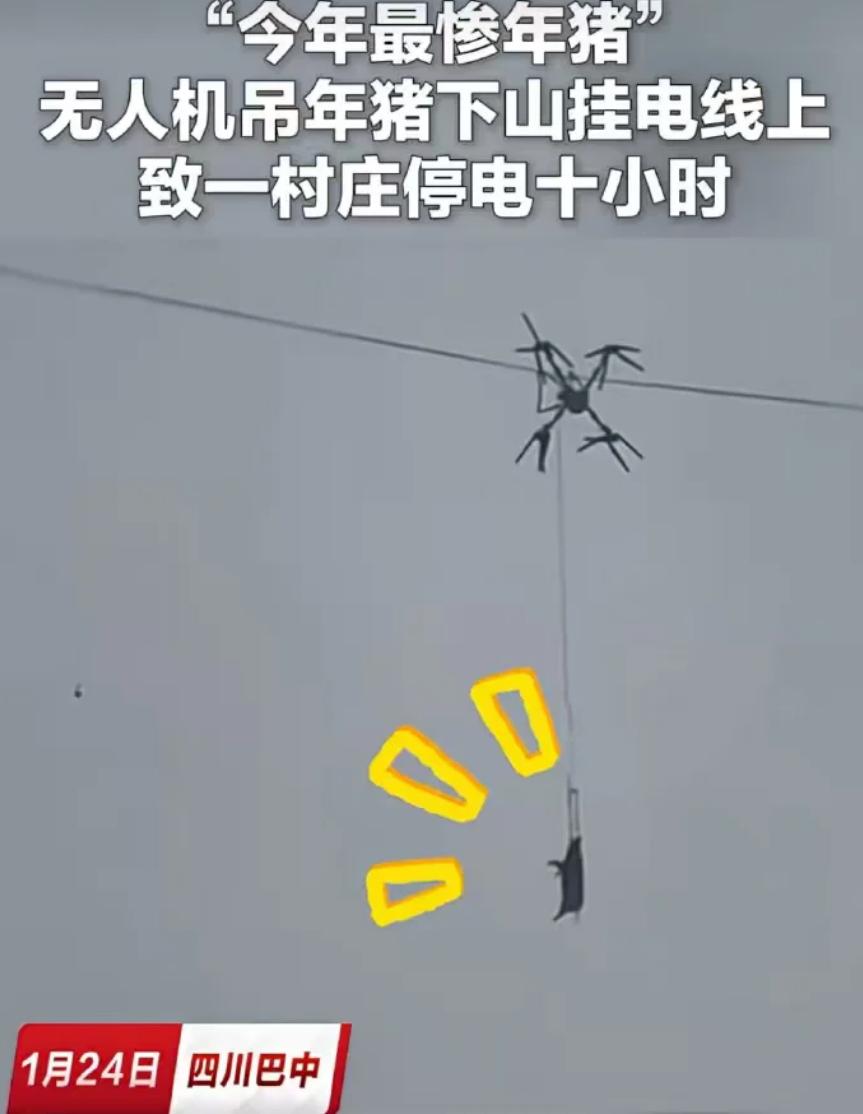
01:正宗大飞猪 没见过猪飞,还没见过猪跑吗? 诶,话别说太早,这下真能看见猪飞了。 一机,一猪,一电线 这只猪不是被电死的,也不是被吓死的,而是被吊死的。 至于这只"飞猪"是如何上天的,其上方不远处的无人机揭示了答案——无人机带着猪飞,结果挂电线上了,猪被绳子活活勒了几个小时,最后以这般猎奇 的方式升了天。 由于最近各地都在蓬勃开展杀年猪活动,对二师兄自然是青睐有加,相关人员本打算在凌晨将十余头生猪吊下山。 本打算吊下山后再现杀 那么天黑天黑,无人机自然也就黑着飞。 在使用无人机吊运二师兄的过程中,开局不利,第一头猪直接就给挂在了电线上,知情人称,现场人员曾多次尝试处置和救援均未成功。 最终该事故导致一村庄停电十小时,经抢修后已恢复供电。 1月24日,在四川巴中的某高压电线上,竟挂着一只生猪。 当年美国没有为救一只麻雀而停了半个国家的电力,这下好了,中国真为了一只猪而停了一个村子十个小时的电。 不过,大量网友还是对这个抽象事故展开了激烈讨论。 在技术层面,涉事无人机应为大疆T100,该型号作为中大型无人机,最大吊运重量为85kg,吊个猪啥的还是没太大问题。 至于很多人讨论的"黑飞"问题,由于能操作该类机型的 ...
欧莱雅们找到第二个中国市场了?
3 6 Ke· 2026-02-06 01:00
Core Insights - The competition among beauty giants in India has intensified, with Unilever investing millions in local brands and L'Oréal committing nearly 30 billion RMB to establish a global AI beauty technology center in India, indicating a strategic focus on this emerging market [1][2]. Group 1: Market Potential - India's population has surpassed China's, with projections indicating it will reach over 1.6 billion by 2050, creating a significant consumer base for the beauty market [3]. - The Indian beauty market is expected to grow to $40 billion (approximately 278.28 billion RMB) by 2035, with a steady annual growth rate of 5.6% [4]. - The current low penetration of high-end beauty products in India suggests substantial room for market upgrades and potential growth [5]. Group 2: Investment Trends - Unilever has made over ten investments in Indian brands in the past two years, focusing on skincare to enhance its brand portfolio, including a notable acquisition of the high-end beauty brand Minimalist for approximately 2.509 billion RMB [6][7]. - Other companies, such as Kose and LVMH, are also accelerating their investments in India, with Kose acquiring a 10% stake in the DTC skincare brand Foxtale [10]. Group 3: Cultural Insights - Many successful local brands in India are rooted in Ayurveda, reflecting a consumer preference for natural ingredients, with over 47% of Indian consumers prioritizing natural components in skincare products [12][14]. - The Ayurveda market is projected to reach $28.83 billion (approximately 200.59 billion RMB) by 2030, growing at a compound annual growth rate of 12.3% [14]. Group 4: Strategic Approaches - International beauty giants are leveraging established e-commerce platforms like Nykaa to penetrate the Indian market quickly, reducing entry barriers and costs [15]. - L'Oréal has invested 3.5 billion euros (approximately 28.93 billion RMB) to establish a global beauty technology center in India, enhancing its technological capabilities [18]. Group 5: Leadership Dynamics - The rise of Indian-origin executives in key positions within major beauty companies is shaping market strategies, with 14 Indian-origin CEOs leading Fortune Global 500 companies as of 2024 [19][26]. - These leaders are instrumental in bridging cultural gaps and ensuring effective execution of localized strategies [26]. Group 6: Performance Metrics - L'Oréal reported a 12.2% year-on-year growth in the SAPMENA-SSA region, with India being a significant contributor to this growth [30]. - Nykaa's financial performance indicates a 25% year-on-year revenue growth, with beauty products contributing 92% of its total revenue, highlighting the market's potential [32]. Group 7: Competitive Landscape - The competition among beauty giants in India is evolving from mere capital investment to deep operational engagement, focusing on local brand acquisitions, the influence of Indian executives, and the market's growth potential [33]. - Companies face challenges related to consumer preferences, distribution channels, and supply chain complexities, necessitating a balance between global strategies and local insights for sustainable growth [33].




Claude Opus 4.6 和GPT-5.3 Codex接管软件世界
3 6 Ke· 2026-02-06 00:54
Core Insights - The AI competition has shifted from a focus on conversational abilities to a new phase characterized by autonomous agents, marking the beginning of the "Agent Autonomy Era" [1][5] Group 1: Company Strategies - Anthropic emphasizes controlled agent behavior, task decomposition, execution stability, and clear human oversight, focusing on minimizing errors [2][4] - OpenAI adopts a more aggressive approach, promoting stronger autonomous planning capabilities and accountability for complex goals, allowing agents to manage entire task processes [3][4] - The competition between Anthropic and OpenAI represents a fundamental debate on whether AI should be a reliable execution tool or a highly autonomous action system [5] Group 2: Market Dynamics - The urgency for this shift is driven by stagnation in chat product engagement, the need for automation in enterprise processes, and the race to define the next generation of AI infrastructure [6] - The introduction of agents signifies a transformation in product logic, positioning agents as digital employees that connect models, tools, and the real world [7] Group 3: SaaS Implications - The rise of agents challenges the traditional SaaS model, which has relied on selling tool usage rights, as agents can automate tasks across systems [10][12] - As agents take over task execution, the value of SaaS interfaces diminishes, leading to concerns about the future pricing and profitability of SaaS products [12][22] - SaaS companies must adapt by either evolving into command and control platforms for agents or becoming high-quality, modular APIs to remain relevant [15][17] Group 4: Future of SaaS - The emergence of agents forces SaaS to confront a critical question: whether they are selling tools or results, with a shift towards task completion becoming paramount [19][20] - The traditional model of charging per user is threatened as agents can perform tasks that previously required multiple human operators, leading to potential revenue declines for SaaS providers [18][19] - The transition to an agent-centric model may result in SaaS companies becoming backend service providers, losing control over user interactions [22] Group 5: Digital Ecosystem Changes - The introduction of agents is expected to disrupt existing software ecosystems, as they can bypass traditional app interfaces and directly execute tasks for users [23][24] - This shift may lead to a decentralization of hardware requirements, as the need for complex user interfaces diminishes in favor of simpler, more efficient interactions with agents [25][26] - The ongoing evolution signifies a move away from a software-centric internet towards a task-centric digital world, where the focus is on achieving results rather than navigating software [26][27]
当马年品牌短片只剩“谐音梗”...
3 6 Ke· 2026-02-06 00:48
Core Viewpoint - The article critiques the trend of brands using horse-themed puns and celebrity endorsements during the Year of the Horse, suggesting that this approach lacks creativity and depth, ultimately leading to consumer fatigue and diminishing returns for brand equity [5][12][20]. Marketing Strategy Analysis - The marketing strategy of using horse-related celebrities is seen as a formulaic approach driven by commercial logic rather than genuine creativity, making it easily replicable and less impactful [6][10]. - Initial campaigns featuring celebrities like Ma Sichun and Ma Yili generated positive responses due to their novelty, but subsequent imitations led to a significant decline in effectiveness [8][12]. - Brands like Tmall Health and Mengniu are criticized for failing to create meaningful connections between their products and the celebrity endorsements, resulting in superficial advertising that lacks substance [10][12]. Emotional Engagement - The article contrasts the shallow emotional engagement of the horse-themed ads with the deeper storytelling found in Apple's annual Chinese New Year short films, which resonate with audiences on a personal level [13][18]. - Apple's approach focuses on authentic emotional expression rather than gimmicky marketing tactics, allowing for a more profound connection with consumers [18][20]. Long-term Brand Value - The article emphasizes the importance of creating sustainable brand narratives that can endure over time, rather than relying on fleeting trends or gimmicks [21]. - It argues that the true challenge in the AI-driven advertising landscape is to maintain authenticity and depth in storytelling, which cannot be easily replicated by technology [20][21].




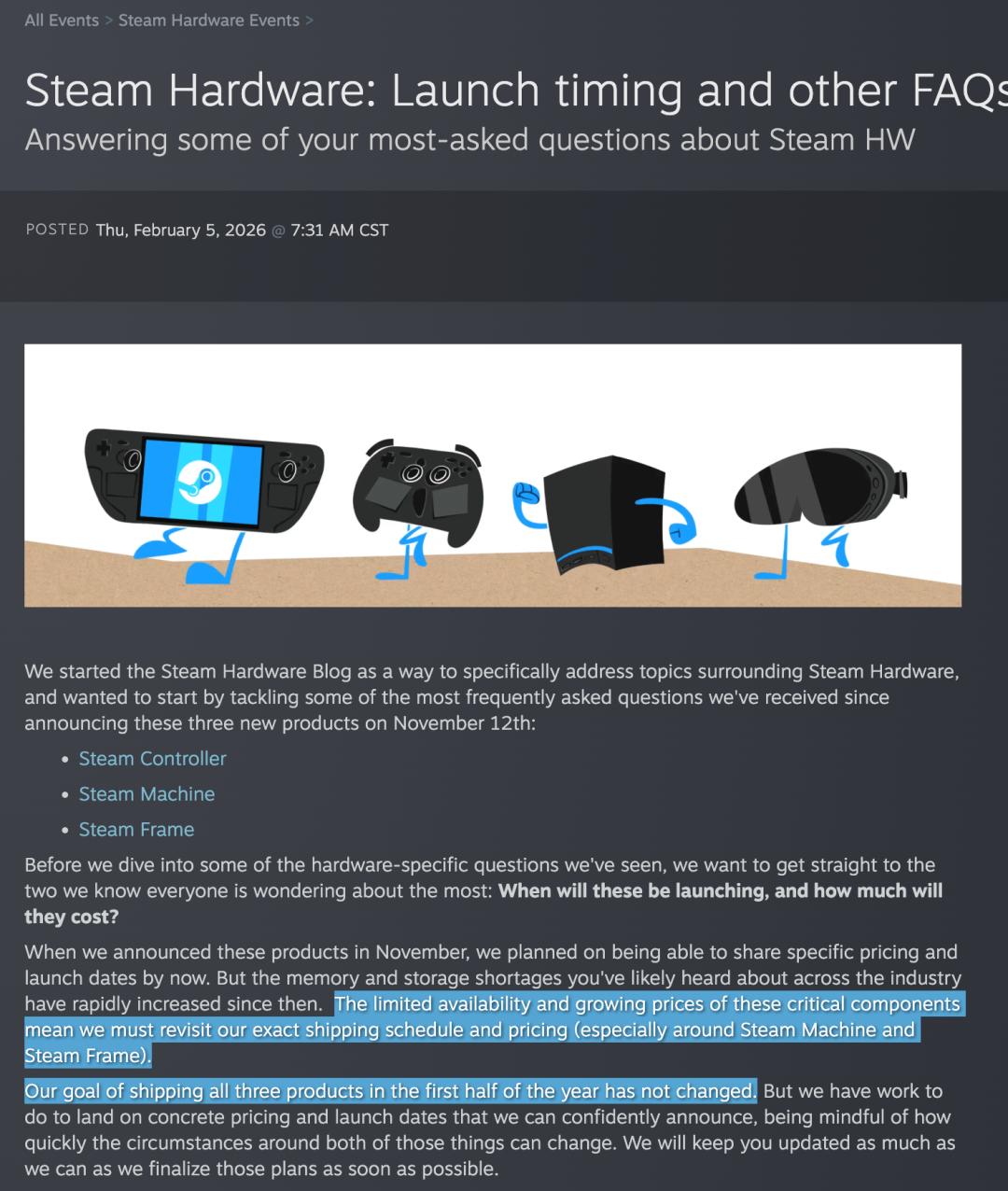
Steam Machine 横空出世,立刻被内存短缺摁在原地
3 6 Ke· 2026-02-06 00:42
Core Viewpoint - Valve's Steam Machine, along with the Frame headset and Controller, has been delayed due to rising memory and storage costs, impacting pricing and release schedules [1][15]. Group 1: Market Dynamics - TrendForce reports that by 2026, 70% of global memory chip production will be consumed by data centers, with Citibank predicting an 88% year-on-year increase in average DRAM prices [3]. - The price of DDR5 memory has surged 3-4 times in recent months, exacerbating the cost challenges for consumer hardware [3][21]. - Samsung and SK Hynix have signed a significant agreement with OpenAI to supply nearly half of the global DRAM capacity for AI infrastructure, leading to a strategic reallocation of silicon wafer production [5]. Group 2: Product Positioning and Challenges - The Steam Machine's pricing is expected to be significantly higher than initially planned, with the 512GB version potentially priced at $950 and the 2TB version at $1,070, surpassing the PS5 Pro's price of $749 [5][15]. - Valve's previous attempt at the Steam Machine in 2013 failed due to high prices, unclear positioning, and a lack of a compelling user experience compared to traditional consoles [6][11]. - The current Steam Machine aims to be closer to an entry-level PC, featuring AMD's Zen 4 CPU and RDNA3 GPU, but faces challenges in delivering a simple, plug-and-play experience that consumers expect from consoles [12][15]. Group 3: Competitive Landscape - The Steam Machine's hardware performance is estimated to be about 85% of the market's RX7600 GPU, which may limit its appeal for high-performance gaming at 4K resolution [17]. - For PC gamers with older hardware, the Steam Machine may be attractive, but for those with mid to high-end PCs, its appeal is limited compared to established consoles like the PS5 Pro [18]. - The overall consumer hardware market is facing structural challenges due to rising costs, making it difficult for new entrants like the Steam Machine to gain traction [21][22].
你工作越成功,投资越危险
3 6 Ke· 2026-02-06 00:42
Core Insights - The article contrasts two different mindsets: work mindset and investment mindset, highlighting their fundamental methodological conflicts [1][3][11] Group 1: Differences in Task Environments - Daily work environments are characterized by repeatability, controllability, and local impact, allowing for clear feedback and iterative improvement [3][6] - Investment environments, in contrast, are marked by unpredictability, non-repeatability, and non-controllability, leading to challenges in establishing effective strategies [4][8] Group 2: Feedback Quality - In work settings, feedback is quick and clear, enabling employees to refine their methods effectively [6][7] - Investment feedback is often delayed and noisy, making it difficult to distinguish between luck and skill, which can mislead investors into believing in the effectiveness of their strategies [6][7][11] Group 3: Non-linearity and Tail Risks - Work progress is typically linear, while investment returns can be highly non-linear and subject to tail risks, where rare events can lead to significant losses [8][10] - The occurrence of black swan events can drastically impact investment outcomes, emphasizing the need for awareness of such risks [10][11] Group 4: Success Paths - Successful work strategies involve rapid testing and iteration based on immediate feedback, while investment strategies can be dangerous if they rely on past successes without proper validation [12][13] - Investors should avoid blindly increasing exposure after a single success, as this can lead to significant losses due to unverified strategies [14][15] Group 5: Recommendations for Investors - Investors should distinguish between luck and skill, focusing on building a long-term investment system with positive expected value [17] - Emphasizing process over results, investors should review their strategies critically, especially when profitable outcomes arise from errors [17] - Acknowledging the potential for being wrong is crucial, as it encourages a more cautious and reflective approach to investment decisions [17][18]