
Xin Lang Ji Jin

Search documents
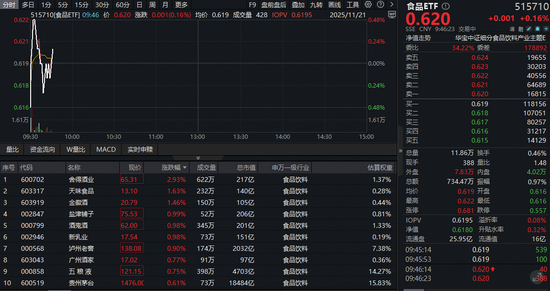
抖音重拳整治“高仿茅台”!吃喝板块韧性彰显,食品ETF(515710)逆市飘红!多家机构看好
Xin Lang Ji Jin· 2025-11-21 02:02
Core Viewpoint - The food and beverage sector demonstrates resilience, with the food ETF (515710) showing a slight increase despite market fluctuations, indicating potential investment opportunities in this sector [1][4]. Group 1: Market Performance - As of November 21, the food and beverage sector ranks third among 30 sectors in terms of growth, with the food ETF (515710) reaching a peak intraday price increase of 0.48% and a current increase of 0.16% [1]. - Leading stocks in the liquor segment, such as Shede Liquor, Tianwei Food, and Jinhuijiu, have shown significant gains, with Shede Liquor rising nearly 3% and others like Guizhou Moutai and Wuliangye also experiencing slight increases [1][4]. Group 2: Investment Opportunities - Analysts suggest that the current market conditions may present a favorable opportunity for investment in the food and beverage sector, particularly in high-quality liquor companies that have shown resilience and clear strategies [1][3]. - The food ETF (515710) is noted for its low valuation, with a price-to-earnings ratio of 21, indicating a potential for long-term investment returns [3][4]. Group 3: Regulatory Environment - Douyin has taken measures against black market accounts promoting counterfeit Moutai products, which may impact the market dynamics for high-end liquor brands but ultimately aims to enhance the integrity of the e-commerce ecosystem [3]. - The recent crackdown on low-priced and counterfeit products is expected to have short-term effects on accounts relying on such gray market flows, but it is anticipated to benefit the overall market order in the long run [3]. Group 4: Future Outlook - With ongoing macroeconomic policies aimed at boosting domestic demand, the food and beverage sector is expected to see improvements in both performance and valuation in the medium to long term [4]. - The food ETF is highlighted as a key asset for investors looking to capitalize on the sector's recovery, with a significant portion of its holdings in leading liquor brands and other food-related stocks [4].



红利风向标 |银行板块逆市上涨,红利价值持续凸显
Xin Lang Ji Jin· 2025-11-21 01:02
Group 1 - The latest dividend yield for the S&P China A-Share Dividend Opportunity Index is 4.92% as of November 21, 2025 [1] - The performance of the S&P China A-Share Dividend Opportunity Index shows a weekly decline of 2.39% and a yearly increase of 11.49% [1] - The annualized volatility of the index is reported at 11.47% [1] Group 2 - The S&P Hong Kong Stock Connect Low Volatility Dividend Index has a recent weekly increase of 0.27% and a yearly increase of 30.80% [2] - The annualized volatility for this index stands at 12.10% [2] - The A500 Low Volatility Dividend ETF shows a weekly increase of 0.28% and a yearly increase of 6.85% [2] Group 3 - The China Securities 800 Low Volatility Dividend Index has a recent weekly increase of 0.23% and a yearly increase of 4.46% [2] - The annualized volatility for this index is reported at 9.55% [2] - The performance of the indices is compared against the Shanghai Composite Index, which has shown various fluctuations [2]

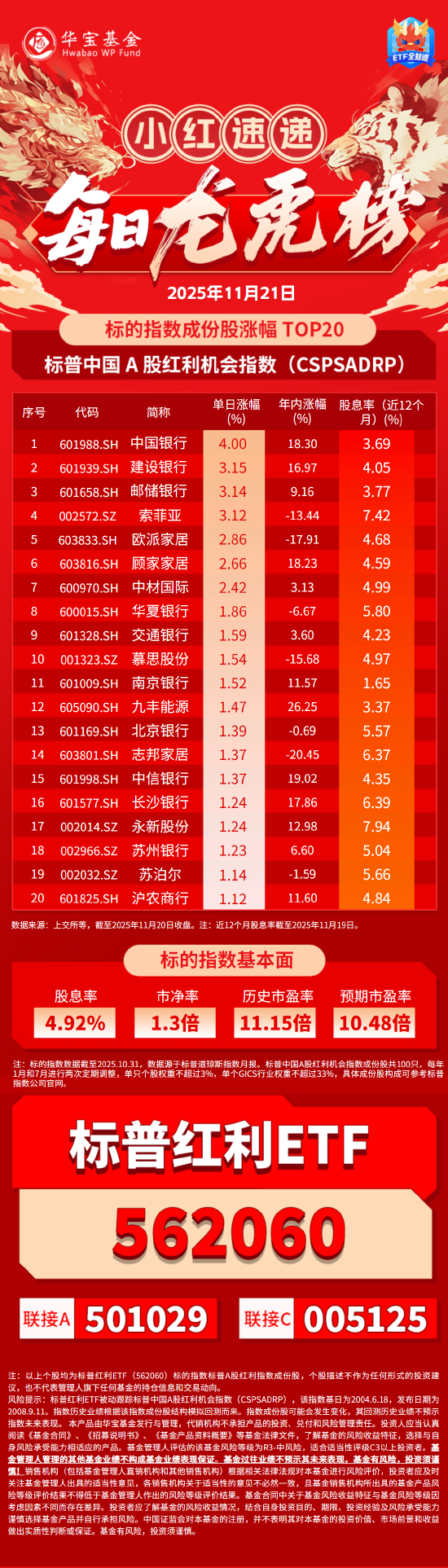
小红日报 | 中国银行涨超4%创新高,标普红利ETF(562060)标的指数收跌0.36%
Xin Lang Ji Jin· 2025-11-21 01:02
Core Insights - The article highlights the top-performing stocks in the S&P China A-Share Dividend Opportunity Index, showcasing significant gains and dividend yields for various companies [1] Group 1: Stock Performance - China Bank (601988 SH) leads with a 4.00% daily increase and an 18.30% year-to-date gain, along with a dividend yield of 3.69% [1] - Construction Bank (601939 SH) follows with a 3.15% daily rise and a 16.97% year-to-date increase, offering a dividend yield of 4.05% [1] - Postal Savings Bank (601658.SH) shows a daily increase of 3.14% and a year-to-date gain of 9.16%, with a dividend yield of 3.77% [1] Group 2: Notable Declines - Home Depot (002572.SZ) has a daily increase of 3.12% but a year-to-date decline of 13.44%, with a dividend yield of 7.42% [1] - Oppein Home Group (603833.SH) experiences a 2.86% daily rise but a significant year-to-date drop of 17.91%, with a dividend yield of 4.68% [1] - Kuka Home (603816.SH) shows a daily increase of 2.66% and a year-to-date gain of 18.23%, with a dividend yield of 4.59% [1] Group 3: Additional Performers - Huaxia Bank (600015.SH) has a daily increase of 1.86% but a year-to-date decline of 6.67%, with a dividend yield of 5.80% [1] - Beijing Bank (601169 SH) shows a daily increase of 1.39% and a slight year-to-date decline of 0.69%, with a dividend yield of 5.57% [1] - CITIC Bank (601998.SH) has a daily increase of 1.37% and a year-to-date gain of 19.02%, with a dividend yield of 4.35% [1]




ETF日报:银行板块P/B估值仍处于较低水平,尚有提升空间,可关注金融ETF
Xin Lang Ji Jin· 2025-11-20 12:35
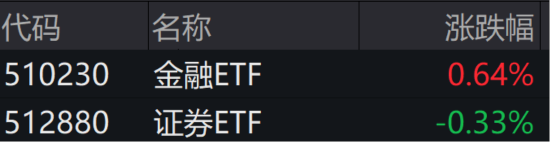
Market Overview - A-shares continued to show volatility, with major indices opening high and closing low. The Shanghai Composite Index fell by 0.4% to 3931.05 points, while the Shenzhen Component Index dropped by 0.76%, and the ChiNext Index decreased by 1.12% [1] - The total trading volume in the A-share market was 1.72 trillion yuan, slightly down from 1.74 trillion yuan the previous day, indicating a reduction in market activity [1] - Over 3800 stocks in the market declined, reflecting a fast rotation of sector performance and an ongoing consolidation pattern [1] Banking Sector - As of November 20, 2025, 26 out of 42 listed banks announced mid-term or third-quarter dividends, with a total proposed payout of approximately 264.6 billion yuan, marking an increase from 258.3 billion yuan last year [3] - The banking sector's net interest margin is under pressure but is expected to stabilize gradually, maintaining a solid fundamental outlook [3] - High dividend yields in a low-interest environment make bank stocks attractive for long-term investment, with the banking sector's P/B valuation still at a low level, indicating potential for improvement [3] Securities Industry - China International Capital Corporation (CICC), Xinda Securities, and Dongxing Securities announced plans for a major asset restructuring, with CICC set to absorb the other two through a share swap [2] - The combined total assets of the three firms post-merger are expected to exceed 1 trillion yuan, positioning them as the fourth largest in the industry [2] - The merger aims to enhance CICC's capabilities across various business lines and improve regional coverage in Liaoning and Fujian [2] Technology Sector - NVIDIA reported Q3 FY26 revenue of $57 billion, a year-over-year increase of 62% and a quarter-over-quarter increase of 22%, exceeding market expectations [4] - The data center segment generated $51.2 billion in revenue, also surpassing forecasts, with Q4 revenue guidance suggesting a new record high [4] - The introduction of Google's Gemini 3 Pro AI model has shown significant performance improvements over its predecessor, indicating strong competition in the AI space [6] Semiconductor and Memory Market - Flash wafer prices remained stable, while DDR memory prices have seen significant increases, with DDR4 memory prices doubling in some cases due to rising costs [7] - NVIDIA's decision to switch server memory from DDR5 to LPDDR5X to reduce power consumption may lead to price increases for older generation products [7] - The semiconductor industry is expected to see continued growth in capital expenditures, particularly in high-end products like optical modules [11]


惊心动魄!化工板块冲高回落,主力25亿抢筹!磷矿需求爆发在即,机构高呼化工景气复苏预期持续
Xin Lang Ji Jin· 2025-11-20 12:01
Group 1 - The chemical sector experienced significant volatility on November 20, with the chemical ETF (516020) initially rising by 1.83% before closing down 1.34%, resulting in a daily fluctuation of over 3% [1] - Key stocks in the sector, including fluorine chemicals, civil explosives, and lithium batteries, saw notable declines, with companies like Duofluoride and Guangdong Hongda hitting the daily limit down, and others like Xinjubang and Hangyang falling over 6% [1] - The chemical sector has garnered attention recently, particularly in the phosphorus chemical industry, with expectations of increased demand for energy storage leading to a potential rise in phosphorus ore demand by 440 million tons by 2025, representing over 4% of current total production [2][3] Group 2 - The basic chemical industry reported revenue of 1.71 trillion yuan in the first three quarters of 2025, a year-on-year increase of 2.8%, with net profits rising by 7.5% to 114 billion yuan, and a net profit margin improvement of 0.3 percentage points to 7.0% [3] - The basic chemical sector has seen significant capital inflow, with a net inflow of 25.87 billion yuan on a single day, ranking third among 30 major sectors, and a total net inflow of 2.017 trillion yuan over the past 60 days, placing it second [4] - Future prospects for the chemical industry appear positive, with expectations of improved supply-demand dynamics and potential valuation increases, suggesting a dual uplift in performance and valuation for the sector [5]

A股“银伟大”火出圈,中行、工行携手新高!英伟达业绩爆表,创业板人工智能逆市四连涨,新一轮行情启动?
Xin Lang Ji Jin· 2025-11-20 11:57
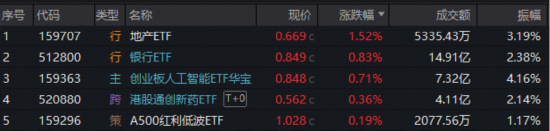
Market Overview - A-shares experienced a collective high opening followed by a decline, with the Shanghai Composite Index dropping 0.4% to 3931.05 points, and the ChiNext Index closing down 1.12% after an initial rise of 1.61% [1][2] - The total market turnover was 1.72 trillion yuan, marking a continuous decrease in trading volume over two days [1] Major Events - A significant merger in the brokerage industry was announced, with China International Capital Corporation (CICC) planning to absorb Dongxing Securities and Xinda Securities, creating a new brokerage giant with nearly 1 trillion yuan in total assets [2] - Nvidia reported better-than-expected earnings, with Q3 revenue reaching $51.2 billion, a 66% year-on-year increase, indicating strong global demand for computing power [12][13] Sector Performance - The banking sector showed strong performance, with major banks like Bank of China and Industrial and Commercial Bank of China reaching historical highs, supported by over 200 billion yuan in mid-term dividends [4][8] - The largest banking ETF (512800) saw a price increase of 1.9% during the day, marking a new high since October, with a trading volume of 1.49 billion yuan [5][6] ETF Highlights - The AI-focused ETF (159363) opened 3% higher and maintained high trading activity, ultimately closing with a 0.71% increase, marking its fourth consecutive rise [10][12] - The Hong Kong innovation drug ETF (520880) managed to rise against the market trend, ending the day with a gain after previously experiencing four consecutive declines [15][16] Future Outlook - Analysts expect a continuation of the current market consolidation pattern as institutions balance their portfolios ahead of year-end [4] - The banking sector is anticipated to remain attractive due to its low valuation and high dividend yield, with a significant amount of mid-term dividends expected to be distributed [8][9]


港股创新药短线突围,520880逆市收涨!后市怎么走?高盛:关注美联储12月降息概率
Xin Lang Ji Jin· 2025-11-20 11:57
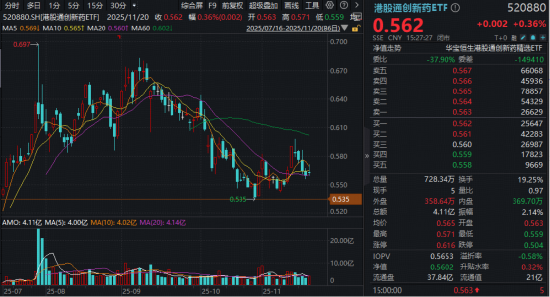
Core Viewpoint - The Hong Kong stock market continues to adjust, with the Hang Seng Index showing mixed performance, while the innovative drug sector demonstrates resilience, as evidenced by the performance of the Hong Kong Stock Connect Innovative Drug ETF (520880) which ended a four-day decline [1][3]. Group 1: Market Performance - The Hong Kong Stock Connect Innovative Drug ETF (520880) saw a price increase of 1.79% during the day, successfully ending its previous four-day decline [1]. - The ETF's performance is supported by major leading stocks in the innovative drug sector, with notable gains from companies such as Innovent Biologics, which rose by 2.84%, and others like China Biologic Products and Kintor Pharmaceutical, which increased by over 1% [1]. Group 2: Investment Insights - Following a strong rebound of nearly 7% the previous week, the ETF has returned to a state of fluctuation, currently trading at a near four-month low, indicating a potential area for cost-effective investment [3]. - The fund manager, Feng Chen, suggests that each significant pullback in the innovative drug sector presents an opportunity for accumulation [3]. - The innovative drug sector is undergoing a notable correction since early September, attributed to market style shifts and the return to more realistic expectations regarding business development (BD) rhythms and amounts [3]. Group 3: ETF Characteristics - The Hong Kong Stock Connect Innovative Drug ETF (520880) is characterized by three unique advantages: it is purely focused on innovative drug companies, has a significant concentration of leading stocks with over 71% weight in the top ten holdings, and maintains better risk control by reducing the weight of less liquid component stocks [3][4]. - The top ten holdings in the ETF account for 71.51% of the total weight, showcasing the dominance of leading companies in the sector [4]. - As of November 19, the ETF has a scale of 2.12 billion HKD and an average daily trading volume of 464 million HKD since its inception, making it the largest and most liquid ETF tracking the same index [4].
逾2000亿“红包雨”来袭,“银伟大”炸裂上涨,中行、工行再创新高!银行10月以来跑赢创业板15%,机构:增配
Xin Lang Ji Jin· 2025-11-20 11:43
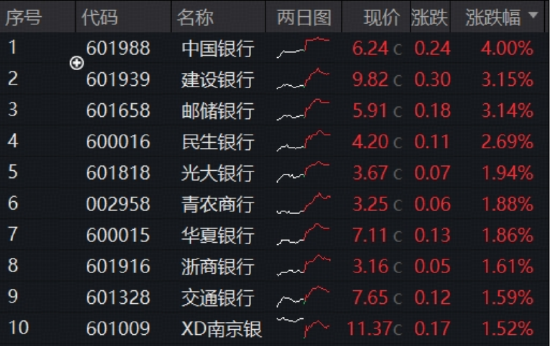
Core Viewpoint - The banking sector has shown strong performance, driven by style rotation and significant mid-term dividend distributions, with major state-owned banks leading the gains [3][5]. Group 1: Market Performance - On November 20, major banks experienced a rally, with China Bank rising over 5% and Industrial and Commercial Bank of China increasing by over 2%, both reaching historical highs [1]. - The China Banking Index has accumulated an 8.95% increase since the beginning of October, outperforming the broader market and exceeding the ChiNext Index by 15 percentage points [4]. Group 2: Dividend Distributions - A total of 24 listed banks have announced mid-term dividends, with a combined payout of nearly 263.8 billion yuan, marking a historical high [5]. - The six major state-owned banks are set to distribute a total of approximately 204.66 billion yuan in dividends, with most record dates concentrated in December [5]. Group 3: Investment Appeal - The banking sector is viewed as a defensive investment due to its low valuation and high dividend yield, making it attractive to investors seeking stability [5]. - As of the end of September, the China Banking Index had a price-to-book ratio of 0.67, placing it in the lower 35.69% percentile over the past decade, while the dividend yield reached 4.29%, significantly above the 10-year government bond yield of 1.88% [5]. Group 4: ETF Activity - The largest banking ETF (512800) saw its price rise by 1.9%, reaching a new high for the month, with a total trading volume of 1.491 billion yuan, indicating increased market interest [2]. - The banking ETF has experienced a significant increase in scale, reaching 20.615 billion yuan, reflecting strong investor demand [6].


供需两端共振,光模块量价齐增,新一轮行情有望开启?创业板人工智能ETF(159363)逆市四连涨!
Xin Lang Ji Jin· 2025-11-20 11:40
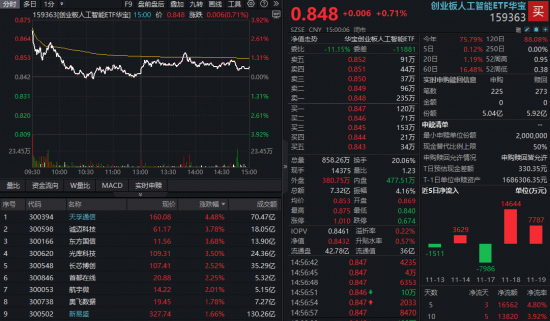
Group 1 - The core viewpoint of the articles highlights the strong performance of the AI and optical module sectors, driven by increasing global demand for computing power and significant revenue growth from key players like Nvidia [3][4] - The A-share optical module leaders are well-positioned to benefit from the booming demand in the computing power market, with a notable increase in retail prices for 1.6T optical modules, which have risen from approximately $1200 to over $2000 [3][4] - The global market for 800G optical modules is projected to reach 40 million units next year, while 1.6T optical modules are expected to exceed 7 million units, indicating a robust growth trajectory for the optical module industry [3][4] Group 2 - The optical module industry is experiencing a "volume and price increase" phenomenon due to strong demand from cloud service providers and accelerated technological advancements among leading manufacturers [4] - The first AI-focused ETF on the ChiNext board, which has over 54% exposure to optical modules, is recommended for investors looking to capitalize on the AI theme and computing power opportunities [4] - The articles emphasize the importance of monitoring the optical communication industry, which is expected to maintain high growth due to ongoing global investments in computing power and continuous technological iterations [4]
杨德龙:大盘走势持续震荡调整 不会改变中长期向上走势
Xin Lang Ji Jin· 2025-11-20 10:19
Group 1 - The market is experiencing fluctuations around the 4000-point mark, indicating significant divergence between bulls and bears as investors take profits towards year-end [1][2] - This bull market is characterized by a "dumbbell" structure, with low valuation, high dividend sectors like banks driving the index up, while tech innovation sectors such as AI and semiconductors show strong performance [2][3] - The current bull market is supported by policy initiatives and capital inflows, with A-shares and H-shares being seen as undervalued compared to US stocks, attracting global investment [3] Group 2 - The ongoing bull market is expected to stimulate consumer spending, with a potential shift from a structural bull market to a comprehensive bull market by 2026, enhancing consumer confidence and economic growth [4] - The evolution of the bull market is anticipated to follow a sequence where tech stocks lead, followed by mid-cap stocks, and finally traditional sectors, with a focus on balanced portfolio allocation [5] - In the tech sector, the demand for computing power is expected to rise, with significant partnerships highlighting the strategic importance of computing infrastructure, suggesting investment opportunities in related technologies [6][7]