
Tai Mei Ti A P P

Search documents
2025 EDGE AWARDS年度十大科技人物重磅揭晓
Tai Mei Ti A P P· 2025-12-25 05:05
Core Insights - The EDGE AWARDS by TMT aims to recognize outstanding individuals who drive technological breakthroughs and redefine industry standards, focusing on innovation and value [2] Group 1: Event Overview - The 2025 T-EDGE Global Dialogue will take place from December 8 to 21, organized by TMT Group in collaboration with NextFin.AI and Barron China [2] - The event will review the year's technological and industrial advancements and honor companies that redefine industry boundaries [2] Group 2: Notable Figures - Chen Tianqiao, founder of Shanda Group, invested $1 billion in AI-driven science and introduced the concept of "discovery intelligence," leading to significant advancements in AI and mental health research [3] - Du Mengran, a geologist from the Chinese Academy of Sciences, made groundbreaking discoveries in deep-sea ecosystems, observing the deepest known animal ecosystem at 9,533 meters [4][5] - Li Chuangang, founder of Aichang KTV, is recognized for his contributions to AI hardware commercialization, launching innovative products that redefine industry standards [6] - Liang Wenfeng, founder of DeepSeek, achieved a significant breakthrough in AI model efficiency, reducing training costs dramatically while maintaining high performance [7] - Liu Jingkang, founder of Insta360, led the company to become a global leader in panoramic imaging, launching innovative products that reshape visual recording [8] - Pan Chunqijie, founder of Mechanical Revolution, successfully positioned the brand among the top three in the gaming laptop market through user-centered innovation [9] - Wang He, assistant professor at Peking University and founder of Galaxy General Robotics, advanced the commercialization of embodied intelligence, achieving significant milestones in robotics [10] - Wang Xingxing, founder of Yushu Technology, initiated the era of affordable humanoid robots, achieving over 90% localization in core components [12] - Zhang Jianzhong, founder of Moore Threads, established a clear technical roadmap for GPU development, demonstrating the potential of domestic GPUs in high-performance computing [13] - Zhou Jingren, CTO of Alibaba Cloud, led advancements in AI foundational models, significantly impacting global open-source communities and enterprise applications [14]


这场对话凑齐了2025最火爆的AI创投要素|2025T-EDGE全球对话
Tai Mei Ti A P P· 2025-12-25 04:22
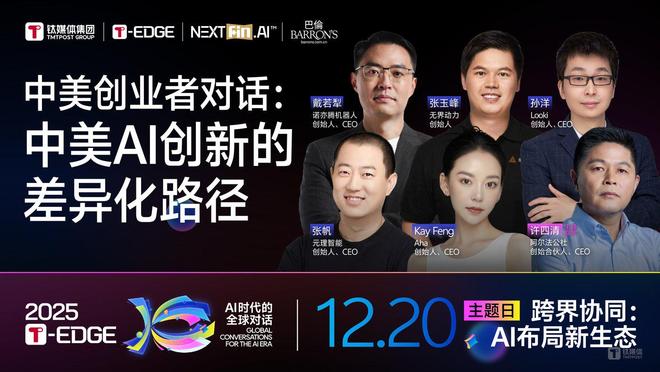
Core Insights - The article discusses the vibrant atmosphere in the AI venture capital scene, particularly among Chinese entrepreneurs and companies, highlighting the interconnectedness of various AI-related tags such as embodied AI, AI hardware, and AI agents [2]. Group 1: Company Highlights - Noitom Robotics, founded by Dai Ruoli, has completed a Pre-A+ round financing of several hundred million RMB, led by Qiming Venture Partners, with a focus on motion capture and robotics [3]. - Wujie Power, founded by Zhang Yufeng, has raised over 500 million RMB in angel financing, focusing on building a "general brain" for robots and achieving breakthroughs in industrial manufacturing and commercial services [4]. - Looki, founded by Sun Yang, has launched its first product, L1, which has received positive sales and user feedback, and has completed multiple rounds of financing totaling over ten million USD [5]. - Yuanli Intelligence, founded by Zhang Fan, focuses on commercial reinforcement learning and has recently completed a seed round financing of nearly ten million USD [6]. - Aha, founded by Kay Feng, has developed a unique "AI employee-style" marketing platform and has served over 300 clients, receiving significant investment from various venture capital firms [7]. Group 2: Industry Trends and Insights - The Chinese AI hardware industry is seen as having advantages in the supply chain, with a focus on integrating AI into daily life, although the direction remains exploratory [11]. - The differences in market logic between Chinese and Western companies are highlighted, with Chinese firms often focusing on B2C growth while Western firms emphasize B2B specialization [12]. - The article notes that the Chinese market is characterized by a higher tolerance for new technologies and products, which can lead to rapid product development through collaboration with B2B clients [10]. - The emergence of reinforcement learning is viewed as a significant advancement, allowing for the transition from human-labeled data to self-optimizing models [15]. - The article emphasizes the importance of real-world data and the collaboration between real and synthetic data in developing effective AI models [26]. Group 3: Future Expectations - The participants express excitement about the potential breakthroughs in AI, particularly in reinforcement learning and the application of agentic AI in real business scenarios [16][17]. - There is a consensus that 2026 could be a pivotal year for AI, with expectations for significant advancements in the integration of AI into physical environments and the realization of commercial reinforcement learning [43][44].
对话蔡恒进:当AI有了自我意识,我们如何与之共处?
Tai Mei Ti A P P· 2025-12-25 03:35
文 | 产联社,作者 | 郑青春 在AI以惊人速度重塑工作、生活乃至思维方式的今天,一个根本性问题摆在每个人面前: 当机器比你更聪明、更高效、甚至更能"共情",你的独特价值在哪里? 带着这个切身的焦虑,我们与跨界学者蔡恒进展开了一场深度对话。 蔡恒进15岁考入中科大,1995年获美国阿拉斯加大学费尔班克斯分校博士学位。他早年深耕空间物理, 后转向人工智能、区块链及元宇宙领域。 他在跨学科的探索中提出意识的认知坎陷理论、主动哈希交互网络及自我肯定需求理论,并曾获得中国 人工智能领域最高奖项"吴文俊人工智能科学技术奖"。 这种跨界背景,使他的AI观点兼具物理学的严谨与哲学的前瞻。面对未来,人类应当如何与AI共存? 他的答案不是对抗,也不是臣服,而是一个更具建设性的路径: 打造你的数字分身,让AI成为"另一个你"。 解码意识与智能的本质:认知坎陷 早年物理学的背景,为蔡恒进后续研究打下了最坚实的根基。"我早年把物理学得比较通透了,后面很 多坑就不会掉进去了。" 他指出,当前很多人试图用"似是而非"的物理概念来重新解释意识和智能,很容易误入歧途。物理规律 的普适性,是他在AI生成各种"虚妄"理论时的"定海神针"。 对 ...
数智驱动与ESG赋能,韵达股份获肯定
Tai Mei Ti A P P· 2025-12-25 03:04
2025年12月21日,钛媒体「2025 EDGE AWARDS」正式揭晓,国内综合物流服务领军企业韵达股份 (002120.SZ)凭借稳健的经营业绩、领先的数字化能力与卓越的可持续发展实践,成功斩获 "最具投 资价值上市公司" 奖项。这一荣誉不仅是行业与市场对其核心竞争力的高度认可,更印证了其在物流行 业变革浪潮中,以科技创新与ESG实践双轮驱动,构筑长期投资价值的战略定力。在电商渗透率持续提 升与物流全球化加速的背景下,韵达股份正从 "快递服务商" 向 "全球综合物流服务商" 稳步迈进,成为 资本市场值得长期关注的优质标的。 数智化+多业务布局,激活增长新动能 作为物流行业数字化转型的先行者,韵达股份始终以"全面数字化、移动数字化"为战略核心,构建 "1+N+AI"多层次科技体系,将技术创新深度融入全链路运营场景。在智能调度领域,自主研发的快件 运营信息系统与GPS卫星定位系统,实现全国2500条陆运主干线、800余条航空直发线路的实时监控与 动态优化;末端服务环节,无人车、智能快递柜与9.4万余个末端门店驿站形成高效网络,成本管控能 力领跑行业。 数智化投入的持续兑现,直接转化为强劲的业绩增长。2025 ...

从智能搜索工具到AI代理电商模式先驱,四年估值200亿美元,Perplexity面临怎样的困境?
Tai Mei Ti A P P· 2025-12-25 03:03
Core Insights - Cristiano Ronaldo has officially invested in the American AI startup Perplexity AI, becoming one of its shareholders, which has attracted global attention to the previously low-profile company [1] - Perplexity AI has emerged as a key player in the AI user competition in India, alongside industry giants like OpenAI and Google, showcasing its technological strength and market competitiveness [4][6] - The company aims to combine traditional search indexing with large language model reasoning capabilities to provide accurate, up-to-date, and verifiable information [9][10] Company Background - Perplexity AI was founded in 2022 by a team of former researchers from OpenAI, Facebook AI Research, and Quora, with the goal of improving search experiences that are often cluttered with ads and low-quality links [6][9] - The first product, Perplexity Ask, was launched in December 2022, integrating GPT-3.5 and Microsoft Bing technology to provide structured answers with source links, achieving over 10 million monthly visits early in 2023 [9][10] Product Development and Strategy - In 2024, Perplexity AI shifted its focus towards becoming an AI agent, aiming to actively assist users in completing specific tasks rather than just providing information [13][14] - The launch of the native AI browser Comet in July 2025 marked a significant step in its AI agent strategy, with a valuation increase from slightly over $500 million to $20 billion in less than two years [16][19] Market Position and Challenges - Despite rapid growth, Perplexity faces challenges in its business model, relying solely on subscription revenue without advertising, leading to low average revenue per user (ARPU) [19][21] - The company is exploring new avenues, such as the AI-driven patent search agent and an agentic commerce model, which aims to revolutionize the shopping experience by allowing AI to complete purchases on behalf of users [24][26] Future Outlook - The agentic AI trend represents a significant leap in AI technology and market potential, although challenges such as user trust and existing e-commerce dependencies remain [27]

钛媒体「年度全球化公司」榜单重磅发布 | 2025 EDGE AWARDS
Tai Mei Ti A P P· 2025-12-25 02:06
Group 1 - In 2025, Chinese companies are shifting from cross-border operations to deeper localization and accelerating globalization in response to changing overseas policies [2] - The U.S. government has implemented policies such as the cancellation of tax exemptions for cross-border packages under $800 and reciprocal tariffs, while the EU has introduced the New Battery Law [2] - Chinese enterprises are transitioning from "single product exports" to "full-chain system output," with market strategies evolving from a focus on Europe and the U.S. to a dual-driven approach involving emerging and traditional markets [2] Group 2 - The EDGE AWARDS recognizes companies that have achieved significant breakthroughs in overseas markets despite fluctuating international conditions, highlighting their contributions to globalization [3] - ECARX has achieved large-scale production and delivery in global markets, securing over $1 billion in overseas orders and achieving profitability in Q3 [3] - Alibaba Cloud is enhancing its global infrastructure to support Chinese enterprises' overseas development, focusing on AI product internationalization and building a global cloud computing network [4] Group 3 - HLA has expanded its global strategy, opening new stores in Southeast Asia, Central Asia, and the Middle East, with overseas revenue increasing by 27.42% [4] - Kudi Coffee has expanded its international presence to 33 countries, with over 18,000 stores globally, ranking third worldwide in the coffee and tea sector [4] - United Imaging Healthcare has seen overseas revenue grow from $40 million to over $2 billion in seven years, with a compound annual growth rate of 93% [5] Group 4 - Pop Mart has experienced explosive growth in overseas revenue, which increased by 437.5% in the first half of 2025, accounting for 40.3% of total revenue [6] - Century Huatong, a leading gaming company, has achieved over $3.8 billion in global revenue from its game "Whiteout Survival" and is actively exploring AI gaming applications [7] - Tongwei Group has a global market share of approximately 30% in polysilicon, with significant growth in component sales across various regions [8] Group 5 - Yanghe Distillery has established a comprehensive international communication system focusing on high-end, platform-based, and localized strategies, covering 86 countries and regions [9] - Yiling Pharmaceutical has successfully registered 17 innovative traditional Chinese medicines in over 50 countries, promoting a multi-faceted approach to global healthcare [10] - The trend of collaborative globalization is emphasized, with companies providing reliable service networks to support Chinese enterprises in overseas markets [11] Group 6 - Amazon Global Selling has facilitated the entry of numerous Chinese sellers into international markets, signing cooperation agreements with various provincial commerce departments [12] - XTransfer offers cross-border financial and risk control services to over 800,000 enterprises, enhancing global competitiveness for small and medium-sized businesses [13] - Huawei Cloud has expanded its global presence with 34 geographic regions and 101 available zones, supporting local industry upgrades in various countries [14] Group 7 - Stripe provides programmable financial services to millions of businesses, enabling Chinese brands to establish payment channels and innovative revenue models as they expand globally [15]

8%股份撬动实控权!秦本军套现6.46亿离场,莱茵生物进入“德福时代”
Tai Mei Ti A P P· 2025-12-24 12:26
Core Viewpoint - The restructuring plan of Rhein Biotech (002166.SZ) involves a significant change in control, with the original controlling shareholder, Qin Benjun, transferring 8.09% of shares and relinquishing 25.5% of voting rights to introduce a new main shareholder, Guangzhou Defu Nutrition, while also acquiring 80% of Beijing Jinkangpu's equity to extend its business into the nutritional supplement sector [2][3][4]. Group 1: Shareholder Changes - Qin Benjun will transfer shares at a price of 10.76 CNY per share, totaling 645.6 million CNY, which is a premium of over 20% compared to the last closing price before suspension [2][4]. - Following the resumption of trading, Rhein Biotech's stock hit a daily limit up, reaching 9.57 CNY per share, marking a new high for the year and a market capitalization of 7.097 billion CNY [3]. - Qin Benjun's exit is attributed to financial pressures and operational difficulties faced by the company, including a recent penalty from the China Securities Regulatory Commission for market manipulation [5][6]. Group 2: Financial Performance and Challenges - Rhein Biotech's net profit from 2021 to 2024 showed significant volatility, with figures of 118 million CNY, 179 million CNY, 83 million CNY, and 163 million CNY, reflecting a concerning stability in profitability [7]. - In the first three quarters of 2025, the company reported revenue of 1.272 billion CNY, an increase of 8.73% year-on-year, but net profit decreased by 30.73% to 70.395 million CNY, indicating a tightening cash flow situation [9]. - As of September 2025, the company had only 255 million CNY in cash but faced short-term interest-bearing liabilities of 807 million CNY, highlighting liquidity issues [9]. Group 3: Strategic Acquisitions - The acquisition of 80% of Beijing Jinkangpu is part of a strategy to create a closed-loop supply chain from raw materials to formulation solutions in the nutritional supplement field [2][10]. - Beijing Jinkangpu reported a revenue of 432 million CNY and a net profit of 70.2658 million CNY in 2024, with a relatively stable financial condition, making it a strategic fit for Rhein Biotech [12]. - The acquisition is expected to enhance Rhein Biotech's product offerings in the dairy sector and leverage its global sales network for international expansion [15]. Group 4: Market Context and Future Prospects - The recent decision by the Ministry of Commerce to impose temporary anti-subsidy duties on EU dairy products may benefit domestic dairy producers, potentially creating a favorable environment for Rhein Biotech's new business direction [14]. - The U.S. federal government's recent reforms on cannabis regulation may open new opportunities for Rhein Biotech's industrial hemp business, particularly in CBD extraction [15][16]. - The establishment of Guangzhou Defu Nutrition, which is closely linked to the new controlling shareholders, indicates a strategic move to consolidate assets and enhance operational efficiency within the healthcare investment sector [13].


炒作三大运营商“迫于美国FCC压力紧急整改”的谣言,既无知又可耻
Tai Mei Ti A P P· 2025-12-24 10:22
Core Viewpoint - The article discusses the misinformation surrounding the compliance order issued by the FCC to the three major telecom operators in Hong Kong, emphasizing that claims of urgent rectification under FCC pressure are unfounded and misleading [1][2][4]. Group 1: FCC Compliance Order Background - The FCC established the RMD mechanism in 2020 to enhance transparency and effective automatic call mitigation [3]. - On March 16, 2023, the FCC revised Rule 64.6305 to strengthen information requirements for RMD certification and expanded obligations for both new and existing submitters [3]. - Additional amendments were made on May 18, 2023, requiring service providers to respond to trace requests within 24 hours [3]. Group 2: Response of Telecom Operators - The three major telecom operators received two notifications from the FCC's Wireless Competition Bureau (WCB) in 2024, requiring them to comply with updated RMD requirements [4]. - Despite these notifications, the operators did not respond until the FCC issued a final compliance order on December 8, 2025, indicating a consistent disregard for the FCC's requests [4][5]. - The operators' lack of response suggests they were not actively working on compliance as claimed by various media outlets [4][5]. Group 3: Misinformation from Media - Various self-proclaimed industry insiders have spread false narratives about the operators' urgent compliance efforts, which are characterized as misleading and harmful [2][4]. - Claims of the operators forming special response teams and rapidly preparing compliance materials are dismissed as fabrications [2][4]. - The article stresses the need to expose and refute these misleading reports to clarify the actual situation [2][4]. Group 4: Implications of FCC's Final Order - The FCC's final order requires the operators to respond within 14 days, but it is unlikely that they can complete the necessary rectifications in such a short timeframe [6][8]. - The order also includes a stipulation that even if the operators correct their RMD certifications, they must provide convincing evidence that their presence does not threaten national security [6]. - The article concludes that the operators are likely taking measures to ensure normal international communication operations, despite not complying with the FCC's demands [9].


叶磊Leo:AI光模块市场预测和新技术展望
Tai Mei Ti A P P· 2025-12-24 09:48
Core Insights - The optical communication industry is facing unprecedented opportunities and challenges due to explosive growth in computing power demand, with optical modules becoming a critical bottleneck in data center development [1][2] - The supply-demand dynamics of the AI optical module market are expected to undergo significant changes by 2026, with current supply constraints primarily driven by four key bottlenecks [2][4] - Emerging technologies such as silicon photonics, CPO, NPO, hollow-core fibers, and micro LED communication are attempting to break existing bottlenecks, but face challenges in cost, reliability, and market acceptance [1][10][22] Supply and Demand Dynamics - AI data centers are currently experiencing a severe shortage of optical modules, a trend expected to continue through 2025, with actual shipment volumes constrained by supply-side factors [2][3] - The demand for 800G and 1.6T optical modules is projected to reach approximately 42 million units by 2025, although inflated market predictions exist [3][4] - Supply-side bottlenecks include shortages of optical chips, optical components, equipment, and skilled personnel, which are critical for production capacity expansion [4][5] Technology Development - Silicon photonics technology is struggling with integration challenges, leading to high costs and low yield rates, which hinder its competitiveness against traditional discrete optical modules [7][8] - CPO technology offers significant advantages in bandwidth density but faces challenges related to integration costs and maintenance difficulties [10][11] - NPO represents a compromise between traditional optical modules and CPO, but its adoption is met with skepticism from traditional optical module manufacturers [12][13] Emerging Technologies - Hollow-core fibers and micro LED communication are highlighted as promising technologies but face significant barriers to commercialization, including high manufacturing costs and integration challenges [22][23][24] - Hollow-core fibers can potentially offer faster transmission speeds and longer distances but require substantial cost reductions to be viable [22][23] - Micro LED technology, while energy-efficient, struggles with performance limitations and the need for a complete overhaul of the existing supply chain [24][25] Market Predictions - By 2026, the optical module market is expected to transition from a state of supply constraints to a more balanced supply-demand scenario, although challenges will persist [5][6] - The industry is at a critical juncture as it approaches the 3.2T era, with significant uncertainty surrounding the technological pathways and potential disruptions to existing market structures [19][20][21]


“图钉型”社会降临:马斯克预言下的中产崩塌与算力霸权
Tai Mei Ti A P P· 2025-12-24 09:48
Core Insights - Elon Musk predicts that in the future, work will become optional due to advancements in humanoid robots and AGI technology, leading to a potential collapse of the traditional labor-for-pay economic model [1][2] - The rise of AI and robotics will redefine poverty and wealth distribution, making survival resources more accessible while potentially increasing wealth inequality [2][3] Group 1: Economic Implications - The marginal cost of productivity is approaching zero, which could lead to a deflationary environment where the value of human labor diminishes significantly [1][2] - The traditional economic model, which has relied on labor as a core production factor since the Industrial Revolution, is being disrupted by technological advancements [1][3] Group 2: Social Structure Changes - The middle class's economic security is eroding as AI reduces the value of high-skill jobs, leading to a polarized "tack-shaped" society where wealth is concentrated among those who control computational power and algorithms [3][5] - In this new economic landscape, computational power and energy may become the new forms of currency, overshadowing traditional monetary wealth [3][5] Group 3: Human Capital and Innovation - Musk emphasizes that human creativity and intuition remain irreplaceable, as demonstrated by the development of the Starship, which was not reliant on AI [4][6] - The future economy will prioritize cognitive abilities and knowledge over traditional financial assets, as the ability to leverage AI for complex problem-solving will become crucial [7]