Tai Mei Ti A P P

Search documents
清空贝壳股票,万科债务压力下的挣扎与选择
Tai Mei Ti A P P· 2025-11-27 11:22
Core Viewpoint - Vanke has completely sold its shares in Beike, ending an 8-year capital cooperation, driven by liquidity pressures and a need to address debt maturity issues [1][4]. Group 1: Background of Cooperation - Vanke's investment in Beike began in 2017, when it invested 3 billion yuan for approximately 7.2% equity in the company, then known as Lianjia [2]. - The partnership was seen as a strong collaboration between offline channels and developers, especially as Beike transitioned to a new business model during its rapid expansion [3]. Group 2: Financial Pressures and Strategic Shift - Vanke faced significant financial challenges in 2024, reporting a net loss of 49.48 billion yuan and a 26.6% decline in contracted sales area, leading to a critical cash flow situation [4]. - The decision to sell Beike shares was influenced by the need to alleviate debt pressure, as Vanke's debt was maturing and financing channels were restricted [4][9]. - Despite a decline in Beike's stock price, Vanke's initial investment has yielded a favorable return based on current valuations [4]. Group 3: Changes in Business Focus - Beike's revenue structure has shifted, with new home business revenue decreasing and non-real estate transaction business growing to 45% of total revenue, reducing strategic alignment with Vanke [5]. - Vanke's holding in Beike transitioned from a strategic investment to a financial one, diminishing its rationale for retaining the shares [5]. Group 4: Industry Trends and Responses - The broader real estate industry is witnessing a trend of companies divesting non-core assets to improve cash flow and reduce financial burdens, as exemplified by Vanke's "slimming down" strategy [6][8]. - Other companies, like Sunac China, have also liquidated their Beike shares to support debt restructuring efforts [6]. Group 5: Future Outlook - Vanke's debt crisis remains severe, with estimated domestic bond repayments of approximately 15.546 billion yuan and USD bond interest of about 30 million [9]. - The company's ability to resolve its debt issues will depend on policy support, market recovery, and its own financial recovery capabilities [9].


超200万台充电宝召回之后,2.1亿台充电宝将被淘汰?
Tai Mei Ti A P P· 2025-11-27 09:15
国产充电宝经历全球超百万部召回之后,事件的余波还在持续。 此前,由于核心电芯供应商的原材料问题,包括安克创新、罗马仕、倍思等企业发起了面向全球用户的 充电宝召回行动。据笔者不完全统计,此次充电宝召回规模超过了200万部。同时,包括罗马仕、安 克、小米、倍思、绿联等在内的移动电源产品的多个3C认证证书也被暂停。 11月26日,有媒体报道称,工信部已于10月及11月多次组织召开《移动电源安全技术规范》征求意见稿 研讨会。"经过三四轮研讨会,目前标准已基本定稿,预计12月公示,2026年2月正式发布,同年6月起 实施。新规落地后,原有3C认证规定将全面失效。"参会企业负责人表示。 消息一出,随即引起市场震动。有市场参与者表示,新规将会淘汰70%充电宝。部分网友则担心:"刚 买的充电宝,是不是要闲置浪费了?还能携带登机吗?" 公开数据显示,2025年我国充电宝市场规模将突破1200亿元,累计认证产品数量将超过3亿台。如果以 此标准计算,市场上将有2.1亿台充电宝被淘汰。按照99元的平均价格计算,淘汰充电宝的价值将超过 200亿元。 不过,事实真是如此吗? 淘汰的是落后产能,已获认证充电宝不受影响 充电宝新规引发市场震 ...


C++之父亲临北京,AI 原生时代最值得参加的系统软件技术大会日程发布
Tai Mei Ti A P P· 2025-11-27 08:42
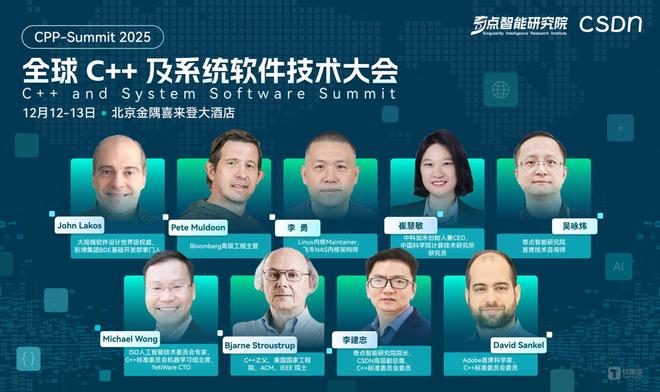
Core Insights - The "2025 Global C++ and System Software Technology Conference" will be held on December 12-13 in Beijing, organized by CSDN and Singularity Intelligence Research Institute [1][17] - The conference will feature Bjarne Stroustrup, the father of C++, along with top experts in system software, high-performance computing, AI infrastructure, and open-source contributions to discuss the evolution of C++ and system software in the AI-native era [3][17] Conference Themes - The conference will cover twelve major themes including modern C++ best practices, architecture and design evolution, software development driven by large models, AI computing and optimization, heterogeneous computing, high performance and low latency, concurrency and parallelism, system-level software, software quality construction, security and reliability, R&D efficiency, and embedded systems [3][5][6] Keynote Speakers and Sessions - Notable speakers include Bjarne Stroustrup, CSDN Senior Vice President Li Jianzhong, and leading figures from major tech companies who will discuss language design philosophy, AI-native infrastructure evolution, and high-performance system engineering practices [3][4] - The first day will feature a high-end roundtable discussion on "System Software in the AI Native Era" with Bjarne Stroustrup and other industry experts [4] Agenda Highlights - The agenda includes sessions on modern C++ best practices, AI computing optimization, and concurrency, featuring experts from companies like Adobe, Alibaba, Xiaomi, and Tsinghua University [5][10] - The second day will focus on topics such as software development driven by large models, high performance and low latency, and software quality, with contributions from leading tech firms like Baidu, Tencent, and Meituan [6][13] Registration and Participation - Registration for the conference is currently open, with incentives for early registrants, including a chance to receive a commemorative edition of the "AI Native Software R&D Maturity Model (AISMM) White Paper" [19]
瑞士机器人科技公司Gravis Robotics研发模块化车顶自主控制套件,实现建筑土方作业自动化
Tai Mei Ti A P P· 2025-11-27 07:41
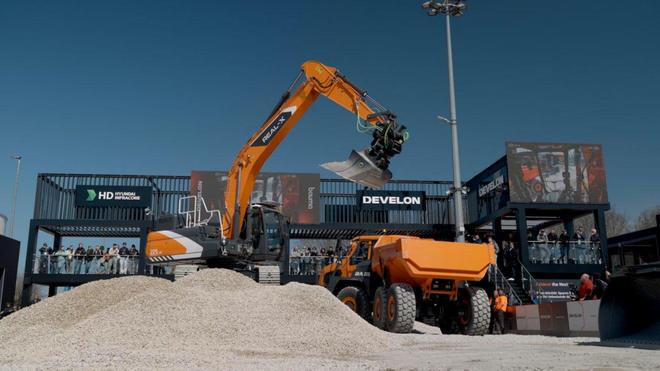
Core Insights - Switzerland has ranked first in the global innovation index for 14 consecutive years since 2011, making it a significant source of innovation and a strategic partner for China in innovation development and technology finance [2] - Gravis Robotics, founded in 2022, focuses on developing a modular autonomous control kit for construction machinery, enhancing operational efficiency through automation [3][5] Company Overview - Gravis Robotics is a spin-off from ETH Zurich, founded by a team of experts in robotics, including CEO Ryan Luke Johns and CTO Dominic Jud, both of whom hold PhDs in robotics from ETH Zurich [3] - The company aims to transform traditional heavy machinery into autonomous robots, addressing labor shortages and improving safety in hazardous construction environments [5][7] Product Features - The modular autonomous control kit integrates machine learning hydraulic control technology with advanced perception and mapping capabilities, allowing existing earth-moving machinery to operate autonomously [7][8] - The kit has been trained in simulated environments to adapt to various terrain conditions, enabling machines like excavators to interpret CAD drawings and perform tasks autonomously [8] - Hardware components include cameras, LiDAR, and a robust edge computing system, ensuring real-time environmental monitoring and operational efficiency [9] Operational Efficiency - Gravis's autonomous control kit can enhance productivity by 30% in construction operations, while also reducing risks associated with manual operation in challenging environments [10] - The portable operation tablet allows for remote control and real-time 3D visualization of tasks, facilitating flexible job area definitions and operational adjustments [10] Collaborations - Gravis has established partnerships with Holcim, a Swiss materials group, and Develon, a South Korean construction machinery manufacturer, to further develop and deploy its technology [10]

储能观察:特斯拉与中企混战,全球储能龙头再易主
Tai Mei Ti A P P· 2025-11-27 07:35
Core Insights - The global energy storage market is experiencing intense competition, with Tesla, Sungrow, BYD, CRRC Zhuzhou, and Huawei leading the shipment rankings for energy storage systems in the first three quarters of 2025 [1][2] - The total global energy storage system shipments reached 286.35 GWh, marking an 84.7% year-on-year increase, with Q3 shipments surpassing 100 GWh for the first time [1] - The rise of energy storage is driven by global carbon reduction goals, making it a critical area for national energy strategies [1] Group 1: Market Dynamics - Chinese energy storage companies have shown remarkable growth, with eight out of the top ten global energy storage companies being Chinese, capturing 63% of the global market share [2] - The competitive landscape is shifting as Chinese firms enhance their global presence, particularly in high-end markets in Europe and the Middle East, where they dominate [2][3] - In the first three quarters of 2025, Chinese companies secured 308 overseas energy storage orders totaling 214.7 GWh, a 131.75% increase year-on-year [3] Group 2: Technological Competition - The competition in the energy storage sector has evolved from price wars to a comprehensive battle over technology and system innovation [4] - Sungrow's competitive edge lies in its self-developed technology system and cost advantages from reverse innovation, with over 5 billion yuan invested in R&D over the past three years [4][5] - BYD has introduced innovative products like the "Hao Han," featuring the world's largest single-capacity blade battery, significantly reducing system failure rates and maintenance costs [5] Group 3: Future Trends - The future competition in the energy storage market will focus on localized operations, long-duration energy storage technologies, and the expansion of new application scenarios [7] - Companies are increasingly establishing local production facilities to meet market demands and reduce costs, with Tesla and Fluence setting up integration plants in Asia [7] - Long-duration energy storage is becoming a focal point, with projects like Fluence's 1 GW/4 GWh system in Germany indicating significant advancements in feasibility and economics [7] Group 4: Investment Landscape - The capital market shows strong enthusiasm for the energy storage sector, with significant stock price increases for companies like Sungrow and Hai Bo Si Chuang, reflecting investor confidence in future growth [8] - The influx of industrial and financial capital into the energy storage field is providing ample funding support for innovation and development [8] - The competition among leading companies is intensifying, with expectations that the top three firms will vie for the title of global leader in energy storage by the end of 2025 [9]



谷歌 Ironwood TPU 突袭,英伟达 GPU 迎来挑战者?
Tai Mei Ti A P P· 2025-11-27 07:35
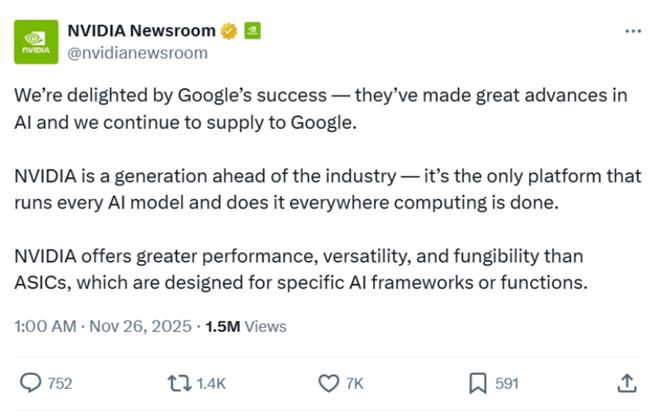
Core Viewpoint - Nvidia issued an urgent statement in response to market discussions regarding AI hardware development, particularly in light of Google's launch of the seventh-generation Ironwood TPU and Meta's consideration of TPU solutions [1][2]. Group 1: Nvidia's Market Position - Nvidia's stock experienced volatility, with a peak decline of 7% and a closing drop of 2.59% following the statement [2]. - The statement has garnered over 1.5 million views and more than 750 comments, indicating significant interest within the AI community [2]. - Observers note that as major clients begin to develop their own chips, the competitive landscape for AI chips is changing [2]. Group 2: Google's AI Infrastructure Strategy - Google is redefining AI infrastructure with a comprehensive solution that integrates custom hardware, cloud services, and specialized chips [3][5]. - The Ironwood TPU is Google's most powerful and energy-efficient accelerator to date, achieving a performance increase of approximately 10 times compared to the previous TPUv5p and over 4 times compared to TPUv6e [3]. - The Ironwood TPU features high bandwidth, large memory capacity, and advanced cooling systems, making it suitable for complex, high-concurrency, low-latency model deployments [3]. Group 3: Implications for the AI Chip Market - Google's introduction of Ironwood signals a significant challenge to Nvidia's GPU dominance, raising questions about the future of Nvidia's market position [8]. - Nvidia emphasizes its unique value proposition as the only platform capable of running all AI models anywhere, highlighting its established ecosystem [8][9]. - Nvidia's advantages include generality and compatibility, a mature ecosystem, and flexibility that allows it to adapt to rapid AI technology iterations [9][12]. Group 4: Future Market Dynamics - Meta is reportedly negotiating with Google to procure TPU chips for deployment in its data centers starting in 2027, reflecting a strategic shift among major tech companies towards diversified AI infrastructure [14]. - If Google continues to leverage its TPU and integrated infrastructure, the AI industry may undergo a profound transformation affecting hardware market dynamics and investment valuation logic [15][16]. - The AI hardware market is expected to transition from a GPU-dominated landscape to a more diversified ecosystem featuring GPUs, TPUs, custom ASICs, and cloud services [17]. Group 5: Investment and Valuation Changes - The focus of hardware competition is shifting from selling chips to providing comprehensive services and infrastructure [18]. - Future valuation metrics will prioritize companies that can offer economical, scalable, and integrated infrastructure solutions [18]. - The lowering of infrastructure barriers is likely to stimulate innovation among AI startups and service-oriented companies, driving the next wave of AI commercialization [19].


卢伟冰成了小米造车的最大受益人
Tai Mei Ti A P P· 2025-11-27 07:35
Core Insights - The core message emphasizes the importance of maintaining quality during challenging times, as articulated by Lei Jun, the founder of Xiaomi, suggesting that quality is essential for survival and innovation is crucial for growth [1] Group 1: Company Strategy and Adjustments - Xiaomi is shifting its focus from aggressive store expansion to optimizing existing stores, with a new initiative led by Vice President Wang Xiaoyan to enhance the performance of Xiaomi Home stores in China [2][3] - The company aims to improve the quality of its store locations and reduce rental costs, indicating a strategic pivot in response to the diminishing returns from rapid expansion [2][3] Group 2: Automotive Business Impact - Xiaomi's automotive venture has significantly contributed to its offline store expansion, achieving 20,000 stores in just two years, with plans to stabilize operations after this rapid growth [3][4] - The automotive business has also enhanced Xiaomi's brand image, particularly in the high-end smartphone market, with a reported 5.6 percentage point increase in market share for smartphones priced between 4,000-6,000 yuan, reaching 18.9% [4][6] Group 3: Financial Performance and Market Position - Xiaomi's automotive division has achieved profitability within a year and a half, with a quarterly operating profit of 700 million yuan and a production capacity exceeding 600,000 vehicles per week [4][5] - Despite a decline in the average selling price (ASP) of smartphones to 1,062.8 yuan, the automotive business is expected to bolster Xiaomi's high-end market presence, although the global brand perception has yet to fully align with this growth [6][7] Group 4: Future Directions and Challenges - The company recognizes the need for a significant breakthrough product to redefine its market narrative, similar to the impact of the Mi MIX smartphone, which set a precedent for innovation [12][14] - Xiaomi's future success hinges on its ability to create products that resonate with consumers and establish a strong technological identity, moving beyond mere price competitiveness [14][15]

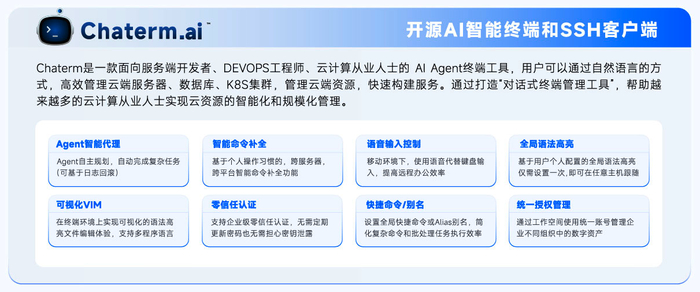
聚焦当下:Chaterm致力于打造20年经验的SRE副驾驶
Tai Mei Ti A P P· 2025-11-27 06:05
Core Insights - The article discusses the emergence and diversification of AI Agents, particularly focusing on Chaterm, which targets the role of operations and maintenance experts in IT environments [1][9]. Group 1: Chaterm's Capabilities - Chaterm is positioned as an AI Agent with the expertise of a "20-year experienced operations expert," capable of diagnosing complex server issues based on vague user descriptions [3][4]. - The AI's ability to perform multi-dimensional analysis allows it to complete root cause analysis in seconds, significantly reducing Mean Time to Recovery (MTTR) compared to human efforts [7][9]. Group 2: Industry Challenges - The rapid growth of AI infrastructure has led to increased complexity in operations, requiring management of diverse hardware like CPUs, GPUs, and NPU, as well as various training and inference platforms [6][7]. - The shift to microservices and Kubernetes architectures complicates fault diagnosis, as issues can span multiple services, making traditional linear troubleshooting methods less effective [7][9]. Group 3: Market Positioning - Chaterm is categorized under Automation & Configuration tools within the cloud-native CNCF landscape, emphasizing its value in cost optimization for B2B clients [8][9]. - The product aims to provide an out-of-the-box solution that integrates seamlessly with existing systems, addressing the high delivery costs associated with deploying AI Agents in modern enterprises [8][9]. Group 4: Collaboration and Development - Chaterm benefits from a strategic partnership with Amazon Web Services (AWS), which provides technical support and access to new services before they are publicly available, enhancing Chaterm's development speed [11][12]. - The collaboration allows Chaterm to leverage AWS's resources, including managed services like EKS and KMS, to build secure and reliable AI solutions [14][15]. Group 5: Future Focus - Chaterm aims to evolve alongside advancements in AI, focusing on operational efficiency, cost optimization, and security compliance in cloud-native environments [14][15]. - The product is designed to encapsulate and disseminate the knowledge of experienced operations personnel, transforming non-standard knowledge into reusable capabilities for teams [15].
5亿元A+轮融资,无问芯穹加速构建Agentic Infra | 巴伦精选
Tai Mei Ti A P P· 2025-11-27 03:28
Core Insights - The article discusses the successful completion of a 500 million yuan A+ round financing by Wunwen Xinqiong, led by Zhuhai Technology Group and Futeng Capital, with participation from various other investors [2][3] - The funds will be allocated to enhance technological advantages, expand AI cloud products and terminal solutions, and invest in the development of intelligent infrastructure [2][3] Company Overview - Wunwen Xinqiong has transitioned to an Agentic Infrastructure model, focusing on creating a new generation of learning and evolving AI agents [3][4] - The company aims to optimize AI infrastructure systems and build a robust ecosystem to support the evolution and application of AI agents [3][4] Technological Developments - The company has established a comprehensive "AI Cloud + Terminal Intelligence" architecture, with the cloud serving as the brain and energy system for AI agents [4][5] - Wunwen Xinqiong's AI Cloud has integrated over 25,000 P of computing power across 53 core data centers in 26 cities, providing end-to-end commercial service capabilities [5][6] Product Innovations - The company has launched the Infini-Megrez terminal model, which offers significant computational efficiency, and the Infini-Mizar inference acceleration engine, which reduces latency and energy consumption [5][6] - New products include the Agents Infra for cloud-based infrastructure and Kernel Mind for terminal inference optimization, along with frameworks for reinforcement learning and efficient communication [7] Market Position and Partnerships - Wunwen Xinqiong has established partnerships with leading AI companies and research institutions, validating its infrastructure solutions in real-world applications [6][8] - Investors highlight the company's strong technical foundation and its potential to drive the next generation of AI infrastructure, emphasizing its strategic importance in the evolving AI landscape [8]
训练AI,然后被裁?Uber AI项目突遭裁员,零工、博士都没留下来
Tai Mei Ti A P P· 2025-11-27 03:20
Group 1 - Uber's AI training program "Project Sandbox" has recently laid off many project members due to changes in client internal priorities, despite initial commitments of at least three months of employment [2] - The layoffs affected both gig workers and PhD holders, with many employees not having received their first paycheck yet, which may be delayed by up to seven weeks [2] - Project Sandbox was launched a month ago, primarily to assist Google in developing AI tools, involving over ten outsourcing companies [2][3] Group 2 - Uber has been accelerating its AI business development, leveraging its experience in ride-hailing and food delivery to optimize pricing, matching, and scheduling efficiency [3] - The company aims to help clients build and test smarter AI models and applications by utilizing its decade-long data accumulation and business experience [3] - Uber's focus on Agentic AI is highlighted in its official publication detailing the requirements for large-scale adoption by 2026, emphasizing the need for extensive human input [4] Group 3 - The AI data labeling industry has seen significant growth, with many individuals participating in AI training tasks, some as a career path and others as a side income [4] - Companies like Surge AI and Scale AI are providing artificial training services for tech giants, but the market remains unstable, with layoffs being a common occurrence [5] - Major AI companies, including Scale AI, have initiated large-scale layoffs due to client losses and operational issues, with Scale AI laying off over 200 full-time employees and more than 500 contractors [6] Group 4 - Meta has also begun significant layoffs in its AI division, with plans to cut 600 AI-related positions between October and November [7] - Despite the current lack of visible impact on overall employment from AI, job postings in data analysis have decreased by 40% compared to pre-pandemic levels, indicating a potential shift in the job market [7] - The early adopters of AI may achieve success, but there is a paradox where those who initially contributed to AI development may ultimately face job insecurity [8]