是说芯语

Search documents
北方华创,A股十年最强,你凭啥?
是说芯语· 2025-05-15 07:03
Core Viewpoint - North Huachuang has emerged as a leading player in the A-share semiconductor industry, achieving a remarkable profit growth from 41.87 million to 5.621 billion yuan over the past decade, marking a 134-fold increase, and surpassing SMIC to become the new "profit king" in 2024 [3][4][9]. Group 1: Company Overview - North Huachuang is recognized as a key player in China's semiconductor industry, inheriting a rich technological legacy from its predecessor companies, including the development of China's first diffusion furnace and plasma etching machine [5]. - The company has expanded its product line through acquisitions, including Akrion Systems LLC and assets from Beiguang Technology, enhancing its capabilities in high-end integrated circuit equipment [5]. - North Huachuang is the only Chinese company in the global top 10 semiconductor equipment manufacturers, ranking sixth in 2024, and is positioned as a platform-type enterprise, which is crucial for competing at the highest level globally [9][11]. Group 2: Market Opportunities - The semiconductor industry is experiencing a surge in demand driven by cloud computing, edge devices, and AI computing power, with China's chip manufacturing expected to grow by 15% in 2024 and 14% in 2025, capturing nearly one-third of global capacity [13]. - The U.S. government's restrictions on China's semiconductor industry have intensified, leading to a shift towards domestic alternatives, with significant sales from U.S. semiconductor equipment manufacturers in China expected to return to local companies [15][17]. - North Huachuang is actively expanding its market presence by entering the ion implantation equipment sector and acquiring ChipSource, which complements its existing product offerings and enhances its supply capabilities across the semiconductor manufacturing process [16].


禁用华为昇腾等三项BIS“指导意见”的一些具体问题
是说芯语· 2025-05-14 23:48
Core Viewpoint - The article discusses the recent guidance issued by the U.S. Department of Commerce regarding export controls on advanced computing integrated circuits, particularly focusing on the implications for Chinese technology companies and the potential impact on the semiconductor industry [3][4]. Group 1: Guidance Overview - The three new guidance documents are not a continuation of the Trump administration's "AI diffusion rules" but represent a new strategy aimed at balancing collaboration with trusted foreign partners while preventing technology from falling into the hands of adversaries [4]. - The "replacement rules" are expected to be released within four to six weeks, likely in June, and will follow standard federal regulatory procedures [4]. Group 2: Specific Guidance Details - **Guidance 1** outlines that using certain Chinese-manufactured high-performance AI chips, specifically Huawei's Ascend series, may violate U.S. export control laws due to the involvement of U.S. technology in their design or production [6][7]. - Companies using Ascend chips face legal risks, as the guidance clarifies that there is no gray area regarding compliance with U.S. export regulations [8][9]. - **Guidance 2** focuses on export licensing requirements for high-performance AI chips used by non-U.S. third-country cloud service providers (CSPs) to train AI models for military applications [14][15]. - **Guidance 3** serves as a warning to U.S. companies to prevent the diversion of controlled chips, emphasizing the need for thorough due diligence and internal audits to identify suspicious purchasing behaviors [18][19]. Group 3: Compliance and Penalties - Companies that violate these guidelines may face severe penalties, including fines, criminal charges, and potential inclusion on the U.S. Entity List, which restricts their ability to conduct business with U.S. entities [13][21]. - The guidance emphasizes the importance of compliance measures, such as conducting thorough customer due diligence and ensuring that products are not used for military or sensitive purposes [17][20].
紫光集团原董事长赵伟国一审被判死缓!
是说芯语· 2025-05-14 09:28
申请入围"中国IC独角兽" 半导体高质量发展创新成果征集 2025年5月14日,吉林省吉林市中级人民法院一审公开宣判紫光集团原董事长赵伟国贪污、为亲友非 法牟利、背信损害上市公司利益案,对被告人赵伟国以贪污罪判处死刑,缓期二年执行,剥夺政治权利 终身,并处没收个人全部财产;以为亲友非法牟利罪判处有期徒刑五年,并处罚金人民币一千万元;以 背信损害上市公司利益罪判处有期徒刑三年,并处罚金人民币二百万元;决定执行死刑,缓期二年执 行,剥夺政治权利终身,并处没收个人全部财产。对追缴在案的赵伟国违法所得返还被害单位。 经审理查明:2018年至2021年,被告人赵伟国利用担任紫光集团董事长的职务便利,与特定关系人李 禄媛共谋,由李禄媛实际控制的公司低价购买原本应当由紫光集团购买的房产,获取房产溢价利益,非 法占有国有资产价值人民币4.7亿余元。2014年至2021年,赵伟国利用担任紫光集团董事长等职务便 利,将本单位的盈利业务交由李禄媛等特定关系人经营,或者以明显高于市场的价格向李禄媛经营管理 的公司购买代建管理服务,造成国家直接经济损失人民币8.9亿余元。2019年,赵伟国还指使其实际控 制的上市公司董事,将公司项目以 ...

美国全球禁用华为昇腾芯片等三项“指导意见”:推美国,拦中国!
是说芯语· 2025-05-14 01:47
Core Viewpoint - The article discusses the recent guidance issued by the Bureau of Industry and Security (BIS) regarding the export controls on AI chips, particularly targeting Huawei's Ascend chips and the implications for U.S. companies and global partners [3][4][20]. Group 1: BIS Guidance Overview - BIS announced the repeal of the Biden-era AI diffusion rules, indicating a shift in U.S. policy towards stricter export controls on AI technology [4][20]. - The first guidance states that using Huawei's Ascend chips anywhere in the world violates U.S. export controls, effectively pressuring third countries to choose sides between Huawei and NVIDIA [4][21]. - The second guidance warns U.S. companies about the risks of using American AI chips to train Chinese models, highlighting potential legal implications [16][21]. Group 2: Legal and Compliance Implications - The guidance serves as a non-binding advisory, indicating how BIS interprets existing export regulations, but lacks the force of law unless incorporated into formal regulations [5][19]. - The concept of "knowledge" is crucial in determining compliance, where companies could be penalized for knowingly using Huawei chips [7][19]. - The third guidance focuses on protecting supply chains from transshipment risks, acting more as a compliance reminder than a legal obligation [18][21]. Group 3: Strategic Objectives - The U.S. aims to maintain its technological leadership by promoting American technology globally while restricting Chinese technology access [9][12]. - The guidance reflects a broader strategy to ensure that U.S. allies adopt American technology, thereby reducing reliance on Chinese alternatives [10][12]. - The recent political maneuvers, including high-profile visits to Saudi Arabia and the UAE, signal a coordinated effort to expand NVIDIA's market presence while discouraging Huawei's influence [13][20].


先全球禁用华为芯片,后召集美国系的AI大侠们齐聚沙特,意欲何为?
是说芯语· 2025-05-13 23:16
Core Viewpoint - The article discusses the implications of new export control regulations from the U.S. Bureau of Industry and Security (BIS) regarding AI technology and chips, particularly focusing on Huawei and the potential impact on the Chinese tech industry [3][5]. Group 1: U.S. Export Control Regulations - The U.S. BIS has announced stricter export controls on AI chips, explicitly banning the global use of Huawei's Ascend chips, with violations leading to breaches of U.S. export control laws [3]. - The regulations include warnings against using U.S. AI chips for training Chinese AI models, indicating a broader strategy to limit technology transfer to China [3]. - The article suggests that these measures are part of a larger tech war, with potential implications for major Chinese companies like Alibaba, Tencent, and ByteDance, regardless of their use of Huawei chips [3][5]. Group 2: Market Reactions and Opportunities - The article posits that the new regulations could create opportunities for domestic Chinese chip manufacturers like Cambricon and Haiguang, as the restrictions are seen as targeting China specifically and may not be enforceable [5]. - It encourages Chinese companies to publicly support domestic chips and Huawei, framing this as a national strategy against U.S. pressures [5]. - The article highlights the need for companies to prepare for potential sanctions and to embrace domestic technology solutions, emphasizing that there is no alternative but to support local chip production [5].

突发!美国商务部正式废除拜登时代的人工智能扩散规则
是说芯语· 2025-05-13 14:25
申请入围"中国IC独角兽" 半导体高质量发展创新成果征集 "特朗普政府将与世界各地值得信赖的外国一起对美国人工智能技术采取大胆、包容的战略,同时防止 技术落入我们的对手手中。与此同时,我们反对拜登政府试图将自己考虑不周且适得其反的 AI 政策强 加给美国人民。" 此外,BIS今天宣布采取行动,加强对海外AI芯片的出口管制,包括: • 发布指导意见,指出在世界任何地方使用华为 Ascend 芯片违反了美国的出口管制。 • 发布指导意见,警告公众允许美国人工智能芯片用于训练和干扰中国人工智能模型的潜在后果。 • 向美国公司发布有关如何保护供应链免受转移策略影响的指南。 当地时间 2025 年 5 月 13 日,美国商务部正式发布文件 废除拜登政府的人工智能扩散规则,同时宣布 采取额外措施加强对全球半导体的出口管制。 美商务部公告称,AI Diffusion Rule 于 2025 年 1 月 15 日发布,合规要求将于 2025 年 5 月 15 日生效。 这些新要求将扼杀美国的创新,并使公司背负繁重的新监管要求。AI 扩散规则还将破坏美国与数十个 国家的外交关系,将其降级为二级国家。 BIS 计划发布一份联邦公 ...
高盛和摩根大通对中芯国际的两种截然不同的结论
是说芯语· 2025-05-13 12:25
Core Viewpoint - The overall sentiment towards SMIC is positive, driven by strong customer demand and the trend of localization in production, despite facing uncertainties from tariffs and geopolitical tensions [2][4]. Group 1: Company Performance - SMIC's management maintains a positive outlook on customer demand, supported by localized production and diversified partnerships, with plans for continued capital expenditure through 2025 to seize long-term growth opportunities [2]. - The company has achieved high capacity utilization rates in recent quarters, with expectations for this trend to continue until Q3 2025, indicating strong order visibility [2]. - SMIC's long-term gross margin target remains at 20%, with expectations of 18.0% in Q1 2024 and 22.5% in Q1 2025, despite rising depreciation costs and short-term ASP pressures [3][4]. Group 2: Financial Projections - According to Goldman Sachs, SMIC's revenue is projected to grow from $1.750 billion in Q1 2024 to $2.247 billion in 2025, with a gross profit increase from $240 million to $506 million in the same period [6]. - JP Morgan's report indicates that SMIC's Q1 revenue was 5% below market expectations, primarily due to ASP declines, while strong shipment growth was noted, particularly in 12-inch wafers [7]. - JP Morgan forecasts a revenue decline of 4-6% for Q2 2024, with a cautious outlook for the second half of 2025, adjusting revenue growth expectations down to 10-11% [7][8]. Group 3: Investment Sentiment - Goldman Sachs maintains a "buy" rating for SMIC, citing attractive valuation and long-term growth potential driven by domestic demand and margin recovery [4]. - Conversely, JP Morgan holds a "reduce" rating, highlighting concerns over weak revenue growth prospects in 2025 and ongoing cost pressures affecting margins [8].


解决“卡脖子”:龙芯与国产EDA成功适配!
是说芯语· 2025-05-13 02:52
Core Viewpoint - The successful pairing of Longxin's 3A5000/3A6000 desktop chips with Shanghai Hejian's PCB design software UniVista Archer marks a significant advancement in the domestic semiconductor industry, enabling a fully self-sufficient ecosystem from hardware to software [2][4]. Group 1: Product Development - Longxin's 3A5000 chip has shown impressive performance, while the upgraded 3A6000 is approximately 50% faster than its predecessor [2]. - The optimization of software code has led to a 30% improvement in data processing efficiency and a nearly 40% increase in software response speed [2]. - The time required for a comprehensive design rule check on a complex circuit board design has been reduced to just 15 minutes for a project with 1 million pins, showcasing significant efficiency gains [2]. Group 2: Industry Impact - The integration of UniVista Archer on Longxin computers addresses the long-standing issue of reliance on foreign high-end PCB design software, which previously dominated over 90% of the market [4]. - The software can accurately import files created with foreign tools, achieving a conversion accuracy of 99.8%, allowing engineers to continue their work without needing to redraw schematics or rebuild databases [4]. - This development is particularly crucial for key sectors like aerospace and industrial control, where self-controllable core technologies enhance security and reduce dependency on foreign supplies [4]. Group 3: Ecosystem Development - The collaboration between Longxin and Hejian establishes a "domestic technology community," creating a complete chain from chip hardware to design software [4]. - The synergy between hardware and software is expected to encourage more domestic companies to participate, leading to advancements in chip processes and software functionalities [4]. - This successful pairing signifies a shift from using foreign tools to achieving full autonomy in electronic design, strengthening the overall competitiveness of the domestic electronics industry [5].


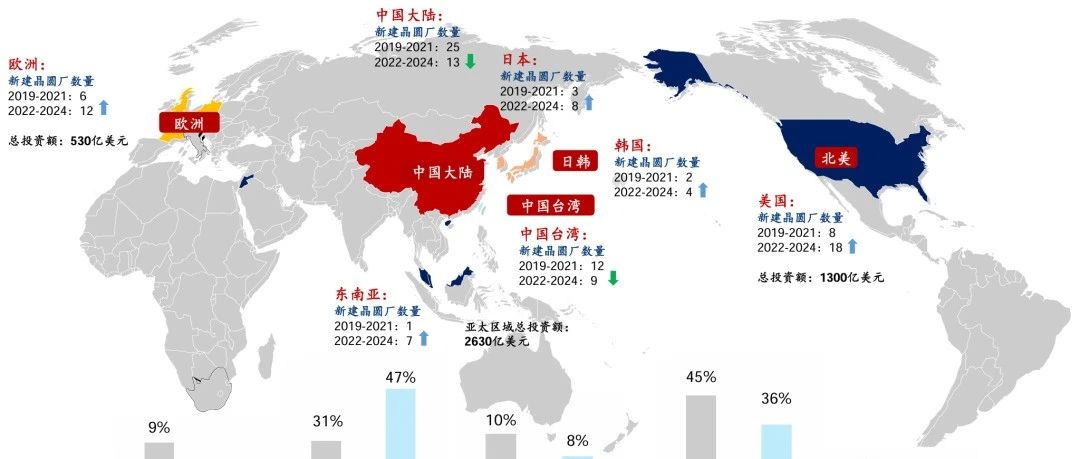
全球新建晶圆厂分布地图
是说芯语· 2025-05-13 00:16
以下文章来源于傅里叶的猫 ,作者小小 傅里叶的猫 . 芯片EDA大厂资深工程师,半导体AI行业解读及研报分享 申请入围"中国IC独角兽" 半导体高质量发展创新成果征集 最近几天我们发的文章里面的数据都很有意思,都是网友们很关注却不好获取的数据。这篇文章,我们 结合华泰证券在今年2月份的一篇研报,截取这个研报中的部分内容,并看下全球新建晶圆厂的格局。 华泰的研究预计,中国大陆2027年在全球12寸成熟制程晶圆代工的市场份额将提升至47%,2023年中国 大陆12寸成熟制程在全球 的产能份额约为29%,预计2024-2027年中国大陆12寸成熟制程产能将保持年 均27% 的快速扩张,到 2027 年占全球的份额将达到 47%。预计 2024-2027 年 40-90nm 节点晶圆代工价 格将呈现 5-8%左右的年降,28nm节点年降预计约3%。晶圆代工为芯片设计企业主要成本,占据约 70- 80%左右的比重。 根据SEMI的数据,2019-2024年全球共兴建128座晶圆厂,其中中国大陆占据30%,扩产高峰期集中于 2019-2021年。展望未来,我们认为中国晶圆代工产业将在全球占据更重要的地位,形成全球竞争力。 ...
关税调整下的半导体行业:短期红利与长期博弈——日内瓦会谈后的产业链重构与技术竞合
是说芯语· 2025-05-12 10:23
Core Viewpoint - The article discusses the recent tariff adjustments between the US and China, highlighting a temporary compromise in the ongoing tech rivalry, particularly in the semiconductor sector, which presents both short-term benefits and long-term challenges for the industry [2][19]. Policy Framework and Execution Mechanism - The US has reduced tariffs on semiconductor-related imports from a maximum of 145% to 30%, while China has lowered its retaliatory tariffs from 125% to 10%, with a 90-day negotiation buffer until August 12, 2025 [2]. - Sensitive areas like semiconductor equipment and AI chips remain excluded from tariff reductions, and the US continues to enforce technology restrictions through an "entity list" [2][7]. Industry Chain Cost Restructuring and Market Segmentation Short-term Cost Improvement and Supply Chain Recovery - Equipment procurement costs have decreased by approximately 18%-22% for companies like SMIC, facilitating expansion plans for advanced processes [4]. - The utilization rate for automotive chips at SMIC's Tianjin facility has increased from 65% to 82% due to reduced costs for mature process chips [5]. - US companies like Qualcomm and Intel are expected to see a 12%-15% increase in sales in China by the second half of 2025, potentially impacting domestic competitors [6]. Long-term Competition and Structural Challenges - Despite tariff reductions, technology access remains restricted, with delays in SMIC's expansion due to equipment export limitations [7]. - Domestic semiconductor equipment and materials are gaining market share, with the bidding rate for domestic 28nm etching machines increasing from 22% to 37% [9]. - The global semiconductor supply chain is undergoing regional restructuring, with increased compliance costs for companies adapting to new trade rules [10]. Differentiated Impact and Strategic Choices in Sub-sectors Semiconductor Equipment and Materials - The cost of exporting lithography and etching machines to China has decreased, but key technologies like EUV lithography remain restricted [11]. - Domestic companies are focusing on technological breakthroughs to reduce costs in semiconductor materials, with current profit margins significantly lower than international competitors [11]. Chip Design and Manufacturing - The import cost of high-end AI chips has decreased by 24%, but US policies may restrict sales to China [12]. - SMIC and Huahong Semiconductor are enhancing their competitiveness in automotive chips, but face pricing pressures from international competitors [12]. Packaging and Testing - SMIC's advancements in advanced packaging technologies may attract more AI chip orders, but competition from US subsidies for TSMC could divert high-end demand [13]. Corporate Response Strategies and Market Outlook Short-term Strategies - Companies are diversifying their supply chains, with SMIC shifting 20% of its equipment procurement to Japan and Europe [14]. - Inventory management strategies are being implemented to mitigate risks from fluctuating tariff policies [15]. Long-term Strategies - Investments in domestic technology are being prioritized, with significant funding directed towards local semiconductor manufacturers [16]. - Companies like Huawei are expanding their market presence in Southeast Asia and the Middle East, with overseas revenue expected to rise [16]. Future Trends - The tariff adjustments represent a temporary easing in US-China tech tensions, but core issues like technology restrictions and industrial subsidies remain unresolved [19]. - The semiconductor industry is expected to experience short-term cost improvements alongside long-term competitive pressures, with key negotiations in the next 90 days being critical for future stability [19].