材料汇

Search documents
新材料全景图:从实验室到全球市场的四大跃迁
材料汇· 2025-12-28 15:55
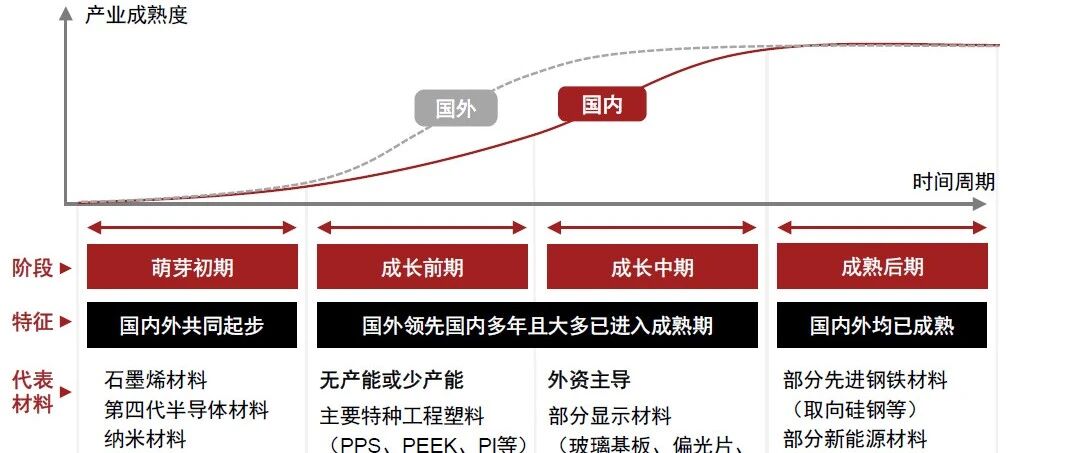
Core Viewpoint - The article outlines the four developmental stages of China's new materials industry, emphasizing its evolution from "catching up" to "keeping pace" and ultimately "leading" in the global market, highlighting the importance of technological iteration and industrial upgrading [2][21]. Group 1: Development Stages - The new materials industry is characterized by four stages: 1. **Emerging Stage**: This is a critical window for China to achieve a "leapfrog" in new materials, where technologies are mostly in experimental stages, and Chinese companies show potential to "keep pace" or even "lead" in certain areas [4][5]. 2. **Early Growth Stage**: This stage is marked by high reliance on imports for core technologies and materials, with significant supply chain risks. The main task is to achieve breakthroughs from "0 to 1" [7][8]. 3. **Mid-Growth Stage**: The industry shows structural maturity with significant domestic production capacity. However, high-end products are still dominated by foreign companies, indicating a need for further breakthroughs in domestic high-end materials [10][11]. 4. **Mature Stage**: Chinese companies have established a competitive advantage in the global market, achieving import substitution and becoming key players in the global supply chain, with the ability to set industry standards [14][21]. Group 2: Key Characteristics of Each Stage - **Emerging Stage**: - Features include a lack of solidified technology routes and significant innovation potential, driven mainly by research institutions and startups [5][6]. - **Early Growth Stage**: - Characterized by high import dependency and long product validation cycles, making it difficult to enter downstream supply chains [8][9]. - **Mid-Growth Stage**: - The market is divided into low-end and high-end segments, with intense competition in the low-end market and foreign dominance in high-end products [11][12]. - **Mature Stage**: - Companies leverage scale, cost control, and supply chain efficiency to compete globally, with some becoming industry leaders [14][21]. Group 3: Future Outlook - The future of the new materials industry in China is expected to play a crucial role in manufacturing upgrades, renewable energy revolutions, and healthcare, aiming for a transition from a "material power" to a "material strong power" [22].

1300+份新材料报告下载:做新材料领域的「攻坚者」
材料汇· 2025-12-28 15:55
Core Viewpoint - The article discusses the rapid growth and investment opportunities in advanced packaging materials, highlighting the potential for domestic companies to replace foreign imports in this sector [7][8]. Market Overview - The global market for advanced packaging materials is projected to reach $2.032 billion by 2028, with the Chinese market expected to grow to 9.67 billion yuan by 2025 [8]. - Specific materials such as PSPI, epoxy resin, and conductive adhesives are identified as key growth areas, with significant market size and growth forecasts [8]. Investment Opportunities - The article outlines various advanced packaging materials and their respective market sizes, including: - PSPI: $528 million in 2023, expected to grow significantly [8]. - Conductive adhesives: projected to reach $3 billion by 2026 [8]. - Chip bonding materials: estimated at $485 million in 2023, with a forecast of $684 million by 2029 [8]. - Domestic companies like Dinglong Co., Guofeng New Materials, and others are positioned to capitalize on these growth opportunities [8]. Competitive Landscape - The article compares domestic and foreign companies in the advanced packaging materials sector, noting that while foreign firms like Fujifilm and Toray dominate, domestic players are emerging rapidly [8]. - The competitive dynamics suggest a potential shift towards domestic production as companies seek to reduce reliance on imports [7][8]. Investment Strategies - Different investment stages in the new materials industry are discussed, emphasizing the importance of assessing team capabilities, market potential, and product maturity at each stage [10]. - The article suggests that investments in more mature companies with established sales channels present lower risks and higher returns [10].


产能大爆发,原料国产化:尼龙66行业正迎来“黄金十年”?
材料汇· 2025-12-27 15:46
Industry Overview - Nylon 66 (PA66) is recognized as the "crown jewel" of engineering plastics, characterized by its high crystallinity and excellent physical properties due to its symmetrical molecular structure [4][6][18] - The historical development of PA66 reflects significant advancements in synthetic materials, starting from its invention by DuPont in the 1930s to its strategic military applications during World War II and subsequent industrial expansion [8][12][14] - PA66's unique properties, such as high melting point (approximately 260°C), mechanical strength, self-lubrication, and chemical resistance, make it irreplaceable in various applications [18][20][21] Industry Positioning - The PA66 industry is transitioning from a "high premium monopoly" to a "self-controlled" model, as China has made significant breakthroughs in the production of key raw materials, particularly adiponitrile (ADN) [33] - The industry is now viewed as a symbol of China's chemical sector achieving high levels of self-reliance and independence [33] Supply Chain Analysis - The PA66 supply chain is characterized by high barriers to entry and significant global division of labor, with ADN being the critical intermediate that determines the industry's viability [40][41] - The supply chain exhibits a "sandglass" structure, with numerous participants upstream and a concentrated number of key players in the middle [43] - The production of ADN is dominated by a few global giants, and the technology involved is complex, leading to a historical monopoly [48][51] Market Dynamics - The global nylon 66 market has been historically dominated by a few companies, with pricing power held by major players like Invista, Ascend, and BASF [63][65] - The market is experiencing a shift, with China's domestic production capacity rapidly increasing, moving from a net importer to a potential net exporter of nylon 66 [79] - The demand for nylon 66 is expected to grow significantly, particularly in the Asian market, driven by applications in automotive and consumer goods [75][76] Technological Advancements - Continuous polymerization processes and vertical reactors are becoming the industry standard, enhancing efficiency and reducing energy consumption [82][87] - The adoption of advanced technologies in production is crucial for maintaining competitive advantages in the global market [105][107] Downstream Applications - The consumption structure of nylon 66 is highly concentrated, with engineering plastics accounting for approximately 57% and synthetic fibers for about 40% of the market [109]



特种尼龙:打破海外垄断,中国高端新材料的下一个百亿赛道
材料汇· 2025-12-27 15:46
Core Viewpoint - Specialty nylon is a key direction for the high-end, functional, and green development of the new materials industry, overcoming limitations of conventional nylon through molecular structure design and synthesis process innovation [1][2]. Group 1: Overview of Specialty Nylon - Specialty nylon refers to polyamide materials excluding common nylons (PA6 and PA66), including long-chain nylon, high-temperature nylon, transparent nylon, and bio-based nylon [5][7]. - Long-chain nylon and high-temperature nylon dominate the specialty nylon market, with various subcategories emerging to meet diverse application needs [5][8]. Group 2: Market Supply and Demand - The global specialty nylon production capacity is approximately 600,000 tons per year, with major producers including Arkema, DuPont, and DSM [10][11]. - The market is characterized by high technical barriers in key monomers and polymerization processes, with significant contributions from both international giants and emerging domestic producers [10][14]. Group 3: Long-Chain Nylon - Long-chain nylon, defined by having more than ten methylene groups in its molecular chain, exhibits high toughness and low water absorption, making it suitable for applications in automotive, electronics, and military sectors [16][20]. - The global production capacity for long-chain nylon is around 270,000 tons per year, with a projected market value of $2.846 billion in 2024, expected to grow to $3.64 billion by 2031, reflecting a CAGR of 3.6% [21][23]. Group 4: High-Temperature Nylon - High-temperature nylon can operate at temperatures up to 150°C, with a global production capacity of approximately 335,000 tons per year, widely used in automotive, electronics, and mechanical manufacturing [26][32]. - The production of high-temperature nylon is dominated by companies like DuPont and Solvay, with ongoing innovations in synthesis processes to enhance performance and sustainability [28][32].



1300+份新材料报告下载:做新材料领域的「攻坚者」
材料汇· 2025-12-27 15:46
Core Viewpoint - The article discusses the rapid growth and investment opportunities in the advanced packaging materials sector, highlighting the potential for domestic companies to replace foreign imports in critical areas of technology [7][8]. Market Overview - The global market for advanced packaging materials is projected to reach $2.032 billion by 2028, with the Chinese market expected to grow to 9.67 billion yuan by 2025 [8]. - Specific materials such as PSPI, epoxy resin, and conductive adhesives are identified as key growth areas, with significant market sizes and growth rates anticipated [8]. Investment Opportunities - The article outlines various advanced packaging materials and their respective market sizes, including: - PSPI: $528 million in 2023, expected to grow significantly [8]. - Conductive adhesives: projected to reach $3 billion by 2026 [8]. - Chip bonding materials: expected to grow from approximately $485 million in 2023 to $684 million by 2029 [8]. - The investment landscape is characterized by a shift towards domestic production, with numerous Chinese companies emerging as competitors to established foreign firms [7][8]. Industry Trends - The article emphasizes the trend of domestic substitution in advanced materials, particularly in sectors heavily reliant on imports from countries like Japan [7][8]. - It highlights the importance of innovation and collaboration among domestic companies to enhance competitiveness in the global market [21]. Strategic Insights - Investment strategies vary across different stages of company development, from seed rounds to pre-IPO phases, with a focus on team capabilities, market potential, and product maturity [10]. - The article suggests that companies in the growth phase with established sales channels and increasing revenue present lower investment risks and higher potential returns [10].
过剩时代的价值突围:中国尼龙6(PA6)产业链全景扫描与战略展望(7448字)
材料汇· 2025-12-27 15:46
Core Viewpoint - The nylon 6 industry is facing significant challenges due to structural overcapacity, with rapid production expansion outpacing demand growth, leading to a decline in industry profit margins and increased competition. The industry must shift from scale expansion to value enhancement, focusing on high-end and differentiated products to navigate these challenges [2][3][7]. Overview - Nylon 6, also known as PA6 or polyamide 6, is a crucial synthetic fiber and engineering plastic material with diverse applications, including textiles, automotive parts, and food packaging. China has become the global center for nylon 6 production, accounting for over 50% of global capacity and consumption [2][3][6]. Industry Chain Analysis - The nylon 6 industry chain includes key components such as caprolactam, nylon 6 chips, fibers, engineering plastics, films, and composite materials. Caprolactam is a vital raw material for producing nylon 6 chips, which are further processed into various products [10][11][12][15]. Market Supply and Demand - Global nylon 6 production capacity is primarily concentrated in China, which holds 57% of the total capacity, followed by Western Europe at 11%. The demand for nylon 6 is expected to grow significantly in China over the next 5-10 years [18][20][22]. Domestic Supply and Demand Forecast - China's nylon 6 chip production and consumption have shown steady growth, with production increasing from 312,000 tons in 2018 to 502,500 tons in 2023, reflecting a compound annual growth rate of 10%. The import dependency for nylon 6 chips has decreased from 11.15% in 2018 to 4.68% in 2023 [25][28]. Production Capacity Distribution - As of the end of 2023, China's caprolactam production capacity reached 6.53 million tons, with 11 companies holding 75.19% of the total capacity. The nylon 6 chip production capacity exceeded 5.34 million tons, with 25 companies contributing to this output [36][39]. Competitive Landscape - The nylon 6 industry is characterized by increasing competition, particularly in the caprolactam and nylon 6 chip segments. Companies are encouraged to enhance their technological capabilities and explore international markets to mitigate overcapacity issues [47][48]. Technological Features - The nylon 6 production process has evolved significantly, with various polymerization techniques employed, including single-stage and two-stage polymerization. The industry is also focusing on improving spinning and twisting technologies to enhance product quality [51][53]. Industry Barriers and Challenges - The nylon 6 industry faces several barriers, including high capital requirements, technological complexities, and increasing competition. New entrants must overcome significant challenges to compete effectively in this mature industry [57][58].



100页深度报告:半导体产业的发展复盘与方向探索
材料汇· 2025-12-26 14:58
Global Semiconductor Market Analysis - The global semiconductor market is projected to reach $659.1 billion in 2024, representing a year-on-year growth of 20.0%, and is expected to grow to $789.3 billion by 2025 [2][14] - Integrated circuits will account for the largest share at 73.9%, while artificial intelligence chips will see the fastest growth at 49.3% [2][14] - In 2023, the top ten companies in the global semiconductor market are primarily from the US, Taiwan, and South Korea, with no mainland Chinese companies in the top ranks [2][16] China Semiconductor Market Analysis - China's semiconductor market is expected to reach $176.9 billion in 2024, with a year-on-year growth of 15.9%, and is projected to reach $206.7 billion by 2025 [2][16] - Integrated circuits will dominate the Chinese market, accounting for $139.3 billion, or 78.7% of the total market, with artificial intelligence chips growing at 48.3% [2][16] Historical Development of the Semiconductor Industry - The global semiconductor industry has evolved through four major phases: the rise of personal computers and the internet (1986-1999), network communications and consumer electronics (2000-2010), the smartphone and 3G/4G/5G era (2010-2020), and the current AI technology and data center phase (2023-present) [3][21][24] Semiconductor Industry Chain Overview - The semiconductor industry chain consists of upstream (EDA/IP, semiconductor equipment, semiconductor materials), midstream (semiconductor design, wafer manufacturing, and packaging/testing), and downstream (packaging and testing) segments [6][62] - Upstream EDA/IP is dominated by companies like Synopsys and Cadence, while semiconductor equipment is led by ASML for EUV lithography, with high industry concentration [6][62] Future Development Directions in the Semiconductor Industry - Key future development areas in the semiconductor industry include third-generation semiconductor materials, computing chips, RF communication chips, and high-bandwidth memory [8][10] Investment Recommendations - The domestic semiconductor industry is expected to make breakthroughs in upstream core equipment, materials, and software, driven by national policies and international dynamics [9] - Investment opportunities are particularly promising in third-generation semiconductor materials, computing chips, RF communication chips, and high-bandwidth storage [9][10]






金属新材料2026年策略:顺时代之势,变革中掘金
材料汇· 2025-12-26 14:58
Core Viewpoint - The article emphasizes investment opportunities in upstream metal new materials driven by three key sectors: AI computing power, new energy, and humanoid robots for 2026. The demand for high-frequency, high-power, high-heat dissipation, and miniaturization is leading the material transformation [1]. Group 1: AI Materials - In the inductance field, metal soft magnetic chip inductors are highlighted for their miniaturization and high current resistance, with companies like Platinum New Materials and Dongkui Co. recommended for investment [1][2]. - In the capacitor sector, the recovery of consumer electronics and the AI engine's resonance suggest a new cycle for MLCCs, with nickel powder benefiting directly, making companies like Boqian New Materials a focus [2]. - The demand for liquid cooling materials in data centers is expected to grow significantly, with companies like Bowei Alloy recommended for their liquid cooling solutions [2]. Group 2: New Energy Materials - Copper is leading the cost revolution in photovoltaics, with companies like Boqian New Materials suggested for investment [4]. - Amorphous alloys are identified as suitable for high power density motors, with Yunlu Co. recommended [4]. - The axial flux motor is anticipated to drive the electric revolution, with Dongmu Co. highlighted for its potential [4]. Group 3: Humanoid Robot Materials - Lightweight materials, particularly magnesium, are noted as competitive, with Baowu Magnesium Industry recommended [4]. - Rare earth permanent magnets are expected to open up long-term growth in high-performance magnetic materials for humanoid robots, with companies like Jinli Permanent Magnet and Ningbo Yunsheng suggested [4]. - MIM (Metal Injection Molding) technology is emphasized for its advantages in robot structural components, with Dongmu Co. again highlighted [4]. Group 4: Capacitors - The MLCC industry is poised for recovery, with significant growth expected in 2024 driven by AI applications and consumer electronics [29]. - AI servers are projected to significantly increase MLCC demand, with estimates suggesting a rise from 603 million units in 2025 to 1.55 billion units by 2028, reflecting a CAGR of 37.2% [37]. - Companies like Boqian New Materials are positioned to benefit from the high-capacity MLCC market driven by AI [38]. Group 5: Liquid Cooling Materials - The demand for liquid cooling solutions is increasing due to the high-density requirements of AI servers, with Bowei Alloy recommended for their innovative materials [49]. - Tungsten-copper alloys are expected to meet the stringent thermal management needs of optical modules, with companies like Sui Rui New Materials suggested for investment [50].


1300+份新材料报告下载:做新材料领域的「攻坚者」
材料汇· 2025-12-24 16:01
点击 最 下方 关注《材料汇》 , 点击"❤"和" "并分享 添加 小编微信 ,寻 志同道合 的你 正文 材料汇文章标签汇总 如何下载(加入知识星球-材料汇) 材料汇部分文章 未来40年材料强国革命:这13大领域将重塑人类文明! 国产替代爆发!14种卡脖子的先进封装材料,百亿赛道谁将突围? | 先进封装材料 | 全球市场规模 | 中国市场规模 | 国外企业 | 国内企业 | | --- | --- | --- | --- | --- | | PSPI | | | 微系统、AZ电子材料 | 鼎龙股份、国风新材、三月科 | | | | 5.28亿美元(23年 7.12亿元(21 | Fujifilm, Toray, HD | 技、八亿时空、强力新材、瑞 | | | 全球) . 预计 | 年中国)、预 | | 华泰、诚志殷竹、艾森股份、 | | | 2028年将达到 | 汁到2025年增 | | 奥采德:波米科技、明士新材 | | | 20.32亿美元 | 长至9.67亿元 | 、旭化成 | 、东阳华芯、上海玟昕、理硕 | | | | | | 科技等 | | 光敏绝缘 | 2020年:0.1亿 | | | | | ...
2035年新材料产业发展需求、发展重点与发展方向
材料汇· 2025-12-24 16:01
Core Viewpoint - The article outlines the strategic development needs of the new materials industry aimed at 2035, emphasizing the importance of advanced materials in various sectors such as aerospace, automotive, energy, and healthcare [2][4]. Group 1: New Material Demand by Application - Aerospace applications require high-strength and damage-resistant aluminum-lithium alloys, carbon fiber composites, and high-temperature alloys [2]. - Energy-efficient vehicles will need lightweight carbon fiber materials, high-strength steel, and advanced semiconductor materials [2]. - The healthcare sector demands biocompatible materials for bone regeneration and dental implants, including bioactive ceramics and titanium alloys [10][12]. Group 2: Development Focus and Directions - Advanced steel materials are essential for manufacturing high-performance marine steel, automotive steel, and energy-use steel [3][17]. - Key strategic materials include high-end special alloys, high-performance fibers, and new energy materials such as lithium-ion and solid-state battery materials [18][19]. - The development of advanced semiconductor materials and chip packaging is crucial for the electronics industry [18]. Group 3: Future Goals - By 2025, the goal is to synchronize new material technologies with international standards and significantly enhance product quality and stability [14]. - By 2035, the aim is to establish a robust domestic innovation system for materials, addressing critical supply issues and enhancing international competitiveness [14]. - By 2050, the objective is to be among the leading countries in material innovation, meeting national economic and defense needs [14]. Group 4: Evaluation and Standardization - The establishment of a comprehensive evaluation and standardization platform for new materials is necessary to support industry development [22][23]. - This includes optimizing the standard system, improving quality evaluation frameworks, and fostering third-party certification bodies [23].