
第三代半导体材料

Search documents
集结产业中坚力量!共破国产化攻坚难题
半导体行业观察· 2026-02-19 02:46
Core Viewpoint - The article emphasizes the importance of heterogeneous integration and optoelectronic fusion in the semiconductor and optoelectronic industries as key paths for technological breakthroughs and domestic substitution, especially with the rapid growth of AI computing power and the upcoming 5G-A and 6G deployments [1]. Industry Overview - By 2025, China's semiconductor market is projected to exceed 2.3 trillion yuan, with the optoelectronic device market accounting for 18%. However, the domestic substitution rate in critical areas such as third-generation semiconductor materials, high-end EDA tools, and photonic integrated chips (PIC) remains below 40% [1]. - The upcoming "Collaborative Innovation Forum from Devices to Networks" aims to facilitate collaboration across the entire industry chain, bringing together key players from academia, enterprises, and demand-side [1]. Event Details - The forum will take place on March 18, 2026, at the Shanghai New International Expo Center, focusing on full industry chain collaboration [1]. - The event will gather around 200 core industry practitioners, including major telecom operators, leading cloud service providers, equipment manufacturers, and key players in the optoelectronic and semiconductor sectors [1]. Participation and Engagement - The forum will also feature a live broadcast on the Semiconductor Industry Observation video account, expected to attract over 100,000 industry peers, breaking down geographical barriers for communication [2]. - Notably, 45% of participating companies have revenues exceeding 1 billion yuan, with an average of over 15% of their revenue invested in R&D [2]. Technological Breakthroughs - The article highlights that the domestic semiconductor industry's breakthroughs are not isolated but require a full-chain collaboration from materials to applications. Current advancements in areas like advanced packaging and optical matrix computing (oMAC) have established a foundation for collaboration [2]. - The event's agenda includes discussions on various topics, such as optoelectronic integrated chips for information and communication systems, silicon photonics for high-speed AI optical connections, and the advantages of silicon capacitors in AI applications [3][4]. Collaborative Innovation - The core of collaborative innovation is to break down information barriers and technological silos, allowing for rapid transformation of academic research into industrial productivity and driving technological iterations through enterprise application needs [7]. - The forum aims to create a bridge for efficient connections across the entire chain from source innovation to industrial implementation, facilitating direct procurement opportunities for participating companies with major cloud service providers and telecom operators [6][7].

利好来了!
中国基金报· 2026-01-08 10:14
Core Viewpoint - Guangzhou is accelerating the construction of an advanced manufacturing city with a focus on strategic industries and innovation, aiming for significant progress by 2030 and a robust industrial system by 2035 [2][4]. Group 1: Strategic Industry Development - By 2030, Guangzhou aims to establish a modern industrial system with a new structure that includes trillion-yuan driving forces and significant improvements in quality and efficiency [4]. - The city plans to cultivate five strategic leading industries, including artificial intelligence, semiconductors, new energy, low-altitude economy, and biomanufacturing, to double industrial added value by 2035 [5][6]. - Six emerging pillar industries will be developed, such as smart connected vehicles and biomedicine, alongside four characteristic advantage industries [6]. Group 2: Technological Innovation and Infrastructure - Guangzhou will support the exploration of autonomous driving applications in public transport and the establishment of intelligent transportation demonstration zones [9]. - The city is focused on promoting the large-scale application of self-controlled automotive chips and enhancing the security of the supply chain [10]. - There will be a push for the construction of intelligent computing infrastructure and the development of a public computing center to support AI and digital transformation [11]. Group 3: Robotics and Advanced Manufacturing - The city will prioritize the development of embodied robots for various applications, including home services and industrial manufacturing [12]. - There is a strong emphasis on advancing third-generation semiconductor materials and promoting the manufacturing of high-value medical devices [13][16]. - By 2035, the robotics and intelligent equipment sector is expected to reach a scale of 300 billion [14]. Group 4: Aerospace and Satellite Development - Guangzhou aims to establish a liquid rocket assembly and testing base to support the development of reusable rocket technology [18]. - The city will encourage local universities and enterprises to participate in satellite constellation projects, fostering a complete commercial aerospace ecosystem [19]. - By 2035, Guangzhou plans to become a core area for integrated circuits and a significant player in the commercial aerospace sector [20][21]. Group 5: Superconducting Materials and Applications - The city will promote the application of high-temperature superconducting materials in various fields, including nuclear fusion and medical devices [22].

36氪研究院 | “十五五”时期重点产业前瞻与发展路径研究
3 6 Ke· 2025-12-29 23:32
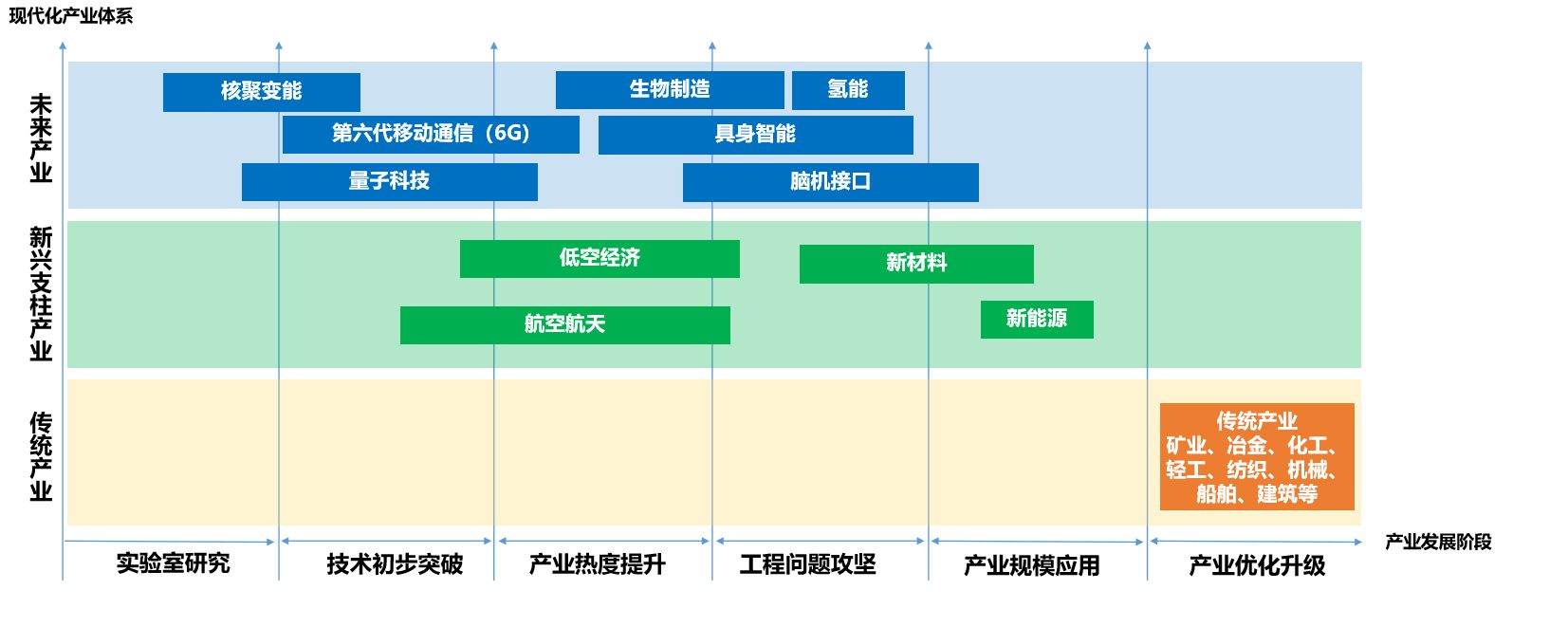
Core Insights - The "14th Five-Year Plan" emphasizes the construction of a modern industrial system as a primary strategic task, marking a shift from isolated technological breakthroughs to systematic industrial upgrades [4][10] - The new energy industry is transitioning from focusing on installed capacity to establishing a "source-network-load-storage" collaborative system, emphasizing dynamic balance between production and consumption [4][18] - The aerospace sector is developing a dual-driven model of national engineering and commercial spaceflight, with large aircraft industrialization and commercial spaceflight jointly promoting the scale and capability of the industrial chain [4][35] - Future industries such as 6G and quantum technology place China in the global leading tier of R&D, aiming to seize the high ground in technology standards and industrial ecosystems through forward-looking layouts [4][61] - The transformation of traditional industries emphasizes not only greening and intelligentization but also explicitly promotes "service-oriented manufacturing," guiding the manufacturing sector to extend services throughout the product lifecycle [4][93] Emerging Pillar Industries - The cultivation of emerging pillar industries is positioned as a core strategy for high-quality development, with a focus on sectors like aerospace and low-altitude economy that have industrialization foundations [14][35] - The new energy sector is expected to maintain a leading global position, with installed capacity projected to reach 1.41 billion kilowatts by the end of 2024, accounting for 83% of new installations [18][20] - The new materials industry is rapidly growing, with a total output value expected to exceed 8 trillion yuan by 2024, although about 30% of key high-end materials still rely on imports [29][30] Future Industries - Future industries represent cutting-edge directions, with a focus on quantum technology, biomanufacturing, hydrogen energy, brain-computer interfaces, and embodied intelligence [61][62] - The quantum technology sector is expected to grow significantly, with the global market projected to reach nearly 1 trillion USD by 2035, driven by advancements in quantum communication and measurement [64][66] - The biomanufacturing industry is anticipated to maintain rapid growth, with a total scale of approximately 1.1 trillion yuan, although it faces challenges in high-end industrial strains and precision technology [69][70] Traditional Industries - The modernization of traditional industries is crucial for maintaining competitiveness in global industrial division, with a focus on enhancing the self-controllability of industrial chains [93][94] - The transformation of traditional industries includes promoting digitalization and green initiatives, as well as extending manufacturing into service-oriented solutions [93][94] - The integration of emerging technologies into traditional industries is expected to create a resilient modern industrial system, laying a decisive foundation for achieving the goal of becoming a manufacturing powerhouse by 2035 [96]
2035年新材料产业发展需求、发展重点与发展方向
材料汇· 2025-12-24 16:01
Core Viewpoint - The article outlines the strategic development needs of the new materials industry aimed at 2035, emphasizing the importance of advanced materials in various sectors such as aerospace, automotive, energy, and healthcare [2][4]. Group 1: New Material Demand by Application - Aerospace applications require high-strength and damage-resistant aluminum-lithium alloys, carbon fiber composites, and high-temperature alloys [2]. - Energy-efficient vehicles will need lightweight carbon fiber materials, high-strength steel, and advanced semiconductor materials [2]. - The healthcare sector demands biocompatible materials for bone regeneration and dental implants, including bioactive ceramics and titanium alloys [10][12]. Group 2: Development Focus and Directions - Advanced steel materials are essential for manufacturing high-performance marine steel, automotive steel, and energy-use steel [3][17]. - Key strategic materials include high-end special alloys, high-performance fibers, and new energy materials such as lithium-ion and solid-state battery materials [18][19]. - The development of advanced semiconductor materials and chip packaging is crucial for the electronics industry [18]. Group 3: Future Goals - By 2025, the goal is to synchronize new material technologies with international standards and significantly enhance product quality and stability [14]. - By 2035, the aim is to establish a robust domestic innovation system for materials, addressing critical supply issues and enhancing international competitiveness [14]. - By 2050, the objective is to be among the leading countries in material innovation, meeting national economic and defense needs [14]. Group 4: Evaluation and Standardization - The establishment of a comprehensive evaluation and standardization platform for new materials is necessary to support industry development [22][23]. - This includes optimizing the standard system, improving quality evaluation frameworks, and fostering third-party certification bodies [23].

重磅!全球关键电子材料应用进展与我国未来发展方向(23000字)
材料汇· 2025-12-23 15:04
Core Viewpoint - The article emphasizes the importance of electronic materials in various high-tech industries, highlighting the need for innovation and domestic production capabilities to enhance China's competitiveness in the global market [7][9]. Group 1: Industry Overview - Electronic materials are crucial for manufacturing electronic devices, integrated circuits (ICs), and optoelectronic devices, directly impacting product functionality and efficiency [7]. - The global semiconductor industry is projected to reach a total sales of $526.8 billion in 2023, with IC electronic materials accounting for approximately 12.7% of this market [7]. - The demand for electronic materials is increasing in sectors such as ICs, display technology, photovoltaic energy, and high-end capacitors/resistors, driven by advancements in information technology and communication [7][9]. Group 2: Key Electronic Materials - **Semiconductor Materials**: Silicon (Si) is the primary material used in over 95% of semiconductor devices, with a market dominated by companies like Shin-Etsu Chemical and Sumco, holding over 90% market share in 8-12 inch wafers [11][15]. - **Electronic Specialty Gases**: The market for electronic specialty gases is highly concentrated, with major players like Air Products and Linde holding over 80% market share. The largest category, NF3, has a market size of $8.8 billion [16][18]. - **Photoresists**: The photoresist market is critical for IC manufacturing, with costs accounting for about 35% of total chip manufacturing costs. The development of EUV photoresists is essential for advanced nodes below 7nm [19][21]. - **Wet Electronic Chemicals**: The global market for wet electronic chemicals was valued at 639.1 billion yuan in 2022, with a projected growth rate of 8.9% annually [25]. - **CMP Materials**: Chemical Mechanical Polishing (CMP) materials are vital for achieving high precision in wafer manufacturing, with the global market for CMP pads and slurries growing significantly from 2016 to 2021 [28][29]. - **Third-Generation Semiconductor Materials**: Materials like SiC and GaN are gaining traction due to their superior properties for high-frequency and high-power applications, with China's market for these materials reaching approximately 85.4 billion yuan in 2023 [30][31]. Group 3: Market Dynamics and Trends - The electronic materials industry is characterized by a high degree of international competition, with the U.S., Europe, Japan, South Korea, and China being the main players [8]. - The ongoing technological revolution and industrial transformation present both challenges and opportunities for the electronic materials sector, necessitating advancements in material performance to meet the demands of emerging technologies like 6G and quantum computing [8][9]. - The article highlights the need for China to enhance its domestic production capabilities and innovation in electronic materials to ensure supply chain security and reduce reliance on foreign imports [9].

合盛硅业董事长罗立国: 以“跬步”至千里 攀“硅基”新高峰
Zheng Quan Shi Bao· 2025-12-17 19:22
Core Insights - The story of the chairman of Hoshine Silicon Industry, Luo Liguo, exemplifies the corporate spirit of "accumulating small steps to reach great heights" through over thirty years of dedication to the mission of "focusing on silicon-based new materials to create a better life" [1][2] - Luo Liguo's journey began in 1989 with a humble start in a craft factory producing straw hats, where he developed a deep understanding of quality and market dynamics, laying a solid foundation for future endeavors [1] - At the turn of the century, he made a strategic pivot to the silicon materials industry, driven by profound insights into industrial development rather than merely chasing trends [1] - The strategic boldness of Luo Liguo is evident in his establishment of the first integrated "coal, electricity, silicon" industrial park in Xinjiang in 2009, which created unparalleled cost and scale advantages through a forward-looking full industry chain layout [1] - After the company's IPO in 2017, Luo Liguo made a decisive choice to focus entirely on the silicon-based main business, positioning the company at the forefront of the global new energy wave [1] - Hoshine Silicon Industry has transformed from an industry follower to a leading player in industrial silicon and organic silicon production capacity, ranking among the world's top [1] Industry Focus - The mission of "focusing on silicon-based new materials" has been a consistent theme throughout the company's journey, from initial developments in silicone rubber to the current advancements in third-generation semiconductor materials used in photovoltaics and new energy vehicles [2] - Each capacity expansion and technological extension led by Luo Liguo aims to contribute to the "dual carbon" strategy of the country, significantly promoting energy transition and enhancing quality of life through green silicon-based products [2] - The narrative of Luo Liguo serves as a practical guide on how the greatest achievements begin with solid foundations and how enduring success stems from decades of unwavering focus on a mission [2]


专访田轩:一家有12项核心专利的AI芯片企业却贷不到款,怎么解?
经济观察报· 2025-12-09 10:21
Core Viewpoint - The core positioning of finance should shift from being a provider of funds to becoming a co-creator of value and an ecosystem builder, deeply participating in the incubation and integration of the industrial innovation chain [1][3][4]. Group 1: New Quality Productivity - New quality productivity is driven by revolutionary technological breakthroughs, innovative allocation of production factors, and deep industrial transformation, enhancing total factor productivity through qualitative changes in labor, materials, and objects [2]. - The cultivation and growth of new quality productivity require a financial system to provide systematic support, with precise matching and efficient allocation of financial resources at every stage [2]. Group 2: Financial Ecosystem Transformation - Traditional financial models focus on collateral assessment and financial metrics, driven by risk aversion, while finance that empowers new quality productivity must integrate deeply into the innovation chain, making forward-looking value judgments based on technological evolution and industrial transformation trends [3][4]. - The financial ecosystem should be built around scenario-based financial product design and an open financial platform that integrates research institutions, industry chains, and venture capital, facilitating the efficient circulation of innovative elements [3][4]. Group 3: Structural Challenges in Financing - There is a structural mismatch between traditional financial practices and the characteristics of technology companies, which often have high R&D costs, low fixed assets, and lack of collateral, making it difficult for traditional credit assessment systems to accurately measure their true value and growth potential [4][5]. - A case study of an AI chip design startup illustrates this issue, where the company was denied a loan due to insufficient collateral despite having significant intellectual property and revenue, highlighting the need for innovative financing solutions [5]. Group 4: Comparison of US and Chinese Market Structures - The comparison of the top ten listed companies in the US and China reflects differences in economic structure, industrial policy, and innovation ecosystems, with the US favoring technology giants and long-term capital support, while China remains focused on traditional economic pillars [7]. - The US capital market has a higher tolerance for long-term, high-risk investments, encouraging disruptive innovation, whereas China's financial system is primarily based on indirect financing, limiting the growth of technology companies [7][8]. Group 5: Financial System Challenges and Reforms - The financial system faces challenges in adapting to structural changes in the economy, particularly in serving technological innovation and industrial upgrading, with traditional risk assessment models being rigid and regulatory frameworks lagging [9]. - Proposed reforms include optimizing credit structures, deepening interest rate marketization, and enhancing the efficiency of financial resource allocation to ensure funds are directed towards key areas like technological innovation [9]. Group 6: Government Investment Funds and Risk Management - Government investment funds should have clear functional positioning, employing a "negative list + due diligence" approach to manage investment risks while maintaining market-oriented operations [10]. - Innovative funding models, such as "mother fund + sub-fund" structures, can help balance fiscal safety and investment risks, focusing on cluster investments to mitigate the impact of individual project failures [10].

专访田轩:金融如何服务新质生产力
Jing Ji Guan Cha Wang· 2025-12-08 09:45
Group 1 - The concept of "new quality productivity" is defined as an advanced productivity driven by technological breakthroughs, innovative allocation of production factors, and deep industrial transformation, aiming to enhance total factor productivity through qualitative changes in labor, materials, and objects [2] - The cultivation and growth of new quality productivity require a financial system to provide systematic support, emphasizing the need for precise matching and efficient allocation of financial resources at every stage [2] Group 2 - Financial institutions should transition from being mere fund providers to becoming value co-creation ecosystem builders, deeply engaging in the incubation and integration of industrial innovation chains [3][4] - The traditional financial model focuses on collateral assessment and financial metrics, while the new model for empowering new quality productivity necessitates a proactive value judgment based on technological evolution and industrial transformation trends [4] Group 3 - The structural mismatch between traditional financial risk aversion and the characteristics of technology companies, which often have high R&D and low fixed assets, leads to difficulties in financing [5] - An example is provided of an AI chip design startup with 12 core patents and annual revenue of 120 million yuan, which was denied a loan due to lack of tangible assets, ultimately securing funding through a financial asset investment company [5] Group 4 - The challenges faced by the financial system include a mismatch between the financial structure and the evolving needs of the real economy, particularly in supporting technological innovation and industrial upgrades [9] - Reforms should focus on enhancing the efficiency of financial resource allocation, optimizing credit structures, and promoting the development of multi-tiered capital markets to better meet the financing needs of specialized and innovative enterprises [10] Group 5 - Local governments have expanded government investment funds to support innovation, but there is a need to balance the safety of fiscal funds with investment risks [11] - Recommendations include defining the functions of government investment funds, adopting a market-oriented approach, and enhancing post-investment management to improve efficiency and reduce risks [11]

构建材料领域多层次创新体系
Xin Hua Ri Bao· 2025-10-28 20:34
Group 1 - The core viewpoint emphasizes that the level of materials determines the competitiveness of industries, as stated by Xu Nanping, an academician of the Chinese Academy of Engineering [1] - Jiangsu's "14th Five-Year" Science and Technology Innovation Plan identifies the new materials industry as a key area for accelerating breakthroughs in core technologies and building a modern industrial system, focusing on research directions such as nanomaterials, advanced carbon materials, advanced metal materials, and third-generation semiconductor materials [1] - A multi-layered innovation system has been established in Jiangsu, including the establishment of a national laboratory alliance in the materials field and the launch of three national key laboratories aimed at original innovation [1] Group 2 - Since the "14th Five-Year" period, the provincial science and technology department has supported enterprises in leading key core technology research projects, promoting a virtuous cycle of "demand-driven research and innovation-driven industry" [2] - This dual approach of driving source innovation from the industrial end and supporting industry iteration through basic research aligns with the concept of "materials empowering industries" emphasized by Xu Nanping [2] - The initiatives are laying a solid foundation for Jiangsu's new materials industry to transition from technological breakthroughs to application expansion, aiming to create a globally influential industrial technology innovation center [2]
全球半导体产业链的重构及其应对
半导体芯闻· 2025-04-27 10:46
如果您希望可以时常见面,欢迎标星收藏哦~ 来源:内容来自学习时报 ,谢谢 。 半导体产业作为现代工业金字塔尖的"明珠"和数字经济的核心底座,支撑着人工智能、6G通信、 新能源汽车等新兴产业发展,全球市场规模增长迅速。当前,世界百年未有之大变局加速演进,科 技革命和大国博弈相互交织,深刻重塑全球秩序与发展格局,地缘政治紧张局势叠加全球芯片短缺 危机等因素,半导体产业关键地位尤为凸显,主要经济体加速布局半导体产业与技术。 半导体产业正经历广泛而深刻的全球性变革。 半导体产业链涵盖基础材料研发、设备制造上游环 节,芯片设计、制造、封装、测试中游环节,消费电子、汽车电子、AI服务器终端应用等下游环 节,呈现高技术、高资本密集型产业特征。在过去效率优先的传统因素驱使下,各国基于资源禀 赋、技术水平、成本考量、产业基础等差异,充分发挥比较优势进行分工布局,半导体产业链在全 球范围内形成高度垂直化分工格局。如美国主导芯片设计,日本、荷兰聚焦关键材料与设备,东亚 地区凭借成熟供应链和低成本劳动力长期主导制造、封测环节。当前,随着技术不断迭代升级,人 工智能、量子计算等前沿领域的加速突破,以及全球经济格局、地缘政治等多重因素的 ...