
GUANGDONG DRIVE BIO-TECH CO.(838275)

Search documents
报告:高温、年中大促与健康需求是二季度消费的主要驱动力
Xin Hua Cai Jing· 2025-09-23 15:16
Core Insights - The report highlights significant growth in consumer goods sales in Q2 2025, driven by high temperatures, mid-year promotions, and health demands [1][2] Group 1: Sales Growth by Category - The top ten categories for sales growth index in consumer goods include home appliances, computer digital products, medical health, home decoration, toys and musical instruments, fresh food, video games, office equipment, maternal and infant products, and pet supplies [1] - Home appliances led with a growth index of 4.36, with "major appliances" sales increasing by 87.1% year-on-year, driven by high temperatures and energy-saving promotional activities [1] - Computer digital products had a growth index of 3.85, with "audio-visual playback" sales up by 71.4%, as high-end devices became more affordable and mid-year promotions stimulated sales [1] - Medical health products saw a growth index of 3.57, with "healthcare devices" sales surging by 87.4%, supported by health consumption subsidies and promotional packages [1] Group 2: Core Trends in Consumer Market - The consumer market is experiencing four core trends: 1. Policy guidance and technological innovation are driving inclusive consumption upgrades, particularly in home appliances and audio-visual equipment [2] 2. Consumption content is shifting from general entertainment to specialization and practicality, with tourism and video games gaining traction [2] 3. Quality experience is driving demand towards refinement, especially in cultural entertainment and fashion [2] 4. Health demand is becoming a priority across all age groups, with technology usage varying between younger and older consumers [2] Group 3: Topic Heat and Consumer Interests - The top ten consumer categories with increasing topic heat in Q2 include tourism, video games, financial services, art collection, local living, cultural entertainment, real estate, medical health, books and audio-visual materials, and toys and musical instruments [2] Group 4: Research Collaboration - The National Market Supervision Administration Development Research Center and Zhidemai Technology Consumer Industry Research Institute have been jointly publishing consumer data reports for six consecutive quarters, providing effective references for the industry [3]
动物保健板块9月22日跌0.36%,金河生物领跌,主力资金净流出5334.18万元
Zheng Xing Xing Ye Ri Bao· 2025-09-22 08:40
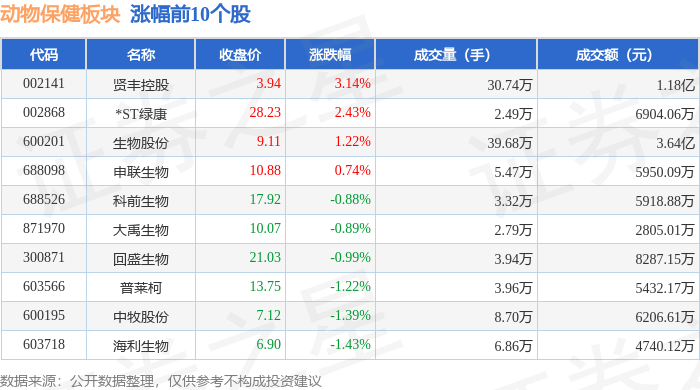
Core Points - The animal health sector experienced a decline of 0.36% on September 22, with Jinhe Biology leading the drop [1] - The Shanghai Composite Index closed at 3828.58, up 0.22%, while the Shenzhen Component Index closed at 13157.97, up 0.67% [1] Stock Performance Summary - The following stocks in the animal health sector showed notable performance: - Shoufeng Holdings (002141) closed at 3.94, up 3.14% with a trading volume of 307,400 shares and a turnover of 118 million yuan [1] - ST Lvkang (002868) closed at 28.23, up 2.43% with a trading volume of 24,900 shares and a turnover of 69.04 million yuan [1] - Shengbiotech (600201) closed at 9.11, up 1.22% with a trading volume of 396,800 shares and a turnover of 364 million yuan [1] - Jinhe Biology (002688) closed at 6.74, down 2.18% with a trading volume of 234,800 shares and a turnover of 158 million yuan [2] - Other stocks such as Haili Biology (603718) and Zhongmu Co. (600195) also experienced declines of 1.43% and 1.39% respectively [1][2] Capital Flow Analysis - On that day, the animal health sector saw a net outflow of 53.34 million yuan from institutional investors, while retail investors contributed a net inflow of 67.06 million yuan [2]


动物保健板块9月19日跌0.26%,驱动力领跌,主力资金净流出9139.61万元
Zheng Xing Xing Ye Ri Bao· 2025-09-19 08:42
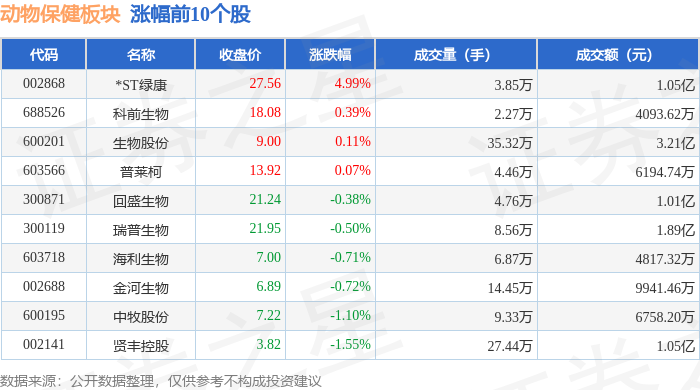
Market Overview - On September 19, the animal health sector declined by 0.26% compared to the previous trading day, with the driving force leading the decline [1] - The Shanghai Composite Index closed at 3820.09, down 0.3%, while the Shenzhen Component Index closed at 13070.86, down 0.04% [1] Stock Performance - Notable stock movements included: - *ST Lvkang (002868): Closed at 27.56, up 4.99% with a trading volume of 38,500 shares and a turnover of 105 million yuan [1] - Kexin Biological (688526): Closed at 18.08, up 0.39% with a trading volume of 22,700 shares and a turnover of 40.94 million yuan [1] - Driving Force (838275): Closed at 10.50, down 4.11% with a trading volume of 21,200 shares and a turnover of 22.63 million yuan [2] Capital Flow - The animal health sector experienced a net outflow of 91.4 million yuan from institutional investors, while retail investors saw a net inflow of 70.15 million yuan [2] - The capital flow for individual stocks showed: - RuiPu Biological (300119): Net inflow of 16.56 million yuan from institutional investors, but a net outflow of 21.57 million yuan from retail investors [3] - *ST Lvkang (002868): Net inflow of 6.13 million yuan from institutional investors, with a net outflow of 4.21 million yuan from retail investors [3]


动物保健板块9月18日跌0.77%,回盛生物领跌,主力资金净流出1.26亿元




Zheng Xing Xing Ye Ri Bao· 2025-09-18 08:46
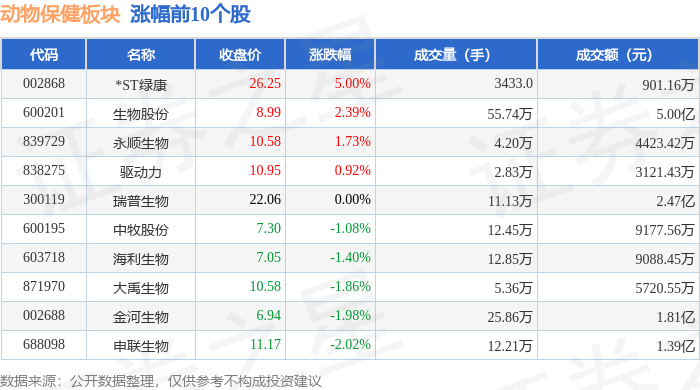
Market Overview - On September 18, the animal health sector declined by 0.77% compared to the previous trading day, with Huisheng Biological leading the decline [1] - The Shanghai Composite Index closed at 3831.66, down 1.15%, while the Shenzhen Component Index closed at 13075.66, down 1.06% [1] Stock Performance - The following stocks in the animal health sector showed notable performance: - *ST Lvkang (002868): Closed at 26.25, up 5.00% with a trading volume of 3433 lots [1] - Shengbi Biological (600201): Closed at 66.8, down 2.39% with a trading volume of 55.74 million [1] - Ruipu Biological (300119): Closed at 22.06, unchanged with a trading volume of 111.3 million [1] - Other stocks such as Jinhai Biological (002688) and Shunlian Biological (688098) also experienced declines of 1.98% and 2.02% respectively [1][2] Capital Flow - The animal health sector experienced a net outflow of 126 million yuan from institutional investors, while retail investors saw a net inflow of 92.38 million yuan [2] - The following stocks had significant capital flow: - Ruipu Biological: Net inflow of 12.35 million yuan from institutional investors [3] - *ST Lvkang: Net outflow of 3.83 million yuan from institutional investors [3] - Jinhai Biological: Net outflow of 25.51 million yuan from institutional investors [3]
“翻倍基”批量涌现,科技创新成最大驱动力
Jing Ji Guan Cha Wang· 2025-09-18 01:26
Core Viewpoint - The market has shown signs of recovery this year, leading to a surge in certain thematic sectors and impressive performance of equity funds, with several funds doubling their value [1] Group 1: Fund Performance - Multiple funds have achieved year-to-date gains exceeding 100%, categorizing them as "doubling funds" [1] - "Doubling funds" are primarily concentrated in high-growth sectors such as technology and pharmaceuticals [1] Group 2: Fund Manager Insights - Fund managers have successfully captured the stage's mainline trends through strategic sector allocation and stock selection [1] - A fund evaluation expert noted that the emergence of "doubling funds" is a result of market sentiment, industry trends, and capital resonance [1] Group 3: Market Conditions - The recovery of the equity market and improved liquidity conditions have created a favorable environment for high-volatility thematic funds [1] - The future performance of "doubling funds" will depend on the continuity of market mainlines and industry trends [1]
“翻倍基”批量涌现 科技创新成最大驱动力
Zheng Quan Shi Bao· 2025-09-17 18:06
Group 1 - The core viewpoint of the articles highlights the emergence of "doubling funds" in the market, particularly in high-growth sectors like technology and pharmaceuticals, driven by favorable market conditions and strategic fund management [1][2][3] - As of September 16, 75 funds have achieved "doubling" status, with notable performers like Yongying Technology Select A and Huatai-PineBridge Hong Kong Advantage Select C, which have returns exceeding 150% [2] - The performance of these funds is closely tied to industry themes, with a strong focus on technology innovation, including AI, robotics, and medical advancements, which have been supported by policy and market trends [3] Group 2 - The significant inflow of capital into "doubling funds" has led to substantial growth in fund sizes, exemplified by Yongying Technology Select, which grew from 0.26 billion to 11.66 billion in assets under management within a year [2] - Fund managers are maintaining high positions in their portfolios, focusing on key areas such as AI infrastructure and innovative pharmaceuticals, which are expected to continue driving growth [3] - The rapid expansion of fund sizes has prompted some funds to impose purchase limits to manage growth and maintain operational flexibility [2]

香港财政司司长陈茂波:科技与金融已成香港经济增长两大驱动力
Zhong Guo Xin Wen Wang· 2025-09-17 13:33
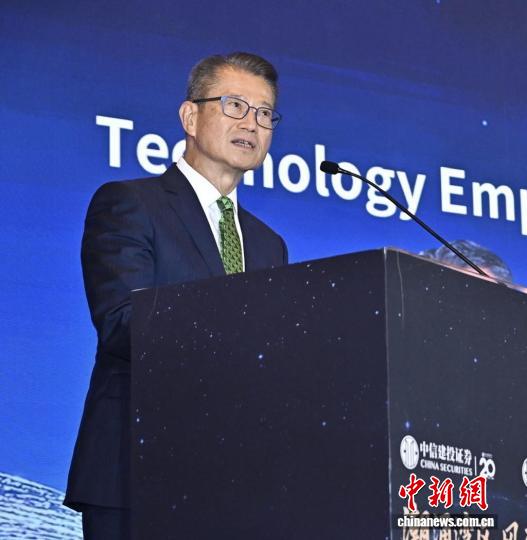
Core Insights - Technology and finance have become the two main driving forces behind Hong Kong's economic growth [1][3] Group 1: Economic Contribution - New economy companies account for approximately 15% of listed companies in Hong Kong and represent about 28% of the total market capitalization, contributing 30% of trading volume [3] - The trading volume's share from new economy sectors has increased by 8% compared to five years ago, indicating their importance in market liquidity [3] Group 2: Biotechnology Sector - The biotechnology sector has been particularly active, with over HKD 230 billion raised by biotech firms in Hong Kong since the listing system reform in 2018, making Hong Kong the leading biotech financing center in Asia and the second globally [3] - The Hang Seng Biotechnology Index has risen by over 80% this year, reflecting the alignment of Hong Kong's stock market with the global value chain [3] Group 3: Government Investment and Support - The Hong Kong government has invested over HKD 250 billion in promoting innovation and technology development, focusing on areas such as artificial intelligence, biotechnology, fintech, new materials, and renewable energy [3] - Innovation parks like Science Park and Cyberport have attracted over 4,700 tech companies and nurtured around 20 unicorns, with many "small giant" companies in growth [3] Group 4: Collaborative Innovation Ecosystem - Hong Kong is actively building a cross-disciplinary collaborative innovation ecosystem, enhancing financial service efficiency through the deep integration of finance and technology, which injects new momentum into the transformation and upgrading of the real economy [3]
第二个5万亿城市要来了!北京“富可敌国”背后的三大驱动力
Sou Hu Cai Jing· 2025-09-16 18:38
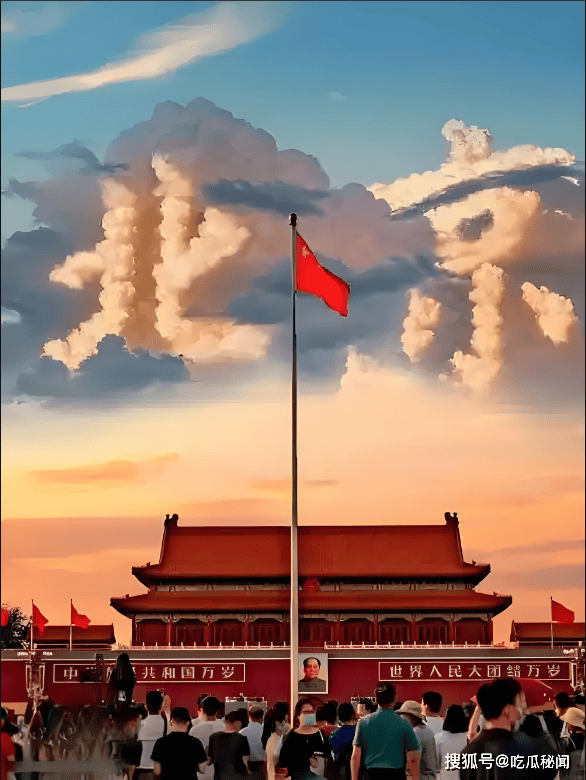
Core Insights - Beijing officially announced that its GDP will exceed 5 trillion yuan by the end of the 14th Five-Year Plan, making it the second city in China and the 21st globally to join the "5 trillion club" [1] - The rapid growth from 4 trillion to 5 trillion yuan in just four years highlights Beijing's remarkable economic development amidst a backdrop of urban reduction [1] Statistical Innovations and Policy Benefits - Two national economic censuses have significantly contributed to the accelerated growth of Beijing and Shanghai, injecting over 700 billion yuan into their economies [3] - The inclusion of R&D investments in the 2018 census and the accounting of virtual rents and digital economy in the 2023 census have been pivotal for Beijing's economic statistics [3] Industrial Structure and Development - Beijing's shift towards high-quality development is marked by the information services sector surpassing 1 trillion yuan, becoming the largest pillar industry [4] - The AI sector is particularly strong, with 158 registered large models (30% of the national total) and over 2,400 companies (50% of the national total), leading to an AI core industry scale exceeding 300 billion yuan [4] National Strategic Positioning - Beijing's unique positioning as a "four centers" city (political, cultural, diplomatic, and scientific innovation) enhances its resource aggregation capabilities [5] - The city has maintained a research and development investment intensity of 6%, ranking first globally for eight consecutive years [5] Economic Comparison with Other Cities - The GDP gap between Beijing-Shanghai and Guangzhou-Shenzhen is equivalent to the GDP of Dongguan, highlighting the administrative and policy advantages of Beijing and Shanghai [7] - Beijing's focus on knowledge economy through state-owned enterprises contrasts with Shanghai's emphasis on hard technology, while Guangzhou and Shenzhen face challenges in traditional industry transformation [7] Future Challenges - Beijing must address the balance between "reduction development" and innovation expansion, consolidate its advantages in emerging technologies, and navigate the challenges posed by global industrial chain restructuring [11] - Guangzhou and Shenzhen need to achieve breakthroughs in new energy and low-altitude economy sectors to reshape their competitive landscape [11] Economic Performance Metrics - With a projected GDP of 5 trillion yuan, Beijing will rank among the top ten global cities by GDP, with a per capita GDP of 228,000 yuan (approximately 32,000 USD) [9] - The city has achieved a threefold energy utilization efficiency compared to the national average and a 65.9% reduction in PM2.5 concentration since 2013, indicating successful economic development alongside ecological governance [9]
动物保健板块9月16日跌0.41%,*ST绿康领跌,主力资金净流出1597.38万元
Zheng Xing Xing Ye Ri Bao· 2025-09-16 08:39
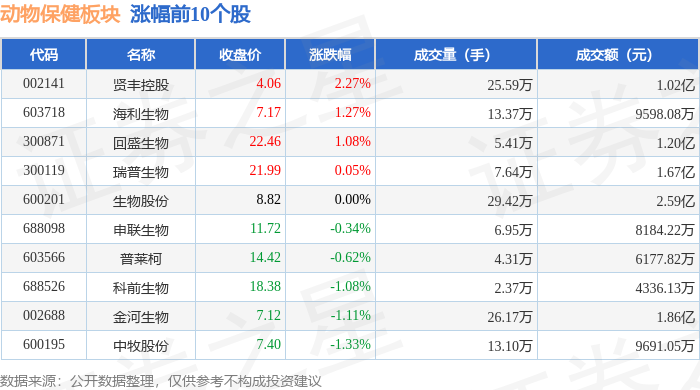
Market Overview - On September 16, the animal health sector declined by 0.41%, with *ST Lvkang leading the drop [1] - The Shanghai Composite Index closed at 3861.87, up 0.04%, while the Shenzhen Component Index closed at 13063.97, up 0.45% [1] Stock Performance - Key stocks in the animal health sector showed mixed performance, with the following notable movements: - Xianfeng Holdings (002141) increased by 2.27% to close at 4.06 [1] - Haili Biological (603718) rose by 1.27% to 7.17 [1] - *ST Lvkang (002868) fell by 4.34% to 23.81, leading the decline [2] - The trading volume and turnover for selected stocks were significant, with Xianfeng Holdings achieving a turnover of 1.02 billion [1] Capital Flow Analysis - The animal health sector experienced a net outflow of 15.97 million from institutional investors, while retail investors saw a net inflow of 11.29 million [2][3] - Notable capital flows included: - Biological Shares (600201) had a net inflow of 12.28 million from institutional investors [3] - *ST Lvkang (002868) saw a net outflow of 2.89 million from institutional investors [3] - Retail investors contributed positively to several stocks, including a net inflow of 12.59 million into Shenyuan Biological (688098) [3]

黄金迎来历史性转折:三大驱动力引爆1979年以来最强涨势
Jin Shi Shu Ju· 2025-09-16 03:09
Core Viewpoint - The article discusses the potential shift towards a fiscal-led era in the U.S. economy, driven by ongoing political pressures on the Federal Reserve and rising inflation due to tariffs, which may lead to gold replacing the dollar as the primary store of value [1][4]. Group 1: Economic and Market Dynamics - Gold has seen a year-to-date increase of 31.38% as of the end of August, marking its best performance since 1979, positioning it as one of the strongest asset classes for the year [1]. - The U.S. government's approach to the Federal Reserve is a significant factor in gold's recent rise and the dollar's continued weakness [1][2]. - The labor market data indicates a more severe economic slowdown than expected, while inflation data remains complex and concerning [2]. Group 2: Federal Reserve Independence and Political Pressure - The struggle for control over the Federal Reserve has significant implications for gold and the dollar, with President Trump’s actions raising unprecedented legal and constitutional questions regarding presidential power and central bank independence [2][3]. - The dismissal of a Federal Reserve board member due to alleged mortgage fraud has sparked concerns about the independence of the Fed, which has historically not seen such dismissals since its establishment in 1913 [2][3]. - The current political climate may lead to a more politicized Federal Reserve, potentially transforming it into a tool for the White House [3][4]. Group 3: Inflation and Gold Demand - Inflation risks are increasingly driven by monetary and fiscal policies rather than demand, which is favorable for gold [2]. - The anticipated rise in commodity costs due to tariffs is expected to increase inflationary pressures, further boosting gold demand as a hedge against purchasing power erosion [3][4]. - The potential for negative real interest rates, driven by fiscal policies and regulatory easing, may enhance gold's appeal as a store of value [4][5]. Group 4: Future Outlook and Global Financial System - The article suggests that the current dollar-centric global financial system may become unsustainable, with a shift towards gold as a neutral reserve asset [4][6]. - The increasing trust in gold over fiat currencies is evidenced by central banks accumulating gold reserves, highlighting its role as a stable alternative in a changing monetary landscape [4][5]. - The anticipated economic policies, including the "Great and Beautiful" Act and tax cuts, are expected to stimulate the economy, further supporting gold's upward trajectory [5][6].