GUANGDONG DRIVE BIO-TECH CO.(838275)

Search documents
2026年汇市展望:美日货币政策分化延续 利差仍是汇率核心驱动力
Xin Lang Cai Jing· 2026-01-05 23:40
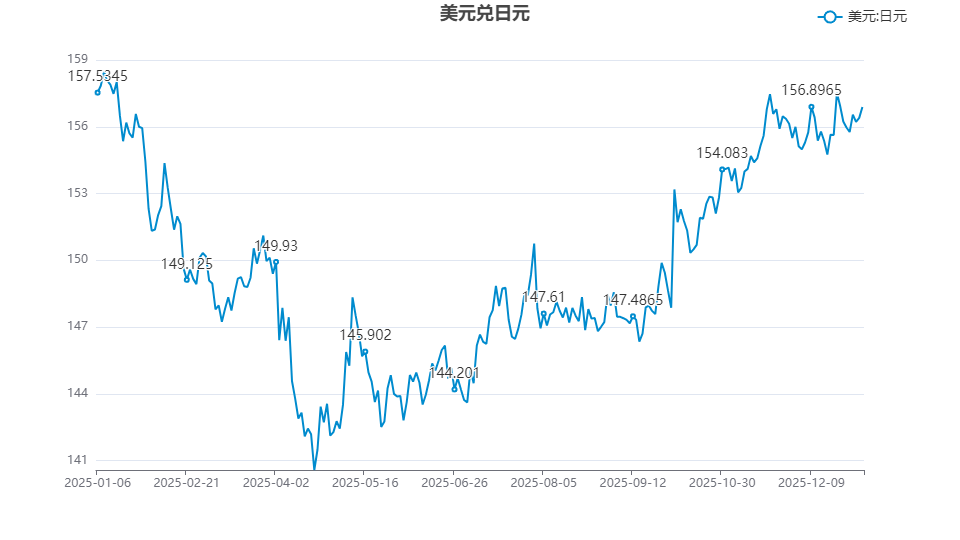
Core Viewpoint - The USD/JPY exchange rate experienced a significant "V-shaped" trend in 2025, ending a four-year upward trajectory, with year-end trading above 156, approaching the intervention threshold of 160 set by Japanese authorities [1][2]. Exchange Rate Dynamics - At the beginning of 2025, the USD/JPY continued its strong performance from 2024, reaching a peak of 158.88. However, it quickly fell to a low of 139.88 in late April due to multiple policy risks, including tariffs announced by Trump and concerns over the independence of the Federal Reserve [2][4]. - The mid-year saw the USD/JPY fluctuate between 140 and 150, influenced by ongoing policy uncertainties and the Bank of Japan's (BOJ) ambiguous stance on future rate hikes [4][10]. Monetary Policy Normalization - 2025 marked a historic turning point for Japan's monetary policy, with the BOJ raising interest rates twice, culminating in a year-end rate of 0.75%, the highest since 1995. This shift was driven by persistent inflation above the 2% target and signs of wage growth [5][6]. - The BOJ's communication strategy evolved from a cautious approach to proactive guidance, confirming the sustainability of inflation and indicating a clear path towards normalization [9][10]. Economic Performance - Japan's economy is projected to achieve a 1.0% real GDP growth in 2025, significantly higher than the 0.1% growth in 2024, primarily driven by domestic demand [10][12]. - Private consumption is expected to be the main growth driver, with a contribution rate of 101.25% to GDP growth in Q3, supported by wage increases and government energy subsidies [10][11]. Structural Challenges - Despite the monetary policy shift, Japan's economy faces structural challenges, including high fiscal deficits and trade imbalances, which continue to weaken the yen's fundamental support [4][10]. - The labor market remains tight, with an unemployment rate around 2.5%, but the number of bankruptcies among small and medium-sized enterprises has reached a 12-year high, highlighting ongoing structural pressures [10][12]. Future Outlook - The divergence in monetary policy between the US and Japan is expected to continue influencing the USD/JPY exchange rate in 2026, with the potential for long-term investment opportunities in this currency pair [12][13]. - Japan's government is likely to maintain an expansionary fiscal stance, which may stimulate short-term growth but could exacerbate fiscal pressures, posing significant uncertainties for the macroeconomic landscape in 2026 [12][13].


【2026年汇市展望】美日货币政策分化延续 利差仍是汇率核心驱动力
Xin Hua Cai Jing· 2026-01-05 23:17
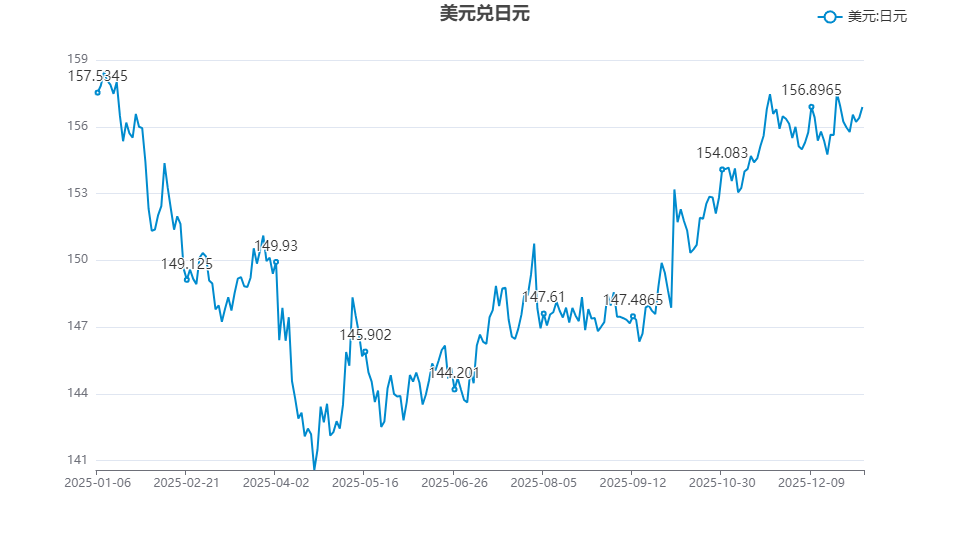
Core Viewpoint - The USD/JPY exchange rate experienced a significant "V-shaped" trend in 2025, ending a four-year upward trajectory, with year-end trading above 156, approaching the intervention threshold of 160 set by Japanese authorities [1][2]. Exchange Rate Dynamics - At the beginning of 2025, the USD/JPY continued its strong performance from 2024, reaching a peak of 158.88, but subsequently fell to a low of 139.88 in late April due to multiple policy risks, including tariffs announced by Trump and concerns over the independence of the Federal Reserve [2][4]. - The mid-year saw the USD/JPY fluctuate between 140 and 150 as policy uncertainties persisted, despite some easing of trade tensions [4]. - A turning point occurred in the third quarter when the election of Suga as Prime Minister led to a large fiscal stimulus plan, raising concerns about Japan's debt sustainability and pushing the USD/JPY back to near its yearly highs [4]. Monetary Policy Normalization - The Bank of Japan (BOJ) took significant steps towards monetary policy normalization in 2025, raising the policy interest rate twice, from 0.25% to 0.75%, marking the highest level since 1995 [5][6]. - The BOJ's communication strategy shifted from cautious observation to proactive guidance, confirming the sustainability of inflation and signaling an irreversible normalization process [9]. Economic Performance - Japan's economy is projected to grow by 1.0% in real GDP in 2025, driven primarily by domestic demand, with private consumption contributing significantly to GDP growth [10]. - The core CPI is expected to average around 3.2%, remaining above the BOJ's 2% target for 44 consecutive months, indicating persistent inflationary pressures [10]. - The labor market remains tight, with an unemployment rate around 2.5%, and real wages turning positive in the second half of the year, supporting consumer resilience [10]. Structural Challenges - Despite the monetary policy shift, Japan faces deep structural challenges, including high fiscal deficits and trade imbalances, which continue to weaken the fundamental support for the yen [4][10]. - The government debt-to-GDP ratio exceeds 260%, raising concerns about fiscal sustainability as interest rates rise [12]. Future Outlook - The divergence in monetary policy between the US and Japan is expected to continue influencing the USD/JPY exchange rate in 2026, with the potential for long-term investment opportunities in this currency pair [12]. - The Japanese government is likely to maintain an expansionary fiscal stance, which may stimulate short-term growth but could exacerbate fiscal pressures, posing significant uncertainties for the macroeconomic landscape in 2026 [12].
交通运输部:到2030年公共数据成为推动交通运输高质量发展的重要驱动力
Zheng Quan Shi Bao Wang· 2026-01-04 01:31
Core Viewpoint - The Ministry of Transport has issued an implementation opinion aimed at accelerating the development and utilization of public data resources in the transportation sector, with a goal to establish a mature management and technical system by 2030 [1] Group 1 - By 2030, the public data resource development and utilization management and technical system in the transportation sector is expected to be more mature [1] - A comprehensive high-quality data resource system for the industry will be fully established [1] - The level of data integration and innovative application is anticipated to significantly improve [1] Group 2 - Public data is projected to become an important driving force for promoting high-quality development in transportation [1]
【AI与电力、新药研发、中国经济复苏.....一文读懂高盛行研团队2026年十大投资主题】高盛2026年十大投资主题聚焦:AI基础设施投资转向数据中心内部及电力供应商;医药研发从减肥药转向心血管领域;中国经济增长将超市场预期,技术进步和出口为主要驱动力等。美联储政策、关税裁决等政治不确定性...
Sou Hu Cai Jing· 2026-01-03 12:48
Group 1 - The core investment themes identified by Goldman Sachs for 2026 include a shift in AI infrastructure investment towards data centers and power suppliers [1] - Pharmaceutical research is transitioning from weight loss drugs to cardiovascular treatments, indicating a change in focus within the healthcare sector [1] - China's economic growth is expected to exceed market expectations, driven primarily by technological advancements and exports [1] Group 2 - Political uncertainties, such as Federal Reserve policies and tariff decisions, are anticipated to dominate the market in the first half of the year [1]
动物保健板块12月31日跌0.05%,贤丰控股领跌,主力资金净流出4526.24万元
Zheng Xing Xing Ye Ri Bao· 2025-12-31 08:56
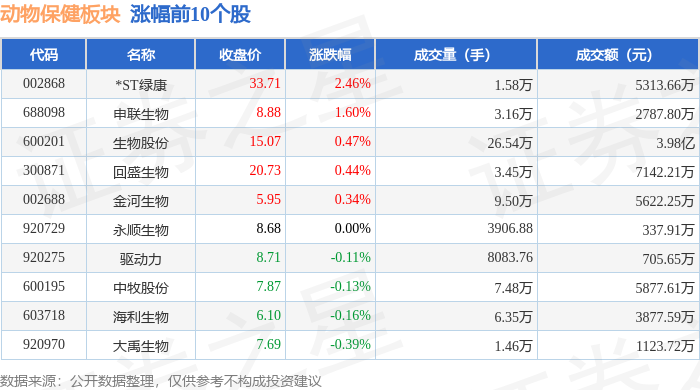
Core Viewpoint - The animal health sector experienced a slight decline of 0.05% on December 31, with Xianfeng Holdings leading the drop. The Shanghai Composite Index rose by 0.09%, while the Shenzhen Component Index fell by 0.58 [1] Group 1: Market Performance - The closing price of Xianfeng Holdings was 3.73, down by 2.61%, with a trading volume of 182,700 shares and a transaction amount of 68.47 million [2] - The animal health sector's main stocks showed mixed performance, with *ST Lvkang rising by 2.46% to 33.71, while several others, including Xianfeng Holdings and Ruipu Bio, saw declines [1][2] - The total trading volume in the animal health sector was significant, with major stocks like Ruipu Bio and Xianfeng Holdings contributing to the overall market activity [2] Group 2: Capital Flow - The animal health sector saw a net outflow of 45.26 million from institutional investors, while retail investors contributed a net inflow of 39.94 million [2] - The capital flow data indicates that retail investors were more active in the market, with a notable net inflow compared to the outflow from institutional investors [2] - Specific stocks like Huisheng Bio and *ST Lvkang had varying levels of net inflow and outflow from different investor categories, reflecting diverse investor sentiment [3]



世界黄金协会首席专家解读:四大关键驱动力将决定2026年金价走势
Jin Shi Shu Ju· 2025-12-31 02:20
Core Insights - Gold is expected to be the best-performing asset class in 2025, driven by four key factors that will also influence its price movements in 2026 [1] Group 1: Key Drivers of Gold Price - The two main macro drivers for gold's success in 2025 are geopolitical tensions and a generally weak US dollar along with moderate interest rate declines [2] - Central banks continue to be strong and stable net buyers of gold, although their purchasing pace has slowed compared to the past two years [2] - A balanced contribution from four main factors—economic expansion, risk and uncertainty, opportunity cost, and momentum—each accounting for approximately 10% of gold's performance [2] Group 2: Future Expectations and Economic Conditions - If the US economy shows a mild decline, it could lead to Federal Reserve rate cuts and further dollar weakness, potentially supporting gold prices by 5% to 15% [3] - In the event of significant economic deterioration, investment demand for gold could surge, with potential prices exceeding $5,000 per ounce [3] - The risk premium associated with gold may decrease if US economic policies yield positive results, potentially leading to a price drop of 5% to 20% [3] Group 3: Central Bank Demand and Recycling Risks - Strong central bank demand is influenced by macro and policy decisions, with continued buying expected to support gold prices [4] - A decline in central bank demand below 600 to 700 tons could exert pressure on future gold prices [4] - In India, gold jewelry is being used as collateral for loans, and an economic downturn could lead to forced liquidations, increasing supply and suppressing gold prices [5]
赛迪顾问发布2026年IT发展趋势:AI与算力成核心驱动力
Xin Hua Cai Jing· 2025-12-30 05:46
Core Insights - The report by CCID Consulting outlines the development blueprint and transformation directions for the IT industry in China by 2026, focusing on ten key areas including computing power, storage, AI, industrial software, and financial digital transformation [1][2][3]. Computing Power - The demand for computing power is expected to grow exponentially due to the deep integration of large models and industry applications, with China's total computing power projected to exceed 1200 EFLOPS by 2026, maintaining the second position globally, and intelligent computing contributing nearly 90% [1]. - A collaborative model of "cloud centralized training and edge flexible reasoning" will be widely adopted, with super-node architectures overcoming traditional computing cluster bottlenecks, becoming a significant choice for large intelligent computing centers [1]. Artificial Intelligence - The "AI+" sector is anticipated to enter a new phase of typical demonstration and large-scale implementation by 2026, with cloud services accelerating towards AI-native evolution, transitioning from "resource supply" to "intelligent engine" [2]. - High-quality private data sets will become scarce resources, and lightweight AI terminals will serve as crucial carriers for application implementation, driving deep penetration of "AI+" in industries such as automotive and logistics [2]. - The large model market is expected to experience explosive growth, with both deployment and usage volumes increasing significantly, focusing on vertical small models and autonomous collaborative intelligent agents [2]. Industrial Software - The global industrial software market is projected to grow steadily from 2023 to 2025, with a compound annual growth rate of approximately 6.4%, reflecting a balance of stable growth and structural optimization [2]. - By 2026, industrial software is expected to play a vital role in transforming manufacturing from experience-driven to data-driven, enhancing industry efficiency and resource allocation [2]. Financial Digital Transformation - By 2025, the financial industry is expected to undergo a high-quality paradigm shift from "digitalization" to "intelligentization," driven by AI and open API ecosystems, supported by distributed core system restructuring and technological breakthroughs [3]. - IT investment in China's financial sector is projected to continue expanding, with AI reshaping financial technology and generative AI accelerating penetration into vertical financial fields, evolving IT from a supportive tool to a core engine driving financial innovation [3].
红星发展:公司扩建硫脲产能的核心逻辑是提升硫脲产品生产科技创新驱动力
Zheng Quan Ri Bao Wang· 2025-12-29 13:42
Group 1 - The core logic behind the company's expansion of thiourea production capacity is to enhance technological innovation in thiourea product manufacturing [1] - The company aims to accelerate the upgrade and transformation of its equipment to improve market share in thiourea products [1] - The goal is to achieve high-end development of specialty chemical products [1]

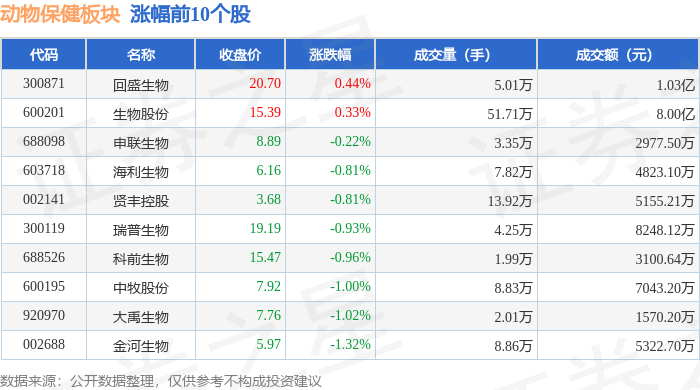
动物保健板块12月29日跌0.59%,驱动力领跌,主力资金净流出1.27亿元
Zheng Xing Xing Ye Ri Bao· 2025-12-29 08:58
Core Viewpoint - The animal health sector experienced a decline of 0.59% on December 29, with the driving force leading the drop, while the Shanghai Composite Index rose by 0.04% to close at 3965.28 [1] Group 1: Market Performance - The animal health sector's individual stock performance showed mixed results, with notable declines in several stocks, including: - Driving Force (Code: 920275) down by 1.78% to 8.84 - ST Green Health (Code: 002868) down by 1.50% to 33.58 - Yongshun Biological (Code: 920729) down by 1.47% to 8.70 [2] - The overall trading volume in the animal health sector indicated a net outflow of 127 million yuan from main funds, while retail investors saw a net inflow of 61.75 million yuan [2][3] Group 2: Individual Stock Analysis - Key individual stock performances included: - Huisheng Biological (Code: 300871) closed at 20.70 with a slight increase of 0.44% and a trading volume of 50,100 shares [1] - Driving Force (Code: 920275) had a trading volume of 9,094.74 shares and a net outflow of 408,300 yuan from main funds [3] - ST Green Health (Code: 002868) saw a significant net outflow of 534,110 yuan from main funds, indicating weak investor sentiment [3] - The stock with the highest decline was Xianfeng Holdings (Code: 002141), which fell by 0.81% to 3.68, with a net outflow of 722,640 yuan from main funds [3]
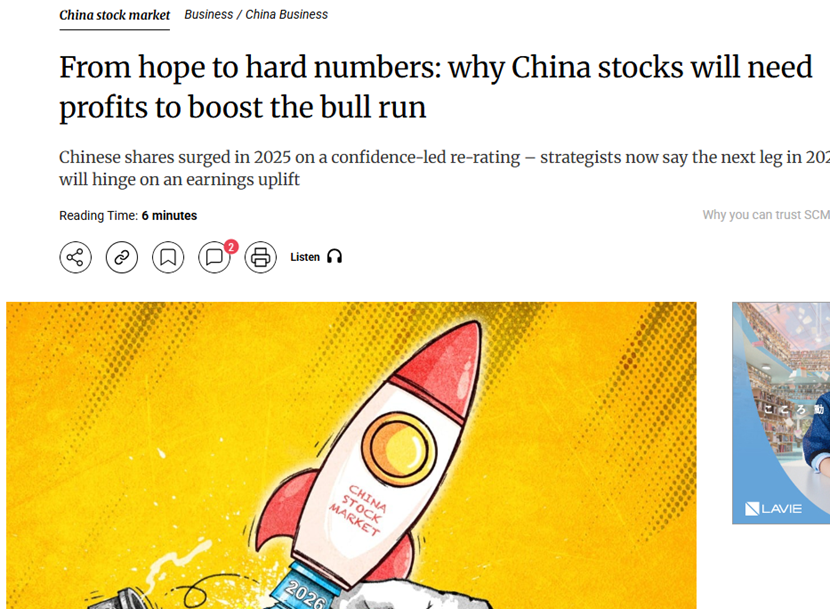
展望2026年A股,外媒称“盈利将成为未来股市的关键驱动力”
Huan Qiu Wang· 2025-12-29 01:11
Group 1 - The highest annual return of public active equity funds in the A-share market reached 236.88%, setting a record as the highest annual return in public fund history, with 72 funds achieving over 100% return this year [1] - Nearly 80% of active funds outperformed their benchmark, but the median return was 29.03%, lower than the average return of 32.71% [1] - UBS and JP Morgan Chase predict profit growth rates for 2025 and 2026 will be between 6% and 15%, indicating that earnings will become a key driver for the stock market, replacing valuation expansion [1] Group 2 - Gary Dugan, CEO of Global Economic Office, stated that the Chinese stock market will be strongly supported in 2026, with encouraging and sustainable fundamentals [4] - Market expectations for economic growth, policy support, and structural industry reforms are anticipated to drive stock market increases, particularly in technology and new energy vehicle sectors [4] - Industry experts suggest that the market will remain in a structural opportunity-driven fluctuation phase until unexpected changes in domestic demand occur, with trading volume being a key signal for market trends [4]