SHK PPT(00016)

Search documents
智通ADR统计 | 2月12日
智通财经网· 2026-02-11 22:31
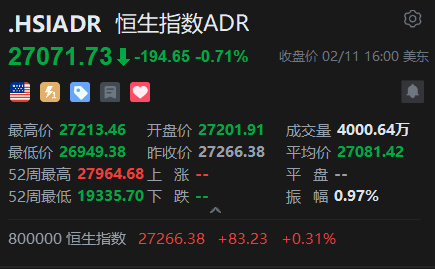
Core Viewpoint - The Hang Seng Index (HSI) closed at 27,071.73, down 194.65 points or 0.71% from the previous close, indicating a decline in market performance [1]. Group 1: Market Performance - The HSI reached a high of 27,213.46 and a low of 26,949.38 during the trading session, with a trading volume of 40 million shares [1]. - The average price for the HSI was 27,081.42, while the 52-week high and low were 27,964.68 and 19,335.70, respectively [1]. Group 2: Major Blue-Chip Stocks - HSBC Holdings closed at HKD 139.794, unchanged from the Hong Kong close, while Tencent Holdings closed at HKD 543.262, down 0.86% [2]. - Among the major stocks, Alibaba (HKD 160.100, down 0.25%), and Xiaomi (HKD 37.100, up 4.27%) showed varied performance [3]. - Notable gainers included BYD Company, which rose by 3.50% to HKD 99.150, while Pop Mart International fell by 5.49% to HKD 255.000 [3].

港股11日涨0.31% 收报27266.38点
Xin Hua Wang· 2026-02-11 09:59
Market Overview - The Hang Seng Index rose by 83.23 points, an increase of 0.31%, closing at 27,266.38 points with a total turnover of HKD 217.218 billion [1] - The National Enterprises Index increased by 25.43 points, closing at 9,268.18 points, a rise of 0.28% [1] - The Hang Seng Tech Index gained 48.96 points, closing at 5,499.99 points, reflecting a growth of 0.9% [1] Blue-Chip Stocks - Tencent Holdings decreased by 0.54%, closing at HKD 548 [1] - Hong Kong Exchanges and Clearing rose by 0.19%, closing at HKD 418 [1] - China Mobile increased by 0.06%, closing at HKD 78.45 [1] - HSBC Holdings fell by 0.36%, closing at HKD 139.8 [1] Local Hong Kong Stocks - Cheung Kong Holdings rose by 0.21%, closing at HKD 46.82 [1] - Sun Hung Kai Properties increased by 0.62%, closing at HKD 129.8 [1] - Henderson Land Development gained 0.49%, closing at HKD 32.96 [1] Chinese Financial Stocks - Bank of China remained unchanged, closing at HKD 4.72 [1] - China Construction Bank rose by 0.37%, closing at HKD 8.15 [1] - Industrial and Commercial Bank of China decreased by 0.15%, closing at HKD 6.56 [1] - Ping An Insurance fell by 1.29%, closing at HKD 72.5 [1] - China Life Insurance dropped by 3.94%, closing at HKD 34.12 [1] Oil and Petrochemical Stocks - Sinopec rose by 1.66%, closing at HKD 5.51 [1] - PetroChina increased by 0.75%, closing at HKD 9.38 [1] - CNOOC gained 0.65%, closing at HKD 24.8 [1]



超十家房地产公司高层变动
第一财经· 2026-02-11 09:44
Core Viewpoint - The real estate industry is experiencing significant executive turnover at the beginning of 2026, with over ten companies undergoing management changes, reflecting a broader trend of organizational restructuring and strategic realignment in response to market pressures [3][5]. Group 1: Executive Changes - In early 2026, companies such as Diyi City Holdings, Zhongliang Holdings, and New World Development have reported executive resignations, with reasons ranging from retirement to personal choices [3][6]. - Zhongliang Holdings saw the resignation of He Jian, who had been with the company since 2015, and the appointment of Zhao Peng as the new executive director and co-president [6]. - Other companies like Rongsheng Development and Guangming Real Estate have also experienced frequent executive changes, indicating a trend across the industry [7]. Group 2: Organizational Restructuring - The beginning of the year is a critical period for real estate companies to implement reforms, with 21 companies making 31 organizational adjustments since January 2025 [9]. - Major firms such as Poly, China Overseas, and Longfor have initiated new rounds of optimization adjustments, indicating ongoing efforts to refine their operational structures [9][10]. - The restructuring aims to enhance resource allocation and core business management, reflecting a shift towards quality-focused survival strategies in the industry [10]. Group 3: Industry Trends and Challenges - The frequent changes in management are symptomatic of the broader challenges facing the real estate sector, including sales pressure and ongoing financial losses since 2022 [11]. - The shift from large-scale development to refined operations and asset-light models necessitates new leadership capable of navigating these changes [11]. - Companies are urged to focus on financial safety, operational efficiency, and precise investment strategies to adapt to the evolving market landscape [11].




开年上演人事“大戏” 华侨城、首开股份等超十家房地产公司高层变动
Di Yi Cai Jing· 2026-02-11 09:00
Group 1 - Over ten real estate companies have experienced executive changes within just over a month since the beginning of 2026 [2][3] - Notable companies undergoing changes include Joy City Holdings, Zhongliang Holdings, New World Development, Rongsheng Development, Bright Realty, and others, with reasons ranging from retirement to personal resignations [2][3] - The adjustments in management are closely aligned with the companies' business development and strategic needs, indicating a trend of organizational restructuring within the industry [2][3] Group 2 - The trend of executive turnover in real estate companies has been ongoing since last year and continues into 2026, with significant changes reported [3][4] - For instance, Joy City Holdings announced the resignation of director Chen Lang due to retirement, while Zhongliang Holdings saw the resignation of He Jian and the appointment of Zhao Peng as new executive director [3][4] - Other companies like Rongsheng Development and Bright Realty have also reported multiple executive resignations for personal reasons, reflecting a broader pattern of leadership changes across the sector [3][4] Group 3 - A new wave of organizational restructuring is occurring, with 21 real estate companies implementing 31 adjustments since January 2025 [5][6] - Major firms such as Poly, China Overseas, and Longfor are undergoing multiple rounds of restructuring, indicating a shift towards optimizing organizational efficiency [5][6] - The adjustments aim to enhance resource allocation and core business management, reflecting a transition towards quality-focused operations in the real estate sector [6][7] Group 4 - The frequent changes in management are indicative of the broader challenges faced by the real estate industry, including sales pressure and financial losses since 2022 [7] - The need for management adjustments is driven by the shift from large-scale development to refined operations and asset-light models, necessitating new leadership with different skill sets [7] - Companies are now focusing on financial security, operational efficiency, and precise investment strategies to adapt to the evolving market landscape [7]

开年上演人事“大戏”,超十家房地产公司高层变动
Di Yi Cai Jing· 2026-02-11 08:52
Core Viewpoint - The real estate industry is experiencing significant executive turnover, with over ten companies undergoing leadership changes within a month, reflecting a broader trend of organizational restructuring and strategic realignment in response to market pressures [2][3][7]. Group 1: Executive Changes - More than ten real estate companies, including Joy City Holdings, Zhongliang Holdings, and New World Development, have reported executive changes since the beginning of 2026, with reasons ranging from retirement to personal resignations [2][3]. - Joy City Holdings announced the resignation of director Chen Lang due to reaching retirement age, while Zhongliang Holdings saw the departure of executive director He Jian and the appointment of Zhao Peng as his successor [3]. - Other companies like Rongsheng Development and Guangming Real Estate have also experienced frequent executive changes, indicating a trend of leadership turnover across the sector [4][5]. Group 2: Organizational Restructuring - The beginning of the year is a critical period for real estate companies to implement reforms, with 21 companies undergoing 31 organizational adjustments since January 2025 [5]. - Major firms such as Poly, China Overseas, and Longfor have initiated new rounds of optimization adjustments, with China Overseas restructuring its management model from a three-tier to a two-tier system [6]. - The adjustments aim to enhance resource allocation and core business management, reflecting a shift towards quality-focused operations in response to market challenges [6][7]. Group 3: Industry Trends and Challenges - The frequent changes in leadership are indicative of the industry's response to ongoing sales pressures and financial losses experienced by publicly listed real estate companies since 2022 [7]. - The shift from large-scale development to refined operations and asset-light models necessitates new leadership capable of navigating these changes [7]. - Companies are urged to focus on financial security, operational efficiency, and precise investment strategies to adapt to the evolving economic landscape [7].


大行评级丨大摩:预期今年香港楼价升10%,偏好新鸿基地产、长实等
Ge Long Hui· 2026-02-11 05:58
Group 1 - Morgan Stanley maintains an optimistic outlook on the Hong Kong residential market, predicting a 10% year-on-year increase in property prices and a 5% growth in rental rates for this year [1] - The firm favors New World Development, Cheung Kong Property, and Henderson Land Development, assigning them "overweight" ratings, while it is bearish on Wharf Real Estate Investment Company, giving it a "underweight" rating [1] - Recent discussions with JLL Hong Kong Chairman, C. K. Chan, indicated that strong purchasing power from mainland buyers is expected to drive property prices up by 5% this year after hitting a bottom last year, with this upward cycle likely to continue for several years [1] Group 2 - The report highlights that a reduction in interest rates and favorable capital market performance could provide further upward momentum for the property market, although geopolitical risks and macroeconomic uncertainties may pose downward pressures [1] - Despite an overall improvement in market sentiment, C. K. Chan noted that the vacancy rate for commercial properties remains high, with only prime assets in Central expected to see rental increases [1]



摩根士丹利料香港今年楼价涨10%、租金涨5%
Xin Lang Cai Jing· 2026-02-11 04:18
Core Viewpoint - Morgan Stanley expresses an optimistic outlook on the Hong Kong residential market, predicting a 10% annual increase in property prices by 2026 and a 5% growth in rental prices, although stock prices are expected to experience increased volatility ahead of earnings season [1] Group 1: Market Predictions - Property prices in Hong Kong are expected to rebound by 5% this year after hitting a low last year, with a potential upward cycle lasting several years, according to JLL Hong Kong Chairman, C. H. Tsang [1] - The forecast includes a 10% annual increase in property prices by 2026 and a 5% increase in rental prices [1] Group 2: Stock Ratings - Morgan Stanley favors stocks of Sun Hung Kai Properties, Cheung Kong Holdings, and Henderson Land Development, assigning them an "Overweight" rating [1] - The firm holds a negative outlook on Wharf Holdings and New World Development, assigning them a "Underweight" rating [1]

新房二手房成交环比调整,放松政策持续出台
CAITONG SECURITIES· 2026-02-10 02:35
Market Performance - The real estate sector (CITIC) had a weekly performance of 0.0%, while the CSI 300 and Wind All A indices decreased by -1.3% and -1.5% respectively, resulting in excess returns of 1.3% and 1.4%[5] - Among 29 CITIC industry sectors, real estate ranked 15th in performance[5] New Housing Market - In the week from January 31 to February 6, 2026, the new housing transaction area in 36 cities was 1.392 million square meters, down 2.9% week-on-week but up 175.7% year-on-year[10] - Cumulative transactions from February 1 to February 6 reached 1.204 million square meters, a year-on-year increase of 257.9%[10] - Year-to-date transactions as of February 6 totaled 6.798 million square meters, down 16.2% year-on-year[10] Second-Hand Housing Market - For the same week, the transaction area for second-hand housing in 15 cities was 1.644 million square meters, down 3.6% week-on-week but up 245.8% year-on-year[16] - Cumulative transactions from February 1 to February 6 were 1.535 million square meters, a year-on-year increase of 423.1%[16] - Year-to-date transactions as of February 6 totaled 8.383 million square meters, up 37.1% year-on-year[16] Inventory and Depletion Cycle - Cumulative new housing inventory in 13 cities was 77.165 million square meters, down 0.7% week-on-week and down 4.6% year-on-year[24] - The new housing depletion cycle for these cities is 22.9 months, with a week-on-week change of -0.1 months and a year-on-year change of +6.2 months[24] Land Market - The land transaction area from February 2 to February 8 was 1.1863 million square meters, down 44.9% week-on-week and down 36.0% year-on-year[43] - The average land price was 1,552 RMB per square meter, up 42.8% week-on-week and up 71.5% year-on-year[43] - Year-to-date land transactions as of February 8 totaled 10.556 million square meters, down 15.8% year-on-year[43] Investment Recommendations - Recommended mainland developers include A-shares: Binhai Group, China Merchants Shekou; Hong Kong stocks: China Overseas Development, Greentown China, China Resources Land, Jianfa International Group[9] - For light asset operation companies, recommended property management companies include Greentown Service and commercial management companies like China Resources Vientiane Life[9] Risk Factors - Risks include potential delays in the relaxation of real estate control policies, continued industry downturns, and ongoing credit risks leading to liquidity deterioration[5]



智通港股沽空统计|2月10日
智通财经网· 2026-02-10 00:24
Group 1 - The top three stocks with the highest short-selling ratios are New World Development Co. Ltd. (80016) at 100.00%, SenseTime Group Inc. (80020) at 80.12%, and Great Wall Motor Co. Ltd. (82333) at 75.14% [1][2] - The highest short-selling amounts are recorded for Xiaomi Corporation (01810) at 1.731 billion, Alibaba Group Holding Ltd. (09988) at 1.550 billion, and Meituan (03690) at 1.518 billion [1][3] - The top three stocks with the highest deviation values are New World Development Co. Ltd. (80016) at 44.46%, SenseTime Group Inc. (80020) at 35.88%, and China National Offshore Oil Corporation (80883) at 26.39% [1][3] Group 2 - The detailed short-selling ratio rankings show New World Development Co. Ltd. (80016) leading with a short-selling amount of 345,900 and a deviation value of 44.46% [2][3] - SenseTime Group Inc. (80020) follows with a short-selling amount of 257,500 and a deviation value of 35.88% [2][3] - Great Wall Motor Co. Ltd. (82333) has a short-selling amount of 70,700 and a deviation value of -3.29% [2] Group 3 - The short-selling amount rankings indicate Xiaomi Corporation (01810) at 1.731 billion with a short-selling ratio of 39.72% and a deviation value of 21.05% [3] - Alibaba Group Holding Ltd. (09988) has a short-selling amount of 1.550 billion with a short-selling ratio of 16.68% and a deviation value of 4.47% [3] - Meituan (03690) shows a short-selling amount of 1.518 billion with a short-selling ratio of 39.18% and a deviation value of 22.10% [3]

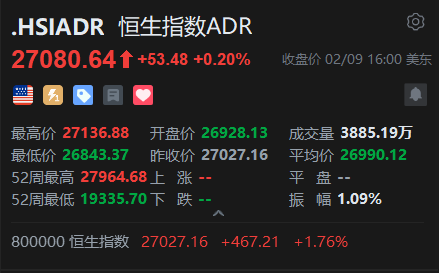
智通ADR统计 | 2月10日





智通财经网· 2026-02-09 22:30
Group 1 - Major blue-chip stocks mostly rose, with HSBC Holdings closing at HKD 141.801, up 1.8% from the previous close [2] - Tencent Holdings closed at HKD 561.139, reflecting a 0.2% increase from the previous close [2] Group 2 - Tencent Holdings (00700) latest price is HKD 560.000, with an increase of HKD 12.500 or 2.28% [3] - Alibaba Group (09988) latest price is HKD 157.900, up HKD 2.900 or 1.87% [3] - HSBC Holdings (00005) latest price is HKD 139.300, up HKD 4.500 or 3.34% [3] - AIA Group (01299) latest price is HKD 86.350, up HKD 2.850 or 3.41% [3] - Meituan (03690) latest price is HKD 91.050, down HKD 0.350 or 0.38% [3] - China Ping An (02318) latest price is HKD 73.000, up HKD 3.400 or 4.89% [3] - Hong Kong Exchanges (00388) latest price is HKD 418.600, up HKD 11.000 or 2.70% [3] - Baidu Group (09888) latest price is HKD 142.200, up HKD 4.400 or 3.19% [3] - Kuaishou Technology (01024) latest price is HKD 69.300, down HKD 1.950 or 2.74% [3]