GEELY AUTO(00175)

Search documents
广域铭岛打造供应链全域数字化新模式
Zheng Quan Ri Bao Wang· 2025-12-09 10:15
Core Insights - The digital transformation of the supply chain is fundamentally changing traditional perceptions, shifting from a linear model centered around manufacturers to a collaborative ecosystem built on digitalization [1] - The partnership between Guangyu Mingdao and Geely Holding Group showcases a new model where suppliers are no longer passive recipients of orders but active participants in quality improvement [1][2] Group 1: Supply Chain Transformation - The traditional command-execute relationship between manufacturers and suppliers is being redefined into a digital partnership characterized by shared data, collaborative decision-making, and joint risk management [1] - Guangyu Mingdao's digital system enables seamless data flow across all supply chain stages, enhancing real-time synchronization of changes from sales forecasting to quality tracking [1] Group 2: Strategic Product Offerings - Guangyu Mingdao introduced its core product, the "Factory Brain," which serves as an intelligent hub for enterprise operations, utilizing data and AI to enhance production efficiency and quality control [2] - The comprehensive solution system from Guangyu Mingdao spans seven business lines, covering all aspects of the automotive supply chain, including data governance, logistics, and digital marketing [2]
回归“一个吉利”,即将收官 吉利汽车公布极氪持有人对价选择
Jin Rong Jie· 2025-12-09 09:54
Core Viewpoint - Geely Automobile Holdings Limited is progressing towards the completion of its privatization transaction with Zeekr Intelligent Technology Holdings Limited, marking a significant step in its strategy to consolidate operations and enhance market competitiveness [1] Group 1: Privatization Transaction Details - Approximately 70.8% of eligible Zeekr holders opted for share consideration, resulting in the issuance of 777,228,611 shares by Geely Automobile [1] - About 29.2% of eligible Zeekr holders chose or are deemed to have chosen cash consideration, leading to a total cash payment of approximately $701 million by Geely Automobile [1] Group 2: Strategic Implications - The merger transaction is expected to be completed by December 29, 2025, which will establish a solid foundation for Geely Automobile to build cost advantages and enhance brand competitiveness [1] - Geely Automobile aims to achieve comprehensive coverage across mainstream, mid-to-high-end, and luxury segments, creating a diverse power system that includes fuel, pure electric, plug-in hybrid, and hydrogen fuel cell vehicles [1] - The company is focused on strengthening its smart manufacturing and technological innovation capabilities, with a commitment to improving profitability and delivering long-term returns to shareholders [1]

没有一家“明星”车企,宁波何以产出浙江四成新能源车?
2 1 Shi Ji Jing Ji Bao Dao· 2025-12-09 09:45
Core Insights - Ningbo is undergoing a significant industrial transformation in the manufacturing landscape of the Yangtze River Delta, particularly in the automotive sector, with a focus on electric vehicles (EVs) [1] - The city has achieved a remarkable growth in its automotive manufacturing output, with a total vehicle production of 645,000 units in the first ten months of 2025, including 286,000 units of new energy vehicles (NEVs), marking a 24% year-on-year increase in output value [1][2] - The automotive industry in Ningbo is characterized by a unique "dual-core" structure, featuring both the locally rooted Geely group and the globally recognized SAIC Volkswagen, which complement each other rather than compete [1][2][3] Automotive Manufacturing - SAIC Volkswagen's Ningbo factory is a "star factory" with a production capacity of 300,000 units per year, contributing to one-third of the city's NEV production, and is notable for its flexible manufacturing capabilities [2] - Geely has established a comprehensive ecosystem in Ningbo, including research institutes, core components, and vehicle manufacturing, which enhances efficiency in R&D and production cycles [2][3] - The rapid rise of the Zeekr brand under Geely is attributed to its ability to leverage local engineering resources and manufacturing capabilities, with projected sales of over 220,000 units in 2024 [3] Supply Chain Dynamics - Ningbo hosts over 5,000 automotive parts companies, including 22 national-level champion enterprises and 97 specialized "little giants," making it a hub for automotive supply chains [4][6] - The local supply chain exhibits a high degree of specialization and geographical clustering, resulting in an average coordination response time of just 2.3 hours between vehicle manufacturers and core suppliers [6] - Traditional automotive parts companies are adapting to the NEV wave, with firms like Joyson Electronics and Shenglong actively transitioning to new technologies and business models [4][6] Research and Innovation - Ningbo is investing in future technologies, such as solid-state batteries, with research led by a team at Dongfang University, which has made significant advancements in solid electrolyte materials [7][9] - The development of a new superionic conductor capable of operating at extreme temperatures has the potential to revolutionize solid-state battery applications, garnering international attention [9] - The city is also exploring smart and connected technologies, with initiatives in automated operations at the Meishan Port area, showcasing its ambition to integrate advanced manufacturing with innovative applications [10]

汽车视点丨年末“翘尾”未现 出口或成2026年车市主要“增长极”
Xin Hua Cai Jing· 2025-12-09 09:41
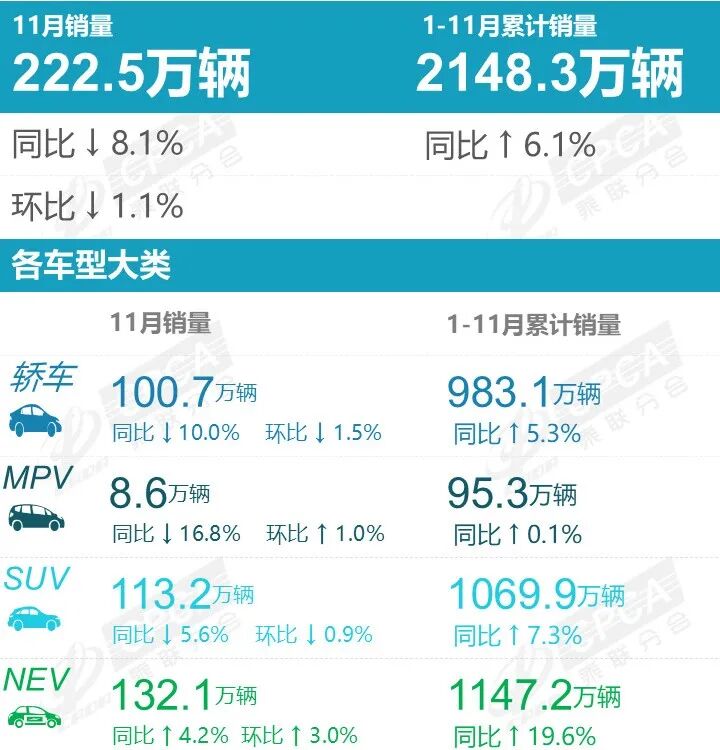
Group 1: Domestic Passenger Car Market Performance - In November, the retail volume of passenger cars in China was 2.225 million units, a year-on-year decrease of 8.1% and a month-on-month decline of 1.1% [1] - Cumulative retail sales from January to November reached 21.483 million units, reflecting a year-on-year growth of 6.1% [1] - The market growth pattern shows fluctuations, with a trend of "high in the front and stable later," indicating a return to normal growth [1] Group 2: New Energy Vehicle (NEV) Market Dynamics - In November, 22 manufacturers achieved monthly NEV wholesale sales exceeding 10,000 units, contributing 94.2% to total NEV sales, with leading brands being BYD, Geely, and Chery [2] - The "second-generation" NEV brands are showing strong growth, with their market share reaching 14.65%, up by 1.1 percentage points year-on-year [2] - The export of NEVs from Chinese brands reached 1.78 million units from January to November, a staggering increase of 139% year-on-year, with NEVs accounting for 40.6% of total exports [3] Group 3: Pricing and Promotion Trends - In November, the number of models with price reductions was 19, a decrease from the previous year, while the average discount for new energy vehicles rose to 10.1%, an increase of 3.1 percentage points year-on-year [4] - The average price reduction for new energy vehicles from January to November was 24,000 yuan, equivalent to 11.7% of the vehicle price [5] - The overall inventory in the industry increased by 60,000 units in November, contrasting with a decrease of 220,000 units in the same month last year [5] Group 4: Future Market Outlook - The expiration of the new energy vehicle purchase tax exemption at the end of the year is expected to boost sales in December, but may lead to challenges in 2026 due to reduced incentives [6] - Analysts predict that total passenger car wholesale sales will grow by approximately 2.9% in 2026, with NEVs being the main growth driver [7] - The competition in the market is expected to intensify with the introduction of 173 new models in 2026, over 90% of which will be NEVs or offer NEV options [7]


吉利汽车(00175.HK)12月9日耗资2870.26万港元回购163.4万股
Ge Long Hui· 2025-12-09 09:40
Group 1 - The core point of the article is that Geely Automobile announced a share buyback plan, intending to repurchase 1.634 million shares at a total cost of HKD 28.7026 million [1] Group 2 - The buyback will occur on December 9, 2025, with the repurchase price ranging from HKD 17.42 to HKD 17.91 per share [1]
汽车视点丨年末“翘尾”未现,出口或成2026年车市主要“增长极”
Zhong Guo Jin Rong Xin Xi Wang· 2025-12-09 09:35
Core Insights - The domestic passenger car retail market in China experienced a decline in November, with retail volume at 2.225 million units, down 8.1% year-on-year and a slight decrease of 1.1% month-on-month. Cumulatively, from January to November, retail sales reached 21.483 million units, reflecting a year-on-year growth of 6.1% [1] - The market dynamics show a pattern of "high at the beginning, stable later, and pressure in the fourth quarter," influenced by high base figures from the previous year and a gradual return to normal growth [1] - The "old-for-new" subsidy policy significantly supported market growth earlier in the year, but its impact is diminishing as subsidies are phased out, leading to a decrease in daily subsidy applications [1] Passenger Car Market Performance - In November, the wholesale sales of new energy vehicles (NEVs) saw 22 manufacturers surpassing 10,000 units, contributing 94.2% to total NEV sales, indicating a concentration in the market [2] - Major domestic brands like BYD, Geely, and Chery led the sales, with respective volumes of 475,000, 188,000, and 112,000 units [2] - The "second-generation" new energy brands are gaining momentum, with their market share reaching 14.65%, up 1.1 percentage points year-on-year [2] Export Trends - November marked a record high for passenger car exports at 601,000 units, a significant year-on-year increase of 52.4%. Domestic brands accounted for 525,000 units of this total [3] - Cumulatively, from January to November, exports of domestic brand NEVs reached 1.78 million units, a staggering increase of 139% year-on-year, with NEVs making up 40.6% of total exports [3] - The structure of NEV exports is improving, with the share of plug-in hybrid vehicles rising from 26% to 42% year-on-year [3] Promotional Activities and Market Dynamics - The anticipated year-end "tail effect" in the market did not materialize, although promotional activities remain strong, particularly for traditional fuel vehicles and NEVs [4] - In November, the average promotional discount for traditional fuel vehicles was stable at 24%, while NEVs saw an increase in promotional intensity, averaging 10.1% [4] - The average price reduction for new NEVs from January to November was 24,000 yuan, equating to 11.7% of the vehicle price [4] Inventory and Market Outlook - Due to weak retail performance in November, overall industry inventory increased by 60,000 units, contrasting sharply with a decrease of 220,000 units in the same month last year [5] - The inventory warning index for automotive dealers rose to 55.6%, indicating a decline in industry prosperity [5] - Looking ahead, the expiration of the NEV purchase tax exemption is expected to boost December sales but may create pressure for 2026, potentially leading to a "micro-growth" phase in the domestic market [6] Future Projections - Analysts predict that total passenger car wholesale sales will grow by approximately 2.9% in 2026, with NEVs expected to drive this growth with a projected increase of 19% [7] - The competitive landscape is set to intensify with 173 new models expected to launch, over 90% of which will be NEVs or offer NEV options [7] - The domestic market may enter a deep adjustment phase in 2026, with globalization becoming a critical factor for future automotive company trajectories [7]




吉利汽车(00175) - 翌日披露报表
2025-12-09 09:31
FF305 翌日披露報表 (股份發行人 ── 已發行股份或庫存股份變動、股份購回及/或在場内出售庫存股份) 表格類別: 股票 狀態: 新提交 公司名稱: 吉利汽車控股有限公司 呈交日期: 2025年12月9日 如上市發行人的已發行股份或庫存股份出現變動而須根據《香港聯合交易所有限公司(「香港聯交所」)證券上市規則》(「《主板上市規則》」)第13.25A條 / 《香港聯合交易所有限公司GEM證券 上市規則》(「《GEM上市規則》」)第17.27A條作出披露,必須填妥第一章節 。 | 第一章節 | | | | | | | | | | | --- | --- | --- | --- | --- | --- | --- | --- | --- | --- | | 1. 股份分類 | 普通股 | | 股份類別 不適用 | | | 於香港聯交所上市 | 是 | | | | 證券代號 (如上市) | 00175 | 說明 | | | | | | | | | 多櫃檯證券代號 | 80175 | RMB 說明 | | | | | | | | | A. 已發行股份或庫存股份變動 | | | | | | | | | | | 事件 ...
吉利汽车公布极氪持有人对价选择,合并进入收官阶段
Ge Long Hui· 2025-12-09 09:17
Core Viewpoint - Geely Automobile Holdings Limited is finalizing the privatization of Zeekr Intelligent Technology Holdings, marking the completion of the "One Geely" strategy, with significant shareholder participation in the exchange of shares and cash [1][2] Group 1: Privatization Details - Approximately 70.8% of eligible Zeekr shareholders opted for share compensation, resulting in the issuance of 777,228,611 shares by Geely Automobile [1] - About 29.2% of eligible Zeekr shareholders chose or are deemed to have chosen cash compensation, leading to a total cash payment of approximately $701 million [1] - Each Zeekr share can be exchanged for $2.687 in cash or 1.23 shares of Geely Automobile, while each American Depositary Share can be exchanged for $26.87 in cash or 12.3 shares of Geely Automobile [1] Group 2: Strategic Implications - The merger is expected to be completed by December 29, 2025, allowing Geely to leverage Zeekr's position in the luxury electric vehicle market and enhance its technological and global capabilities [2] - Geely aims to cover mainstream, mid-to-high-end, and luxury segments, establishing a diverse power system that includes fuel, pure electric, plug-in hybrid, and hydrogen electric vehicles [2] - Financial performance shows a revenue of 239.5 billion yuan for the first three quarters of 2025, a 26% year-on-year increase, and a core net profit of 10.62 billion yuan, reflecting a 59% growth [2] - As of September 2025, Geely's total cash level reached 60.1 billion yuan, with a net cash level of 45.2 billion yuan, ensuring ample reserves for long-term development [2]
回归“一个吉利”即将收官,吉利汽车公布极氪持有人对价选择
Ge Long Hui A P P· 2025-12-09 09:08
Core Viewpoint - Geely Automobile (0175.HK) announced the results of the privatization transaction for Zeekr Intelligent Technology Holdings Co., Ltd. (NYSE: ZK), indicating a significant step towards the completion of the "One Geely" strategy [1] Group 1: Privatization Transaction Details - Approximately 70.8% of eligible Zeekr holders opted for share consideration, leading to the issuance of a total of 777,228,611 shares by Geely Automobile [1] - About 29.2% of eligible Zeekr holders chose or are considered to have chosen cash consideration, resulting in a total cash payment of approximately $701 million by Geely Automobile [1] Group 2: Strategic Implications - The merger transaction between Geely Automobile and Zeekr is expected to be completed by December 29, 2025, which will establish a solid foundation for Geely to enhance cost advantages, brand competitiveness, and global market influence [1] - Geely aims to achieve comprehensive coverage across mainstream, mid-to-high-end, and luxury segments, forming a diverse power system that includes "fuel, pure electric, plug-in hybrid, and hydrogen fuel cell" [1] - The company is focused on strengthening its smart manufacturing and technological innovation capabilities, with a commitment to improving profitability and delivering long-term returns to shareholders [1]
乘联分会:11月份国内狭义乘用车市场零售销量达222.5万辆 同比下降8.1%
Zhi Tong Cai Jing· 2025-12-09 08:53
Core Insights - The domestic retail sales of narrow passenger vehicles in China reached 2.225 million units in November 2025, representing a year-on-year decline of 8.1% and a month-on-month decrease of 1.1%. Cumulatively, from January to November 2025, sales totaled 21.483 million units, showing a year-on-year growth of 6.1% [1][3]. Group 1: Market Performance - The retail growth trend for the year is characterized as "front low, middle high, and back flat," confirming initial predictions. The "dual new policies" have played a role in stabilizing the market and adjusting growth rates [3]. - In November, the penetration rate of new energy passenger vehicles in the domestic market reached 59.4%, with a penetration rate of 79.6% among domestic brands and 38.8% in the luxury vehicle segment [3]. Group 2: Manufacturer Sales Rankings - In November 2025, BYD Auto led the sales with 474,921 units, although this represented a year-on-year decline of 5.8%. Geely Auto followed with 310,428 units, showing a significant year-on-year increase of 24.1% [5]. - For the cumulative sales from January to November 2025, BYD Auto also ranked first with 4.131 million units sold, reflecting a year-on-year growth of 10.4%. Geely Auto's sales reached 2.788 million units, marking a substantial increase of 41.8% [6]. Group 3: New Energy Vehicle (NEV) Sales - In November 2025, BYD Auto again topped the NEV wholesale sales with 474,921 units, despite a year-on-year decline of 5.8%. Geely Auto's NEV sales increased by 53.4% year-on-year, reaching 187,798 units [9]. - Cumulatively, from January to November 2025, BYD Auto sold 4.131 million NEVs, achieving a year-on-year growth of 10.4%, while Geely Auto's NEV sales surged by 97.4% to 1.534 million units [11].