
Sinopec Corp.(00386)

Search documents
港交所文件显示:12月12日,中国石油化工股份(00386.HK)回购了67.8万股H股,耗资290万港元。
Jin Rong Jie· 2025-12-12 09:51
Core Viewpoint - On December 12, China Petroleum & Chemical Corporation (Sinopec) repurchased 678,000 H-shares at a cost of HKD 2.9 million [1] Group 1 - The repurchase of shares indicates a strategic move by the company to enhance shareholder value [1] - The total expenditure for the share buyback was HKD 2.9 million, reflecting the company's commitment to returning capital to shareholders [1]

中国石油化工股份(00386.HK)12月12日耗资292.43万港元回购67.8万股
Ge Long Hui· 2025-12-12 09:46
Group 1 - The company, China Petroleum & Chemical Corporation (Sinopec), announced a share buyback plan, intending to repurchase 678,000 shares at a cost of HKD 2.9243 million [1] - The buyback price is set between HKD 4.29 and HKD 4.32 per share [1]
中国石油化工股份(00386)12月12日斥资292.43万港元回购67.8万股
智通财经网· 2025-12-12 09:45
Core Viewpoint - China Petroleum & Chemical Corporation (Sinopec) announced a share buyback plan, indicating confidence in its stock value and future prospects [1] Group 1: Company Actions - The company plans to repurchase 678,000 shares at a total cost of HKD 2.9243 million [1]
中国石油化工股份(00386) - 翌日披露报表
2025-12-12 09:41
FF305 翌日披露報表 (股份發行人 ── 已發行股份或庫存股份變動、股份購回及/或在場内出售庫存股份) 表格類別: 股票 狀態: 新提交 公司名稱: 中國石油化工股份有限公司 呈交日期: 2025年12月12日 如上市發行人的已發行股份或庫存股份出現變動而須根據《香港聯合交易所有限公司(「香港聯交所」)證券上市規則》(「《主板上市規則》」)第13.25A條 / 《香港聯合交易所有限公司GEM證券 上市規則》(「《GEM上市規則》」)第17.27A條作出披露,必須填妥第一章節 。 | 第一章節 | | | | | | | --- | --- | --- | --- | --- | --- | | 1. 股份分類 | 普通股 | 股份類別 H | 於香港聯交所上市 | 是 | | | 證券代號 (如上市) | 00386 | 說明 | | | | | A. 已發行股份或庫存股份變動 | | | | | | | | | 已發行股份(不包括庫存股份)變動 | 庫存股份變動 | | | | | 事件 | 佔有關事件前的現有已發 已發行股份(不包括庫存股份)數 行股份(不包括庫存股 目 份)數目百分比 (註3) | ...
苯酚丙酮、纤维素——大宗商品热点解读
2025-12-12 02:19
Summary of Key Points from Conference Call Records Industry Overview - The records primarily discuss the phenol-acetone and cellulose industries, highlighting the importance of extending the industrial chain to enhance companies' risk resistance capabilities. For instance, Guangxi Huayi is expanding downstream, while Sinopec, Shenghong, and Hengli Petrochemical are extending between refining and chemical sectors [1][2]. Core Insights and Arguments - **Industrial Chain Extension**: Companies with longer industrial chains exhibit stronger profit risk capabilities. Sinopec's strategy of shutting down old facilities and launching new ones exemplifies this trend [1][2]. - **Anti-Competition Measures**: The industry is implementing anti-competition strategies through the elimination of outdated capacities, low-cost suppliers servicing high-cost companies, and enhancing production capabilities to reduce import space [3]. - **Downstream Demand**: The demand for epoxy resins and polycarbonate (PC) supports profits in these sectors, with PC sales growth projected at 7%-10%. However, this demand does not fully translate to upstream raw materials like phenol and acetone, leading to weaker upstream profits [5]. - **Market Dynamics**: In the acetone downstream market, Bisphenol A accounts for over 30%, with methyl isobutyl ketone (MIBK) at 25%, isopropanol at 13%, and dimethyl sulfoxide (DMSO) at 5%. Bisphenol A has stable operations but low profits, while domestic supply of methyl paper has increased due to favorable export conditions last year [8]. Import and Export Trends - **Acetone Imports**: In 2025, acetone imports are expected to rise by 50%, primarily due to the expiration of anti-dumping measures and increased exports from Japan, Singapore, South Korea, and Taiwan, driven by their own weak downstream demand [9]. - **Cellulose Exports**: From 2021 to 2025, cellulose exports have shown a narrow growth trend, with a significant increase in demand from emerging markets. The total cellulose export volume for the first ten months of 2025 reached 17.3 million tons, a 15.45% increase year-on-year [15][23]. Profitability and Market Conditions - **Profit Trends**: The years 2020 to 2025 show high-profit years concentrated around 2021, correlating with rapid growth in the wind power sector. However, upstream raw materials like phenol and acetone have seen weaker profits [6]. - **Cost and Price Dynamics**: The cost structure for cellulose ethers includes raw materials like refined cotton and caustic soda. Prices for HPMC in different regions range from 13,500 to 28,000 yuan per ton, with market conditions leading to a downward trend in prices due to weak demand and high inventory levels [17][18]. Future Outlook - **Capacity Expansion**: The cellulose ether industry is expected to continue expanding, with an estimated additional capacity of 113,000 tons by the end of 2026. The industry is gradually shifting towards high-end applications in pharmaceuticals and food [19][20]. - **Challenges Ahead**: The cellulose market faces challenges such as weak end-market demand and high inventory levels. The industry is expected to see increased concentration as smaller players may be eliminated due to low profitability [21][23]. - **Emerging Markets**: Future growth in the cellulose sector is anticipated to be driven by high-end product demand in pharmaceuticals and food, with leading companies accelerating their strategic adjustments [20][23]. Conclusion - The phenol-acetone and cellulose industries are navigating a complex landscape characterized by capacity expansions, shifting demand dynamics, and competitive pressures. Companies are focusing on enhancing their industrial chains and adapting to market conditions to maintain profitability and growth.
稳健配置+涨价品种,聚焦四大投资方向 | 投研报告
Sou Hu Cai Jing· 2025-12-12 01:23
Group 1: Core Investment Strategies - The report recommends focusing on dividend strategies with companies like China National Offshore Oil Corporation (CNOOC), China National Petroleum Corporation (CNPC), and China Petroleum & Chemical Corporation (Sinopec), expecting Brent oil prices to stabilize between $60-70 per barrel in 2026 [2] - CNOOC is committed to increasing reserves and production while reducing costs, promising a dividend payout ratio of no less than 45% from 2025 to 2027 [2] - CNPC is expected to benefit from the domestic natural gas market reform, while Sinopec is monitoring the progress of domestic refining and chemical industry competition [2] Group 2: Chemical Sector Investment - The report suggests investing in undervalued chemical leaders such as Wanhua Chemical, Baofeng Energy, Satellite Chemical, and Hualu Hengsheng, as they are expected to benefit from industry barriers related to cost, technology, and market [2] - The chemical sector is anticipated to see a bottoming out of performance due to market influx of funds, including quantitative investments prioritizing chemical ETFs [2] Group 3: Demand-Driven Price Increases - Traditional demand areas include food additives, pesticides, and fertilizers, with stable growth expected in vitamin and methionine demand, focusing on companies like New Hope Liuhe and Adisseo [3] - The pesticide market is expected to see price increases due to overseas demand and limited domestic supply, with companies like Yangnong Chemical and Jiangshan Chemical being highlighted [3] - In fertilizers, potassium supply and demand are expected to remain tight, supporting price increases, with a focus on companies like Asia Potash International and Dongfang Iron Tower [3] Group 4: Emerging Demand in Phosphate and Fluorine Chemicals - The phosphate chemical sector is expected to benefit from increased demand for lithium iron phosphate and hexafluorophosphate lithium driven by the new energy battery and energy storage sectors, with companies like Chuanheng Chemical and Xingfa Group being monitored [3] - The fluorine chemical sector is seeing increased demand for liquid cooling driven by AI applications, with attention on companies like Juhua Co., Sanmei Chemical, and Yonghe Chemical [3] Group 5: Domestic Price Increases Driven by Competition - In the large refining sector, domestic PTA and filament industries are experiencing competition, with companies like Hengli Petrochemical and Rongsheng Petrochemical being of interest [3] - The organic silicon sector is nearing the end of its expansion cycle, with major domestic companies reducing operational rates, focusing on companies like Sinan Chemical and Dongyue Silicon Material [3] - The soda ash industry is facing regulatory controls on existing and new capacities, with older capacities under assessment for elimination, highlighting companies like Boyuan Chemical [3]

中国石油化工股份(00386.HK)连续31日回购 累计斥资5.71亿港元
Zheng Quan Shi Bao Wang· 2025-12-11 13:42
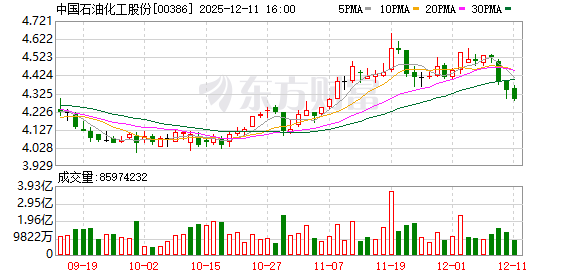
Core Viewpoint - China Petroleum & Chemical Corporation (Sinopec) has been actively repurchasing its shares, indicating a strategy to enhance shareholder value and confidence in its stock performance [2][3]. Share Buyback Summary - On December 11, 2025, Sinopec repurchased 2.546 million shares at a price range of HKD 4.280 to HKD 4.370, totaling HKD 10.9615 million [2]. - The stock closed at HKD 4.290 on the same day, reflecting a decline of 1.15%, with a total trading volume of HKD 370 million [2]. - Since October 30, 2025, the company has conducted buybacks for 31 consecutive days, acquiring a total of 13 million shares for a cumulative amount of HKD 57.1 million, during which the stock price increased by 1.66% [2]. - Year-to-date, Sinopec has executed 64 buybacks, totaling 35.2 million shares and an aggregate expenditure of HKD 163.7 million [2]. Detailed Buyback Data - The buyback details include various dates, number of shares repurchased, highest and lowest prices, and total amounts spent, showcasing a consistent buyback strategy [3].

股票行情快报:中国石化(600028)12月11日主力资金净卖出1951.18万元
Sou Hu Cai Jing· 2025-12-11 12:41
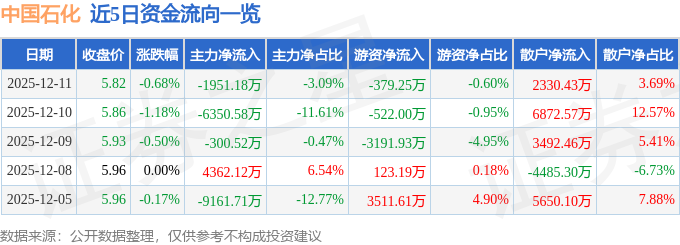
Core Viewpoint - As of December 11, 2025, Sinopec (600028) closed at 5.82 yuan, down 0.68%, with a trading volume of 1.0898 million hands and a transaction amount of 632 million yuan [1] Group 1: Financial Performance - For the first three quarters of 2025, Sinopec reported a main operating revenue of 21,134.41 billion yuan, a year-on-year decrease of 10.69% [3] - The net profit attributable to shareholders was 299.84 billion yuan, down 32.23% year-on-year [3] - The third quarter alone saw a main operating revenue of 7,043.89 billion yuan, a decline of 10.88% year-on-year, while the net profit for the quarter was 85.01 billion yuan, down 0.5% [3] - The company’s gross profit margin stood at 15.68%, with a net profit margin of 1.61% [3] Group 2: Market Position and Valuation - Sinopec's total market capitalization is 704.734 billion yuan, significantly higher than the industry average of 209.014 billion yuan [3] - The company ranks 2nd in net assets at 988.361 billion yuan, compared to the industry average of 192.121 billion yuan [3] - The price-to-earnings ratio (P/E) is 17.63, which is lower than the industry average of 32.96, ranking 4th in the industry [3] - The price-to-book ratio (P/B) is 0.85, significantly lower than the industry average of 2.42, ranking 2nd in the industry [3] Group 3: Recent Trading Activity - On December 11, 2025, the net outflow of main funds was 19.5118 million yuan, accounting for 3.09% of the total transaction amount [2] - Retail investors showed a net inflow of 23.3043 million yuan, representing 3.69% of the total transaction amount on the same day [1][2] - Over the past five days, the stock has experienced fluctuations in fund flows, with notable net outflows from main and speculative funds on several days [2]
中国石化(600028) - 中国石化H股公告-翌日披露表格
2025-12-11 10:01
FF305 Next Day Disclosure Return (Equity issuer - changes in issued shares or treasury shares, share buybacks and/or on-market sales of treasury shares) Instrument: Equity issuer Status: New Submission Name of Issuer: China Petroleum & Chemical Corporation Date Submitted: 11 December 2025 Section I must be completed by a listed issuer where there has been a change in its issued shares or treasury shares which is discloseable pursuant to rule 13.25A of the Rules Governing the Listing of Securities on The Sto ...
中国石油化工股份(00386.HK)12月11日耗资1096.15万港元回购254.6万股
Ge Long Hui· 2025-12-11 09:39
Group 1 - The core announcement is that China Petroleum & Chemical Corporation (Sinopec) plans to repurchase 2.546 million shares at a cost of HKD 10.9615 million [1] - The repurchase price per share is set between HKD 4.28 and HKD 4.37 [1]