TENCENT(00700)

Search documents
“翻倍基”调仓 基金经理激辩AI投资,坚守算力还是冲向应用?
2 1 Shi Ji Jing Ji Bao Dao· 2026-01-23 02:26
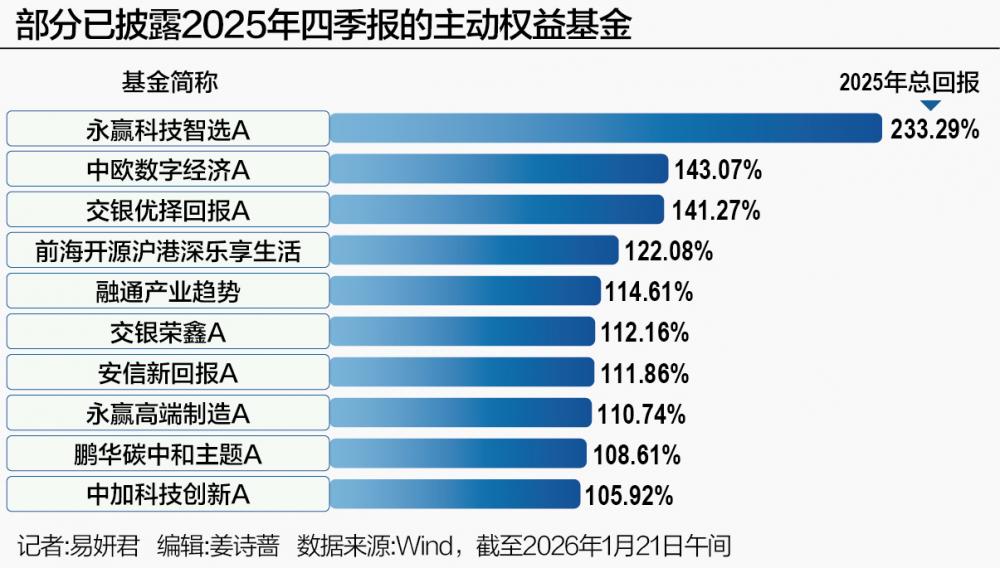
Core Insights - The 2025 annual performance of AI-themed funds has drawn market attention, with significant adjustments in their holdings during the reporting period [1] - There is a divergence among fund managers regarding investment opportunities in the AI sector for 2026, despite some funds experiencing substantial net value increases due to their investments in AI application stocks [9] Fund Adjustments - The top-performing active equity funds have made considerable adjustments to their AI asset holdings, with some funds increasing their positions in leading companies while others have reduced their stakes [1][4] - For instance, the fund Yongying Technology Select increased its holdings in Dongshan Precision, Jingwang Electronics, and others, while reducing its stake in Zhongji Xuchuang [1][4] - The fund Zhongou Digital Economy has also shifted its focus, increasing investments in domestic AI and AI infrastructure while reducing exposure to smart driving and edge AI [1][6] Sector Consensus and Divergence - There is a consensus among high-performing funds regarding the PCB sector, with several funds increasing their positions in companies like Dongshan Precision and Shengxin Technology [5][6] - However, there are notable divergences in the strategies of different funds regarding specific AI sub-sectors, such as the varying approaches to Zhongji Xuchuang [4][5] Future Outlook - Fund managers are considering how to capitalize on the expanding AI market, with a focus on the potential for significant breakthroughs in AI applications and the ongoing competition in the large model sector [10][11] - Some managers emphasize the importance of balancing growth potential with safety margins, while others highlight the need for diversified investments to mitigate risks associated with high valuations in the AI sector [12]





金融界财经早餐:潘功胜发声,今年降准降息还有空间!多家银行落实消费贷贴息优化;中际旭创成公募基金第一重仓股;商业航天领域动态频出;阿里旗下平头哥筹划IPO(1月23日)
Jin Rong Jie· 2026-01-23 01:47
Economic Policy - The People's Bank of China will continue to implement a moderately loose monetary policy in 2026, utilizing various tools such as reserve requirement ratio cuts and interest rate reductions to maintain ample liquidity [1] - The Ministry of Commerce and nine other departments have issued opinions to promote high-quality development in the pharmaceutical retail industry, supporting mergers and acquisitions among retail pharmacies [1] Capital Market Developments - The People's Bank of China announced a 900 billion yuan MLF operation to maintain liquidity in the banking system, with a one-year term [3] - Public funds have focused on core sectors such as electronics and power equipment, with Zhongji Xuchuang becoming the largest holding stock, valued at 78.421 billion yuan [3] - The National Development and Reform Commission has allocated 93.6 billion yuan in special bonds to support over 4,500 projects across various sectors, driving total investment exceeding 460 billion yuan [3] Industry Highlights - The commercial aerospace sector is gaining attention, with Blue Arrow Aerospace's IPO status changing to "inquiry" as it aims to become the first commercial aerospace stock [7] - Domestic AI chip company Suiyuan Technology has received approval for its IPO, aiming to raise 6 billion yuan for AI chip development [7] - The human-shaped robot sector remains active, with Zhejiang's innovation center completing a 450 million yuan Pre-A round of financing [7] Company Updates - Zhaoyi Innovation expects a net profit of 1.61 billion yuan for 2025, a year-on-year increase of approximately 46%, benefiting from AI computing demand [8] - ST Biology announced the termination of its major asset restructuring plan to acquire a 51% stake in Hunan Huize Biomedical Technology [9] - Xiaomi Group plans to repurchase up to 2.5 billion Hong Kong dollars of its Class B shares starting January 23 [10] - Alibaba has decided to support its chip subsidiary "Pingtouge" for future independent listing, initiating a restructuring process [11] - Intel reported a fourth-quarter revenue of 13.674 billion dollars, with a net loss of 591 million dollars, while its annual revenue was 52.853 billion dollars [11]






腾讯投的上海AI芯片独角兽,要IPO了,拟募资60亿
3 6 Ke· 2026-01-23 01:35
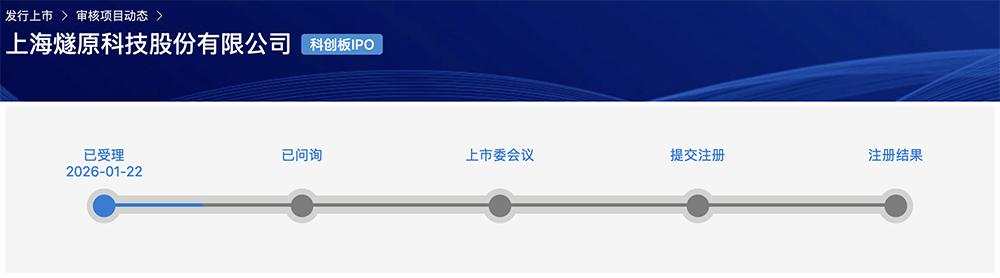
Core Viewpoint - Suiruan Technology, an AI chip unicorn based in Shanghai, has had its IPO application accepted by the Shanghai Stock Exchange, aiming to raise 6 billion yuan for the development and industrialization of its fifth and sixth generation cloud AI chip series [1][12]. Company Overview - Founded in March 2018, Suiruan Technology has a registered capital of 387 million yuan and has developed four generations of architecture with five cloud AI chips [3]. - The company has established a complete product system including AI chips, AI acceleration cards, intelligent computing systems, and AI computing software platforms [5]. Market Position - Suiruan Technology's AI acceleration cards and modules sold approximately 38,800 units in 2024, capturing about 1.4% of the Chinese AI acceleration card market, ranking among the top domestic AI chip manufacturers [9][21]. - The company is positioned in the early development stage of the domestic cloud AI chip industry, competing with other local firms like Huawei HiSilicon and Cambricon [8]. Financial Performance - Revenue for Suiruan Technology was 0.90 billion yuan in 2022, 3.01 billion yuan in 2023, and is projected to reach 7.22 billion yuan in 2024, with a net loss of 15.10 billion yuan expected for 2024 [14]. - The company has not yet achieved profitability, with a gross margin of 36.23% as of September 2025, which is below the average of comparable companies [17][18]. R&D and Product Development - The company plans to release its fourth generation AI inference card and ESL32/64 super node clusters in 2025, with the fifth generation cloud AI chip expected in 2027 [3][12]. - Suiruan Technology has invested heavily in R&D, with expenses reaching 13.12 billion yuan in 2024, and aims to enhance its product offerings through continuous innovation [14][19]. Customer Base and Sales Strategy - Tencent Technology is the largest customer, accounting for 71.84% of sales in the first nine months of 2025, indicating a high customer concentration risk [8][33]. - The company primarily uses a direct sales model, with over 94% of revenue coming from the top five customers in recent years [31][33]. Shareholding Structure - Major shareholders include Tencent Technology, the National Big Fund Phase II, and Meitu Technology, holding 19.95%, 4.32%, and 1.31% respectively [7][37]. - The founders, Zhao Lidong and Zhang Yalin, collectively control approximately 28.14% of the company [39]. Industry Trends - The non-GPGPU chip market share is expected to increase from 36% in 2024 to 45% by 2027, highlighting a shift in AI chip demand [44]. - By 2028, major internet companies like ByteDance, Alibaba, and Tencent are projected to account for nearly 50% of China's AI capital expenditure, emphasizing the importance of entering the supply chains of leading internet firms [47]. Future Outlook - Suiruan Technology plans to collaborate with domestic partners to develop a fully localized supply chain for its cloud AI chip products, aiming to build a competitive domestic AI computing ecosystem [49].

公募基金最新前十大重仓股出炉
Zhong Zheng Wang· 2026-01-23 00:53
Group 1 - The general aviation sector in A-shares has strengthened again, with multiple aviation-themed ETFs rising nearly 4%, while military and satellite-related ETFs have generally increased over 3% [1] - In contrast, previously popular sectors such as semiconductor equipment, power grids, and gold stocks have collectively cooled down, with several semiconductor equipment-themed ETFs dropping over 2% [1] Group 2 - The latest top ten heavy stocks from public funds have been disclosed, including Zhongji Xuchuang, Xinyi Sheng, CATL, Tencent Holdings, Zijin Mining, Alibaba-W, Cambricon, Luxshare Precision, Kweichow Moutai, and Dongshan Precision [1] Group 3 - To maintain ample liquidity in the banking system, the People's Bank of China will conduct a 900 billion yuan MLF operation with a one-year term on January 23, using a fixed quantity, interest rate bidding, and multiple price level bidding methods [1]



四大证券报精华摘要:1月23日
Zhong Guo Jin Rong Xin Xi Wang· 2026-01-23 00:17
Group 1: Commercial Aerospace - The Chinese commercial aerospace sector is entering a new phase aimed at large-scale launches and commercial closed-loop systems, with significant breakthroughs expected in rocket capacity over the next 3 to 5 years [1] - By 2025, China's commercial aerospace is projected to complete 50 launches, accounting for 54% of total space launches, with 25 commercial rockets launched and 311 commercial satellites in orbit, representing 84% of total satellites [1] - The capital market for commercial aerospace companies is accelerating, with several leading firms preparing for IPOs, including Blue Arrow Aerospace and Zhongke Aerospace [1] Group 2: Public Fund Performance - The latest public fund reports reveal that the top ten holdings include companies like Zhongji Xuchuang, Ningde Times, and Tencent, with notable increases in holdings for companies like Zhongji Xuchuang, which saw an increase of 22.602 billion yuan [2] - The automotive industry is facing cost pressures due to rising prices of memory chips and metals, impacting supply chain dynamics and competition [2] Group 3: Biopharmaceutical Industry - Over 50 biopharmaceutical companies have disclosed their 2025 performance forecasts, with nearly 50% showing positive expectations, particularly in the CXO sector, where WuXi AppTec anticipates a revenue increase of approximately 15.84% [3] - The biopharmaceutical industry is expected to enter a new phase of high-quality development as structural reforms and supportive policies continue to evolve [3] Group 4: Fundraising and Market Trends - The public fund market has seen a resurgence, with several equity funds raising over 7 billion yuan, indicating a positive trend in active equity fund performance [4] - The Shanghai Suiruan Technology Co., Ltd. has received approval for its IPO, aiming to raise 6 billion yuan for product development and business expansion [5] Group 5: Aluminum Market - The aluminum market has shown strong performance, with prices rising over 12% since mid-December 2025, supported by favorable macroeconomic conditions and demand for aluminum in various applications [6] - The copper-aluminum price ratio exceeding 4 suggests a potential shift towards aluminum in sectors like air conditioning, indicating new demand growth [6] Group 6: Banking Sector - Five listed banks have reported a year-on-year increase in net profit for 2025, with improvements in non-performing loan ratios for three banks [9] - The banking sector is expected to maintain stable performance, supported by improved funding costs and a potential stabilization of net interest margins [9] Group 7: Chemical Industry - The chemical industry is experiencing positive performance, with over 60% of companies reporting improved earnings, driven by rising prices of certain chemical products [10] - The DOP market is expected to maintain upward momentum due to strong raw material prices and limited supply, indicating a stable support for pricing [10]
陆家嘴财经早餐2026年1月23日星期五
Wind万得· 2026-01-23 00:13
Monetary Policy and Economic Measures - The central bank governor Pan Gongsheng stated that a moderately loose monetary policy will continue in 2026, with room for further cuts in reserve requirement ratios and interest rates to maintain ample liquidity [3] - The first batch of 936 billion yuan of ultra-long special government bonds has been allocated to support approximately 4,500 projects in various sectors, expected to drive total investment exceeding 460 billion yuan [4] - The People's Bank of China will conduct a 900 billion yuan MLF operation on January 23, net injecting 700 billion yuan into the market, marking the 11th consecutive month of increased operations [4] Consumer and Investment Trends - State-owned banks collectively announced the implementation of personal consumption loan interest subsidy policies, allowing some high-quality clients to enjoy effective interest rates in the "2%" range, lower than current housing loan rates [3] - Public funds have focused their fourth-quarter 2025 positions on core sectors such as electronics and power equipment, with Zhongji Xuchuang becoming the largest holding stock [3] Market Performance - The A-share market saw a slight increase, with the Shanghai Composite Index rising 0.14% to 4122.58 points, and the Shenzhen Component Index increasing by 0.5% [6] - The Hong Kong stock market also experienced minor fluctuations, with the Hang Seng Index rising 0.17% to 26629.96 points, and net inflows from southbound funds amounting to 5.166 billion HKD [6] Corporate Developments - Alibaba Group has decided to support its chip company "Pingtouge" for independent listing, with plans for restructuring to a mixed-ownership enterprise [7] - Xiaomi Group has initiated a stock repurchase plan of up to 2.5 billion HKD [9] - Nanjing Bank reported a net profit growth of 8.08% year-on-year for 2025 [9] Regulatory and Policy Updates - The State Administration for Market Regulation has issued a red card for the first time in the public utility sector, prohibiting a merger between two gas companies [10] - Nine departments jointly issued opinions to promote high-quality development in the pharmaceutical retail industry, encouraging mergers and acquisitions among retail pharmacies [10] Economic Indicators - The unemployment rate for urban labor aged 16-24 was reported at 16.5% in December 2025, while the rate for those aged 25-29 was 6.9% [5] - The National Bureau of Statistics reported a 28.1% year-on-year increase in sales revenue for the smart device manufacturing industry in 2025 [10]




8点1氪丨错版“马年茅台”二手价格被炒至2800元 ;“黑白颠周媛”账号被封;兰博基尼2025销量创历史新高,卖出10747辆
3 6 Ke· 2026-01-23 00:03
Group 1 - The "Year of the Horse" Moutai liquor has a printing error, leading to a surge in second-hand prices reaching up to 2800 yuan, compared to the original price of 1899 yuan [2][3] - The account of influencer Zhou Yuan, known for controversial content, has been banned after generating over 24 million yuan in revenue from paid courses [2][3] - Lamborghini announced a record delivery of 10,747 vehicles in 2025, marking a 60-unit increase from the previous year and achieving growth for the fifth consecutive year [3] Group 2 - Yonghui Supermarket expects a net loss of 2.14 billion yuan for 2025 due to significant strategic adjustments and asset write-offs [4][6] - The company has a high debt ratio of 88.96% and a low liquidity ratio of 0.63, indicating financial strain [6] - The company plans to complete its strategic adjustments by 2026 [6] Group 3 - Gold prices have reached a new high of 4950 USD per ounce, with a 0.28% increase [11] - Goldman Sachs raised its gold price target for December 2026 from 4900 USD to 5400 USD, citing increased demand for gold as a hedge against macroeconomic uncertainties [12] - Nvidia has overtaken Apple as TSMC's largest customer, accounting for 13% of TSMC's total revenue [12] Group 4 - The Chinese government has implemented a subsidy program for elderly individuals with moderate to severe disabilities, providing up to 800 yuan per month [13] - The subsidy is aimed at supporting various elderly care services, including home and institutional care [13] Group 5 - SpaceX plans to launch its second-generation Starlink system by 2027 [16] - Amazon is preparing to lay off thousands of corporate employees as part of its restructuring efforts [17] - Tesla's CEO Elon Musk indicated plans to sell the Optimus robot to the public by the end of next year [18]


8点1氪丨错版“马年茅台”二手价格被炒至2800元;vivo叫停AI眼镜项目;兰博基尼2025销量创历史新高,卖出10747辆
3 6 Ke· 2026-01-22 23:57
Group 1 - The "Year of the Horse" edition of Moutai has a printing error, leading to a surge in second-hand prices, with listings ranging from 2300 to 2800 yuan, up from the original price of 1899 yuan [2] - Vivo has halted its AI glasses project after six months of development, citing difficulties in differentiation as the reason for the decision [2] - Lamborghini announced a record delivery of 10,747 vehicles in 2025, marking a 60-unit increase from 2024 and achieving over 10,000 deliveries for the second consecutive year [3] Group 2 - Yonghui Supermarket expects a net loss of 2.14 billion yuan for 2025 due to significant strategic adjustments, including store renovations and asset write-offs [4] - The company has a high debt ratio of 88.96% and a current ratio of 0.63, indicating financial strain [6] - The company plans to complete its strategic adjustments by 2026 [6] Group 3 - Goldman Sachs raised its gold price target for December 2026 from 4900 to 5400 dollars per ounce, driven by increased diversification in gold holdings amid global uncertainties [11] - Nvidia has overtaken Apple as TSMC's largest customer, accounting for approximately 13% of TSMC's total revenue [11] - China has implemented a nationwide subsidy program for elderly individuals with moderate to severe disabilities, providing up to 800 yuan per month for various elder care services [12] Group 4 - Intel reported a 4.1% year-over-year decline in Q4 revenue, totaling 13.67 billion dollars, while adjusted EPS rose to 0.15 dollars [23] - The company expects Q1 revenue to be between 11.7 billion and 12.7 billion dollars, with adjusted EPS projected at 0.0 dollars [23] - The company "Raising a Cow" achieved over 7 billion yuan in revenue for 2025, reflecting steady growth from the previous year [23]


张坤在管基金披露2025年四季报:减持白酒股 加仓阿里巴巴
Zhi Tong Cai Jing· 2026-01-22 23:43
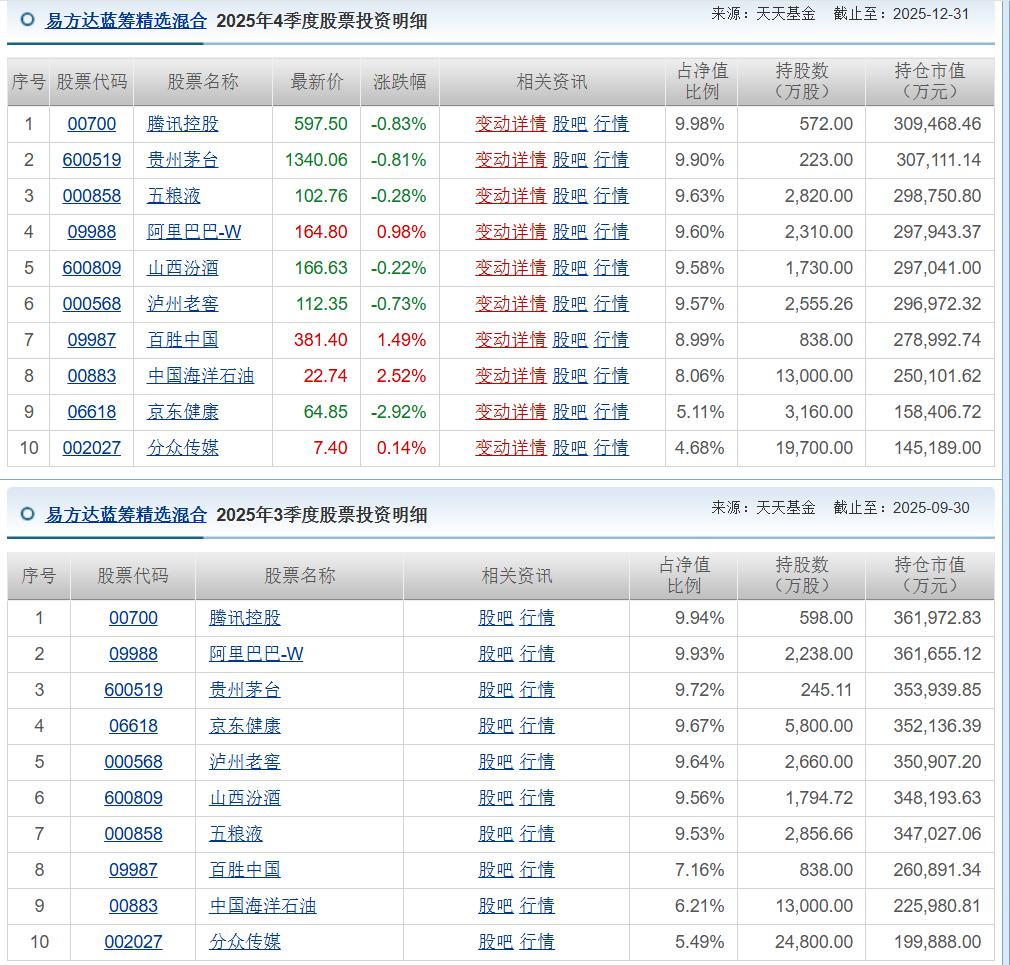
易方达蓝筹精选的前十大重仓股并未发生变更,依次为:腾讯控股(00700)、贵州茅台(600519.SH)、五粮液(000858.SZ)、阿里巴巴(09988)、山西 汾酒(600809.SH)、泸州老窖(000568.SZ)、百胜中国(09987)、中国海洋石油(00883)、京东健康(06618)、分众传媒(002027.SZ)。其中,张坤较大 幅度地减持了分众传媒,还减持了泸州老窖、山西汾酒、五粮液;加仓了阿里巴巴。 | 序号 | 股票代码 | 股票名称 | 相关资讯 | 占浄值 | 持股数 | 持仓市值 | | --- | --- | --- | --- | --- | --- | --- | | | | | | 比例 | (万股) | (万元) | | 1 | 00700 | 腾讯控股 | 股吧 行情 | 9.94% | 598.00 | 361,972.83 | | 2 | 09988 | 阿里巴巴-W | 股吧 行情 | 9.93% | 2.238.00 | 361.655.12 | | 3 | 600519 | 贵州茅台 | 股吧 行情 | 9.72% | 245.11 | 353.939.85 ...



【钛晨报】央行行长潘功胜:2026年将继续实施好适度宽松的货币政策,发挥增量政策和存量政策集成效应;落实个人消费贷款最新财政贴息政策,六大行集体公告;商务部等9部门关于促进药品零售行业高质量发展的意见
Sou Hu Cai Jing· 2026-01-22 23:39
Monetary Policy - The People's Bank of China (PBOC) will continue to implement a moderately loose monetary policy in 2026, focusing on promoting stable economic growth and reasonable price recovery [2] - The PBOC plans to flexibly use various monetary policy tools such as reserve requirement ratio (RRR) cuts and interest rate reductions to maintain ample liquidity [2] - There is still room for RRR cuts and interest rate reductions this year, with an emphasis on managing interest rate policies to keep financing costs low [2] Structural Policies - The PBOC has introduced a series of structural monetary policies, including a 0.25 percentage point reduction in the interest rates of various structural monetary policy tools [3] - The PBOC has set up a dedicated 1 trillion yuan relending facility for private enterprises and increased the relending quota for agricultural and small enterprises by 500 billion yuan to 4.35 trillion yuan [3] - The PBOC aims to maintain stable financial markets and manage expectations, ensuring the RMB exchange rate remains stable [3] Real Estate Market - The real estate market in 2025 is expected to stabilize with four positive signals, including a noticeable stabilization in sales scale for new and second-hand homes [4] - There is increasing differentiation among cities and regions, with some core cities showing signs of activity in the real estate market [4] - Inventory levels have shown a certain degree of decline, contributing to the overall market recovery [4] Investment and Innovation - A strong domestic demand market is crucial for promoting technological innovation, as it attracts global resources, talent, and capital [5] - A domestic company with leading foundational model capabilities could benefit from a stronger consumer environment, enhancing subscription revenue and model investment interactions [5] AI and Technology Developments - Baidu has officially released the Wenxin large model 5.0, which supports various forms of information understanding and output [6] - Baichuan Intelligent has launched the Baichuan-M3 Plus, which significantly reduces the hallucination rate in medical scenarios and introduces evidence anchoring technology for verifiable medical judgments [8] Market Regulations - The State Administration for Market Regulation has prohibited certain gas companies from establishing joint ventures, marking a significant enforcement of antitrust laws in the public utility sector [15] - The Ministry of Commerce and other departments have issued opinions to promote high-quality development in the pharmaceutical retail industry, encouraging participation in centralized procurement [13] International Investment Trends - The Swedish largest private pension fund has sold a significant portion of its U.S. Treasury holdings due to concerns over the unpredictability of the U.S. government and rising debt levels [20] - Chinese enterprises are expected to maintain healthy and orderly development in foreign investments, with direct investments reaching $174.38 billion in 2025, a 7.1% increase from the previous year [14]