
LENOVO GROUP(00992)

Search documents
午评:港股恒指涨0.26% 科指涨1.6% 科网股普涨 汽车股走强 蔚来涨超6%
Xin Lang Cai Jing· 2025-12-29 04:03
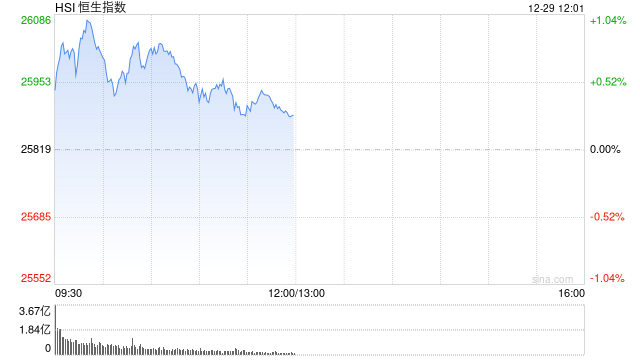
12月29日消息,港股三大指数集体上涨。截至午间收盘,恒生指数涨0.26%,报25886.75点,恒生科技 指数涨1.60%,国企指数涨0.77%。盘面上,科网股普涨,网易、美团涨超2%,百度、联想、快手、哔 哩哔哩涨超1%;汽车股走强,蔚来涨超6%;脑机接口概念普涨,心玮医疗涨超10%;纸业股涨幅居 前,玖龙纸业涨超4%。 | 名称 | | 最新价 | 涨跌幅 √ | | --- | --- | --- | --- | | 但生科技指数 | NY | 5587.24 | +1.60% | | 800700 | | | | | 国企指数 | ี | 8983.59 | +0.77% | | 800100 | | | | | 恒生指数 | 200 | 25886.75 | +0.26% | | 800000 | | | | 汽车股走强,蔚来涨超6%。方正证券发布研报称,中央经济工作会议及财政部明确优化"两新"政策, 多地遴选以旧换新平台企业。据媒体披露,2026年国补将延续,单车最高补3万元,聚焦淘汰老旧高排 放车辆,同时提升新能源补贴与混动车型纯电续航门槛。 脑机接口概念普涨,心玮医疗涨超10%。光大证券发布 ...






联想深度参与赛事直转播等核心环节
Zheng Quan Ri Bao Wang· 2025-12-29 03:44
Group 1 - Lenovo is the official technology partner for the 2026 FIFA World Cup, engaging deeply in content production, smart operations, and live broadcasting to enhance fan experience [1] - The launch of "Your World Cup Viewing Buddy" - Lenovo Tianxi AI Football Smart Agent World Cup Edition, aims to provide interactive and professional analysis for fans [1][2] - The Tianxi AI integrates across various devices, creating a personal knowledge base that manages user interactions and tasks seamlessly [2][3] Group 2 - Tianxi AI has developed a secure architecture for personal data protection, receiving the first "Excellence" certification for generative AI security from the China Academy of Information and Communications Technology [2] - Lenovo's strategy of "Tianxi AI One Body Multi-End" is driving the implementation of advanced AI experiences, with over 5000 applications in its ecosystem [3] - The transition from "Device AI" to "Personal AI" signifies a technological evolution that will reshape industry dynamics and ecosystems [3] Group 3 - Lenovo's Tech World event at CES 2026 will define the direction for AI technology, emphasizing the importance of user-centric design in AI applications [4] - The ongoing exploration of AI aims to enhance its understanding and service to humans, moving towards a future that is clearer and more empathetic [4]
首份个人AI产业发展白皮书发布,个人超级智能体将迎规模化落地
Jing Ji Wang· 2025-12-29 03:16
Core Insights - The white paper released by Lenovo and IDC outlines the framework for the personal AI industry, focusing on its definition, core characteristics, and market development trends [1][4]. Group 1: Definition and Characteristics of Personal AI - Personal AI is defined as a user-centered system that integrates software, hardware, and services, with data and algorithm sovereignty belonging to the user [4]. - Four key characteristics of personal AI are identified: user-centric personal superintelligence, AI terminals combined with personal cloud, cross-platform open ecosystems, and trustworthy security based on personal AI sovereignty [4]. Group 2: Industry Structure and Transformation - The personal AI era will shift the industry center from operating systems and commercial platforms to personal superintelligence, fundamentally altering the industry structure [4]. - Personal AI promotes a unified technology system characterized by multi-end integration, end-cloud collaboration, and deep software-hardware fusion [4]. Group 3: Ecosystem and Market Predictions - The white paper emphasizes a transition from a platform-centric structure to a multi-layered collaborative ecosystem, with personal superintelligence as the primary user interface [6]. - IDC predicts that 2026 will mark the beginning of the personal AI industry, with traditional AI terminal shipments in China expected to exceed 300 million units [6].

“杭州六小龙”云深处启动IPO;英伟达准备向中国客户交付H200芯片丨Going Global
创业邦· 2025-12-28 10:29
Core Insights - The article highlights significant developments in the global expansion of Chinese companies, focusing on logistics, e-commerce, robotics, and AI technologies, indicating a trend of increasing international collaboration and competition in various sectors. Group 1: Major Events - Temu partners with PostNL to enhance cross-border logistics for local sellers in Europe, aiming to improve delivery flexibility and consumer experience [3][4] - TikTok Shop launches the "One Merchant, Sell Globally" project, enabling merchants to manage multiple stores across regions with integrated functionalities [5] - "Hangzhou Six Dragons" company Yun Shen Chu initiates IPO process after completing over 500 million yuan in Series C financing [7][8] Group 2: Company Responses and Developments - DJI expresses regret over the FCC's decision to list all non-U.S. manufactured drones on a regulated list, emphasizing the impact on market competition and consumer choice [11][12] - Lenovo plans to release the world's first "AI Super Intelligent Agent," aiming to integrate hardware interactions across its ecosystem [14] - MiniMax passes the Hong Kong Stock Exchange hearing, potentially becoming the first publicly listed company focused on general artificial intelligence (AGI) [15][17] Group 3: Market Trends and Financial Insights - OpenAI reports a computing profit margin of 70%, significantly higher than previous estimates, although it still faces challenges in achieving overall profitability [24][29][31] - Dyson founder James Dyson transfers £624 million to Singapore, indicating a strategic shift in wealth management and investment focus [26][27] Group 4: Future Plans and Innovations - Baidu's autonomous driving service platform, "萝卜快跑," plans to launch in London by 2026, marking a significant expansion into right-hand drive markets [18] - Nvidia is set to deliver H200 chips to Chinese customers, with expected shipments between 5,000 to 10,000 modules, despite regulatory uncertainties [24][26]

国足缺席世界杯,但中国大模型们集体参赛
量子位· 2025-12-28 03:06
Core Viewpoint - The article discusses the upcoming AlphaGoal Prediction Cup, an AI competition organized by Lenovo, where Chinese large models will compete in predicting football match outcomes, marking a significant shift from traditional AI applications to real-world engagement [4][25][34]. Group 1: Event Overview - The AlphaGoal Prediction Cup will feature eight major Chinese AI models competing against each other and against AI agents created by fans and developers [6][10]. - This event is described as a historic first for public participation in AI predictions, potentially transforming the experience of football from mere observation to active involvement [8][27]. Group 2: Participating Models - The eight participating models include notable players such as Baidu's Wenxin Yiyan, Tencent's Hunyuan, and SenseTime, each with unique strengths in data processing and prediction capabilities [14][15]. - The competition aims to challenge these models to predict match outcomes using a variety of data points, including player statistics, historical match data, and even social media sentiment [22][17]. Group 3: Significance of the Event - The AlphaGoal Prediction Cup is positioned as a pivotal moment for AI, moving beyond traditional testing environments to engage with the complexities of the real world, akin to previous landmark human-AI competitions [29][34]. - The event is expected to demonstrate AI's ability to understand causality and not just correlation, marking a step towards general artificial intelligence [35][34]. Group 4: Lenovo's Role - Lenovo, as the organizer and official technology partner of FIFA, is facilitating this competition to connect AI models with real-world applications, positioning itself as an ecosystem organizer rather than just a hardware provider [38][39]. - The Lenovo Tianxi AI platform, with over 280 million monthly active users, serves as a crucial interface for these AI models to reach and engage with a broad audience [40][41].

AI需要破壁人
虎嗅APP· 2025-12-27 13:34
Core Viewpoint - The future of AI will not be dominated by a single or few large cloud models, as there is a fundamental conflict between efficiency and sovereignty when AI attempts to integrate into personal lives [2] Group 1: AI Sovereignty and Personal AI - There is a distinction between public AI, which is platform-centric and controlled by commercial entities, and personal AI, which represents individual interests and allows users to own their data and algorithm evolution rights [2][11] - The establishment of "personal AI sovereignty" marks a critical transition from AI as an assistant to AI as a teammate [2][10] - A lack of clear sovereignty definitions has led to a trust crisis as personal AI agents attempt to replace users in tasks [2][3] Group 2: Industry Structure and Collaboration - The AI industry needs a structural transformation to define boundaries, interfaces, and collaboration methods from the ground up, with a focus on user control [7][8] - A new industry architecture is proposed, consisting of three layers: integration layer, service layer, and capability layer, which aims to reduce user anxiety regarding privacy and security [8][9] - The architecture allows for local execution of privacy-related tasks, minimizing concerns about data exposure [9] Group 3: New Order and Ecosystem Development - Establishing personal AI sovereignty requires efficient protocols for interaction among sovereign entities to build order [15][16] - Lenovo aims to replace invasive methods with protocols that respect user sovereignty, introducing models like the Model Context Protocol (MCP) and Agent to Agent (A2A) agreements [17] - The shift in business logic from traditional keyword matching to a focus on task completion rates signifies a new paradigm in AI interactions [18] Group 4: User Experience and AI Evolution - The foundation of safety and rules is strengthened by personal AI sovereignty, allowing for the evolution of AI into a "digital twin" that closely mirrors user thought processes [25][28] - Lenovo's AI 3.5 showcases advancements in continuous memory, collaborative actions among multiple agents, and user-friendly interfaces that adapt to user intentions [30][31][33] - The long-term vision for AI competition is shifting from model capabilities to the design of systems and definitions of sovereignty [37] Group 5: Future Implications and Observations - The path towards AI becoming a true teammate requires not only stronger models but also an accepted rule system [38] - Lenovo's approach emphasizes stable progress, long-term accumulation, and ecosystem co-construction, reflecting a mature industry participant's experience [38]

联想阿木:个人AI是未来创新和普惠的关键方向
Zhong Guo Qing Nian Bao· 2025-12-27 11:27
Core Insights - The 2025 Lenovo Tianxi AI Ecosystem Partner Conference was held in Beijing, focusing on the theme "Empowering Intelligent Agents, Initiating a New Ecosystem" [1] - Lenovo's Vice President, Abulikemu Abulimit, emphasized that "personal AI is the key direction for future innovation and inclusivity" [1] Group 1: AI Integration and User Adoption - In the past year, AI agents have rapidly integrated into the daily lives of millions, with IDC reporting that by 2025, 24% of Chinese users will have knowledge of intelligent agents, and nearly 50% will have used them [3] - The public AI sector has seen explosive growth in 2023, with applications like ChatGPT and DeepSeek driving the inclusivity of public AI [3] Group 2: Characteristics of Personal AI - Personal AI is characterized by four main features: it is user-centered rather than platform-centered, employs a hybrid architecture to address trust and cost issues, enables cross-platform service delivery, and ensures data and algorithm sovereignty for users [3][4] - The rise of personal AI is reshaping industry structures into a three-layer architecture: integration layer, service layer, and capability layer [4] Group 3: Future of Personal AI - For personal AI to achieve scalability, trustworthiness, and sustainable evolution, collaboration across the entire industry chain is essential [4] - Abulikemu called for industry partners to build a new journey of inclusivity in personal AI based on the open and win-win Tianxi ecosystem [4]

豆包的朋友又多了一个?
Hua Er Jie Jian Wen· 2025-12-27 11:27
Core Insights - ByteDance and ZTE launched the "Doubao Phone," intensifying competition for the next-generation super entry point in the industry [2] - Lenovo plans to unveil its first global "AI Super Intelligent Body" at CES, directly competing with Doubao Phone Assistant, focusing on cross-device connectivity [2][3] - Lenovo's strategy emphasizes a hybrid AI approach, integrating personal, enterprise, and public intelligence over the next decade [6] Group 1 - Lenovo is collaborating closely with ByteDance's Doubao and Volcano Engine, indicating a partnership despite potential competition with the new AI Super Intelligent Body [4][5] - The smartphone market is experiencing a "Matthew Effect," where Lenovo must leverage AI opportunities to enhance Motorola's global market position [8] - ByteDance's strategy involves pre-installing AIGC plugins on partner devices, empowering more hardware terminals with Doubao Phone Assistant's capabilities [9] Group 2 - Vivo and ByteDance are reportedly in discussions for collaboration, while Meizu has expressed interest in working with Doubao [10] - OPPO has denied rejecting collaboration with ByteDance, emphasizing an open approach to partnerships based on user experience [10][11] - The competition for AI super entry points is just beginning, with hardware manufacturers concerned about becoming mere hardware providers if they overly rely on ByteDance's Doubao Assistant [13]

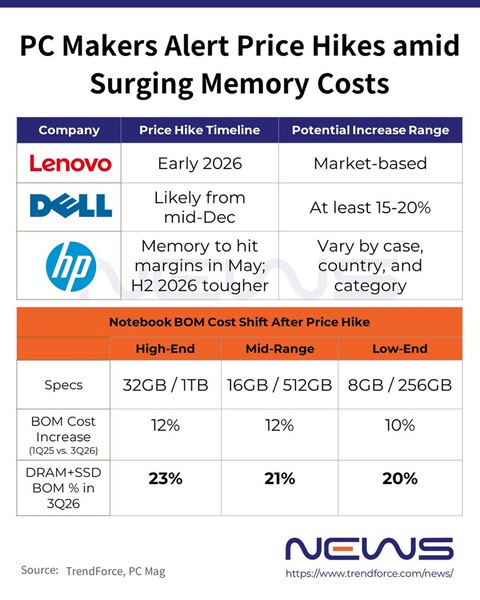
集邦咨询预测 DDR5 内存价格再涨 45%!2026 年电脑恐迎“史上最贵”的一年
Xin Lang Cai Jing· 2025-12-27 10:24
Core Insights - Major laptop manufacturers like Lenovo and HP are likely to delay their new product launches in 2026 due to a historic memory shortage impacting their product roadmaps [1] - The cost of core components is rising significantly, leading brands to reassess their release plans to avoid inventory buildup and high pricing risks [1] - The SSD prices are increasing due to AI monopolizing NAND flash supply, with DDR5 memory prices expected to rise by 45% by the end of 2026, making storage components account for 23% of total laptop material costs [1] Group 1: Price Hikes and Cost Implications - Lenovo plans to increase prices by at least 15-20% starting from mid-December 2025, with high-end models potentially seeing price hikes of up to 30% to maintain profit margins [2] - The BOM (Bill of Materials) cost for high-end laptops is expected to increase by 12% from Q1 2025 to Q3 2026, with DRAM and SSD components making up 23% of the BOM in 2026 [2] Group 2: Manufacturer Strategies - Dell and Framework have announced upcoming price increases, while ASUS considered producing DDR5 memory in-house but later denied this rumor [3] - Custom PC brand Maingear is encouraging customers to send in their own memory modules for assembly, although this unconventional method may not yield significant cost savings [3] Group 3: Market Outlook - The PC market, after a strong growth in 2025 driven by Windows 11 upgrade demands, is expected to face a sharp decline in 2026 due to the exhaustion of upgrade incentives and delayed new product launches [5] - Analysts predict a decrease in laptop sales in 2026 as consumer purchasing power declines and new product availability diminishes [5]

联想申请信息处理方法和装置专利,引导目标模型基于目标工具的工具信息生成输出结果
Jin Rong Jie· 2025-12-27 06:28
Core Insights - Lenovo (Beijing) Co., Ltd. has applied for a patent titled "Information Processing Method and Device," with publication number CN121211335A, filed on September 2025 [1] - The patent describes a method involving the construction of combined information based on at least two processing tools that have a relational connection, which is then stored in a knowledge base [1] Company Overview - Lenovo (Beijing) Co., Ltd. was established in 1992 and is located in Beijing, primarily engaged in the manufacturing of computers, communications, and other electronic devices [1] - The company has a registered capital of 565 million Hong Kong dollars [1] - Lenovo (Beijing) has invested in 107 enterprises and participated in 5,000 bidding projects, with 1,751 trademark records and 5,000 patent records [1] - Additionally, the company holds 238 administrative licenses [1]