KUAISHOU(01024)

Search documents
西部证券晨会纪要-20250902
Western Securities· 2025-09-02 01:19
Fixed Income - August PMI data shows manufacturing PMI contraction slowing down, while service sector sentiment significantly rebounds, with manufacturing PMI at 49.4%, up 0.1 percentage points month-on-month [6][7] - The service sector's business activity index is at 50.3%, up 0.2 percentage points month-on-month, indicating a recovery in service sector activities [6][9] - The report suggests controlling duration levels in the bond market and focusing on structural opportunities such as tax-inclusive bonds and new/old bonds, as the bond market is expected to remain in a volatile trend [6][9] Basic Chemicals - Yuntian Holdings - Yuntian Holdings reported a 2025 H1 revenue of 11.4 billion yuan, a year-on-year increase of 3.59%, and a net profit of 511 million yuan, up 12.60% year-on-year [11][12] - The company’s gross margin and net profit margin improved to 11.99% and 4.48%, respectively, with significant growth in new compound fertilizer sales [12][13] - Future net profits are projected at 1.009 billion, 1.305 billion, and 1.614 billion yuan for 2025-2027, with corresponding PE ratios of 13.7, 10.6, and 8.5, maintaining a "buy" rating [12][13] Computer - Dingjie Intelligence - Dingjie Intelligence achieved a 2025 H1 revenue of 1.045 billion yuan, a 4.1% year-on-year increase, and a net profit of 45 million yuan, up 6.1% year-on-year [15][16] - The company’s AI business saw a significant revenue increase of 125.9%, becoming a key growth driver [17] - Future revenue projections are 2.568 billion, 2.816 billion, and 3.056 billion yuan for 2025-2027, with net profits of 202 million, 251 million, and 293 million yuan, maintaining a "buy" rating [17] Media - Xindong Company - Xindong Company reported a 2025 H1 revenue of 3.082 billion yuan, a year-on-year increase of 38.8%, and a net profit of 755 million yuan, up 268.0% year-on-year [19][20] - The company’s self-developed games and the TAPTAP platform significantly contributed to revenue growth, with game revenue reaching 2.071 billion yuan, a 39.4% increase year-on-year [19][20] - Future net profit projections are 1.727 billion, 2.137 billion, and 2.305 billion yuan for 2025-2027, with growth rates of 113%, 24%, and 8% respectively, maintaining a "buy" rating [20] Home Appliances - Midea Group - Midea Group achieved a 2025 H1 revenue of 251.124 billion yuan, a year-on-year increase of 15.58%, and a net profit of 26.014 billion yuan, up 25.04% year-on-year [25][26] - The company’s B-end solutions saw a revenue increase of 20.8%, with significant contributions from new energy and industrial technology sectors [26] - Future revenue projections are expected to grow at rates of 9.9%, 8.0%, and 7.2% for 2025-2027, with net profit growth of 15.2%, 10.4%, and 9.9%, maintaining a "buy" rating [27] Automotive - Changan Automobile - Changan Automobile reported a 2025 H1 revenue of 72.69 billion yuan, a year-on-year decrease of 5.3%, with a net profit of 2.29 billion yuan, down 19.1% [29][30] - The company’s new energy vehicle sales reached 452,000 units, a 49.1% increase year-on-year, outperforming the industry average [29][30] - Future revenue projections are 187 billion, 209.6 billion, and 229.7 billion yuan for 2025-2027, with corresponding EPS of 0.90, 1.09, and 1.24 yuan, maintaining a "buy" rating [30] Light Industry Manufacturing - Craft Home - Craft Home reported a 2025 H1 revenue of 1.681 billion yuan, a year-on-year increase of 39.29%, and a net profit of 432 million yuan, up 51.38% [35][36] - The company’s gross margin improved to 25.69%, driven by product structure upgrades and increased sales of high-value products [36][37] - Future net profit projections are 903 million, 1.124 billion, and 1.332 billion yuan for 2025-2027, maintaining a "buy" rating [37] Agriculture - Juxing Agriculture - Juxing Agriculture reported a 2025 H1 revenue of 371.7 million yuan, a year-on-year increase of 66.49%, and a net profit of 18.1 million yuan, up 504.12% [39][40] - The company’s pig sales volume increased significantly, with a total of 1.907 million pigs sold in H1, a 75.02% increase year-on-year [39][40] - Future net profit projections are 569 million, 867 million, and 1.116 billion yuan for 2025-2027, maintaining a "buy" rating [41]




港股股票回购一览:31只个股获公司回购
Mei Ri Jing Ji Xin Wen· 2025-09-02 01:15
Core Viewpoint - The article highlights the significant stock buybacks by various Hong Kong-listed companies, indicating a trend of companies returning capital to shareholders through repurchases, with Tencent Holdings leading in buyback amounts [1] Group 1: Stock Buybacks - On September 1, a total of 31 Hong Kong stocks conducted buybacks, with 5 stocks exceeding 10 million HKD in buyback amounts [1] - Tencent Holdings, China Hongqiao, and Kuaishou-W had the largest buyback amounts, at 550 million HKD, 392 million HKD, and 83.7162 million HKD respectively [1] - Year-to-date, 224 Hong Kong stocks have conducted buybacks, with 44 stocks having cumulative buyback amounts exceeding 100 million HKD [1] Group 2: Cumulative Buyback Amounts - The companies with the highest cumulative buyback amounts this year are Tencent Holdings at 46.099 billion HKD, HSBC Holdings at 24.145 billion HKD, and AIA Group at 17.693 billion HKD [1]


智通港股回购统计|9月2日




智通财经网· 2025-09-02 01:15
Summary of Key Points Core Viewpoint - Multiple companies, including Tencent Holdings and China Hongqiao, conducted share buybacks on September 1, 2025, with Tencent leading in terms of buyback amount and quantity [1][2]. Group 1: Buyback Details - Tencent Holdings (00700) repurchased 910,000 shares for a total of 550 million [2]. - China Hongqiao (01378) repurchased 15,275,500 shares for a total of 392 million [2]. - Weichai Power (02338) repurchased 7,300,000 shares for a total of 109 million [2]. - Kuaishou-W (01024) repurchased 113,700 shares for a total of 83.72 million [2]. - Hang Seng Bank (00011) repurchased 210,000 shares for a total of 23.57 million [2]. Group 2: Cumulative Buyback Data - Tencent's cumulative buyback for the year reached 47,571,000 shares, accounting for 0.518% of its total share capital [2]. - China Hongqiao's cumulative buyback reached 104 million shares, accounting for 1.110% of its total share capital [2]. - Weichai Power's cumulative buyback reached 46,442,500 shares, accounting for 0.533% of its total share capital [2]. - Kuaishou's cumulative buyback for the year was 113,700 shares, accounting for 0.026% of its total share capital [2]. - Hang Seng Bank's cumulative buyback reached 4,440,000 shares, accounting for 0.236% of its total share capital [2].
赛道Hyper | 可灵AI角逐首尾帧生成战场
Hua Er Jie Jian Wen· 2025-09-02 01:00
Core Insights - Kuaishou's launch of the Keling AI 2.1 model introduces a "first and last frame" feature, enhancing content generation effectiveness by 235% compared to version 1.6, marking a shift in competition towards content production quality [1] - The traditional short video platform paradigm of "distribution-recommendation-duration" is evolving, with generative AI lowering production barriers and shifting focus to who can enable creators to produce distributable content more efficiently [1][3] - The first and last frames are critical for content usability, influencing viewer engagement metrics such as click-through rates and completion rates [1] Production and Economic Implications - The Keling 2.1 model's improvements are not generic but focus on aspects like transition naturalness and style consistency, directly impacting production quality [3] - This advancement leads to increased output per unit time for creators, reduced advertising production costs, and enhanced internal platform cycles, resulting in lower marginal costs and a rightward shift in the supply curve [3][5] - The role of creators is shifting from manual editing to strategic content planning, emphasizing narrative structure and character management over mere technical skills [4][5] Advertising and Financial Aspects - The transition from custom video production to template-based creation allows for faster creative testing cycles and measurable results, enhancing budget turnover rates [6][7] - The potential for financialization of creative assets emerges as template assets can be reused and monetized, leading to new financial instruments around high-efficiency templates [9] - The revenue structure of platforms may evolve to include stable non-advertising income streams from tool subscriptions, template transactions, and data services [9][10] Competitive Landscape - The competitive dynamics among platforms are shifting, with Kuaishou's strategy focusing on enhancing production capabilities to create a differentiated stack of abilities [11] - The first and last frame functionality is pivotal as it directly relates to content usability and commercial viability, positioning Kuaishou favorably in the market [11][20] User Experience and Industry Evolution - The consistency of first and last frames enhances narrative flow and allows for individualized content experiences, reflecting a deeper transformation in content generation [16] - The standardization of frame generation is likely to reorganize industry roles, with platforms taking on foundational infrastructure roles while MCNs and agencies focus on character building and cross-platform distribution [17] - The underlying logic of this feature iteration integrates technological, commercial, and industrial dimensions, positioning generative capabilities as a key asset for platforms [18][19]
AI内容播放量持续增长 快手生态大会透露AIGC新趋势
Shang Hai Zheng Quan Bao· 2025-09-01 18:52
Core Insights - The 2025 Kuaishou Creator Conference highlighted the rapid development of AI large models and the growing trend of AI-generated content in the industry [2] - Kuaishou's CEO reported a significant increase in the creator ecosystem, with daily active users reaching 409 million and total usage time growing by 7.5% year-on-year [3] Group 1: User Engagement and Creator Growth - Kuaishou's platform saw a 100% year-on-year increase in submissions from creators with over 10,000 followers, with 91 million creators continuously updating content for over three years [3] - Daily interactions among private domain users exceeded 4 billion [3] Group 2: AI Content and Commercialization - In July, the viewership of AI-generated content on Kuaishou surged by 321% compared to January [3] - The AI video large model has transitioned from experimental to commercial use, with significant improvements in realism and controllability [4] Group 3: Revenue and Market Potential - AI creators' daily video pricing ranges from thousands to 50,000 yuan per minute, with global creator earnings increasing by 159% from January to June [4] - Kuaishou's AI revenue exceeded 250 million yuan in the first half of the year, with Morgan Stanley raising revenue forecasts for Kuaishou's AI segment significantly for 2025 and 2026 [4][5] Group 4: Industry Landscape - The global video content production market is valued at approximately 120 billion dollars, with generative AI expected to transform the industry [5] - The market for generative AI is projected to reach between 11 billion and 23 billion dollars, divided into professional and consumer segments [5]

快手-W(01024.HK)9月1日回购8371.62万港元,年内累计回购20.00亿港元
Zheng Quan Shi Bao Wang· 2025-09-01 16:06
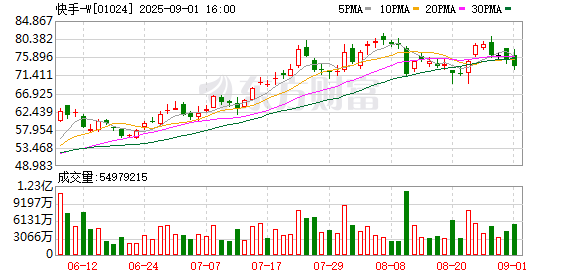
Summary of Key Points Core Viewpoint - Kuaishou-W has been actively repurchasing its shares, indicating a strategy to enhance shareholder value amidst market fluctuations [2]. Share Buyback Details - On September 1, Kuaishou-W repurchased 1.137 million shares at a price range of HKD 73.350 to HKD 73.750, totaling HKD 83.7162 million [2]. - The stock closed at HKD 73.600 on the same day, reflecting a decline of 2.32%, with a total trading volume of HKD 4.072 billion [2]. - Year-to-date, Kuaishou-W has conducted 24 buybacks, acquiring a total of 39.9343 million shares for a cumulative amount of HKD 2 billion [2]. Historical Buyback Data - The buyback history includes significant transactions, such as: - On March 26, 2025, Kuaishou-W repurchased 10.4664 million shares for HKD 584.6374 million at a maximum price of HKD 57.100 [2]. - Other notable buybacks occurred on March 27, 2025, with 1.2396 million shares bought for HKD 69.8384 million, and on March 28, 2025, with 796,300 shares for HKD 44.5529 million [2]. - The buyback activity has shown a range of prices, with the highest recorded price being HKD 73.750 on September 1, 2025, and the lowest at HKD 39.200 on January 10, 2025 [2][3].
港股通净买入119.42亿港元
Zheng Quan Shi Bao Wang· 2025-09-01 16:02
Market Overview - On September 1, the Hang Seng Index rose by 2.15%, closing at 25,617.42 points, with a total net inflow of southbound funds through the Stock Connect amounting to HKD 11.942 billion [1][3] - The total trading volume for the Stock Connect on the same day was HKD 200.589 billion, with a net buying amount of HKD 11.942 billion [1][3] Stock Performance - In the Shanghai Stock Connect, the trading volume was HKD 118.631 billion, with a net buying of HKD 5.659 billion; in the Shenzhen Stock Connect, the trading volume was HKD 81.958 billion, with a net buying of HKD 6.283 billion [1][3] - Alibaba-W was the most actively traded stock, with a trading volume of HKD 16.03349 billion and a net buying amount of HKD 0.85129 billion, closing with an increase of 18.50% [2][3] - Other notable stocks included SMIC and Huahong Semiconductor, with trading volumes of HKD 6.336 billion and HKD 4.042 billion, respectively [1][2] Net Buying and Selling - In terms of net buying, Alibaba-W led with HKD 4.069 billion, while the stock with the highest net selling was Pop Mart, with a net selling of HKD 0.722 billion, closing down by 4.34% [2][3] - The top ten actively traded stocks in the Shenzhen Stock Connect also featured Alibaba-W, SMIC, and Xiaomi Group, with respective trading volumes of HKD 12.2701 billion, HKD 4.271 billion, and HKD 2.498 billion [2][3]



港股通9月1日成交活跃股名单
Zheng Quan Shi Bao Wang· 2025-09-01 16:00
Group 1 - The Hang Seng Index rose by 2.15% on September 1, with southbound trading totaling HKD 200.59 billion, including HKD 106.27 billion in buying and HKD 94.32 billion in selling, resulting in a net buying amount of HKD 11.94 billion [1] - The southbound trading through the Shenzhen Stock Connect had a total trading amount of HKD 81.96 billion, with net buying of HKD 6.28 billion, while the Shanghai Stock Connect had a total trading amount of HKD 118.63 billion, with net buying of HKD 5.66 billion [1] - Alibaba-W was the most actively traded stock with a total trading amount of HKD 28.30 billion and a net buying amount of HKD 4.92 billion, closing with an increase of 18.50% [1][2] Group 2 - Among the stocks listed, Alibaba-W, Tencent Holdings, and Huahong Semiconductor were among the top active stocks in both Shenzhen and Shanghai southbound trading, with Alibaba-W having a net buying amount of HKD 4.92 billion and Tencent Holdings at HKD 0.12 billion [2] - There were two stocks that received net buying from southbound funds for more than three consecutive days, with Alibaba-W leading at a total net buying of HKD 10.90 billion over seven days, followed by Huahong Semiconductor with HKD 1.09 billion over five days [2] - The trading data for September 1 shows that Xiaomi Group-W had a total trading amount of HKD 51.01 billion with a net selling of HKD 1.03 billion, while Pop Mart had a total trading amount of HKD 33.93 billion with a net selling of HKD 0.91 billion [2]

今起实施!AI生成内容必须带“身份证”,腾讯、抖音、快手、B站、DeepSeek等平台已公告→
Di Yi Cai Jing· 2025-09-01 15:26
Core Points - The implementation of the "Identification Method for AI-Generated Synthetic Content" began on September 1, requiring all AI-generated content to have clear identification labels [1][5][8] - The regulation mandates that various stakeholders in the AI content generation chain, including service providers and content platforms, must ensure proper labeling of AI-generated content [8][11] Group 1: Regulatory Framework - The "Identification Method" requires explicit and implicit labeling for AI-generated text, images, audio, and video content [5][8] - Content dissemination platforms like Bilibili and Xiaohongshu must verify metadata and provide necessary labeling features to inform users about AI-generated content [8][11] - Users are also required to label AI-generated content when uploading or sharing it [8][11] Group 2: Industry Response - Companies like MiniMax have demonstrated how to implement explicit labeling in their platforms, using visible indicators such as badges stating "AI generated" [9][10] - Douyin has introduced features to assist creators in labeling AI content and has implemented metadata identification for traceability [11][13] - Tencent and Kuaishou have also announced measures to comply with the new regulations, ensuring transparency and user awareness regarding AI-generated content [13][15] Group 3: Market Implications - The new regulations are seen as a foundation for the credibility of generative content, influencing market competitiveness for large model enterprises [10] - The Shanghai Municipal Cyberspace Administration has initiated an ecological alliance to promote implicit labeling recognition among over 30 companies [10][11] - The industry is adapting to these regulations, with platforms actively enhancing their content governance capabilities to align with the new standards [14][15]


2025快手创作者大会亮点:短视频直播联动,亿级分账收入成变现新焦点
Sou Hu Cai Jing· 2025-09-01 13:38
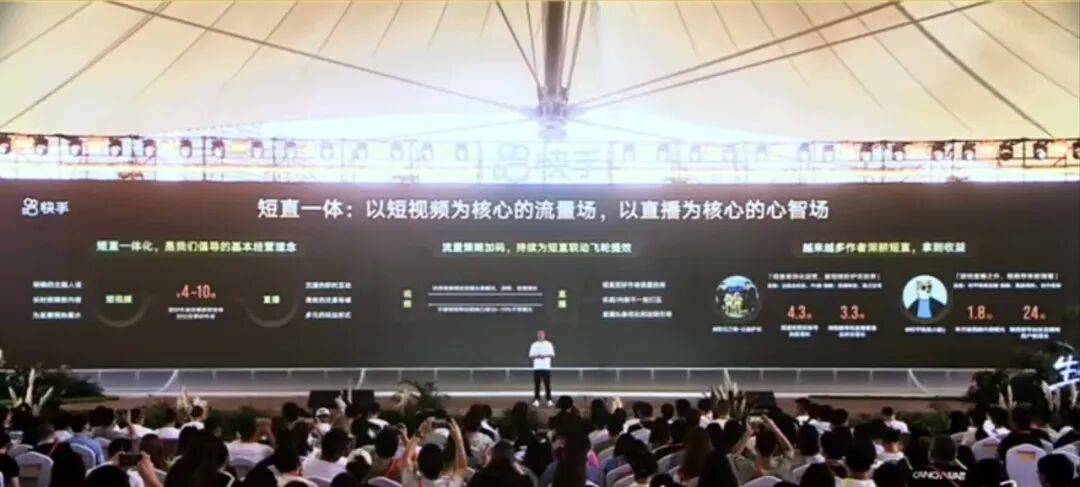
Core Insights - The central theme of Kuaishou's "Photosynthesis Creator Conference" is the strong advocacy for personalized creation and differentiated content [1] - The conference reflects on the achievements of creators over the past year and provides a vision for the future content ecosystem [1] Group 1: Creator Growth - The number of creators with over 10,000 followers has doubled in the past year, indicating significant growth in content creation [1] - Kuaishou has seen the emergence of 480,000 creators with over 10,000 followers and 3,000 creators with over 1 million followers [1] - The number of professional streamers has increased by 8% year-on-year, with 26 million creators earning income on the platform [1] Group 2: Monetization and Income - The number of creators earning over 1,000 per month has increased by nearly 12%, showcasing improved monetization opportunities [1] - Kuaishou anticipates that the monetization pathways for short dramas and mini-games will generate hundreds of millions in revenue for creators in the coming year [3] Group 3: AI Content and Engagement - AI content has seen a remarkable increase, with playback volume surging over 300% compared to six months ago [3] - Over 91 million creators have remained active on Kuaishou for three consecutive years, contributing fresh content [3] Group 4: Content Strategy and Integration - Kuaishou emphasizes the integration of short videos and live streaming, believing that this combination will enhance creator success [3] - Creators proficient in both short videos and live streaming achieve 4 to 10 times higher traffic efficiency compared to those focusing on a single format [3] - The platform is committed to enhancing the synergy between private and public traffic, providing new growth opportunities for creators with high engagement in private domains [3]