BYD(01211)

Search documents
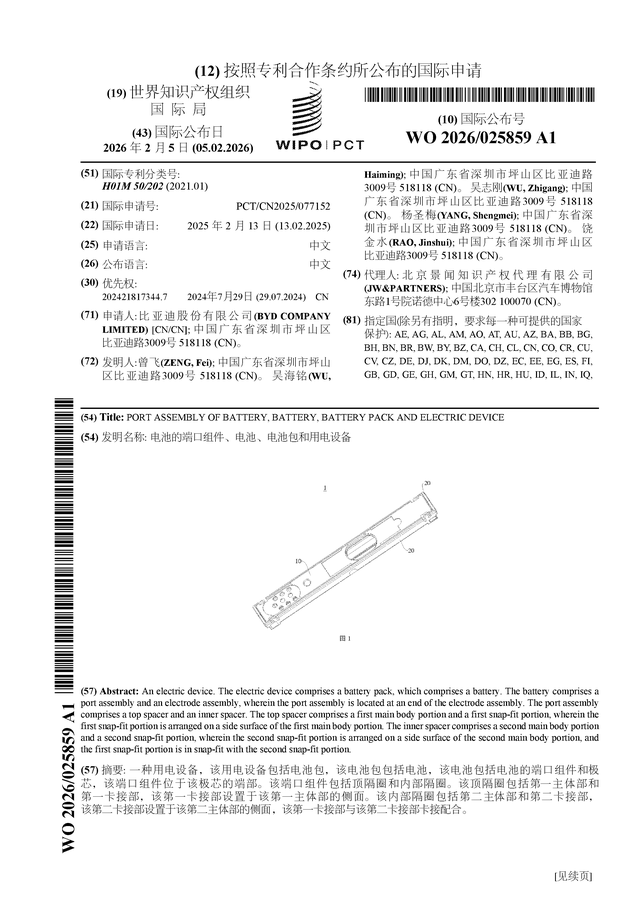
比亚迪公布国际专利申请:“电池的端口组件、电池、电池包和用电设备”
Sou Hu Cai Jing· 2026-02-07 21:47
Group 1 - BYD has filed an international patent application for a battery port component, battery, battery pack, and electrical equipment, with the application number PCT/CN2025/077152, and the international publication date set for February 5, 2026 [1] - In 2023, BYD has announced a total of 262 international patent applications, representing a significant increase of 495.45% compared to the same period last year [3] - For the first half of 2025, BYD invested 29.596 billion yuan in research and development, which is a year-on-year increase of 50.84% [3]


比亚迪公布国际专利申请:“电池盖和电池”
Sou Hu Cai Jing· 2026-02-07 21:47
专利详情如下: 证券之星消息,根据企查查数据显示比亚迪(002594)公布了一项国际专利申请,专利名为"电池盖和 电池",专利申请号为PCT/CN2025/075778,国际公布日为2026年2月5日。 今年以来比亚迪已公布的国际专利申请262个,较去年同期增加了495.45%。结合公司2025年中报财务 数据,2025上半年公司在研发方面投入了295.96亿元,同比增50.84%。 数据来源:企查查 以上内容为证券之星据公开信息整理,由AI算法生成(网信算备310104345710301240019号),不构成 投资建议。 图片来源:世界知识产权组织(WIPO) ...

小米YU7 GT、理想L9、问界M6领衔!2月工信部重磅新车亮相!
电动车公社· 2026-02-07 16:22
Core Viewpoint - The Chinese automotive industry is facing a slowdown in sales growth due to policy adjustments and the holiday season, aligning with predictions of a market shift in 2026 [1][2]. Industry Overview - According to Morgan Stanley, Chinese passenger car sales are expected to grow by 9% year-on-year in 2025, reaching a historical high, before declining by 5% in 2026 [2]. - Despite continued growth in new energy vehicle (NEV) sales and exports, a potential decline of around 30% in the first quarter is anticipated due to changes in subsidies and purchase tax policies, which may further impact annual sales [4]. - The industry consensus indicates that the Chinese automotive sector is entering a decisive phase, with pessimistic views suggesting that only 5-7 NEV companies may survive in the coming years, while optimistic estimates suggest a maximum of 10 [5]. Competitive Landscape - As competition intensifies, new models are set to launch, with over 20 different NEV models preparing to enter the market post-Spring Festival, indicating a fierce battle for market share in the upcoming months [6][7]. - The focus of new vehicle launches is on high-end features, with three key themes identified: high-end, high-end, and high-end [8]. New Model Highlights - The new Li Auto L9 features a larger size and advanced technology, including a 72.7 kWh battery and various high-tech components, positioning it as a critical product for Li Auto's success this year [11]. - The Xiaomi YU7 GT, with enhanced performance specifications, aims to compete directly with high-end models like the Porsche Cayenne Turbo GT [15]. - The AITO M6, a new model from AITO, is designed to target the market segment dominated by Model Y and Li L6, offering both pure electric and range-extended versions [19]. - XPeng's GX model aims to leverage L4-level autonomous driving technology, featuring advanced specifications and a focus on high-end market penetration [26]. - The Wey V9X, as a new model from Great Wall Motors, is positioned to compete with other large SUVs in the market, although pricing details are yet to be announced [31]. - The Volvo ES90, a pure electric sedan, is part of Volvo's accelerated electrification strategy, sharing technology with the EX90 and focusing on safety, range, and intelligence [44]. - The Zeekr 8X performance version emphasizes extreme performance and rapid charging capabilities, set to compete with the Xiaomi YU7 GT [49].





斯塔默访华后,中英工商界如何展望未来?
Di Yi Cai Jing Zi Xun· 2026-02-07 15:55
Group 1: Overview of UK-China Economic Relations - The UK-China economic relationship is showing signs of recovery, with a more pragmatic attitude from both sides as indicated by recent high-level interactions [2][3] - Jack Perry, Chairman of the 48 Group, noted that these interactions have provided new opportunities for enhancing business confidence in UK-China economic cooperation [2] Group 2: Business Perspectives on China's Role - Sir Douglas Flint, incoming Chairman of Prudential, emphasized China's leading position in manufacturing, innovation, energy transition, and low-carbon economy, highlighting its critical role in global supply chains [3] - The positive changes in UK-China relations, particularly in personnel exchanges and high-level interactions, are creating clearer expectations for business cooperation [3] Group 3: Focus on Renewable Energy and Manufacturing - Renewable energy and green transition were key discussion topics, with Greg Jackson, CEO of Octopus Energy, stating that China's advancements in renewable energy and electric vehicle technology are significantly lowering global energy transition costs [4][5] - Octopus Energy is already collaborating with multiple Chinese companies and aims to deepen cooperation in areas like energy system optimization and electricity market mechanisms [5] Group 4: Automotive Industry Developments - BYD's UK and Ireland National Manager, Ge Hongde, reported that BYD has established over 100 stores in the UK and is in an accelerated development phase, focusing on expanding sales and service networks [7] - BYD's factory in Hungary has begun trial production, with plans to gradually increase capacity and produce multiple vehicle models, aiming for a "made in Europe, for Europe" operational model [7] Group 5: Financial Services and Digital Infrastructure - In the financial sector, Spdb Bank's London Deputy General Manager, Lu Jie, highlighted the bank's dual role in supporting Chinese enterprises abroad and assisting UK companies entering the Chinese market [8] - There is an increasing focus on cross-border trade financing, mergers and acquisitions, and green finance, with a noticeable rise in UK companies' interest in the Chinese market [8] - China Mobile International's UK General Manager, Li Naihao, noted the growing demand for communication, data, and digital solutions as Chinese companies expand overseas, indicating deepening cooperation between the two countries [8]

斯塔默访华后,中英工商界如何展望未来?
第一财经· 2026-02-07 15:49
Core Viewpoint - The article highlights the warming of Sino-British economic relations, driven by recent high-level interactions and a more pragmatic attitude from both sides, which is fostering confidence among businesses in both countries [3][4]. Group 1: Economic Cooperation - The recent high-level interactions between China and the UK have provided new opportunities for enhancing business confidence in Sino-British economic cooperation [4]. - British business leaders recognize China's significant role in the global economy, particularly in manufacturing, innovation, energy transition, and low-carbon economy, emphasizing the importance of collaboration in these sectors [4]. - The improvement in Sino-British relations has made UK businesses feel more comfortable, leading to increased willingness to explore new opportunities in the Chinese market [4]. Group 2: Renewable Energy and Green Transition - Renewable energy and green transition emerged as key discussion topics, with UK energy firms acknowledging China's advancements in renewable energy, battery technology, and electric transportation, which are reducing global energy transition costs [5]. - Collaboration with China in these areas is seen as beneficial for the UK to ensure energy security while achieving a more cost-effective and efficient energy system [5]. Group 3: Automotive Industry - The automotive sector is a focal point for Sino-British collaboration, with BYD expanding its presence in the UK market, having established over 100 stores and planning further expansion [6]. - BYD's factory in Hungary has begun trial production, with plans to increase capacity and produce multiple vehicle models, aiming for a "made in Europe" operational model to better align with local market needs [6]. Group 4: Financial Services and Digital Infrastructure - In the financial sector, Chinese banks in London focus on dual services, supporting Chinese enterprises abroad while assisting UK firms in entering the Chinese market [8]. - There is an increasing demand for communication, data, and digital solutions as Chinese companies expand overseas, with ongoing deepening of cooperation between China and the UK in these areas [9].

英国观察丨从“气氛改善”到“信心修复”:斯塔默访华后,中英工商界如何展望未来?
Di Yi Cai Jing Zi Xun· 2026-02-07 14:00
Group 1 - The UK-China trade relationship is showing signs of recovery, with a more pragmatic attitude from both sides, as indicated by recent high-level interactions [1][3] - Chinese manufacturing, innovation, energy transition, and low-carbon economy are recognized as critical areas where China plays a leading role in the global economy [3] - UK businesses feel more comfortable and willing to engage with the Chinese market due to the recent positive changes in UK-China relations [3] Group 2 - Renewable energy and green transition are key discussion topics, with Chinese advancements in renewable energy and electric transportation significantly lowering global energy transition costs [4] - BYD has established a presence in the UK market, with over 100 stores and plans for further expansion and infrastructure development [6] - Chinese banks in London are focusing on supporting both Chinese enterprises going abroad and UK businesses entering the Chinese market, with an emphasis on cross-border trade financing and green finance [7]

“立场转变”!加拿大对华最新表态
中国能源报· 2026-02-07 09:46
Core Viewpoint - The Canadian government is actively working to facilitate joint ventures with Chinese companies to manufacture electric vehicles for global markets, marking a shift in its stance towards China [2]. Group 1: Government Initiatives - Canadian Industry Minister Mélanie Joly stated that the government is promoting joint ventures for electric vehicle manufacturing with China, aiming to reduce reliance on the U.S. automotive market and strengthen the domestic industry [2]. - Canadian automotive parts companies like Magna International, Linamar, and Martinrea International are already operating in China and can participate in joint assembly plants in Canada [2]. - Joly emphasized the potential for Canadian companies to collaborate with Chinese electric vehicle firms to create vehicles for global distribution [2]. Group 2: Economic Context - The move to engage with Chinese automotive investments is part of a broader trade truce, with China agreeing to lift tariffs on Canadian agricultural products and Canada allowing up to 49,000 Chinese electric vehicles annually at a most-favored-nation tariff rate of 6.1% [3]. - Despite higher labor costs in Canada compared to China, Joly believes that jointly developed electric vehicles can still be globally competitive, citing the example of Honda's affordable Civic model produced in Ontario [3]. Group 3: Safety and Standards - Joly mentioned that solutions can be found in automotive software to address safety concerns related to Chinese automotive technology, and that labor standards can be established that align with Canadian expectations [2].

重大转向!加拿大宣布与中国合作造电动汽车,承诺关税降至6.1%
Mei Ri Jing Ji Xin Wen· 2026-02-07 09:24
Core Viewpoint - Canada is shifting its strategy in response to ongoing pressures from the Trump administration, focusing on electric vehicle (EV) production and collaboration with China to enhance its automotive industry and reduce reliance on the U.S. market [1][4][6]. Group 1: Electric Vehicle Strategy - Canadian Prime Minister Mark Carney announced a new electric vehicle strategy that includes restarting purchase subsidies and promoting domestic production and export of electric vehicles in collaboration with China [1][4]. - The Canadian government aims to leverage existing and new trade agreements, including a recent EV cooperation agreement with China, to attract large-scale investments and diversify its automotive export market [4][7]. - Canada plans to reduce tariffs on Chinese electric vehicles from 100% to 6.1% and set an annual import quota of 49,000 vehicles, reflecting a significant policy shift towards enhancing trade relations with China [6][7]. Group 2: Industry Impact and Employment - The Canadian automotive industry employs approximately 125,000 workers and is crucial to the national economy, with about 90% of vehicles exported to the U.S. [6][7]. - The strategy aims to counteract the negative impact of U.S. tariffs on Canadian vehicles, which have been set at 25%, and to find alternative markets and strategies for the Canadian automotive sector [6][8]. - Canadian companies are encouraged to collaborate with Chinese electric vehicle manufacturers to create joint ventures that can compete globally, despite higher production costs in Canada [5][6]. Group 3: Public Support and Perception - Recent polls indicate that a majority of Canadians support allowing more Chinese electric vehicles to be sold in Canada, reflecting a shift in public perception towards China [7]. - The Canadian government is engaging in active dialogue with Chinese automotive companies to explore complementary investments in the Canadian automotive sector [5][7].
关于中国电动车,加拿大最新表态
Xin Lang Cai Jing· 2026-02-07 08:28
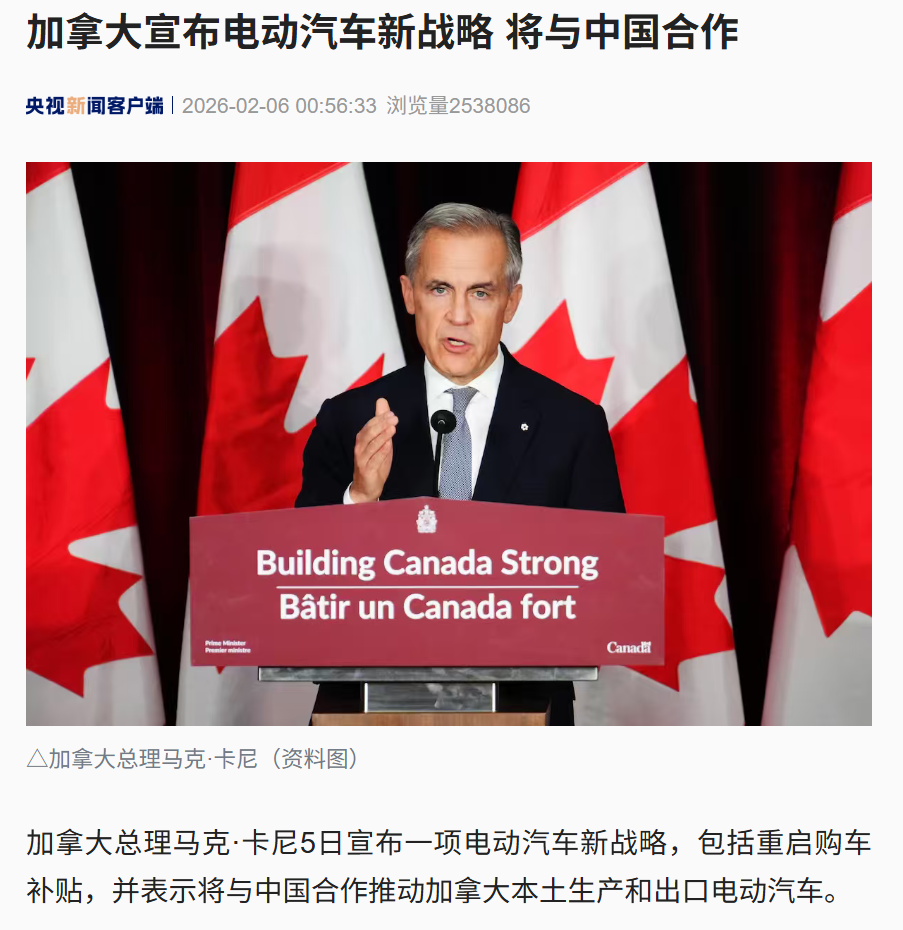
Group 1 - The Canadian government is working to facilitate joint ventures with Chinese companies for electric vehicle manufacturing to be sold globally [2] - Canadian automotive parts companies like Magna International, Linamar, and Martinrea International are already operating in China and can participate in joint assembly plants in Canada [2] - The shift in Canada's stance towards China aims to reduce reliance on the U.S. automotive market and strengthen the domestic automotive industry [2] Group 2 - Canada previously accused China of providing unfair subsidies to its manufacturers and raised safety concerns regarding Chinese automotive technology [2] - The Canadian government is engaging in "active dialogue" on how Canadian companies can complement new Chinese investments in the Canadian automotive sector [2] - Canada has agreed to allow up to 49,000 Chinese electric vehicles to enter its market annually at the most favored nation tariff rate of 6.1% as part of broader trade negotiations [3]

加拿大工业部长:加拿大正寻求与中国合资建厂,生产电动汽车并出口全球
Xin Lang Cai Jing· 2026-02-07 07:23
Core Viewpoint - The Canadian government is shifting its policy towards China, seeking to establish a joint venture electric vehicle manufacturing plant in Canada, which will produce and export electric vehicles globally, marking a significant change in its trade strategy [1][2]. Group 1: Policy Changes and Economic Strategy - Canadian Prime Minister Carney announced a large-scale incentive plan providing billions of Canadian dollars in financial subsidies and tax reductions to boost the automotive industry, interpreted as a move away from reliance on the U.S. market [2][8]. - The Canadian government aims to reduce dependency on the U.S. automotive market and strengthen its domestic automotive industry by collaborating with Chinese electric vehicle manufacturers [1][4]. - The government plans to offer CAD 3 billion for factory investments, lower corporate tax rates for zero-emission vehicle manufacturers, and allow accelerated depreciation for investments in electric vehicle factories and equipment [7][8]. Group 2: Trade Relations with China - During a recent visit to China, Carney emphasized that Canada-China relations are entering a new development phase, with China being viewed as a more stable and predictable trade partner than the U.S. [4][5]. - The Canadian government has decided to eliminate the 100% additional tariff on imported Chinese electric vehicles, which is seen as a major policy shift [4][5]. - Canadian Industrial Minister Joly highlighted the potential for Canadian companies to collaborate with Chinese electric vehicle firms to create a Canada-China vehicle for global export [1][5]. Group 3: Market Implications - The new vehicle purchase subsidy program specifies that vehicles produced in countries without a free trade agreement with Canada will not qualify for subsidies, effectively excluding many Chinese electric vehicles from receiving financial support [8]. - The Canadian government is actively engaging with new investors outside the U.S. as part of its broader strategy to reduce economic dependence on the U.S. [8].