BYD(01211)

Search documents
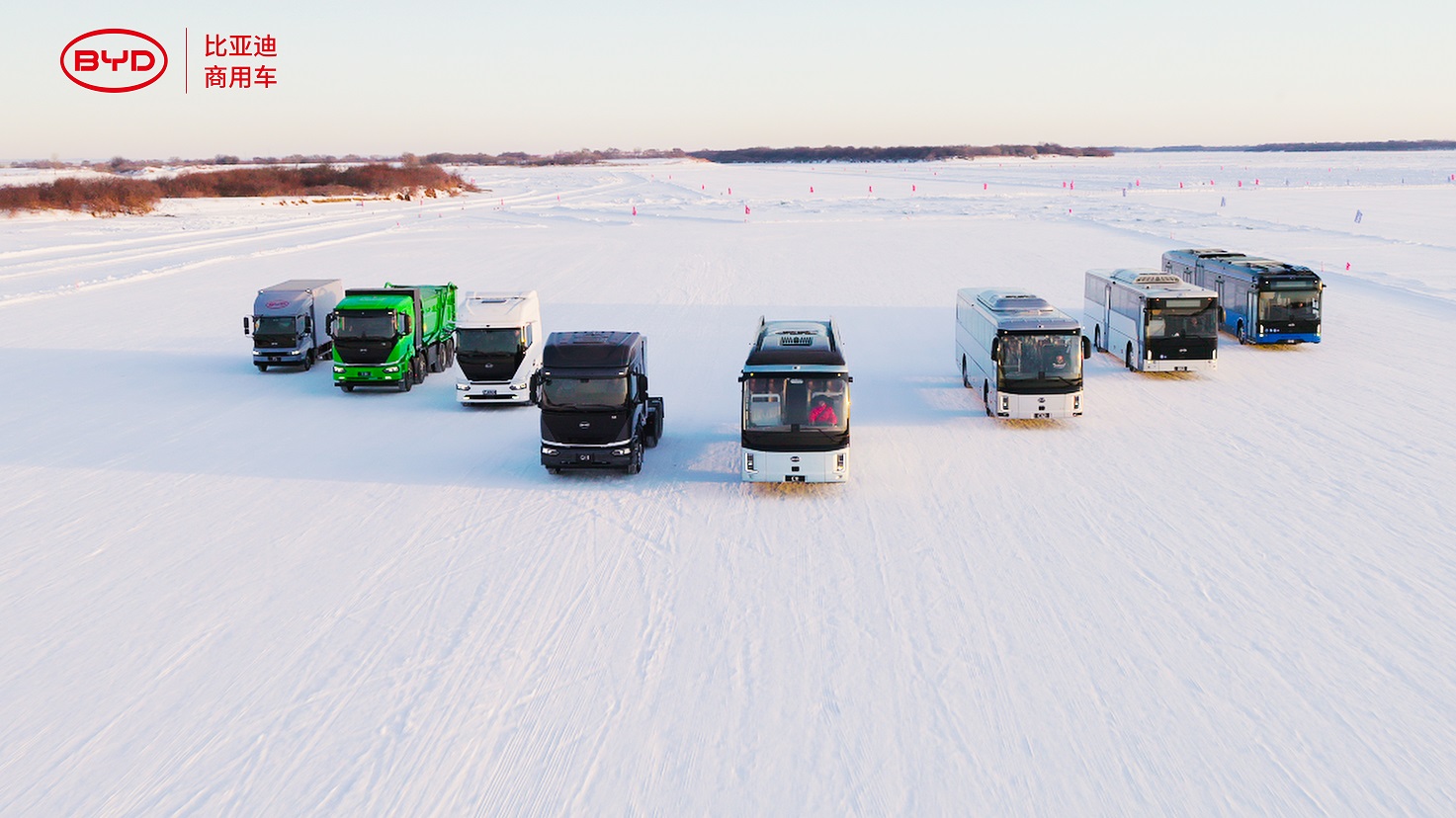
从极寒破冰,到穿越周期 比亚迪商用车向新、向质、向高之行
Zhong Guo Qi Che Bao Wang· 2026-02-05 08:06
Core Insights - BYD's commercial vehicle division has established itself as a leader in the electric vehicle sector, emphasizing the importance of being a pioneer in technology and market strategies [2][3] - The "14th Five-Year Plan" marks a critical transition for China's new energy vehicle industry, shifting from policy-driven to market-driven growth, with BYD focusing on comprehensive solutions for commercial vehicles [3][5] - BYD's strategic shift from a single electric focus to a dual approach of "pure electric + hybrid" is a significant development, exemplified by the launch of the T5DM hybrid light truck [5][10] Strategic Transformation - The transition during the "14th Five-Year Plan" has allowed BYD to solidify its foundation and expand its market presence, aiming to become a full-spectrum provider of new energy solutions for commercial vehicles [3][5] - The introduction of the T5DM hybrid light truck addresses market pain points such as range anxiety and the need for efficient fuel alternatives, leveraging BYD's established hybrid technology [5][10] - BYD's product matrix now includes a variety of vehicles, such as the T4 electric truck and C11 passenger bus, designed to meet diverse market needs and enhance operational efficiency [6][11] Technological Advancements - BYD has developed a robust technology system capable of operating in extreme conditions while also catering to large-scale market demands, showcasing a balance of strength and flexibility [7][8] - The company has implemented advanced technologies for cold weather performance, ensuring reliable operation in harsh environments, which is critical for market acceptance [8][10] - BYD's vertical integration and control over the supply chain enable it to offer competitive pricing, achieving "fuel-electric parity" for its hybrid vehicles [10][11] Market Position and Future Outlook - BYD's global sales reached 57,013 units in the past year, with significant contributions from both buses and trucks, highlighting its expanding footprint across over 400 cities worldwide [16] - The company aims to transition from product output to establishing technical standards and value output in the global market, enhancing its competitive edge [12][14] - BYD's potential to define global standards in hybrid commercial vehicles and reshape business models through data-driven solutions positions it as a key player in the future of the industry [14][16]


洞察小型电动汽车市场竞争态势(2026):低利润、高销量的小型电动电动汽车使汽车制造商获得丰厚收益
易车· 2026-02-05 07:54
Investment Rating - The report indicates a strong investment opportunity in the small electric vehicle (EV) sector, particularly for Chinese brands, which are projected to capture nearly 96% of the market share by 2025 [6][21][98]. Core Insights - The small electric vehicle market in China is expected to grow from less than 500,000 units in 2020 to over 3 million units by 2025, marking a sixfold increase [6][98]. - Despite the surge in sales, the profit margins for small electric vehicles remain low, leading some manufacturers to strategically avoid this segment due to economic inefficiencies [7][98]. - The rise of small electric vehicles has significantly contributed to the market share of Chinese brands, which increased from approximately 30% to 60% between 2020 and 2025, with small EVs accounting for one-third of this growth [6][60][98]. Summary by Sections Market Growth - From 2020 to 2025, the sales of small electric vehicles in China are projected to increase dramatically, with Chinese brands benefiting the most, achieving a market share of nearly 96% by 2025 [6][9][98]. - The share of small electric vehicles in new car sales in China is expected to rise from less than 3% to over 14% during the same period [9][98]. Consumer Demographics - By 2025, nearly 60% of small electric vehicle buyers will come from households that previously owned foreign brands, with over 80% of these buyers being women [30][32][98]. - The shift in consumer demographics indicates a growing acceptance of Chinese brands among former foreign brand users, particularly in the small electric vehicle segment [32][49][98]. Competitive Landscape - Major Chinese brands such as BYD, Wuling, and Geely are expected to dominate the market, with BYD projected to exceed 3 million units in sales by 2025 [20][17][98]. - The report highlights that foreign brands like Volkswagen and Toyota are struggling to compete effectively against the rise of Chinese small electric vehicles, which are expected to capture a significant portion of the market by 2026 [21][68][98]. Cost Advantages - The total cost advantage of small electric vehicles over traditional internal combustion engine vehicles is a key factor driving their popularity, with significant savings in lifecycle costs [78][79][98]. - As the small electric vehicle supply chain matures, foreign brands are also expected to benefit from reduced manufacturing costs, although they still face challenges in competing with the pricing of Chinese brands [86][88][98].

小米首进中国500强前十,台积电腾讯稳居前二
Bei Ke Cai Jing· 2026-02-05 07:49
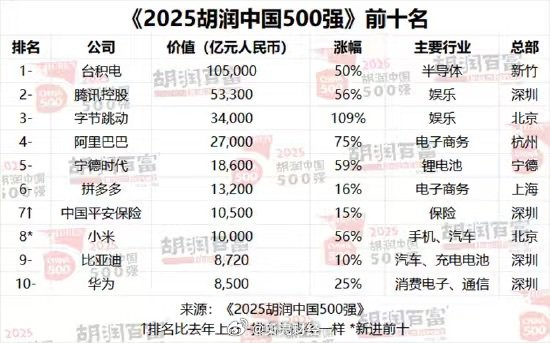
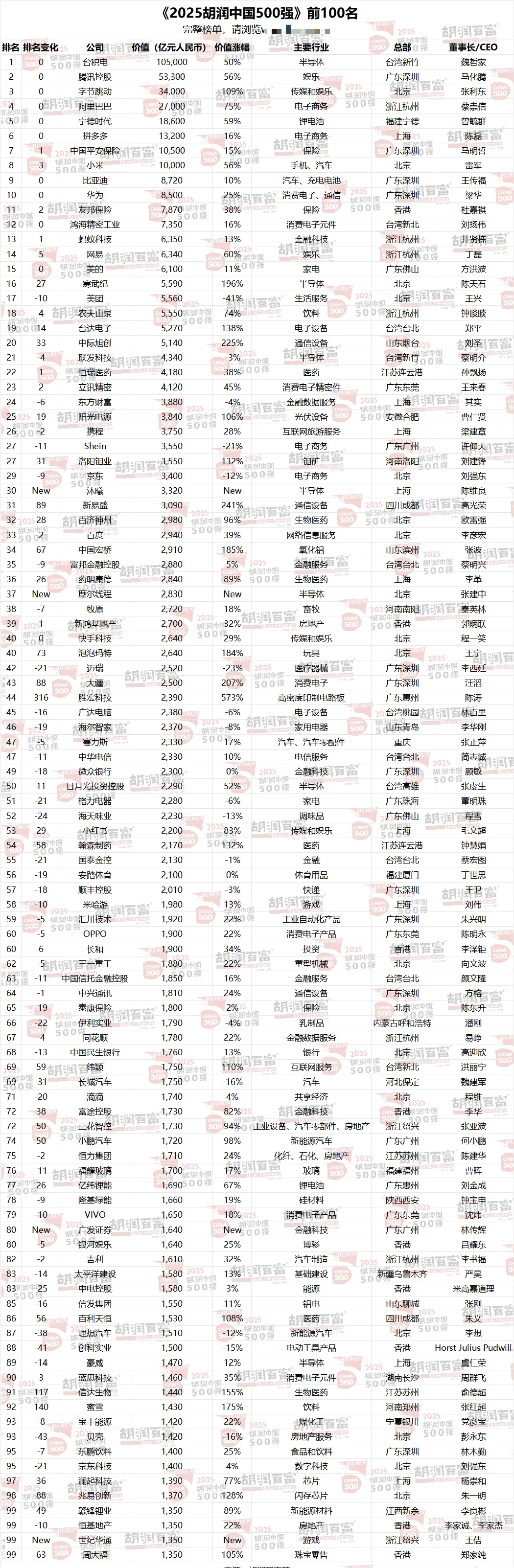
Core Insights - Xiaomi has entered the top ten of the "2025 Hurun China 500" list for the first time, ranking eighth with a valuation of 1 trillion RMB, reflecting a growth of 357 billion RMB [1] Group 1: Company Rankings - TSMC retains its position as the highest-valued private enterprise in China with a valuation of 10.5 trillion RMB, an increase of 3.5 trillion RMB [1] - Tencent ranks second with a valuation of 5.3 trillion RMB, growing by 1.9 trillion RMB [1] - ByteDance holds the third position with a valuation of 3.4 trillion RMB, increasing by 1.8 trillion RMB [1] - Alibaba is fourth with a valuation of 2.7 trillion RMB, reflecting a growth of 75% [1] - Xiaomi's valuation growth of 56% places it eighth among the top ten companies [1] Group 2: Industry Insights - The top ten companies are primarily from the semiconductor, entertainment, e-commerce, and battery industries, indicating a diverse range of sectors driving growth in the Chinese market [1] - The significant valuation increases across these companies suggest a robust recovery and expansion within the Chinese economy [1]





《2025胡润中国500强》发布,小米、比亚迪、华为进入前十
Jin Rong Jie· 2026-02-05 07:07
Core Insights - TSMC retains the top position in the "2025 Hurun China 500" list with a value of 10.5 trillion RMB, marking a 50% increase [1][4] - Tencent, ByteDance, Alibaba, and CATL follow in the rankings with values of 5.33 trillion, 3.4 trillion, 2.7 trillion, and 1.86 trillion RMB respectively [1][4] - The total value of the top 500 companies reached 77 trillion RMB, an increase of 21 trillion RMB, representing a growth rate of 38% [4] Company Rankings - TSMC: 10.5 trillion RMB, 50% increase [1][4] - Tencent: 5.33 trillion RMB, 56% increase [2][4] - ByteDance: 3.4 trillion RMB, 109% decrease [2][4] - Alibaba: 2.7 trillion RMB, 75% increase [2][4] - CATL: 1.86 trillion RMB, 59% increase [2][4] - Xiaomi: 1 trillion RMB, 3-position rise [1][4] - BYD: 872 billion RMB, 10% increase [1][4] - Huawei: 850 billion RMB, 25% increase [1][4] Industry Insights - The semiconductor industry, represented by companies like TSMC, has shown the most significant growth [4] - Major cities such as Beijing, Shanghai, and Shenzhen host the highest number of companies in the top 500, with 59, 57, and 49 companies respectively [4] - The combined presence of these six cities accounts for 50% of the total companies in the Hurun China 500 list [4]
BYD hits a January speed bump as China's EV market shows demand slowdown
Invezz· 2026-02-05 06:48
Core Insights - China's electric vehicle market is experiencing significant strain, with January sales indicating weaker domestic demand and heightened competition [1] Company Analysis - BYD, recognized as the largest electric vehicle manufacturer in China, is facing challenges due to the declining sales figures and increased competition within the market [1]


比亚迪高级副总裁亚历山大·巴尔迪:计划到2026年底在巴西新工厂本地生产和采购50%的汽车零部件
Xin Lang Cai Jing· 2026-02-05 05:47
。 比亚迪 高级副总裁亚历山大·巴尔迪:计划到2026年底在巴西新工厂本地生产和采购50%的 汽车零部件 ...
多家车企1月销量出炉 出口成拉动销量重要因素
Zhong Guo Zhi Liang Xin Wen Wang· 2026-02-05 05:41
Core Insights - The overall sales of car manufacturers in January showed a year-on-year increase but a month-on-month decline, with exports becoming a significant factor in driving sales amid domestic market fluctuations [1][2][3] - The competition in the domestic market is intensifying, leading to a structural differentiation in the performance of new energy vehicles versus traditional fuel vehicles, as well as between new entrants and established brands [1][3] Group 1: Traditional Automakers - SAIC Motor Corporation achieved vehicle sales of 327,000 units, a year-on-year increase of 23.9% but a month-on-month decline of approximately 18.03%; overseas sales reached 105,000 units, up 51.7% year-on-year [1] - GAC Group sold 116,600 vehicles, marking an 18.47% year-on-year increase but a month-on-month drop of 37.79%; overseas sales grew by 68.59% year-on-year [1] - Geely Automobile reported sales of 270,200 units, a year-on-year increase of 1.29% and a month-on-month increase of 14.08%; overseas sales surged by 121% [2] Group 2: New Energy and Emerging Automakers - NIO delivered 27,200 vehicles, a year-on-year increase of 96.1% but a month-on-month decline of 43.53% [3] - The AITO brand under Huawei delivered 57,900 vehicles, a year-on-year increase of 65.6% but a month-on-month decline of 35.3% [3] - BYD's sales were significantly impacted by the reduction in new energy vehicle purchase tax, with January sales at 210,100 units, a year-on-year decline of 30.11% and a month-on-month decline of 50.04%; however, overseas sales exceeded 100,000 units, up 43.3% year-on-year [2][3] Group 3: Market Trends and Strategies - The January sales data indicates that the domestic automotive market, particularly in the new energy vehicle sector, is moving away from a universally high-growth model [3] - Many automakers are responding to market changes by increasing promotions, offering extended loan terms and low-interest rates, and some are directly reducing prices to maintain market share [3] - The need for automakers to develop unique competitive advantages is emphasized, especially in light of the changing subsidy policies and market dynamics [3]




市场消息:比亚迪将在巴西工厂本地化生产并采购 50% 的零部件。
Xin Lang Cai Jing· 2026-02-05 05:29
市场消息:比亚迪将在巴西工厂本地化生产并采购 50% 的零部件。 ...
把“问题清单”变为“成效清单”—— 中国标准化研究院青年专家用标准赋能民营企业高质量发展纪实
Zhong Guo Zhi Liang Xin Wen Wang· 2026-02-05 05:27
Core Viewpoint - The article emphasizes the importance of standardization in empowering private enterprises for high-quality development, highlighting the need for unified standards to address industry challenges and enhance competitiveness in the global market [1][2]. Group 1: Standardization Initiatives - The China Standardization Research Institute organized a "Standardization Research and Service" initiative, involving youth expert teams to address standardization challenges faced by private enterprises [1]. - The initiative included direct engagement with companies like BYD and Angel, focusing on understanding their needs and providing practical solutions [1][2]. Group 2: Industry Challenges - Companies expressed a need for a unified standard to quantify and trace "green attributes," indicating that the lack of standardized rules hampers their ability to leverage technological advancements for competitive advantage [2][3]. - The challenges faced by enterprises in participating in international standardization efforts were highlighted, with calls for national support and the formation of international industry organizations to enhance collaboration [3]. Group 3: Green Transformation and Standards - Both BYD and Angel raised concerns about the absence of standardized metrics for carbon footprint accounting and green transformation, indicating a broader need for comprehensive solutions beyond single standards [4]. - The article suggests that standards serve as a critical pathway for translating high-level development goals into actionable practices for private enterprises [4]. Group 4: User Experience and Standardization - Angel's approach to standardization included developing a sensory evaluation system for drinking water, which transformed subjective experiences into quantifiable standards, showcasing a successful model for industry-standard innovation [5]. - The establishment of a complete chain from standard formulation to certification and application was noted as a significant achievement, addressing industry pain points and enhancing market alignment [5]. Group 5: Ongoing Support and Future Plans - Following the research initiative, the team began organizing a "demand-service" matching list to address specific needs from BYD and Angel, ensuring continued support for their standardization efforts [6]. - The commitment to follow up on enterprise needs and develop replicable standardization service models was reiterated, aiming to empower more private enterprises for high-quality development [6].
Exclusive: BYD shifts to local parts in Brazil factory in bid for market leadership
Reuters· 2026-02-05 05:03
Core Viewpoint - Chinese automaker BYD aims to produce and source 50% of its vehicle components locally at its new Brazilian factory by the end of 2026 [1] Group 1: Company Strategy - BYD's strategy includes localizing production to enhance supply chain efficiency and reduce costs [1] - The company is focusing on expanding its presence in the Brazilian market, which is part of its broader international growth plan [1] Group 2: Industry Context - The move aligns with a growing trend among automakers to localize production in key markets to mitigate risks associated with global supply chains [1] - Local sourcing is expected to contribute to the sustainability goals of the automotive industry, as it may reduce transportation emissions and support local economies [1]