BYD(01211)

Search documents
比亚迪股份(01211) - 截至2026年1月31日股份发行人的证券变动月报表
2026-02-02 09:13
股份發行人及根據《上市規則》第十九B章上市的香港預託證券發行人的證券變動月報表 截至月份: 2026年1月31日 狀態: 新提交 致:香港交易及結算所有限公司 公司名稱: 比亚迪股份有限公司 呈交日期: 2026年2月2日 I. 法定/註冊股本變動 | 1. 股份分類 | 普通股 | | 股份類別 | H | | | 於香港聯交所上市 (註1) | | 是 | | | --- | --- | --- | --- | --- | --- | --- | --- | --- | --- | --- | | 證券代號 (如上市) | 01211 | | 說明 | | | | | | | | | 多櫃檯證券代號 | 81211 | RMB | 說明 | | | | | | | | | | | | 法定/註冊股份數目 | | | 面值 | | | 法定/註冊股本 | | | 上月底結存 | | | | 3,683,400,000 | RMB | | | 1 RMB | | 3,683,400,000 | | 增加 / 減少 (-) | | | | | | | | RMB | | | | 本月底結存 | | | | 3, ...
Asian Shares Follow Wall Street Lower As Risk Aversion Mounts
RTTNews· 2026-02-02 08:46
Market Overview - Asian stocks declined, following Wall Street's downward trend, due to ongoing trade tensions, uncertainty over U.S. monetary policy, and heavy selling in precious metals [1] - Precious metals, including gold and silver, saw significant declines, with gold dropping over 5% and silver nearly 8% [2] - Oil prices fell nearly 5% amid reports of U.S. and Iran readiness to negotiate an agreement to ease tensions [2] Chinese Market - Chinese and Hong Kong markets experienced sharp declines, with China Vanke warning of an 11.8 billion net loss for 2025 and BYD reporting a 30.1% year-on-year drop in vehicle sales for January [3] - The Shanghai Composite index fell 2.48% to 4,015.75, while the Hang Seng index dropped 2.23% to 26,775.57 [3] - Both China Vanke and BYD shares fell more than 4% in Shanghai [3] Economic Data - China's official manufacturing purchasing managers' index (PMI) was reported at 49.3, below forecasts, indicating contraction, while the non-manufacturing PMI also fell into contraction [4] - A private gauge indicated that Chinese manufacturing activity continued to expand in January [4] Japanese Market - The Nikkei average decreased by 1.25% to 52,655.18, reversing early gains, while the broader Topix index settled 0.85% lower at 3,536.13 [5] - Major companies like SoftBank Group, Advantest, Disco Corp, and Lasertec saw declines ranging from 3.8% to 14% [5] - Investors overlooked a private-sector survey indicating Japan's manufacturing activity grew at the fastest pace in about three and a half years [6] South Korean Market - The Kospi average plunged 5.26% to 4,949.67, ending a four-session winning streak, with major companies like Hyundai Motor and Samsung Electronics falling between 4% and 9% [7] - The Korea Exchange issued a sell-side circuit breaker for 5 minutes during the trading session [7] Australian and New Zealand Markets - Australian markets closed lower, with the S&P/ASX 200 falling 1.02% to 8,778.60, driven down by financials and materials amid rate hike concerns [7] - New Zealand's S&P/NZX-50 index finished marginally lower at 13,412.44 [8] U.S. Market Influence - U.S. stocks ended lower, with the dollar index climbing and Treasury yields surging after President Trump nominated Kevin Warsh for Fed Chair, leading to a hawkish shift in U.S. monetary policy [8][9] - Warsh is perceived as skeptical of loose monetary policy and has previously criticized the Fed for underestimating inflation risks [9]




东南亚出海解码:中国车企“卷”向东南亚,本土化成争夺新杠杆
3 6 Ke· 2026-02-02 08:22
Core Insights - Southeast Asia's automotive industry is entering a policy adjustment window from late 2025 to early 2026, with Thailand significantly reducing electric vehicle (EV) tax rates and Malaysia ending tax exemptions for imported pure electric vehicles, shifting from broad consumer subsidies to more refined industrial guidance [1][2]. Policy Adjustments - Southeast Asian automotive markets are revising their industrial incentive policies, aiming to use tax and access regulations to attract international capital and technology [2]. - Thailand's new vehicle consumption tax will reduce the tax rate for pure electric vehicles to 2% by 2026, with conditions for plug-in hybrid vehicles to include local manufacturing of batteries and advanced driver-assistance systems (ADAS) [2]. - Malaysia has ended the road tax exemption for imported pure electric vehicles, implementing a tiered tax system based on motor power, encouraging local production while maintaining consumer interest [4]. Market Dynamics - Indonesia shows significant potential, with electric vehicle sales projected to grow by 49% in 2025, accounting for over 15% of total new car sales, making it the fourth largest export market for Chinese electric vehicles globally [5]. - By the end of 2025, 16 Chinese automotive brands will have entered the Indonesian market, surpassing Japanese brands, although Japanese brands still dominate in new car sales with Toyota holding a 31.6% market share [7]. - In Malaysia, Chinese brands are leading the electric vehicle market, with seven out of the top ten pure electric vehicle models being Chinese, and BYD emerging as the top-selling brand [7][8]. Competitive Landscape - The competition is shifting from product export to a comprehensive localization strategy that includes manufacturing, research and development, sales, and ecosystem integration [9]. - Geely aims for an export target of 640,000 vehicles by 2026, expanding its presence in Thailand with plans for new showrooms and service centers [11]. - Chery is establishing Malaysia as a regional production and export hub, investing 2.2 billion ringgit in a new factory with a capacity of 100,000 vehicles per year [11]. Future Outlook - The future of the Southeast Asian automotive market will be determined by refined policy guidance, infrastructure development, and the depth of localization by automotive companies [12]. - Chinese automotive companies will need to deepen their full industry chain localization to consolidate and expand their market share, moving beyond initial advantages gained through product cost-effectiveness and early electric vehicle adoption [12].

香港恒生科技指数收跌3.36% 贵金属板块大跌
Mei Ri Jing Ji Xin Wen· 2026-02-02 08:17
Market Performance - The Hang Seng Index closed down by 2.23% and the Hang Seng Tech Index fell by 3.36% [1] - Precious metals experienced significant declines, with Shandong Gold and Chifeng Gold dropping over 12%, Lingbao Gold down over 8%, and China Silver Group also down over 8% [1] Automotive Sector - Automotive stocks declined, with BYD falling nearly 7% and Xpeng Motors down over 6% [1] Telecommunications Sector - The three major telecom operators collectively weakened, with China Unicom down over 6%, China Telecom down over 5%, and China Mobile down over 2% [1] - The adjustment of the value-added tax rate for telecom services from 6% to 9% will impact the revenue and profits of these three companies [1]


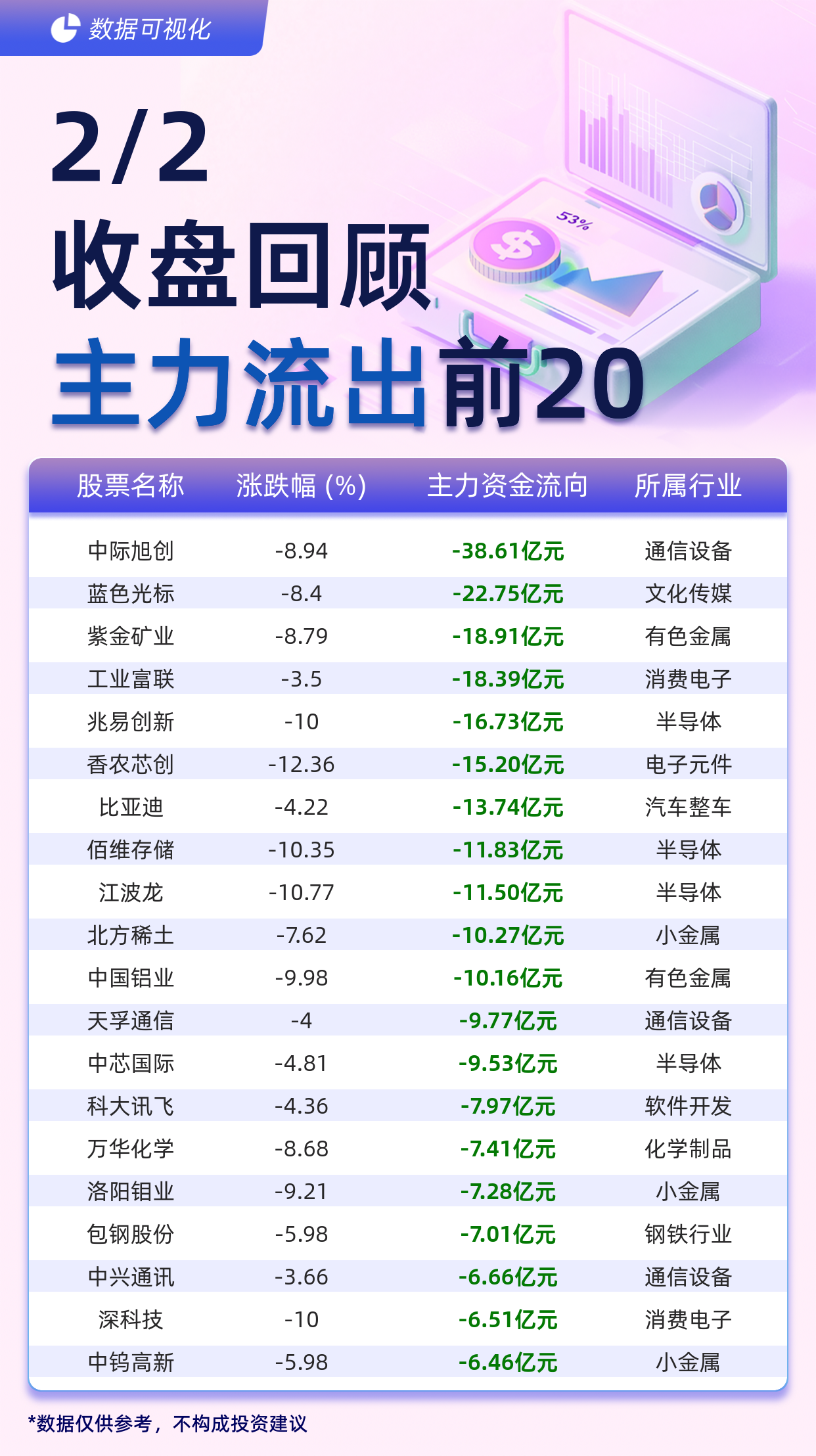
主力个股资金流出前20:中际旭创流出38.61亿元、蓝色光标流出22.75亿元
Jin Rong Jie· 2026-02-02 07:31
Core Viewpoint - The data indicates significant outflows of capital from various stocks, with notable declines in share prices across multiple sectors, suggesting a bearish sentiment in the market. Group 1: Major Stocks with Capital Outflows - Zhongji Xuchuang experienced the highest capital outflow of 3.861 billion, with a share price decline of 8.94% [1][2] - BlueFocus Media saw a capital outflow of 2.275 billion, with a decrease of 8.4% in its stock price [1][2] - Zijin Mining had an outflow of 1.891 billion, reflecting an 8.79% drop in its share price [1][2] - Industrial Fulian faced an outflow of 1.839 billion, with a 3.5% decline in stock value [1][2] - Zhaoyi Innovation reported a capital outflow of 1.673 billion, with a significant drop of 10% in its share price [1][2] Group 2: Additional Stocks with Notable Outflows - Shannon Microelectronics had an outflow of 1.520 billion, with a steep decline of 12.36% [1][2] - BYD experienced a capital outflow of 1.374 billion, with a 4.22% decrease in its stock price [1][2] - Baiwei Storage saw an outflow of 1.183 billion, with a decline of 10.35% [1][2] - Jiangbolong had an outflow of 1.150 billion, with a 10.77% drop in its share price [1][2] - Northern Rare Earth reported an outflow of 1.027 billion, with a 7.62% decline [1][2] Group 3: Other Stocks with Capital Outflows - China Aluminum faced an outflow of 1.016 billion, with a stock price decrease of 9.98% [1][2] - Tianfu Communication had an outflow of 0.977 billion, with a 4% decline in its share price [1][3] - SMIC reported an outflow of 0.953 billion, with a 4.81% drop [1][3] - iFlytek experienced an outflow of 0.797 billion, with a 4.36% decline [1][3] - Wanhua Chemical had an outflow of 0.741 billion, with an 8.68% decrease [1][3]





1月车市“大变天”:吉利反超比亚迪,小米SU7停产致销量跌超二成
Feng Huang Wang· 2026-02-02 07:06
"2026年是吉利汽车产品大年,吉利汽车将在每个季度都推出1-2款全新产品,涵盖多款全新混动车型及 全新一代醇氢能源车型,全力冲击全年345万辆的销量目标。"吉利汽车方面表示,公司将2026年的出口 销量目标锚定64万辆,同比增幅超50%以上。 "痛失"销冠的比亚迪,1月呈现"国内下滑、海外增长"的分化态势。产销快报显示,比亚迪当月实现销 售21万辆,同比下降30.11%,环比下降50.04%。其中,国内市场销量10.5万辆,同比下降54.35%;海外 市场销量10万辆,同比增长51.47%。 2月2日,车市告别"先抑后扬"的2025年后,受市场订单提前"透支"、促销费政策调整、传统淡季等叠加 因素影响,多家传统车企和造车新品牌于2月初发布的销量数据表明,今年1月汽车市场整体呈现销量环 比下滑、同比上扬的局面。 在极氪销量同比超100%带动下,虽然吉利品牌、领克品牌录得小幅下滑,但吉利汽车于2月1日晚间披 露的1月销量数据显示,其当月乘用车销量达27.02万辆,同比增长1.29%,环比增长14.08%,成为目前 唯一实现同环比正增长的企业,并借此反超比亚迪,登顶当月"销冠"。 在新能源领域,吉利汽车1月新能源 ...

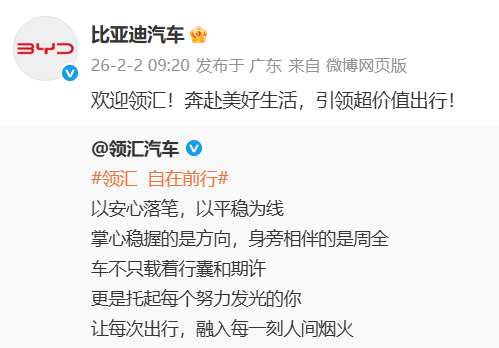
比亚迪第四款子品牌“领汇汽车”正式官宣亮相
Xin Lang Cai Jing· 2026-02-02 05:42
Group 1 - BYD officially announced the launch of its fourth sub-brand "Linghui Auto" on February 2, following Fangchengbao, Tengshi, and Yangwang [1][4] - The Linghui brand is positioned as a "super value travel practitioner," targeting the B-end operation market, including ride-hailing, taxis, and government vehicles, distinguishing itself from the personal passenger car market [1][4] Group 2 - The first batch of Linghui models includes four vehicles, covering both pure electric and plug-in hybrid powertrains, forming a complete product line from compact sedans to mid-to-large MPVs [3][7] - Linghui e5 is based on the Qin PLUS EV, targeting the entry-level market with a focus on economy and durability, suitable for ride-hailing scenarios [3][7] - Linghui e7 is derived from the Sea Lion 07 EV platform, positioned in the mid-range, balancing performance and cost to meet dedicated vehicle needs [3][7] - Linghui e9, based on the BYD Han, is over 5 meters long and features dual motors with 135kW/150kW, aimed at high-end business travel, potentially being the first operational vehicle equipped with the "Heavenly Eye" L2+ level driver assistance system [3][7] - Linghui M9 is based on the BYD Xia plug-in hybrid platform, with a comprehensive range of 1200 kilometers, suitable for long-distance transfers and business receptions, with plans to launch a right-hand drive version for overseas markets [3][7]
比亚迪股份暴跌近8%
Xin Lang Cai Jing· 2026-02-02 04:29
Core Viewpoint - BYD's stock price has significantly declined, reflecting broader challenges in the electric vehicle market, with a notable drop in sales figures for 2026 [1] Group 1: Stock Performance - On February 2, BYD's stock opened lower, closing at HKD 90.10, a decline of nearly 8% [1] - The stock price has fallen approximately 42.69% from its peak of HKD 157.82 per share in June 2022, resulting in a market value reduction of about HKD 248.1 billion [1] Group 2: Sales Performance - BYD announced that it expects to achieve approximately 210,000 electric vehicle sales in January 2026, representing a year-on-year decrease of 30% [1] - Passenger vehicle sales are projected to be around 205,500 units, down 30.67% year-on-year [1] - Sales of pure electric vehicles are anticipated to be about 83,200 units, reflecting a decline of 33.60% [1] - Plug-in hybrid vehicle sales are expected to reach 122,300 units, down 28.53% year-on-year [1]
恒生科技指数大跌,小鹏、比亚迪等领跌
Xin Lang Cai Jing· 2026-02-02 03:40
开源证券提出,在购置税减免退坡及梯度以旧换新补贴预计对主流价位段新能源车销量造成较大影响的 背景下,2026年重点看好高端化发展方向。 比亚迪2月1日公告,2026年1月新能源汽车产23万辆、销21万辆,同比分别降29.13%、30.11%。小鹏汽 车公告,公司1月交付新车20011辆,同比下降34.07%,环比下降46.65%。主因或为购置税减半致需求 减少。 恒生科技指数ETF(513180)在跟踪恒生科技指数的ETF中规模排名第一,覆盖造车新势力龙头,持仓 比亚迪、蔚来、理想、小鹏、零跑。 2月2日,恒生科技指数盘中一度跌超3%。新能源车板块领跌,小鹏汽车、蔚来、比亚迪股份和零跑汽 车跌幅居前,恒生科技指数ETF(513180)盘中跌近3%。 ...

恒科指跌3%
Xin Lang Cai Jing· 2026-02-02 03:12
Core Viewpoint - The Hong Kong stock market experienced a decline, with major indices falling significantly, particularly the Hang Seng Technology Index which dropped by 3% and the Hang Seng Index which fell by over 2% [1] Company Performance - Hua Hong Semiconductor saw a decline of over 10% in its stock price [1] - China Unicom's stock fell by more than 9% [1] - Xpeng Motors experienced a drop exceeding 8% [1] - China Telecom's shares decreased by over 7% [1] - NIO and BYD Company both saw declines of more than 5% [1]