BYD(01211)

Search documents
上海伯镭智能科技股份有限公司获“C+轮”融资,金额1亿人民币
Sou Hu Cai Jing· 2026-02-02 12:01
Core Insights - Shanghai Berai Intelligent Technology Co., Ltd. recently completed a C+ round financing, raising 100 million RMB, with BYD as the investor [1] Company Overview - Shanghai Berai Intelligent Technology Co., Ltd. was established in 2015 and is located in Shanghai, primarily engaged in software and information technology services [1] - The company has a registered capital of 14.01589 million RMB and has completed its C+ round financing by 2026 [1] Investment and Intellectual Property - The company has made investments in 14 other enterprises and holds 38 trademark registrations and 166 patents [1] - Additionally, it possesses 6 administrative licenses [1] Shareholders - The shareholders of Shanghai Berai include Hu Xinyi, Yang Yang, Jiaxing Ronghe Zhijia Equity Investment Partnership (Limited Partnership), Shanghai Guifu Intelligent Technology Partnership (Limited Partnership), and Shenzhen Tuo Jin Venture Capital Fund Partnership (Limited Partnership) [1]
比亚迪天神之眼5.0辅助驾驶发布 搭载最新大模型版本
Feng Huang Wang· 2026-02-02 11:41
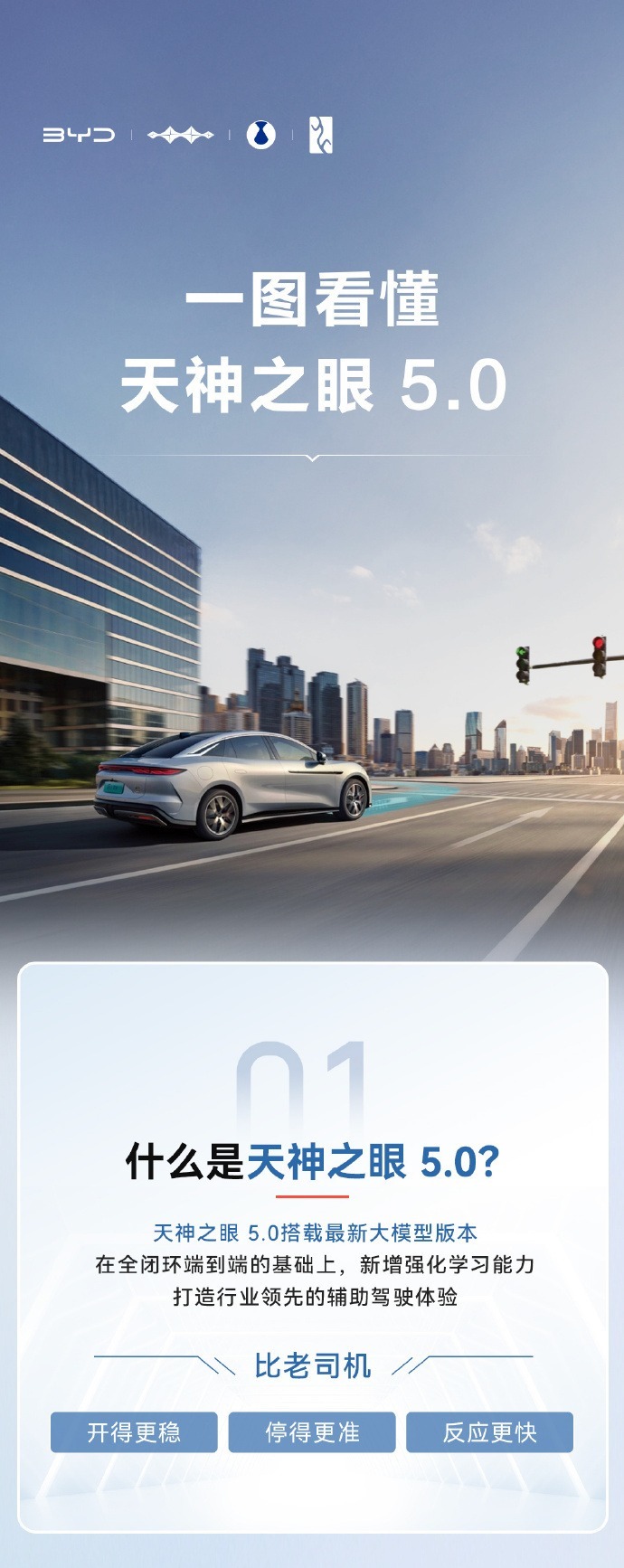
据介绍,比亚迪天神之眼5.0采用强化学习+闭环训练,实现了AI大模型自进化。该系统在安全功能方面 列举了多项场景:自动紧急转向可在日间130公里/小时速度下对静止前车进行避障;自动紧急制动支持 最高135公里/小时速度下的隧道静止前车刹停,以及日间转弯盲区儿童穿行刹停。 在驾驶行为模拟上,系统具备借道绕行临停车、窄路会车与掉头等能力。此外,还展示了在窄路超越慢 速两轮车、施工占道绕行及窄巷穿行等场景下的处理逻辑。 比亚迪公布,截至2025年12月31日,其辅助驾驶车型保有量已超过256万辆,辅助驾驶系统每日生成的 数据里程超过1.6亿公里。 凤凰网科技讯 1月28日,比亚迪(002594)汽车发布天神之眼5.0辅助驾驶,其搭载最新大模型版本,在 全闭环端到端的基础上,新增强化学习能力,宣称"比老司机开得更稳、停得更准、反应更快。" ...

告别电车起火!固态电池决战 2027,中国凭啥赢?
Sou Hu Cai Jing· 2026-02-02 11:03
Core Viewpoint - Solid-state batteries are emerging as a revolutionary solution to address key pain points in electric vehicles, including fire safety, range anxiety, and charging speed, with significant investment interest from major companies in the industry [1][2]. Group 1: Safety and Performance Advantages - Solid-state batteries can prevent fires, as they require temperatures above 300°C to trigger thermal runaway, compared to 130-200°C for traditional lithium batteries [3]. - The use of solid electrolytes instead of liquid electrolytes enhances safety, making solid-state batteries much less likely to catch fire even in severe accidents [3]. - Solid-state batteries can significantly improve driving range, with potential distances of 1000 to 1500 kilometers on a single charge, surpassing the current best electric vehicles [5][6]. Group 2: Charging Speed - Solid-state batteries can achieve a full charge for 1000 kilometers of range in just over 10 minutes, which is much faster than current charging technologies [7]. Group 3: Current Market Status and Challenges - No company has yet achieved mass production of solid-state batteries, with the industry facing challenges in scaling from laboratory to production [7][21]. - The cost of solid-state battery materials is significantly higher, with solid-state electrolytes costing over ten times that of liquid electrolytes, leading to high production costs [12][13]. - The complexity of mass production processes and the need for a mature supply chain are major hurdles for the industry [11][21]. Group 4: Development Pathways - The industry is exploring "semi-solid" batteries as a transitional solution, with companies like SAIC and NIO already implementing these technologies [14][15]. - Several companies, including CATL and BYD, are working on pilot production lines for solid-state batteries, aiming for small-scale production by 2027 [16][21]. Group 5: Global Competition and Future Outlook - Countries like Japan, South Korea, and the USA are heavily investing in solid-state battery technology, with various companies pursuing different technological pathways [19]. - China has a competitive advantage due to its established lithium battery supply chain and supportive policies, positioning it to potentially lead in the solid-state battery race [20].

汽车股股价悉数受挫 小鹏汽车-W(09868)跌9.21% 机构指1月新能源车销量承压
Xin Lang Cai Jing· 2026-02-02 11:01
Group 1 - The automotive stocks have faced significant declines, with Xpeng Motors down 9.21%, NIO down 6.47%, and BYD down 4.86% as of the report date [1] - A report from Kaiyuan Securities indicates that the domestic passenger car market is expected to remain flat year-on-year but will see a month-on-month decline in January 2026, with new energy vehicle sales under pressure and penetration rate dropping to approximately 44.4% [1] - The market is experiencing structural differentiation, with brands like AITO and Xiaomi achieving high growth through popular models, while pure electric brands like BYD are facing sales pressure [1] Group 2 - January is projected to be the last complete sales month before the Spring Festival, with retail sales expected to reach 1.8 million units, showing a year-on-year stability but a significant month-on-month decline [2] - The first week of January saw weak market performance with an average daily retail of 30,000 units, while the second week showed slight recovery with 50,000 units [2] - By the fourth week of January, retail sales are expected to peak at 120,000 units per day, driven by the implementation of subsidy policies and increased pre-holiday purchasing demand [2]


解码消费新浪潮,世研指数发布《2025年度消费榜单》趋势报告
3 6 Ke· 2026-02-02 10:44
Core Insights - The report titled "2025 Consumer Rankings: Decoding Consumption Trends" was officially released by the World Research Index on January 27, providing a systematic analysis of hot categories, brands, and consumption hotspots for 2025, aimed at helping businesses accurately grasp consumption trends and identify growth opportunities [1]. Group 1: Key Observations - The report's core observation revolves around two main themes: "Rational Foundation, Value Return" and "Emotional Leap, Scene Integration," utilizing a proprietary consumption index evaluation system developed by the World Research Index [4]. - The report systematically outlines annual hot categories, the top 100 brands, twelve major industry hot brands, a hot consumption map, and key events, presenting an objective and dynamic view of consumption trends in the Chinese market [4]. Group 2: Annual Hot Categories - The top annual hot categories include cooking oils and seasonings (1.82), mobile communications (1.74), major appliances (1.70), and main fermented foods (1.65), indicating a strong consumer focus on essential goods and the continued penetration of technology in daily life [6]. - Categories such as smart devices (1.59) and facial care (1.55) reflect a trend towards intelligent and convenient upgrades in consumer products [6]. Group 3: Annual Brand Rankings - The top brands in the annual brand rankings include Apple (1.93), BYD (1.91), and Huawei (1.82), showcasing strong brand loyalty and consumer interest in technology and lifestyle products [8]. - In the 3C digital and home appliance sectors, brands like Apple, Huawei, and Xiaomi are noted for their innovation in AI smartphones and smart home products, indicating a shift towards integrated smart living solutions [12]. Group 4: Industry Trends - The outdoor trend is reshaping the sportswear and outdoor industries, with domestic brands like Anta and Li Ning leveraging functional technology and aesthetic styles to penetrate everyday fashion, promoting a "national outdoorization" consumption trend [14]. - The pet product market is evolving from basic care to high-quality living, with brands focusing on scientific and premium offerings, driven by trends towards "humanization" in pet care [19]. Group 5: Consumption Hotspots - The report identifies social livelihood and digital technology as the two main engines of annual consumption hotspots, intertwined with seasonal rhythms and cultural tourism emotions, shaping a rich and interconnected consumption pulse [24]. - Key consumption events for 2025 have shifted from traditional holiday promotions to a diverse network of social emotions, technological innovations, and cultural phenomena, marking the entry into an era of omnipresent consumption triggers [26].




观车 · 论势 || 10万辆背后的“出海”新范式
Zhong Guo Qi Che Bao Wang· 2026-02-02 10:44
Core Insights - In 2025, Chinese automakers achieved a significant breakthrough in the European market, with monthly sales surpassing 100,000 units for the first time in December, representing a year-on-year increase of over 100% and a market share rise to 9.5% [2] - The total annual sales for Chinese automakers in Europe reached 811,000 units, marking a 99% year-on-year increase and a record market share of 6.1% [2] - This growth signifies a shift from "product export" to "ecosystem establishment," indicating that Chinese automotive industry has successfully moved beyond the low-cost label in global competition [2] Market Strategy - Chinese automakers effectively responded to trade policy changes, particularly the EU's imposition of tariffs on electric vehicles, by pivoting towards plug-in hybrid models that still benefit from lower tariffs [3] - The BYD Seal U plug-in hybrid model led the sales chart in Europe with 73,000 units sold in 2025, demonstrating the effectiveness of this strategic shift [3] - A consensus on pricing mechanisms for electric vehicles between China and the EU in January 2026 further solidified the foundation for future sales growth [3] Localization Efforts - Chinese automakers are deepening their localization efforts in Europe, with significant investments in manufacturing and supply chain setups [4] - BYD is investing €4 billion in a passenger vehicle factory in Hungary, set to begin production in Q2 2026, which will help circumvent EU trade barriers [4] - Partnerships with local firms, such as Xpeng and GAC collaborating with Magna, are facilitating localized production and adaptation to European market needs [4] Product Development - The product offerings from Chinese automakers have significantly improved, with a full range of vehicles now available that meet European market demands [4] - Chinese brands are no longer perceived as low-cost alternatives but are recognized for their technological advantages, offering higher specifications at similar price points [4] - Several Chinese models have received five-star ratings in Euro NCAP safety tests, further enhancing their reputation in the European market [4] Technological Advancements - Chinese automakers have gained a competitive edge through the mastery of core technologies such as CTB body integration and high-energy batteries, which enhance performance and safety [5] - The integration of smart cockpit and intelligent driving features has created a differentiated competitive advantage for Chinese brands [5] - The rise of Chinese automakers is not merely a market competition but represents a complementary and mutually beneficial evolution in the global automotive industry's electrification transition [5]

比亚迪(002594) - H股公告(股份发行人及根据《上市规则》第十九B章上市的香港预托证券发行人的证券变动月报表)
2026-02-02 10:30
股份發行人及根據《上市規則》第十九B章上市的香港預託證券發行人的證券變動月報表 截至月份: 2026年1月31日 狀態: 新提交 致:香港交易及結算所有限公司 公司名稱: 比亚迪股份有限公司 呈交日期: 2026年2月2日 I. 法定/註冊股本變動 | 1. 股份分類 | 普通股 | | 股份類別 | H | | | 於香港聯交所上市 (註1) | | 是 | | | --- | --- | --- | --- | --- | --- | --- | --- | --- | --- | --- | | 證券代號 (如上市) | 01211 | | 說明 | | | | | | | | | 多櫃檯證券代號 | 81211 | RMB | 說明 | | | | | | | | | | | | 法定/註冊股份數目 | | | 面值 | | | 法定/註冊股本 | | | 上月底結存 | | | | 3,683,400,000 | RMB | | | 1 RMB | | 3,683,400,000 | | 增加 / 減少 (-) | | | | | | | | RMB | | | | 本月底結存 | | | | 3, ...
比亚迪推出全新品牌“领汇”,搭载天神之眼辅助驾驶系统
Feng Huang Wang· 2026-02-02 10:27
Core Viewpoint - BYD officially announced the launch of its new automotive brand "Linghui Auto," targeting the mobility market with a focus on "uncompromised technology and more affordable pricing" to fill a gap in the current electric vehicle market [1] Group 1: Market Positioning - Linghui Auto aims to address the market gap between high-priced luxury models and mainstream products that lack performance and experience [4] - The new brand is positioned to offer competitive pricing while enhancing the driving experience through advanced technology [4] Group 2: Technological Integration - Future products from Linghui Auto are planned to feature advanced systems such as the "Tianshen Eye" driver assistance system and the "Yunlian" intelligent body control system [4] - The brand will leverage existing technologies from BYD, including the e-platform 3.0, fifth-generation DM technology, and the eight-in-one electric drive platform [4]
比亚迪全新子品牌领汇汽车正式官宣亮相
Xin Hua Cai Jing· 2026-02-02 09:26
Group 1 - BYD's new sub-brand, Linghui Auto, officially announced its launch on February 2, positioning itself as a "super value mobility practitioner" with a vision to "redefine mobility through technological innovation" [1] - The brand emphasizes "uncompromising technology and more affordable prices" [1] - Linghui Auto will feature advanced systems such as the "Tianshen Eye" driver assistance system and the Yunlian intelligent body control system, integrating resources from the e-platform 3.0 and fifth-generation DM technology for future vehicle models [1]
乘用车板块2月2日跌1.96%,比亚迪领跌,主力资金净流出18.3亿元
Zheng Xing Xing Ye Ri Bao· 2026-02-02 09:15
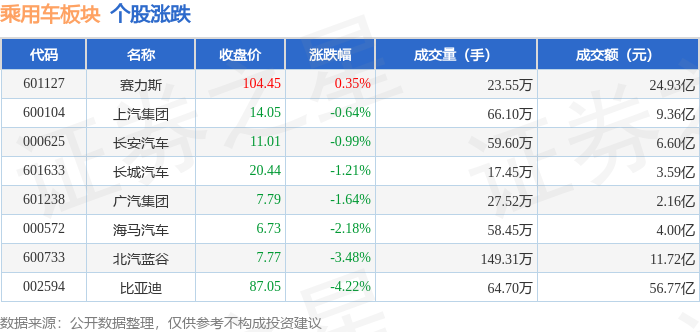
Group 1 - The passenger car sector experienced a decline of 1.96% on February 2, with BYD leading the drop [1] - The Shanghai Composite Index closed at 4015.75, down 2.48%, while the Shenzhen Component Index closed at 13824.35, down 2.69% [1] - Major stocks in the passenger car sector showed varied performance, with BYD closing at 87.05, down 4.22%, and other notable declines from companies like BAIC Blue Valley and Great Wall Motors [1] Group 2 - The passenger car sector saw a net outflow of 1.83 billion yuan from institutional investors, while retail investors contributed a net inflow of 1.18 billion yuan [1] - Specific stock performances indicated significant net outflows for companies like SAIC Motor and Great Wall Motors, while Changan Automobile and BYD saw notable retail inflows [1]