
BYD(01211)

Search documents
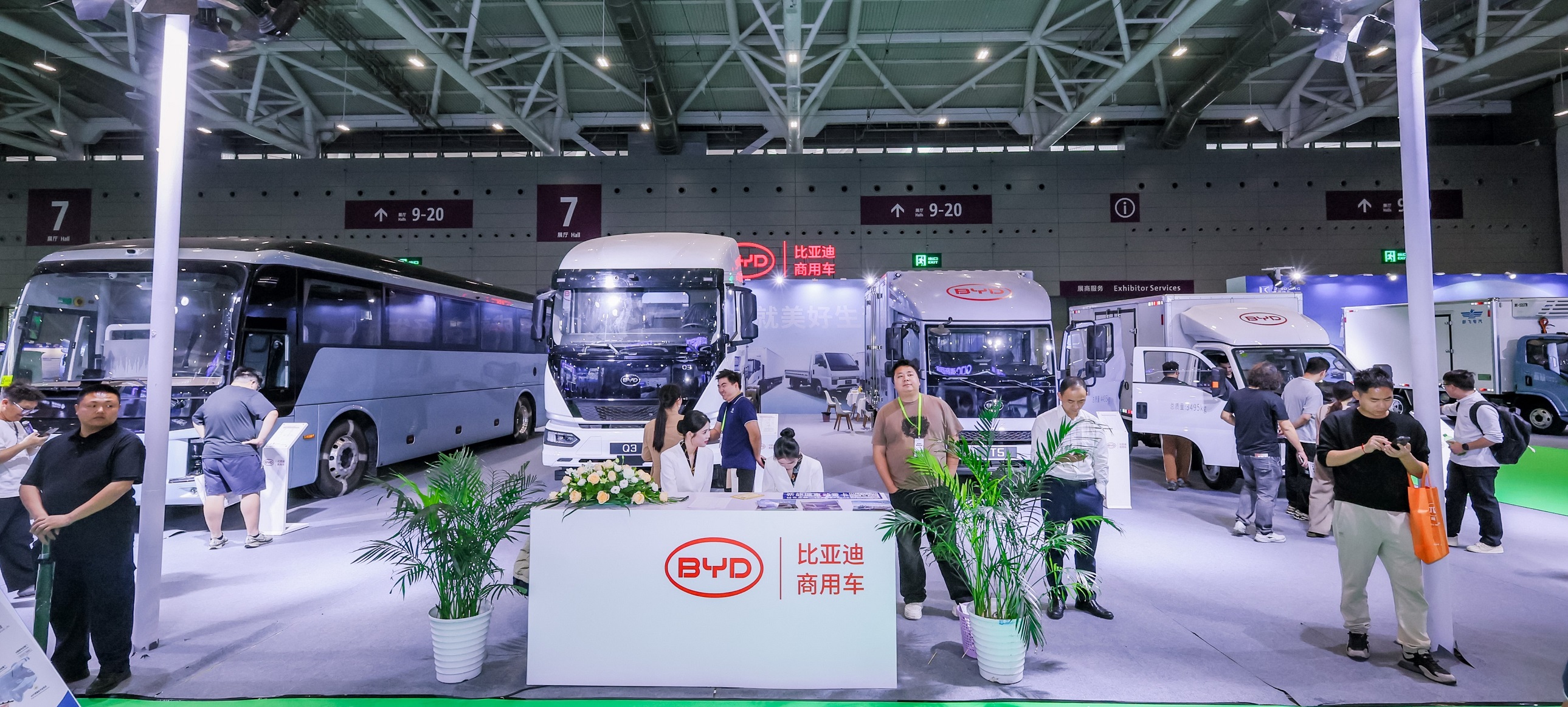
携四款纯电力作参展 比亚迪商用车诠释新能源领军实力
Zhong Guo Qi Che Bao Wang· 2026-03-24 08:29
Core Insights - The article highlights the transition of the new energy commercial vehicle industry from policy-driven to market-driven growth, with BYD leading the global sector through its comprehensive technology in the "three electrics and one core" [1] - BYD showcased four pure electric models at the 2026 Shenzhen International Commercial Vehicle Expo, demonstrating its commitment to innovation and leadership in the new energy commercial vehicle market [1][8] Group 1: Product Highlights - The pure electric sedan truck T4 addresses traditional issues such as safety, high operating costs, and poor urban maneuverability, featuring advanced design and technology for enhanced convenience and safety [3] - The T4 is equipped with a blade battery and a 150kW flat wire motor, providing 204 horsepower and an energy efficiency of "1 kWh per 5.5 km," with a warranty of up to ten years or 800,000 km on key components [3] - The pure electric light truck T5 utilizes blade battery technology and a powerful flat wire motor, achieving significant energy efficiency and operational cost advantages, while also offering hybrid options for diverse transportation needs [4] Group 2: Advanced Features - The pure electric tractor Q3 is designed for high-efficiency operations in short-haul transport, featuring a 452kWh blade battery and a peak power of 410kW, with a range exceeding 260 km [5] - The Q3 includes various comfort and safety features, such as a multi-functional steering wheel and advanced stability systems, enhancing user experience in demanding transport scenarios [5] - The pure electric bus C11 focuses on safety, comfort, and economic efficiency, utilizing advanced battery technology and safety systems to surpass traditional fuel vehicles in performance [7] Group 3: Strategic Vision - BYD's introduction of these four electric models exemplifies its commitment to technological innovation and industry advancement, aiming to meet diverse market demands and enhance product offerings [8] - The company plans to continue its focus on the new energy commercial vehicle sector, leveraging its technological strengths and global presence to drive quality upgrades in the industry [8]


任泽平带你看前沿科技:2026研学计划
泽平宏观· 2026-03-24 08:24
Core Viewpoint - The article emphasizes the importance of practical learning experiences in cutting-edge technology and investment research, highlighting the collaboration between entrepreneurs and leading companies to explore new opportunities in emerging industries [4][13]. Schedule Overview - The schedule for 2025 includes visits to major technology companies and events such as CES, with a focus on AI, robotics, and commercial space [7][8]. - Key events include closed-door investment research meetings on China's AI strength and participation in the Hong Kong Web3 Carnival [8][9]. Learning Experience - Participants will engage in deep explorations of technology companies, gaining insights into strategic decisions, technological challenges, and industry disruption logic through direct dialogues with founders and executives [13][24]. - The program aims to empower entrepreneurs by focusing on three dimensions: cutting-edge technology trends, emerging industry ecosystems, and business model exploration [13]. Past Activities - In 2023, participants visited leading companies such as Huawei and ByteDance, while in 2024, they will explore companies like BYD and Tencent, focusing on themes like artificial intelligence and new energy [24][25]. - The program has a history of facilitating high-end investment research meetings, providing a platform for exploring future technologies and connecting diverse resources [25]. Participant Feedback - Feedback from participants highlights the value of hands-on learning and the opportunity to engage with top-tier companies, enhancing their understanding of market dynamics and investment strategies [42][48]. - Participants express appreciation for the program's focus on practical insights and the cultivation of a long-term investment mindset [48][49].




港股汽车股尾盘涨幅扩大 吉利汽车涨4.9%
Mei Ri Jing Ji Xin Wen· 2026-03-24 07:43
Core Viewpoint - The Hong Kong automotive stocks experienced significant gains in the late trading session, indicating a positive market sentiment towards the sector [1] Group 1: Stock Performance - Geely Automobile (00175.HK) rose by 4.9%, reaching HKD 20.98 [1] - BYD Company (01211.HK) increased by 4.1%, trading at HKD 106.6 [1] - Li Auto-W (02015.HK) saw a rise of 4.01%, with shares priced at HKD 67.4 [1] - Xpeng Motors-W (09868.HK) gained 3.21%, with a share price of HKD 73.9 [1]



续航150公里!比亚迪电摩锂电池上市
鑫椤锂电· 2026-03-24 07:31
Core Insights - The article discusses the launch of BYD's new lithium iron phosphate battery series specifically designed for electric motorcycles, named "Riding Fortress," which aims to enhance the electric two-wheeler market with advanced battery technology [1][5]. Market Overview - The article outlines various market segments for 2025, including lithium carbonate, electrolytes, copper foil, lithium cobalt oxide, ternary materials, lithium iron phosphate, manganese lithium, ternary precursors, lithium hexafluorophosphate, iron phosphate, VC additives, sodium-ion batteries, new lithium salts (LIFSI), separators, lithium batteries, aluminum foil, energy storage batteries, energy storage systems, manganese iron phosphate, and anode materials [1]. Product Features - The 76V45Ah battery can achieve a range of 150 kilometers, has a cycle life exceeding 3000 times, a capacity of 3456Wh, and weighs only 25 kilograms [3]. - The battery features a square aluminum shell lithium iron phosphate cell, IPX7 waterproof rating, and supports multiple communication protocols including Bluetooth, 485, and CAN, ensuring safety with a 70A protection board and a 76V10A aluminum charger, priced at 3456 yuan including the charger [5]. Industry Impact - BYD's entry into the electric motorcycle battery market with automotive-grade technology addresses common issues in the two-wheeler battery sector, such as insufficient range, short lifespan, and significant low-temperature degradation, thereby enhancing the overall user experience [5]. - The introduction of long-range and high-durability electric motorcycle batteries is expected to become mainstream in the market [5].

比亚迪5分钟极速充电,震惊美媒
半导体行业观察· 2026-03-24 03:20
Core Viewpoint - BYD has significantly improved its fast-charging technology, allowing certain electric vehicle batteries to charge from 10% to 70% in five minutes and fully charge in about nine minutes, which could add over 600 miles of range in the time it takes to order a coffee [2] Group 1: Charging Technology - BYD's new fast-charging technology can deliver up to 1500 kW of power, compared to the common 350 kW chargers in the U.S. that take 15 to 25 minutes to charge to 80% [2] - The new Blade battery technology, which utilizes lithium manganese iron phosphate (LMFP), enhances energy density and charging speed [3] - The energy density of BYD's latest battery has improved by 5% compared to the previous year's model, with the Tengshi Z9GT capable of exceeding 620 miles (approximately 1000 kilometers) on a single charge [4] Group 2: Infrastructure and Market Challenges - BYD plans to integrate its new charging stations into the existing infrastructure, simplifying deployment and preventing grid overload by equipping charging stations with energy storage batteries [5] - Despite the impressive charging speed, experts suggest that this advancement may not significantly change the daily lives of most electric vehicle owners, as many can charge at home [6] - The U.S. electric vehicle market faces challenges, including the cancellation of upcoming electric models by Honda and others, and a lack of federal support for electric vehicles, which hinders market growth [6]
顺周期-冰火转换-时刻-策略对话汽车
2026-03-24 01:27
Summary of Key Points from the Conference Call Industry Overview - The overseas penetration rate of new energy vehicles (NEVs) is currently only 10%, with long-term potential expected to reach 50%-60%, allowing Chinese automakers to access a market capacity of approximately 40-50 million vehicles [1][4] - The global automotive market's annual sales volume is estimated to be between 80 million to 100 million vehicles, excluding the Chinese market of about 20-24 million and the U.S. market of approximately 15-16 million [3] Company-Specific Insights BYD - BYD's overseas sales are projected to reach 1.6 to 1.7 million units by 2026, contributing profits of 30-35 billion yuan, which will account for 60%-70% of the company's total profits [1][6] - The company is expected to further increase its overseas sales to 2.8 to 3.5 million units by 2027, indicating a strong growth trend [6] Geely - Geely's export volume is expected to grow from 420,000 units in 2025 to 750,000-800,000 units in 2026, with nearly 40% being NEVs [6] - The profit contribution from Geely's NEV exports is estimated to be between 6-8 billion yuan, with overall export business contributing over 50% to the company's profits [6] Chery - Chery's NEV exports are projected to exceed 600% year-on-year growth in 2025, with expected exports of 550,000-600,000 units by 2026 [1][6] Market Dynamics - The demand for NEVs in overseas markets has been positively impacted by the recent U.S.-Iran conflict, particularly in oil-sensitive regions like Europe and Singapore, where foot traffic in stores has increased by approximately 80%-90% year-on-year [2] - The penetration rate of NEVs in Europe is nearing 30% by 2025, indicating a high market acceptance compared to China's current rate of about 55% [2] Competitive Advantages - Chinese NEV manufacturers and their supply chains exhibit significant cost advantages, particularly in battery costs, with domestic battery costs at around 0.3 yuan/Wh compared to 0.8-1.0 yuan/Wh overseas [5] - The export gross margin for domestic NEV manufacturers is generally over 20%, with some regions approaching 30%, translating to a per-vehicle profit of around 20,000 yuan, which is 8-10 times higher than domestic profit levels [5] Supply Chain Beneficiaries - Companies like Fute Technology and Weimais are expected to benefit significantly from the growth in the European NEV market, with profit contributions projected at 35%-40% and over 30%, respectively [7] - Fute Technology's European NEV business is anticipated to account for 25%-30% of its total revenue [7] - Other suppliers such as United Power and Jingjin Electric are also expected to benefit from the trend of NEVs going overseas [7]
汽车行业2026一季度业绩前瞻
2026-03-24 01:27
Summary of Automotive Industry Conference Call Industry Overview - The automotive industry is facing dual pressure on volume and profit in Q1 2026, with wholesale volume expected to decline by approximately 8% year-on-year, while new energy vehicle sales are projected to slightly decrease. Exports are the only bright spot, with a year-on-year increase of 55% [1][2][3]. Key Points Performance Expectations - **Overall Industry Performance**: Q1 2026 is anticipated to be the low point for volume and profit in the passenger car sector, with most automakers expected to see profit declines exceeding 20% year-on-year due to rising costs from copper, aluminum, lithium carbonate, and the appreciation of the RMB [1][2][3]. - **Geely Auto**: Expected to report profits exceeding 4 billion yuan, with a quarter-on-quarter increase of over 10%, driven by the high profitability of the Geely 9X model and a year-on-year export growth of 140% [1][4]. - **Heavy Truck Sector**: Strong export performance with a year-on-year increase of 30% in January-February 2026. China National Heavy Duty Truck Corporation (CNHTC) is expected to see a profit increase of 60% to 500 million yuan [1][2][3]. Segment Performance - **Intelligent Vehicle Sector**: Outperforming the overall vehicle sector, with Huayang Group expected to see a nearly 20% year-on-year growth, benefiting from Xiaomi's automotive sales and new product lines [1][7]. - **Parts Sector**: Mixed performance with leading companies like Fuyao Glass and Xingyu maintaining lower pressure due to strong overseas expansion. Companies like Kingood are expected to benefit from the rising aluminum prices [1][6]. Sales and Profitability - **Sales Disparities**: Despite overall industry decline, companies like NIO and Seres are expected to show significant sales growth due to new model launches, while BYD and XPeng are facing larger declines [2][3][4]. - **Profit Expectations**: Most passenger car companies are expected to see a year-on-year profit decline of over 20%. Geely is projected to stand out with a profit of over 4 billion yuan [4][5]. Market Trends - **Two-Wheeler Sector**: The sector continues to show strong growth in large-displacement exports, with Chuanfeng Power's exports expected to increase by 60% year-on-year, although overall performance is expected to remain flat due to tariff impacts [1][10]. Additional Insights - **Investment Strategy**: The investment strategy for 2026 focuses on performance and valuation, with recommendations in areas such as AIGC-enabled "power shortage," L4-level intelligence, and robotics. Key companies recommended include Weichai Power, Xpeng Motors, and Top Group [2]. - **Challenges**: The industry faces challenges from rising raw material costs and currency fluctuations, which are expected to negatively impact profitability in Q1 2026 [3][4]. This summary encapsulates the key insights and performance expectations for the automotive industry as discussed in the conference call, highlighting both opportunities and challenges within various segments.




泛能源板块投资机会电话会议
2026-03-24 01:27
Summary of Key Points from Conference Call Records Industry Overview - **Energy Sector**: The focus has shifted from technology stocks to energy and resource sectors due to tightening liquidity and expectations of a single interest rate cut by the Federal Reserve in 2026 [1][2][3]. Coal Sector - **Investment Logic**: Companies with coal chemical assets are recommended due to their aggressive growth potential. The rise in oil prices is expected to increase chemical product prices, benefiting companies like Guanghui Energy and Yanzhou Coal Mining [1][4][5]. - **Market Dynamics**: Despite a year-on-year decline in coal prices in Q1 2026, the average price for the year is expected to remain stable or slightly increase compared to 2025. The presence of flexible supply from domestic and Indonesian mines will help stabilize prices [5]. Energy Storage and Lithium Battery - **Growth Projections**: The energy storage sector, particularly household and commercial storage, is expected to see a growth rate of 30%-50% in 2026. Companies like Deye Technology and Jinlang Technology are highlighted as key players [1][5][6]. - **Lithium Demand**: A projected increase of over 30% in lithium battery demand in 2026 is anticipated, driven by high oil prices and the growth of the energy storage market [6][7]. Offshore Wind Power - **Market Growth**: The domestic offshore wind power market is entering a high growth phase, with installed capacity expected to reach 8-10 GW in 2026 and 13-15 GW by 2027. European projects are also accelerating due to energy security concerns [1][8]. Oil and Gas Equipment - **Capital Expenditure**: High oil prices are driving capital expenditures in North America and the Middle East, benefiting companies like Jereh and Neway. These companies are positioned well for growth due to their exposure to international oil service markets [1][10][11]. Public Utilities - **Mature Sector**: The waste-to-energy sector is entering a mature phase with significant potential for dividend increases. Companies like China Everbright Environment are expected to see substantial growth in earnings and dividends [1][12][13]. Investment Strategies - **Neutral Hedging**: Given the geopolitical uncertainties, a neutral hedging strategy is recommended, increasing allocations to the energy sector to mitigate risks associated with holding technology stocks [2][3]. Key Recommendations - **Coal Sector**: Focus on companies with coal chemical assets such as Guanghui Energy and Yanzhou Coal Mining [1][5]. - **Energy Storage**: Companies like Deye Technology and Jinlang Technology are recommended due to their strong growth prospects in the energy storage market [5][6]. - **Lithium Battery**: Ningde Times is highlighted for its strong market position and expected growth in both battery and energy storage sectors [6][7]. - **Offshore Wind**: Recommended companies include Daikin Heavy Industries and Tianjun Wind Power, which are well-positioned in the growing offshore wind market [8]. - **Public Utilities**: China Everbright Environment and Green Power Environmental are recommended for their stable earnings and dividend growth potential [12][13]. Conclusion - The energy sector, particularly coal, energy storage, and offshore wind, presents significant investment opportunities amid current geopolitical tensions and market dynamics. Companies with strong fundamentals and growth potential are well-positioned to benefit from these trends [1][2][3][4][5][6][7][8][12][13].

“开了两个加油站都没油了!”油价上调,国家临时调控稳油市
21世纪经济报道· 2026-03-24 00:08
Core Viewpoint - The article discusses the recent adjustments in domestic fuel prices in China due to the surge in international oil prices, highlighting the impact on consumers and the growing demand for electric vehicles as a result of rising fuel costs [4][5]. Fuel Price Adjustments - On March 23, the National Development and Reform Commission (NDRC) announced temporary adjustments to domestic fuel prices to alleviate the burden on consumers amid rising international oil prices. The adjustments resulted in a reduction of 1160 yuan per ton for gasoline and 1115 yuan per ton for diesel, translating to a price of approximately 0.86 yuan per liter for 89 gasoline and 0.91 yuan per liter for 92 gasoline [4]. - If the theoretical increase had been implemented, gasoline and diesel prices would have risen by 2205 yuan and 2120 yuan per ton, respectively, leading to an increase of about 1.84 yuan per liter for 92 gasoline and 1.81 yuan per liter for diesel [4]. Impact on Electric Vehicle Market - The surge in oil prices has led to a significant increase in the sales of new energy vehicles (NEVs) in China, with brands like BYD seeing a notable rise in orders both domestically and internationally. Countries such as Australia, Thailand, Singapore, and Indonesia have reported a surge in orders for Chinese NEVs [5]. - As of March 23, there are 1.5128 million existing NEV-related enterprises in China, with a steady increase in registrations over the past decade. The number of new registrations is projected to exceed 30,000 in 2024 and 2025, indicating a robust growth trend in the NEV sector [6].

全球视野看电车之五:基于能源安全视角看全球新能源增长潜力
Changjiang Securities· 2026-03-23 23:30
Investment Rating - The investment rating for the automotive and automotive parts industry is "Positive" and maintained [7] Core Insights - The rise in oil prices, influenced by the Middle East situation, has raised energy security concerns, prompting South Korea to initiate a resource security crisis alert and consider implementing vehicle restrictions [2][17] - The transportation sector accounts for a significant portion of oil consumption in many countries, and the current low penetration of new energy vehicles (NEVs) globally means that reliance on traditional fuel vehicles exacerbates risks associated with energy supply constraints. Diversifying the energy structure can mitigate these risks, and rising oil prices can accelerate the transition to NEVs in the global passenger vehicle market [2][19] - The potential for domestic NEVs to expand internationally is substantial, with projected sales for EVs, PHEVs, and HEVs in regions excluding China, the US, and Japan reaching 3.54 million, 1.4 million, and 4.62 million units respectively by 2025. If domestic NEVs capture 50%-60% of the market share in these categories, it could represent a growth potential of 4.3-5.3 times [23][24] Summary by Sections Global Energy Security Perspective - The recent increase in oil prices has raised energy security issues, with Brent crude oil futures reaching $108.65 per barrel, a 70% increase over the past two months. South Korea has raised its resource security crisis alert level and is considering measures such as vehicle restrictions to manage demand [17][19] New Energy Vehicle Market Potential - The transportation sector's oil consumption is significant, with many countries having low NEV penetration rates. High oil prices can drive the shift towards NEVs, as traditional fuel vehicles' dependence on oil resources increases risks associated with supply constraints [19][20] - Major regions for NEV exports from China include Western Europe, Southeast Asia, and Latin America, where leading companies like BYD, SAIC, and Geely are currently underrepresented in market share. As NEV penetration increases, these companies are expected to capture a larger share of the market [26][29]

