BYD(01211)

Search documents
60万一张车牌?新加坡车市到底多疯狂
汽车商业评论· 2026-03-23 23:06
Group 1 - The core point of the article highlights the high costs associated with car ownership in Singapore, particularly the Certificate of Entitlement (COE) prices, which are significant barriers to entry for consumers, yet the demand for cars remains strong [3][4][14]. - In the latest COE bidding, the prices for small and large cars were reported at 111,890 SGD (approximately 601,000 RMB) and 115,568 SGD (approximately 621,000 RMB) respectively, indicating the high financial commitment required for car ownership [3][9]. - Despite the high costs, the new car registration in Singapore is projected to reach 52,678 units by 2025, with electric vehicles (EVs) making up about 45% of this figure, reflecting a shift in consumer preferences towards electric options [3][17]. Group 2 - The COE system in Singapore is unique, requiring all vehicles to secure a COE before registration, which grants a ten-year ownership and road usage right [8][9]. - The government has frozen the annual growth rate of cars and motorcycles since February 2018, which will continue until early 2028, leading to increased competition for existing vehicle quotas and influencing COE prices [9][11]. - The government is also adjusting policies to accommodate electric vehicles, including raising the power threshold for EVs eligible for the A group COE and providing incentives for early adoption [12][11]. Group 3 - The article notes that the automotive market in Singapore is not just about selling cars but also about creating experiences, as evidenced by luxury brands like Porsche investing in experience centers [25][27]. - Porsche's new experience center in Singapore, set to open in 2027, will feature a 2-kilometer track and is aimed at enhancing brand engagement in the region [25][26]. - Despite high prices, luxury brands continue to invest in Singapore, indicating a belief in the market's potential and the importance of customer experience over mere sales figures [22][21]. Group 4 - The article emphasizes the growing acceptance of electric vehicles among Singaporean consumers, with brands like BYD rapidly increasing their market share, selling 3,002 vehicles in the first four months of 2025, surpassing Toyota [29][30]. - The local distribution network for BYD is expanding quickly, with multiple sales points established, indicating a strategic approach to cater to a diverse consumer base in a high-cost market [31][32]. - Overall, the article suggests that despite the high costs of car ownership, Singapore remains a viable market for investment in the automotive sector, driven by evolving consumer preferences and strategic brand positioning [32].



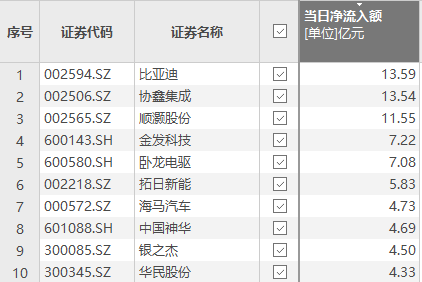
资金风向标 | 比亚迪获资金净流入13.59亿元
Shang Hai Zheng Quan Bao· 2026-03-23 12:51
Core Viewpoint - The article highlights the top ten stocks with the highest net inflow of funds on March 23, with BYD leading the list with a net inflow of 1.359 billion yuan [1]. Group 1: Top Stocks by Net Inflow - BYD (002594.SZ) received a net inflow of 1.359 billion yuan [2]. - Xiexin Integrated (002506.SZ) followed closely with a net inflow of 1.354 billion yuan [2]. - Shunhao Co., Ltd. (002565.SZ) had a net inflow of 1.155 billion yuan [2]. - Jinfat Technology (600143.SH) recorded a net inflow of 722 million yuan [2]. - Wolong Electric Drive (600580.SH) saw a net inflow of 708 million yuan [2]. - Tuojin New Energy (002218.SZ) had a net inflow of 583 million yuan [2]. - Haima Automobile (000572.SZ) experienced a net inflow of 473 million yuan [2]. - China Shenhua (601088.SH) recorded a net inflow of 469 million yuan [2]. - Yinzhi Jie (300085.SZ) had a net inflow of 450 million yuan [2]. - Huamin Co., Ltd. (300345.SZ) saw a net inflow of 433 million yuan [2].
油费是电费4倍!中国电车爆火
第一财经· 2026-03-23 09:25
Core Viewpoint - The rising oil prices are significantly boosting the sales of electric vehicles (EVs), particularly from Chinese brands, as consumers seek cost-effective alternatives to traditional fuel vehicles [4][5][9]. Group 1: Sales Trends and Market Dynamics - In Australia, the sales of electric vehicles have surged, with a Melbourne dealer reporting a 50% year-on-year increase in sales due to rising oil prices [3][5]. - The retail sales of new energy vehicles in China reached 285,000 units from March 1 to March 15, marking a 36% increase compared to the same period last month [10]. - In February, the growth rate of new energy vehicle sales in Australia rose to 11.8%, a historical high, with Tesla and BYD leading the market [7]. Group 2: Competitive Landscape - Chinese automotive brands are increasingly capturing market share from traditional Japanese fuel vehicles in Australia, with new energy vehicle sales surpassing those of Japanese brands for the first time [5][9]. - The cost advantage of electric vehicles is becoming more pronounced, with the cost of filling a fuel tank being four times higher than charging an electric vehicle [5][6]. - BYD's Atto 3 and other models are experiencing high demand due to competitive pricing compared to traditional models like the Tesla Model Y [5][6]. Group 3: Global Expansion and Future Outlook - Chinese brands such as BYD, Changan, and Xpeng are seeing a surge in orders across Southeast Asia, indicating a growing international demand for their electric vehicles [9]. - The penetration rate of new energy vehicles in China has exceeded 45%, with a target for significant growth in overseas markets by 2026 [9][10]. - The high oil prices are expected to enhance the competitiveness of the Chinese new energy vehicle industry in the long term, despite short-term pressures from rising costs in logistics and materials [9][10].

比亚迪3月23日现2笔大宗交易 总成交金额1205.46万元 其中机构买入1205.46万元 溢价率为0.00%
Xin Lang Zheng Quan· 2026-03-23 09:12
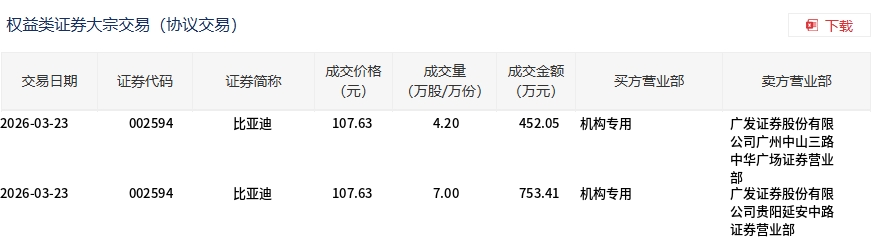
Group 1 - BYD's stock closed up 4.46% at 107.63 yuan, with two block trades totaling 112,000 shares and a transaction amount of 12.05 million yuan [1] - The first transaction was at a price of 107.63 yuan for 42,000 shares, amounting to 4.52 million yuan, with a premium rate of 0.00% [1] - The second transaction was also at 107.63 yuan for 70,000 shares, totaling 7.53 million yuan, with a premium rate of 0.00% [1] Group 2 - In the last three months, BYD has had a total of six block trades, with a cumulative transaction amount of 61.64 million yuan [1] - Over the past five trading days, the stock has increased by 2.88%, with a net inflow of 680 million yuan from main funds [1]
比亚迪今日大宗交易平价成交11.2万股,成交额1205.46万元
Xin Lang Cai Jing· 2026-03-23 08:56
Summary of Key Points Core Viewpoint - On March 23, BYD executed a block trade of 112,000 shares, with a transaction value of 12.05 million yuan, representing 0.06% of the total trading volume for the day, at a price of 107.63 yuan, which was consistent with the market closing price [1][2]. Group 1: Transaction Details - The block trade on March 23 involved a total of 112,000 shares of BYD, with a total transaction value of 12.05 million yuan [1][2]. - The transaction price was 107.63 yuan per share, which was equal to the market closing price on that day [1][2]. - The trading volume included two separate transactions: one for 42,000 shares valued at 4.52 million yuan and another for 70,000 shares valued at 7.53 million yuan [3]. Group 2: Trading Parties - The buyer for both transactions was an institutional entity, while the seller was identified as Guotai Junan Securities Co., Ltd., with specific branches involved in the trades [3].
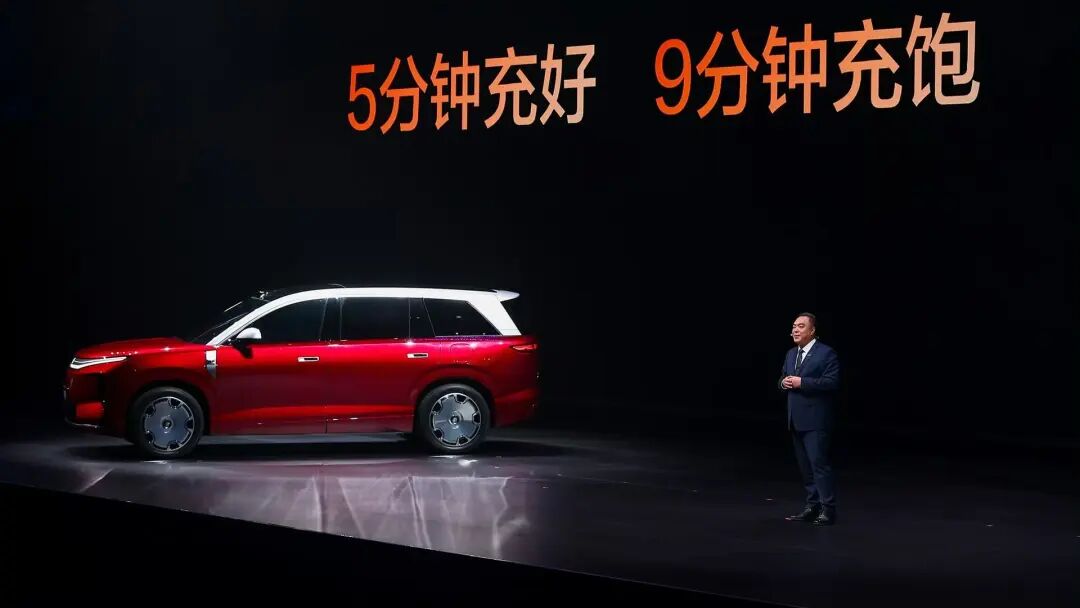
896线激光雷达版智界发布即交付 比亚迪“老将”赵长江现身
Xin Lang Cai Jing· 2026-03-23 08:56
Core Insights - Huawei launched the upgraded versions of the Zhijie R7 and new S7 during its Spring All-Scenario Product Launch on March 23 [1] - The first batch of 896 line dual-light path image-level lidar Zhijie Dual 7 vehicles was officially delivered in seven cities including Beijing, Shanghai, Shenzhen, Nanjing, Hefei, Hangzhou, and Changsha [1] - Zhao Changjiang, a veteran from BYD and currently the Executive Director and Executive Vice President of Zhijie, was present at the delivery event in Changsha to hand over the new vehicles to the first batch of owners [1]
比亚迪收红 第二代刀片电池车型迎上市潮
Shang Hai Zheng Quan Bao· 2026-03-23 08:47
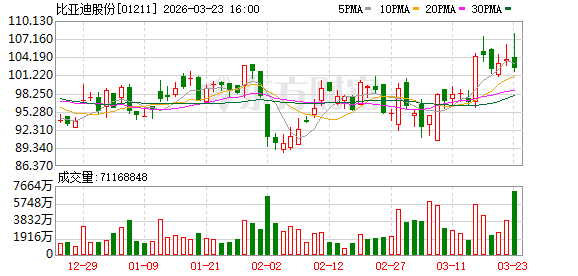
Core Viewpoint - BYD's stock performance has been strong, with a 4.46% increase, driven by positive news regarding new technologies and upcoming product launches [2] Group 1: New Technologies and Products - BYD has launched its second-generation blade battery and flash charging technology, which shows improvements in charging speed, energy density, lifespan, and safety compared to the first generation [3] - The company plans to introduce 10 new models equipped with the second-generation blade battery, enhancing its product matrix and potentially increasing sales due to rising oil prices [6] - A new intelligent driving technology conference is expected in April, focusing on self-developed chips, full-range lidar, and world model algorithms, which could significantly reduce the cost of advanced driving technologies [6][9] Group 2: Sales and Market Expansion - Citigroup forecasts that BYD's domestic and export sales will expand monthly, reaching approximately 220,000 to 250,000 units by March 2026 [3] - BYD's overseas sales are projected to exceed 1 million units by 2025, accounting for about 20% of total sales, with significant orders from Argentina and Mexico marking a key step in its Latin American market strategy [13] Group 3: Workforce and Production Capacity - BYD is ramping up recruitment across its facilities, with over 1,000 operational positions and more than 1,100 technical roles available, reflecting its commitment to increasing production capacity [10] - The company currently employs over 900,000 people, making it the largest automotive company by employee count in the A-share market [10] Group 4: Solid-State Battery Development - BYD is committed to investing in solid-state battery technology, facing significant scientific challenges but aiming to maintain its leadership in liquid battery technology while advancing solid-state research [10]
比亚迪收红,第二代刀片电池车型迎上市潮
Shang Hai Zheng Quan Bao· 2026-03-23 08:45
Core Viewpoint - BYD's stock performance has been strong, with a 4.46% increase closing at 107.63 yuan, driven by positive news including the launch of the second-generation blade battery and fast-charging technology, and an upcoming smart driving technology conference [1] Group 1: Product Development - The second-generation blade battery and fast-charging technology have been launched, showing improvements in charging speed, energy density, lifespan, and safety compared to the first generation [3] - BYD plans to release 10 new models equipped with the second-generation blade battery, enhancing its product matrix amid rising oil prices, which could boost future sales [5] - The company is also focusing on solid-state battery development, maintaining a leading position globally in research breakthroughs, product maturity, and production line layout [10] Group 2: Market Expansion - Citigroup forecasts that BYD's domestic and export sales will expand monthly, reaching approximately 220,000 to 250,000 units by March 2026 [3] - BYD's overseas sales are expected to exceed 1 million units by 2025, accounting for about 20% of total sales, with significant orders from Argentina and Mexico totaling 100,000 electric vehicles [10] Group 3: Recruitment and Workforce - BYD is ramping up recruitment across various locations, with over 1,000 operational positions and more than 1,100 technical positions available, reflecting the company's growth and expansion plans [9] - The total number of employees at BYD has surpassed 900,000, making it the largest automotive company by workforce in the A-share market [9]
汽车周观点:油价上涨强化出海逻辑,重视整车配置机会
GOLDEN SUN SECURITIES· 2026-03-23 08:24
Investment Rating - The industry investment rating is maintained as "Increase" [5] Core Views - The automotive sector is experiencing a significant improvement in weekly data, with wholesale daily averages increasing to 31,000 vehicles in the first week of March and 58,000 vehicles in the second week, alongside retail daily averages of 31,000 and 45,000 vehicles respectively. This improvement is attributed to the end of the holiday season and new vehicle launches. The rise in oil prices due to geopolitical tensions in the Middle East is expected to boost demand for new energy vehicles, accelerating the overseas expansion of automotive companies. The profitability of car manufacturers is currently at a low point, but is expected to improve from March to June as new vehicles are launched and sales recover [1][2][3] Summary by Sections Weekly Dynamics - The report highlights that new energy vehicle companies such as Xiaopeng, Li Auto, and others have achieved significant year-on-year sales growth, with Xiaopeng and Li Auto reaching profitability in Q4 2025. The overall sales growth for these companies is reported at 126% for Xiaopeng and 103% for Li Auto [10][12] Weekly Market Performance - The automotive sector saw an overall decline of 4.40% in the week from March 16 to March 22, ranking 16th out of 31 sectors. The Shanghai Composite Index fell by 3.38%, while the Shenzhen Component Index and CSI 300 Index decreased by 2.90% and 2.19% respectively. Among sub-sectors, passenger vehicles showed a slight increase of 0.78%, while other segments like automotive services and parts experienced declines of 5.53% and 6.20% respectively [13][20] Recommendations - The report suggests focusing on several companies across different segments: 1. Passenger Vehicles: Jianghuai Automobile, Geely Automobile, BYD, Xiaopeng Motors, Tesla 2. Commercial Vehicles: Weichai Power, China National Heavy Duty Truck Group, Yutong Bus, King Long Automobile 3. Liquid Cooling: Yinlun Holdings, Feilong Holdings, Ruikeda 4. Robotics: Zhejiang Rongtai, Laling Holdings, Deka Motor Holdings, Top Group, Sanhua Intelligent Controls, Xinquan, Shuanghuan Transmission, Hengshuai 5. Autonomous Driving: Horizon Robotics, Hesai Technology, Suteng Juchuang, Pony.ai, Nexperia, Coboda, Jingwei Hirun, Borsali 6. Commercial Aviation: Chaojie Holdings, Haoneng Holdings, Jingwei Hirun [3]




油价重回“9元时代”,比亚迪插混经济性优势凸显
Zhi Tong Cai Jing· 2026-03-23 08:13
Group 1 - The core viewpoint is that due to the escalating geopolitical tensions in the Middle East, domestic fuel prices are expected to rise significantly, with predictions indicating a 1.6 yuan increase per liter for 92 octane gasoline, leading to most regions returning to the "9 yuan era" [1] - This price increase means that filling up a tank will cost nearly an additional 100 yuan compared to previous prices [1] Group 2 - In response to rising fuel prices, BYD's hybrid vehicle owners are notably more relaxed, as the fifth-generation DM technology allows for both electric and gasoline use, providing cost savings [2] - The DM-i model offers a commuting cost of only 0.05 yuan per kilometer, with a pure electric range of 210 km, making it suitable for a week's worth of commuting on a single charge [2] - For users with home charging stations, the annual energy cost is less than 4,000 yuan, while comparable gasoline vehicles incur fuel costs exceeding 13,000 yuan annually, resulting in savings of nearly 10,000 yuan for hybrid vehicle owners [2] Group 3 - For scenarios requiring gasoline, BYD's hybrid vehicles have achieved a fuel consumption rate of 2.6 liters per 100 kilometers after OTA updates, setting a new global low for hybrid fuel consumption [5] - This translates to a fuel cost of approximately 0.23 yuan per kilometer even when the battery is depleted [5] Group 4 - The comprehensive range of BYD's hybrid vehicles can exceed 2,148 kilometers, allowing for long-distance travel without the need for refueling [7] - The flexibility of using either electric or gasoline modes provides users with significant advantages, especially as fuel prices rise [7] - Users can choose to charge when convenient or refuel when necessary, making the overall cost-effective regardless of the situation [8]