
XIAOMI(01810)

Search documents
鹿客科技冲刺IPO,患“小米依赖症”,自有业务萎缩
Guo Ji Jin Rong Bao· 2026-02-11 07:43
Core Viewpoint - Luoketech (Beijing) Co., Ltd. has submitted an application for a mainboard IPO to the Hong Kong Stock Exchange, aiming to become the "first AI smart lock stock" in the Hong Kong market [1] Group 1: Financial Performance - The company reported revenue growth from 1.015 billion to 1.086 billion yuan from 2023 to 2024, with a year-on-year increase of 11.5% in the first three quarters of 2025, reaching 774 million yuan [2] - Profits for 2023 and 2024 are projected at 14.03 million and 53.11 million yuan, respectively, with 31.98 million yuan reported for the first three quarters of 2025 [3] Group 2: Cash Flow Challenges - Operating cash flow showed a significant decline, with net inflow dropping from 89.485 million yuan in 2023 to just 1.247 million yuan in 2024, and turning negative with a net outflow of 38.307 million yuan in the first three quarters of 2025 [4] - As of September 2025, cash and cash equivalents were only 66.73 million yuan, a substantial decrease from the beginning of the period [5] Group 3: Business Structure and Dependency - The company's revenue growth heavily relies on ODM (Original Design Manufacturer) business, which accounted for 61.6% of total revenue in the first three quarters of 2025, up from 50.6% in 2023 [6] - Revenue from proprietary brand consumer products declined from 319 million yuan in 2023 to 301 million yuan in 2024, further dropping to 159 million yuan in the first three quarters of 2025, reducing its share from 27.8% to 20.5% [6] - The overall gross margin decreased from 35.2% in 2024 to 31.2% in 2025 due to the imbalance in business structure [7] Group 4: Client Dependency Risks - The company is significantly dependent on a single client, with sales to the top five clients accounting for 65.2% of total revenue, and sales to the largest client, Xiaomi, making up 60.6% [8] - The founder, Chen Bin, acknowledged that after receiving investment from Xiaomi, the company largely abandoned its proprietary brand, leading to a lack of product differentiation [9]

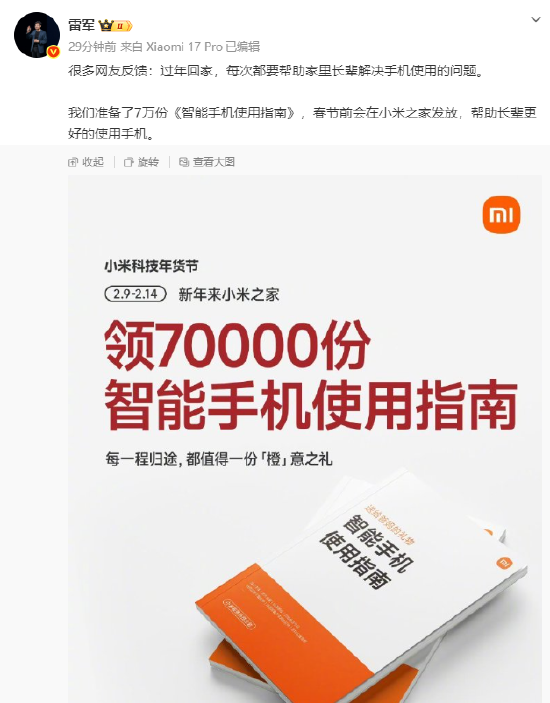
雷军:准备发放7万份《智能手机使用指南》,帮助长辈更好使用手机
Xin Lang Cai Jing· 2026-02-11 07:22
Group 1 - The founder of Xiaomi, Lei Jun, announced that many users have reported needing to assist their elderly family members with smartphone usage during the Chinese New Year [1][3] - Xiaomi plans to distribute 70,000 copies of the "Smartphone User Guide" at Xiaomi stores before the Spring Festival to help the elderly use smartphones more effectively [1][3]

雷军:小米正为新一代SU7做准备!港股科技ETF天弘(159128)标的指数盘中涨超1%
2 1 Shi Ji Jing Ji Bao Dao· 2026-02-11 06:56
Group 1 - The Hong Kong stock market showed a strong rebound on February 11, with the Hang Seng Tech Index rising nearly 1% and the Guozheng Hong Kong Stock Connect Tech Index increasing over 1% [1] - Notable performers among constituent stocks included Bilibili-W and Xiaomi Group-W, both rising over 5%, while BYD Company Limited saw an increase of nearly 4% [1] - The Tianhong Hong Kong Tech ETF (159128) has attracted significant capital, with a net subscription of 10 million units and a total inflow exceeding 720 million yuan over the past 20 trading days [1] Group 2 - Xiaomi Group's founder and CEO Lei Jun announced the completion of the first-generation Xiaomi SU7 production, with over 360,000 units delivered [2] - The production line is currently being modified to prepare for the next generation of the SU7 [2] - According to招商证券, the recent downturn in the Hong Kong tech sector presents significant investment opportunities, as the current market volatility is seen as a temporary liquidity shock [2]

小米集团涨超5% 新一代SU7预计4月上市
Ge Long Hui· 2026-02-11 06:46
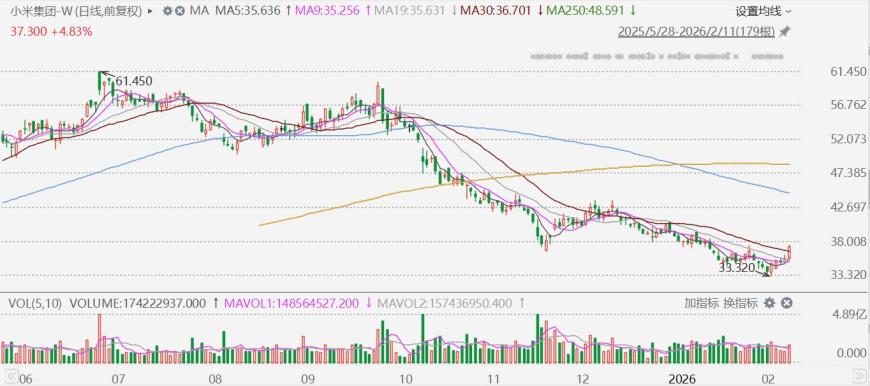
Core Insights - Xiaomi Group-W (1810.HK) showed strong performance on February 11, with an intraday increase of 5.4%, reaching HKD 37.5 [1] - Lei Jun announced the official discontinuation of the first-generation SU7, with the last vehicle rolling off the production line [1] - The new generation SU7 is expected to launch in April [1] - A segment on CCTV's "News Broadcast" showcased a multi-terminal smart device interoperability test, featuring three devices, including two tablets and a smartphone [1] - Speculation suggests that the showcased devices belong to the Xiaomi brand, with the central tablet likely being the Xiaomi Pad 7 Ultra, which was first released in May last year [1] - The Xiaomi Pad 7 Ultra features the flagship processor, the玄戒O1, and demonstrated a vehicle control interface, indicating that the HyperOS vehicle system is operational on the玄戒 chip [1]
港股异动丨小米集团涨超5% 新一代SU7预计4月上市
Ge Long Hui· 2026-02-11 06:32
Core Viewpoint - Xiaomi Group-W (1810.HK) showed strong performance today, with a peak increase of 5.4% reaching HKD 37.5 per share, following announcements from CEO Lei Jun regarding the production status of the SU7 model and the introduction of new devices [1] Group 1: Product Developments - The original SU7 model has officially ceased production, with the last unit having been completed [1] - A new generation of the SU7 is expected to launch in April [1] Group 2: Technology and Device Innovations - A segment on CCTV's "News Broadcast" showcased a multi-terminal smart device interoperability test, featuring three devices: two tablets and a smartphone [1] - The displayed devices are speculated to belong to the Xiaomi brand, with one tablet featuring a notch design, likely the Xiaomi Pad 7 Ultra [1] - The Xiaomi Pad 7 Ultra, released in May last year, is equipped with the flagship processor, the玄戒O1, and demonstrated a vehicle interface, indicating that the HyperOS vehicle system is operational on the玄戒 chip [1]
冲击三连涨!港股硬科技拐点出现?港股信息技术ETF劲涨1.2%,小米集团大涨超5%
Xin Lang Ji Jin· 2026-02-11 06:02
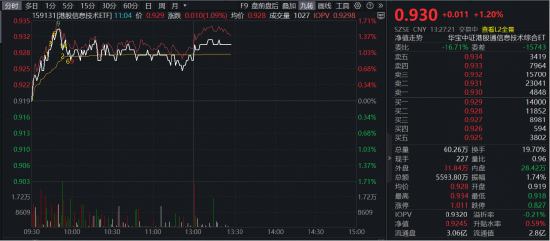
Core Viewpoint - The Hong Kong stock market is experiencing a strong performance in the hard technology sector, with significant gains in companies like Kintor Pharmaceutical and Kingsoft Cloud, indicating a potential investment opportunity in the semiconductor and technology industries [1][3]. Group 1: Market Performance - Kintor Pharmaceutical's stock surged over 13%, while Kingsoft Cloud rose more than 9%, and both Kintor Group and Xiaomi Group increased by over 5% [1]. - The first ETF focusing on the Hong Kong chip industry, the Hong Kong Information Technology ETF (159131), saw a price increase of 1.2%, with a trading volume exceeding 55.93 million yuan [1][3]. Group 2: ETF Composition and Strategy - The ETF is structured with a composition of 70% hardware and 30% software, heavily investing in semiconductor, electronics, and computer software sectors, covering 42 hard technology companies [3]. - Major holdings include Semiconductor Manufacturing International Corporation (15.21% weight), Xiaomi Group (12.08% weight), and Hua Hong Semiconductor (8.68% weight), excluding large-cap internet companies like Alibaba and Tencent, which allows for a sharper focus on AI hard technology trends [3]. Group 3: Market Analysis and Future Outlook - According to recent analysis from China Merchants Securities, the Hong Kong technology sector, represented by the Hang Seng Technology Index, has seen significant declines, suggesting a potential for value investment at this juncture [2]. - The current market volatility is characterized as a severe liquidity shock, with the situation not fundamentally different from past market conditions, indicating that favorable factors are accumulating for future growth [2].
小米旗下瀚星创投等入股曦诺未来
Sou Hu Cai Jing· 2026-02-11 05:48
官网显示,该公司是一家人形机器人领域的核心零部件供应商。 2月11日,天眼查App显示,近日,杭州曦诺未来科技有限公司发生工商变更,新增小米旗下瀚星创业 投资有限公司、宁德时代参投的福建时代泽远股权投资基金合伙企业(有限合伙)等为股东,同时,注 册资本由500万人民币增至约598.8万人民币。 杭州曦诺未来科技有限公司成立于2024年12月,法定代表人为夏宇轩,经营范围包括智能机器人的研 发、智能机器人销售、工业机器人制造等。股东信息显示,该公司现由夏长亮、夏宇轩及上述新增股东 等共同持股。 ...

冲击三连涨!港股硬科技拐点出现?港股信息技术ETF(159131)劲涨1.2%,小米集团大涨超5%
Xin Lang Cai Jing· 2026-02-11 05:47
Core Viewpoint - The Hong Kong stock market's hard technology sector is showing strong performance, with significant gains in stocks like Kintor Pharmaceutical and Kingsoft Cloud, alongside the launch of the first ETF focused on the Hong Kong chip industry, indicating potential investment opportunities in this sector [1][6]. Group 1: Market Performance - Kintor Pharmaceutical's stock rose over 13%, while Kingsoft Cloud increased by more than 9%, and both Kintor Group and Xiaomi Group saw gains exceeding 5% [1][6]. - The newly launched Hong Kong Information Technology ETF (159131), which focuses on the chip industry, has seen a price increase of 1.2% and a trading volume exceeding 55.93 million CNY [1][6]. Group 2: ETF Details - The ETF is the first in the market to focus on the Hong Kong chip industry, with its index composed of 70% hardware and 30% software, covering 42 hard technology companies [3][8]. - Major holdings in the ETF include Semiconductor Manufacturing International Corporation (15.21% weight), Xiaomi Group (12.08% weight), and Hua Hong Semiconductor (8.68% weight), excluding large internet companies like Alibaba and Tencent [3][8]. Group 3: Market Analysis - According to recent research from China Merchants Securities, the current market volatility presents a significant allocation value, suggesting that recent fluctuations are primarily due to liquidity shocks [2][8]. - The report indicates that the current market conditions are not fundamentally different from those observed in November 2025, with positive factors accumulating for future outlook [2][8].
小米之家痛揍理发店
半佛仙人· 2026-02-11 05:20
Core Viewpoint - The article discusses the potential of Xiaomi's business model in the hairdressing industry, suggesting that Xiaomi could revolutionize the sector by integrating its technology and customer experience into hair salons, making them more appealing and efficient [5][9]. Group 1: Xiaomi's Unique Approach - Xiaomi's stores provide a unique shopping experience that encourages customers to explore its ecosystem, contrasting with traditional hair salons that often have a more rigid and less engaging atmosphere [5][6]. - The integration of Xiaomi products in the hairdressing process enhances customer experience, from using Xiaomi's heated towel racks to massage chairs, creating a seamless blend of service and technology [6][7]. Group 2: Pricing Strategy - Xiaomi's pricing strategy is highlighted as being significantly lower than traditional salons, with services priced at just 8.8 yuan, positioning it as a cost-effective alternative in the market [9][11]. - The article emphasizes that Xiaomi does not rely on high margins, instead focusing on volume and customer retention, which could disrupt the traditional pricing models in the hairdressing industry [9][11]. Group 3: Precision and Quality - The article asserts that Xiaomi's technological expertise allows for greater precision in haircuts, with a focus on data and accuracy, which could redefine standards in the hairdressing industry [11][12]. - The use of advanced technology in hairdressing, such as precise temperature control and high-quality hairdryers, enhances the overall service quality, making it a competitive advantage for Xiaomi [11][12]. Group 4: Market Impact - The potential impact of Xiaomi's entry into the hairdressing market could lead to a significant transformation, not only in hair salons but also in related retail sectors, as customers may be drawn to the innovative experience [11][12]. - The article suggests that if successful, Xiaomi's model could lead to a proliferation of its stores, creating a new standard in the industry and potentially leading to a renaissance in consumer experiences [11][12].

小米認股證市場結構透視:遠價外街貨集中度逾96%藏風險
Ge Long Hui· 2026-02-11 05:13
Core Viewpoint - Xiaomi's current stock price is at 37.22 HKD, with technical analysis indicating key support at 34.4 HKD and resistance at 37.3 HKD, suggesting a trading range between these levels [1] Price Structure Analysis - Among the 242 existing Xiaomi warrants, the far out-of-the-money range dominates with 227 products, exercise prices ranging from 39.98 HKD to 100.18 HKD. The near-the-money range has 12 products with exercise prices between 37.08 HKD and 37.15 HKD, while the slightly in-the-money range has only 2 products priced at 35.88 HKD to 35.90 HKD [2] - The deep in-the-money range contains just 1 product with an exercise price of 32 HKD [2] Market Sentiment and Distribution - The total street stock amounts to 6,085 million shares, with 96.78% concentrated in the far out-of-the-money range, indicating a highly emotional market sentiment. The near-the-money range, despite having only 12 products, accounts for 3.04% of the street stock, showing significant market interest in breakthrough speculation [3] - The deep in-the-money range has a street stock share of only 0.13%, reflecting limited investor interest in alternative stock strategies [3] Trading Activity and Capital Behavior - The total trading volume is 56,141 thousand HKD, with 85.62% from the far out-of-the-money range, but this range has a low trading stock ratio of only 0.82%, indicating insufficient capital activity relative to stock size. The near-the-money range accounts for 14.10% of trading volume with a higher trading stock ratio of 4.28% [4] - The slightly in-the-money range shows a trading stock ratio of 3.90%, indicating good capital efficiency [4] Terms Competitiveness Analysis - The near-the-money range has an average implied volatility of 41.98% and an actual leverage of 3.74 times, making the terms relatively reasonable. The far out-of-the-money range has an average implied volatility of 46.47% and a higher leverage of 6.36 times, although the cost and technical space are not well matched [5] - The deep in-the-money range has an implied volatility of 39.13%, offering some cost advantages, but product options are extremely limited [5] Example Products in Different Ranges - The near-the-money range is represented by HSBC 22791 with an exercise price of 37.12 HKD, an implied volatility of 40.22%, and an actual leverage of 3.9 times, with a street stock of 29.05 million shares. The far out-of-the-money range is exemplified by the warrant 24746 with an exercise price of 39.98 HKD, an implied volatility of 40.95%, and an actual leverage of 7.5 times [6] Structural Risk Summary - The current structural risk is concentrated in the far out-of-the-money range, where street stock concentration reaches 96.78%, with 74 high-risk products showing low trading volumes. If the underlying stock fails to break the resistance at 37.3 HKD, these far out-of-the-money warrants will face significant time value decay risk, especially those with exercise prices above 50 HKD [7] Market Status Summary - The market shows extreme concentration of far out-of-the-money street stock but sparse trading, indicating a divergence between emotional betting and technical analysis. There is notable interest in breakthrough speculation, but a lack of consensus in capital [8]