
ANTA SPORTS(02020)

Search documents
中国公司全球化周报|安踏斥资123亿成为彪马最大股东/TikTok Shop 东南亚跨境电商推出春节专项激励政策
3 6 Ke· 2026-02-01 02:36
Group 1: Events and Collaborations - The "Dubai Business Forum - China" will take place in Shenzhen on May 14, 2026, focusing on economic growth opportunities and strategic investments between China and Dubai [2] - Anta Sports has acquired a 29.06% stake in Puma SE for €1.506 billion (approximately RMB 12.3 billion), becoming Puma's largest shareholder, aiming to enhance global collaboration [3] - Kimi's overseas revenue has surpassed domestic revenue, with a fourfold increase in global paid users following the launch of the K2.5 model [4] - Fengwu Technology and Zhongqing Robotics have formed a strategic partnership to promote their solutions in overseas markets [4] - Xiaomi launched the Redmi Note 15 series in Qatar, reinforcing its retail partnership with Intertec Group [4] Group 2: Market Developments and Investments - Ninebot's RoboVan has commenced regular operations in the UAE, with a new smart warehouse opening in Abu Dhabi [5] - AliExpress has become one of the fastest-growing platforms in the U.S. with an 18.7% increase in website visits in 2025 [6] - BYD is collaborating with Vietnam's Kim Long Motor to build a $130 million electric vehicle battery factory [6] - Winona, a brand under Betaini Group, has officially entered the Middle Eastern market with its first offline store in Qatar [6] - Chinese companies are experiencing a resurgence in building battery storage factories overseas, with significant investments in Egypt and the U.S. [7] Group 3: Financing and Growth - Qatar Investment Authority led a $150 million investment in Dongpeng Beverage, marking its first significant investment in the Chinese consumer sector [8] - Jumpshot Star has completed over RMB 5 billion in Series B+ financing to accelerate its AI terminal strategy [8] - Inge Smart has secured several million yuan in financing to expand its global market presence [8] - Future Robotics has completed several hundred million yuan in Series B financing, with products sold in dozens of countries [8] - Yinghansi Power has raised over RMB 100 million in multiple financing rounds to enhance its global market expansion [8] Group 4: Policy and Market Trends - The Ministry of Commerce in China plans to launch a national-level overseas comprehensive service platform to support businesses going abroad [9] - The Latin American e-commerce market is projected to reach $215.3 billion by 2026, growing at 1.5 times the global rate [10] - Russia is planning to impose new taxes on goods imported through cross-border e-commerce platforms to address tax discrepancies [11]



预见2025:《2025年中国网球行业全景图谱》(附市场规模、竞争格局和发展趋势等)
Qian Zhan Wang· 2026-02-01 02:15
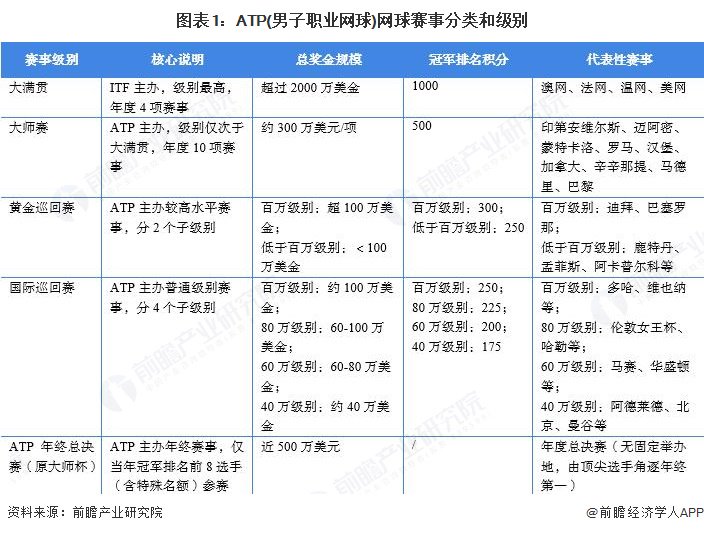
Industry Overview - Tennis is a sport typically played between two players or two pairs, aiming to hit a ball over a net using rackets, with the goal of making it difficult for opponents to return the ball [1] - The tennis events are categorized into ATP (men's professional tennis) and WTA (women's tennis), with ATP being the Association of Tennis Professionals and WTA being the Women's Tennis Association [1] Prize Money and Rankings - Grand Slam events, the highest level of tournaments, have a total prize pool exceeding $20 million, awarding 1000 ranking points [2] - ATP Masters events, the second highest level, offer around $3 million per event and 500 ranking points [2] - WTA events also have a similar structure, with Grand Slams offering approximately $3 million and various levels of tournaments providing different prize amounts and ranking points [3] Industry Chain Structure - The tennis industry chain consists of three main segments: upstream (equipment supply and venue construction), midstream (tennis services), and downstream (consumer spending) [5][7] - Upstream focuses on equipment suppliers, including brands like YONEX and DUNLOP, while midstream includes tennis clubs and training services [7] - Downstream encompasses ticket sales, equipment purchases, venue rentals, and media dissemination [5] Market Growth - The Chinese tennis market is experiencing rapid growth, with a market size of 37 billion yuan in 2024, reflecting a 14.4% increase from the previous year [18] - The market is expected to continue expanding, with projections indicating it could exceed 65 billion yuan by 2030, driven by increased participation and interest in the sport [27] Competitive Landscape - The tennis industry is concentrated in economically developed regions, particularly Guangdong and Beijing, which host a significant number of enterprises across the industry chain [18][22] - Guangdong is identified as a core area for production, while other provinces like Jiangsu and Zhejiang also have notable industry presence [22] Policy and Development Trends - Recent policies have shifted from focusing solely on competitive performance to supporting the entire industry chain, promoting infrastructure, event ecosystems, and talent development [11][13] - The industry is moving towards a more diversified participation model, aiming to attract various demographics through community programs and partnerships [23] - The government is actively encouraging the development of tennis through various initiatives, enhancing the sport's accessibility and integration into broader economic activities [13][16]


2025年度消费榜单:从指数看趋势,解码消费新浪潮
值得买科技· 2026-01-31 09:39
Investment Rating - The report does not explicitly state an investment rating for the industry Core Insights - The report highlights the dual focus of consumer behavior on "rational health" and "emotional satisfaction" in the food and beverage sector, indicating a shift towards higher demands for nutritional value and product traceability while also catering to emotional needs through enjoyable and affordable snacks [40][54] - The rise of "active health" consumption among the elderly demographic is driving growth in categories such as smart monitoring devices and high-purity nutritional products, with brands like 诺特兰德 and 鱼跃 leading the way [46] - The integration of AI and innovative product forms is creating significant brand differentiation in the 3C digital sector, with companies like Apple and Huawei establishing strong market positions through advanced technology [19][21] Summary by Sections Annual Data Overview - The report provides a comprehensive overview of consumer trends across 12 key industries, including 3C digital, food and fresh produce, home appliances, and more [11][10] Key Industry Observations - **Food and Fresh Produce**: The sector is characterized by a focus on essential goods like grains and fresh foods, with brands like 伊利 and 蒙牛 emphasizing transparency and nutritional value [15][40] - **3C Digital**: Brands are leveraging AI and innovative designs to create competitive advantages, with Apple and Huawei leading the brand rankings [19][21] - **Home Appliances**: The industry is moving towards smart home solutions, with brands like 海尔 and 美的 focusing on health and technology integration [28][29] - **Sports and Outdoor**: Domestic brands like 安踏 and 李宁 are capitalizing on the outdoor trend, merging functionality with aesthetic appeal [22][24] - **Beauty and Personal Care**: The sector is shifting towards efficacy-driven products, with brands like 雅诗兰黛 and 珀莱雅 focusing on scientific formulations [31][33] - **Pet Products**: The market is evolving towards premium offerings, with brands like 麦富迪 and 蓝氏 focusing on high-quality ingredients and innovative products [25][26] - **Automotive**: The industry is experiencing a transition towards electric and smart vehicles, with brands like 比亚迪 and 丰田 leading the charge [37][39] - **Healthcare**: The focus is on proactive health solutions for the elderly, with brands like 诺特兰德 and 鱼跃 providing comprehensive health management products [46][48] Annual Hot Categories - The report identifies key hot categories for the year, including grains and seasonings, mobile communications, and home appliances, with respective heat index scores indicating consumer interest [17][15] Brand Rankings - The report lists top brands across various categories, highlighting their annual heat index scores, which reflect consumer engagement and popularity [18][21][24][33][35][39][41][48] Consumer Trends - The report outlines emerging consumer trends such as the "atmosphere economy," where consumers seek to create immersive experiences through their purchases, and the shift towards outdoor lifestyles as a form of identity expression [68][71]





福建「豪门」,打响继承之战
3 6 Ke· 2026-01-31 09:22
Core Insights - The article discusses the generational transition in family-owned businesses in Fujian, China, highlighting the challenges faced by the second generation as they take over leadership roles in a competitive and changing market environment [3][4][5]. Group 1: Leadership Transition - Xu Shihui, the founder of Dali Food Group, has retired, passing the presidency to his daughter Xu Yangyang, marking a significant leadership change in the company known for brands like "Dali Garden" and "Kebike" [3][4]. - Similarly, Cao Dewang, founder of Fuyao Group, has stepped down as chairman, with his son Cao Hui taking over, indicating a broader trend of leadership transitions among Fujian entrepreneurs [3][4]. - Other notable transitions include Xu Lianjie of Hengan Group handing over to his son Xu Qingliu, and Fu Guangming of Shennong Group passing control to his daughter Fu Fenfang [4]. Group 2: Challenges of Succession - The second generation faces intense pressure to meet the expectations set by their predecessors, often leading to comparisons in capability and performance [4][12]. - The decision to take over leadership roles is fraught with internal conflict, as many heirs express reluctance to step into their parents' shoes, preferring to pursue their own entrepreneurial paths [5][12]. - The article highlights the contrasting experiences of successors, with some like Cao Hui initially resisting the idea of taking over, while others like Xu Yangyang have been groomed for leadership from a young age [8][12]. Group 3: Market Dynamics and Performance - Dali Group's revenue peaked at 22.294 billion yuan in 2021 but has since declined, with 2023 revenue reported at 18.86 billion yuan, presenting a significant challenge for Xu Yangyang as she takes over [17][19]. - Hengan Group's Xu Qingliu aims to double the paper product business revenue target to 30 billion yuan, facing challenges such as raw material price fluctuations and industry competition [22]. - Fuyao Group, under Cao Hui's leadership, reported a revenue of 21.45 billion yuan in the first half of 2025, with a net profit exceeding 4.8 billion yuan, indicating a strong market position but also the need for continued innovation and growth [22]. Group 4: Cultural and Strategic Considerations - The article emphasizes the traditional approach of bloodline succession in Fujian businesses, where the eldest son is often seen as the most suitable successor [5][12]. - The concept of family alliances through marriage is highlighted as a strategy to strengthen business ties among Fujian entrepreneurs, reflecting a long-standing cultural practice [25][26]. - The establishment of family offices by Fujian businesses is noted as a modern approach to managing wealth and addressing succession issues, allowing for better risk management and strategic collaboration [26][28].


福建「豪门」,打响继承之战
36氪· 2026-01-31 09:08
Core Viewpoint - The article discusses the generational transition in family businesses among Fujian entrepreneurs, highlighting the challenges faced by the second generation as they take over leadership roles in a competitive and changing market environment [5][6][7]. Group 1: Leadership Transition - Xu Shihui, founder of Dali Food Group, has retired, passing the presidency to his daughter Xu Yangyang, who has been groomed for this role over the years [6][7]. - Similarly, Cao Dewang, founder of Fuyao Group, has stepped down as chairman, handing over the reins to his son Cao Hui, who has been prepared for leadership through international experience [6][10]. - The trend of generational handover is becoming more common among Fujian private enterprises, with several second-generation leaders taking charge of their family businesses [7][8]. Group 2: Challenges of Succession - The second generation faces intense pressure to meet the expectations set by their predecessors, often leading to a struggle between personal ambition and familial duty [5][16]. - The article notes that many second-generation entrepreneurs are hesitant to take over, with some preferring to pursue their own ventures instead of stepping into established family businesses [8][10]. - The transition is often marked by conflicts, as seen in the case of Cao Hui, who initially resisted taking over Fuyao but eventually agreed under his father's insistence [10][11]. Group 3: Business Performance and Strategy - Dali Food's revenue peaked at 22.294 billion yuan in 2021 but has since declined, with 2023 revenue reported at 18.86 billion yuan, indicating significant challenges for Xu Yangyang as she takes over [22][24]. - Fuyao Group, under Cao Hui's leadership, reported a revenue of 21.45 billion yuan in the first half of 2025, showing a double-digit growth, but maintaining this growth will be a key challenge [27]. - The article highlights the strategic shifts required by the new leaders, such as Xu Yangyang's attempts to innovate Dali's product lines in response to changing consumer preferences [24][22]. Group 4: Cultural and Structural Dynamics - The article emphasizes the traditional approach of family succession in Fujian, where leadership is typically passed down to the eldest son, reflecting deep-rooted cultural practices [8][10]. - The concept of family alliances through marriage is also discussed, showcasing how Fujian entrepreneurs are forming strategic partnerships to strengthen their business networks [30][31]. - The establishment of family offices among Fujian businesses is noted as a modern strategy to manage wealth and address succession issues, indicating a blend of traditional and contemporary approaches to business continuity [32][34].


阿迪“弯腰”赞助苏超、耐克换帅:国际运动巨头在华战略悄然变阵
Hua Xia Shi Bao· 2026-01-30 13:17
Core Insights - Recent strategic adjustments by international sports brands, particularly Nike and Adidas, highlight a fundamental shift in their market position in China, facing increasing competition from local brands and other international players [2][6] - Adidas has announced a partnership with the Jiangsu Province City Football League for 2026, marking a significant move to sponsor a provincial event, which is seen as a re-evaluation of regional sports IP value [3][4] - Both companies are adopting defensive strategies to maintain their market share amid declining performance and increased competition [6][9] Adidas Sponsorship of Jiangsu Super League - Adidas will provide financial support and custom gear for 13 participating teams in the Jiangsu Super League, with a reported investment of 21 million yuan (approximately 3 million USD) [3] - The league has gained significant popularity, with over 2.43 million attendees and 2.2 billion online views during its inaugural season, establishing itself as a major provincial sports event [3][4] Market Performance and Competition - Nike's revenue in Greater China has declined from 8.29 billion USD in FY2021 to 6.586 billion USD in FY2025, indicating ongoing performance challenges [6] - Adidas experienced a significant drop in net sales from 4.597 billion USD in 2021 to 3.179 billion USD in 2022, with slow recovery in subsequent years [6] - Market share for Nike decreased from 18.1% in 2021 to 15.1% in 2024, while Adidas fell from 15% to 9.3% in the same period, contrasting with local brand Anta's rise from 9.8% to 10.7% [7] Strategic Responses - Nike has appointed Cathy Sparks as the new General Manager for Greater China, aiming to revitalize its operations in the region [5] - Adidas emphasizes the integration of global strategy with local insights through its partnership with the Jiangsu Super League, aiming to strengthen its brand connection with Chinese consumers [4][8] - The acquisition of Puma shares by Anta is seen as a potential threat to Nike and Adidas, prompting their recent strategic moves to enhance local engagement [8][9]


豪掷123亿,安踏拿下彪马近三成股权,全球化战略落关键一子?
Xi Niu Cai Jing· 2026-01-30 08:55
Group 1 - The core point of the article is that Anta Sports, China's largest sportswear group, is acquiring a 29.06% stake in the global sports brand Puma for approximately €1.5 billion (around ¥12.3 billion) [2] Group 2 - Anta Sports' Chairman, Ding Shizhong, expressed confidence in Puma's long-term value, believing that Puma's strong brand assets and global influence are not fully reflected in its stock price [3] - The acquisition is seen as a strategic move to support Puma's revival, leveraging Anta's strengths in the Chinese market where Puma has underperformed [3] - Anta's investment aligns with its global "three-step" strategy, marking a significant step in operating global brands, following its successful management of Fila and the acquisition of Amer Sports [3] Group 3 - Market analysts view the transaction as mutually beneficial, with Puma gaining funding and market resources while maintaining operational autonomy, and Anta enhancing its global presence with a well-known brand [4]

安踏体育:拟收购Puma29%股权,完善全球化版图-20260130
Zhong Guo Yin He Zheng Quan· 2026-01-30 07:45
Investment Rating - The report maintains a "Buy" rating for Anta Sports (stock code: 2020.HK) [6][35]. Core Insights - Anta Sports plans to acquire a 29.06% stake in PUMA SE for €1.5 billion, which will make it the largest single shareholder of PUMA. This acquisition is aimed at enhancing its global footprint and brand matrix, following previous acquisitions of Amer Sports and Jack Wolfskin [6][8]. - The acquisition is expected to strengthen Anta's position in the mid-to-high-end professional sports sector and create new growth opportunities through global resource integration and synergy effects [6][8]. - PUMA is currently undergoing a strategic reset, which has led to a decline in its revenue and profits. The company reported a revenue of €5.974 billion in the first three quarters of 2025, down 8.5% year-on-year, and a net loss of €308 million [9][6]. - The report highlights that PUMA's footwear segment remains resilient, contributing approximately 53.7% of its revenue, and is expected to drive future growth despite current challenges [17][9]. Financial Projections - Anta Sports' projected total revenue for 2024 is ¥70.826 billion, with a growth rate of 13.58%. The net profit is expected to be ¥15.596 billion, reflecting a profit growth rate of 52.36% [2][36]. - The earnings per share (EPS) forecast for 2025 is adjusted to ¥4.66, with a corresponding price-to-earnings (PE) ratio of 15 [36][35]. - The report anticipates a gradual recovery in PUMA's performance post-acquisition, with long-term benefits expected from the integration of PUMA into Anta's operations [35][34].
盘点丨2025运动服饰本土化与场景延伸双重竞速
Xin Lang Cai Jing· 2026-01-30 06:12
Core Insights - The sports fashion apparel industry in 2025 is undergoing significant transformation, with opportunities and risks intertwined, as international giants seek new growth points while local brands innovate and niche players achieve breakthroughs [2][29] Event Summaries Event 1: Li Ning Sponsors the Chinese Olympic Committee - In May 2025, Li Ning became the sports apparel partner for the Chinese Olympic Committee for 2025-2028, enhancing brand value [18] - The brand launched the "Milan Shining" event in October, showcasing the Chinese sports delegation's award outfits and a new lifestyle series, reinforcing its cultural and technological integration [18][3] Event 2: Anta Group's Brand Matrix Growth - Anta achieved low double-digit growth in retail sales, stabilizing total revenue at 70 billion, with a notable performance in the fourth quarter despite market pressures [19] - The main brand saw low single-digit growth, while FILA and other brands like Descente experienced higher growth rates, indicating a diversified brand strategy [19][4] Event 3: Controversy Surrounding 361° Brand Image - In September 2025, 361° terminated its endorsement with Zhang Shuihua due to a scandal, which negatively impacted the brand's image and performance [20] - Despite maintaining growth, 361° faced its lowest growth rates in five years, highlighting systemic flaws in brand endorsement risk management [20][5] Event 4: Lululemon's Growth in China - Lululemon's comparable sales in China surged by 25% in Q3 2025, becoming a key growth driver despite previous downward adjustments in performance guidance [21][22] - The brand's strategic focus on core athletic categories and product line optimization contributed to its success in the Chinese market [21][22] Event 5: Xtep's Strong Profit Growth - Xtep reported a revenue of 6.838 billion yuan in the first half of 2025, with a 7.1% year-on-year increase, and a net profit of 914 million yuan, reflecting strong profitability [22] - The brand's focus on marathon sponsorships and product innovation has solidified its position in the professional running segment [22][6] Event 6: Nike's Return to Innovation - Facing declining profits, Nike restructured its innovation teams to focus on athlete-centered product development, unveiling several new technologies in 2025 [23] - This strategic shift aims to enhance product performance and address market demands for innovation [23][9] Event 7: Puma's Crisis Due to Tariffs and Performance Decline - Puma faced a 10.4% decline in global sales and significant losses due to increased production costs from tariffs, leading to layoffs and a drop in stock price [24] - The company's strategic missteps in supply chain management have exacerbated its challenges in a competitive market [24][10] Event 8: Clarks' Channel Transformation Failure - Clarks experienced a 10% revenue decline in the UK due to over-reliance on physical stores and a lack of digital strategy, resulting in significant layoffs [25] - The brand's failure to adapt to changing consumer habits highlights the necessity for channel transformation in the retail sector [25][11] Event 9: Under Armour's Struggles with Growth - Under Armour's brand image suffered as it faced challenges from previous expansion efforts, leading to high inventory turnover and financial losses [26] - The company's restructuring efforts focus on core business areas but have yet to yield positive results [26][12] Event 10: HOKA's Growth Slowdown - HOKA's growth rate significantly decreased, with a mere 11.1% increase in net sales for Q2 2026, prompting concerns about its long-term sustainability [27] - The brand's reliance on high growth without establishing strong technical barriers has led to vulnerabilities in a competitive landscape [27][13] Event 11: IPO Aspirations of BERSHKA and Tamboor - BERSHKA filed for an IPO aiming to become a leading player in high-performance outdoor apparel, while Tamboor also submitted documents for public listing [28] - These moves reflect the growing trend of local brands capitalizing on market opportunities in the outdoor segment [28][14] Conclusion - The sports fashion apparel industry in 2025 has undergone a profound value reconstruction, with brands like Lululemon and Nike achieving breakthroughs through precise positioning and local adaptation [29] - The shift from scale expansion to quality growth emphasizes the importance of innovation and risk management for sustained success in the evolving market landscape [29]
国信证券:运动品牌行业增长难掩价格战隐忧 关注价格内卷中引领新方向的品牌机遇
智通财经网· 2026-01-30 03:33
Core Insights - The sports brand industry is experiencing a duality, with a strong growth in overall market demand but intense price competition, leading to a critical point in the product lifecycle [1][2] Industry Overview - The sports and outdoor market continues to grow, with apparel showing a clear "volume and price increase" trend driven by high-priced brands, while footwear is experiencing a "volume increase and price drop" trend [2][3] - In Q4 2025, the overall sports category saw a slight price increase of 0.9% but a sales volume decline of 1.7%, with outdoor products achieving a sales growth of 13.5% [3] International Brands - Nike is undergoing significant adjustments, with a 15.5% year-on-year sales decline and a market share drop to 9.7%, while Adidas also saw a 6.2% sales decline but maintained a market share of 8.5% [4] - Adidas' basketball shoes and casual shoes are experiencing growth despite overall declines in other categories [4] Domestic Brands - Domestic brands are facing substantial price competition, with a slight decline in market share across four major brands, while professional products are receiving positive market feedback [5] - The pricing strategy of domestic brands has led to only marginal sales increases, particularly in footwear [5] Key Takeaways - The industry shows strong growth potential, with a stable penetration rate in the sports and outdoor sector, while price competition intensifies [6] - Nike is under pressure with ongoing product adjustments, while Adidas stabilizes its market share with specific product growth [6] - Domestic brands are leveraging professional product lines to maintain market presence amidst increasing price competition [6]
