GAC GROUP(02238)

Search documents
华为与车企合作造车新故事:“两境”在磨合中前进
第一财经· 2025-11-21 10:21
Core Viewpoint - Huawei's automotive business unit (BU) is gaining attention at the 2025 Guangzhou Auto Show, particularly through its collaboration with Dongfeng Motor Group and GAC Group to create the "Two Realms" - Yijing and Qijing, which signifies a new cooperative model in the automotive industry [3][4]. Group 1: Collaboration Dynamics - The collaboration between Huawei and traditional automakers is characterized by intense discussions and disagreements, which are seen as a natural part of the process aimed at improving product quality [4][5]. - Both teams involved in the "Two Realms" project often engage in heated debates over product details, but these conflicts ultimately strengthen their partnership [4][6]. Group 2: Strategic Importance - The partnership with Huawei is crucial for traditional automakers as it represents a significant step towards their transformation into electric, intelligent, and high-end vehicles [4][5]. - Executives from both Dongfeng and GAC have prioritized the Qijing project, indicating its critical importance to their strategic goals [4][6]. Group 3: Collaboration Model - The collaboration encompasses the entire product lifecycle, from initial project discussions to marketing and ecosystem services, promoting a new integration of smart technology and brand synergy [5][6]. - Huawei is integrating its processes and methodologies, such as IPD and IPMS, into the automakers' existing frameworks to foster deep collaboration [5][6]. - Project teams from Huawei are embedded within the automakers, facilitating real-time adjustments to product planning and development [5][6]. Group 4: Market Strategy - Both Yijing and Qijing will establish independent sales channels, diverging from traditional automotive sales methods, with Qijing already initiating a nationwide dealer recruitment process [6][7]. - The first models from Yijing are set to debut at the 2026 Beijing Auto Show, while Qijing plans to launch two models next year, both equipped with Huawei's L3 autonomous driving system [7][8]. Group 5: Competitive Landscape - The automotive market is becoming increasingly competitive, and both Yijing and Qijing must differentiate themselves to avoid homogenization [7][8]. - There is ongoing speculation about the similarities and differences between Huawei's "Two Realms" and its "Five Realms" strategy, indicating a competitive yet collaborative environment within Huawei's automotive initiatives [7][8].



华为与车企合作造车新故事:“两境”在磨合中前进
Di Yi Cai Jing Zi Xun· 2025-11-21 09:36
Core Viewpoint - Huawei's automotive business unit (BU) has become a focal point at the 2025 Guangzhou Auto Show, particularly with its collaboration with Dongfeng Motor Group and GAC Group to create the "Two Realms" - Yijing and Qijing [1] Group 1: Collaboration Dynamics - The collaboration between Huawei and traditional automakers is marked by intense discussions and disagreements, which are seen as a natural part of the integration process [1][2] - Both teams often engage in heated debates over product details, but these disputes are aimed at enhancing product quality [1] - Huawei's CEO of Intelligent Automotive Solutions emphasized the importance of collaboration by suggesting that teams should take breaks to regroup and identify each other's strengths [1] Group 2: Strategic Importance - The partnership is crucial for traditional automakers as it represents a significant step towards electrification, intelligence, and premium transformation [1] - GAC Group's chairman highlighted the strategic importance of the Qijing project, stating it will be prioritized with concentrated resources for long-term development [1] Group 3: Collaboration Model - The collaboration model includes four key aspects: 1. Comprehensive cooperation throughout the product lifecycle, from initial project stages to marketing and ecosystem services [2] 2. Integration of Huawei's processes and methodologies with those of the automakers for deep collaboration [2] 3. Joint project teams with Huawei personnel embedded within the automakers to facilitate real-time adjustments [2] 4. Establishment of independent sales channels for both Yijing and Qijing, diverging from traditional and Huawei's existing channels [3] Group 4: Market Positioning and Product Plans - Yijing aims to create a diverse product matrix targeting various market segments, with its first model set to debut at the 2026 Beijing Auto Show [4] - Qijing plans to launch two models next year, both equipped with Huawei's L3 autonomous driving system, with the first model expected to be delivered by June [4] - The competition in the automotive market is intensifying, and both brands must differentiate themselves to avoid homogenization [4] Group 5: Competitive Landscape - There is ongoing market speculation regarding the similarities and differences between Huawei's "Two Realms" and "Five Realms" models, indicating a competitive dynamic within Huawei's automotive strategy [4]
首次设立“科技广汽”展区,广汽集团携全品牌亮相2025广州国际车展
Bei Jing Shang Bao· 2025-11-21 08:41
Core Viewpoint - The Guangzhou International Auto Show 2025 showcased GAC Group's reform achievements from the "Panyu Action" initiative and introduced four value-creating engines: "new technology, new products, new services, and new ecology" [1] Group 1: Company Developments - GAC Group presented multiple latest smart technology models across all its brands at the auto show [1] - The company established a new exhibition area called "Technology GAC" to explore future mobility possibilities for users [1] Group 2: Service Expansion - GAC plans to add 600 brand experience stores, aiming to cover over 90% of county-level markets nationwide [1] - The company has initiated the first batch of 100 city招商布局 (investment layout) and received inquiries from over a thousand potential partners [1] Group 3: Technological Advancements - GAC has been actively promoting OTA (Over-The-Air) upgrades, completing 45 OTA updates this year alone [1] - The updates have added and optimized over 300 features and experiences, impacting nearly 1.5 million vehicle owners across more than 16 models [1]
汽车股尾盘跌幅扩大 部分新势力业绩不如预期 明年新能源汽车购置税重新征收
Zhi Tong Cai Jing· 2025-11-21 07:20
Core Viewpoint - The automotive sector is experiencing a decline in stock prices, particularly among new energy vehicle manufacturers, following the release of disappointing third-quarter financial results. Analysts predict a shift in the industry landscape due to upcoming policy changes and market dynamics [1]. Group 1: Stock Performance - Xpeng Motors (09868) saw a decline of 4.34%, closing at 78.3 HKD [1] - Great Wall Motors (601633) dropped by 4.05%, ending at 14.47 HKD [1] - GAC Group (601238) fell by 2.76%, with a closing price of 3.17 HKD [1] - Li Auto (02015) decreased by 1.78%, closing at 68.8 HKD [1] Group 2: Financial Results and Market Expectations - The disappointing financial data from some new energy vehicle companies has triggered significant stock declines [1] - Despite the downturn, the fourth quarter is expected to maintain high growth in the new energy vehicle sector, although traditional fuel vehicles may regain some market share by 2026 due to the reintroduction of purchase taxes [1] Group 3: Analyst Insights - Analysts, including Guotai Junan's strategist Wu Lixian, anticipate a divergence in the automotive industry, suggesting that investors should focus on companies with strong growth momentum [1] - The expected 5% purchase tax in the coming year poses challenges for automotive companies but may also serve as a filtering mechanism, allowing more competitive firms to emerge [1] - Long-term impacts of policy changes may not necessarily be negative for leading companies in the sector [1]


港股异动 | 汽车股尾盘跌幅扩大 部分新势力业绩不如预期 明年新能源汽车购置税重新征收
智通财经网· 2025-11-21 07:16
Core Viewpoint - The automotive sector is experiencing a decline in stock prices, particularly for companies like Xpeng Motors, Great Wall Motors, GAC Group, and Li Auto, following the release of third-quarter earnings that did not meet expectations [1] Group 1: Stock Performance - Xpeng Motors-W (09868) fell by 4.34% to HKD 78.3 - Great Wall Motors (02333) decreased by 4.05% to HKD 14.47 - GAC Group (02238) dropped by 2.76% to HKD 3.17 - Li Auto-W (02015) declined by 1.78% to HKD 68.8 [1] Group 2: Market Outlook - Analysts suggest that the financial data of some new energy vehicle companies fell short of expectations, leading to significant stock declines [1] - The fourth quarter is expected to maintain high growth in the new energy vehicle sector, despite ongoing price reductions [1] - The reintroduction of the new energy vehicle purchase tax in 2026 may alter the competitive landscape, potentially allowing traditional fuel vehicles to regain market share [1] Group 3: Investment Strategy - According to Everbright Securities' strategist, the automotive industry will see a divergence, with a focus on companies showing strong growth momentum [1] - The anticipated 5% purchase tax in the coming year poses challenges for automotive companies but may also serve as a filtering mechanism, benefiting more competitive firms [1] - Long-term impacts of policy changes may not necessarily be negative for leading companies in the sector [1]
“启境”品牌横空出世 华为乾崑赋能打造华系年轻品智旗舰
Zheng Quan Ri Bao Wang· 2025-11-21 05:58
Core Insights - Huawei's new high-end smart electric vehicle brand, "Qijing," was officially launched at the Huawei QianKun Ecological Conference, marking a significant step in Huawei's strategic layout in the smart automotive sector [1] - The collaboration between Huawei and GAC Group aims to create a "Dream Car" that integrates dynamic performance, intelligence, safety, and driving pleasure, targeting young users [1][2] - The partnership emphasizes deep integration and co-creation, moving beyond traditional hardware approaches to an ecosystem of collaborative innovation [2] Group 1: Strategic Collaboration - Huawei and GAC Group signed a deepening cooperation agreement on November 30, 2024, initiating the joint creation of the high-end smart automotive brand [1] - The collaboration is characterized by a "shared office, synchronized decision-making" approach, fostering a tightly-knit cooperative mechanism [1][2] - The partnership aims to leverage Huawei's full-stack intelligent technologies and design resources to enhance the Qijing brand [2] Group 2: Product Philosophy and Safety - Qijing's product philosophy focuses on achieving excellence across multiple dimensions, including design, safety, intelligence, control, range, and space [2] - Safety is prioritized in the product development process, with a commitment to rigorous standards and extensive testing [3] - The battery safety measures include 144 safety-related design elements and 86 battery DV testing standards, exceeding new national standards [3] Group 3: Technological Innovations - Qijing vehicles will feature Huawei's digital chassis engine, integrating control across power, braking, body, and chassis systems [3] - The brand will implement Huawei's comprehensive smart solutions, including L3-level autonomous driving capabilities from the outset [4] - A full-chain development system will be established, incorporating Huawei's integrated product development (IPD) framework to ensure alignment with market demands [4] Group 4: Future Plans - Qijing plans to launch two new models by 2026, with the first expected to be delivered in June 2024 [4] - All models will be equipped with Huawei's advanced QianKun smart automotive solutions, enhancing the intelligent driving experience for users [4]
广汽集团与麦格纳将在欧洲进行整车生产合作
Zheng Quan Shi Bao Wang· 2025-11-21 04:07
Core Viewpoint - GAC Group is expanding its localized production scale in Europe through a partnership with Magna, which is a significant step in accelerating its electrification strategy and enhancing its production, supply chain, and sales operations [1] Group 1 - GAC Group and Magna announced a collaboration for complete vehicle production in Europe [1] - This partnership aims to boost GAC Group's local production capabilities in the European market [1] - The electric SUV model AION V has commenced mass production at Magna's Graz plant [1]
Magna to produce China's GAC electric vehicles in Europe
Reuters· 2025-11-21 02:09
Core Viewpoint - Guangzhou Automobile Group (GAC) will manufacture its electric AION V model at a Magna facility in Austria to circumvent EU tariffs on China-made electric vehicles [1] Company Summary - GAC is strategically partnering with Magna to produce the AION V in Europe, which is expected to enhance its market position in the EU by avoiding tariffs [1] Industry Summary - The move reflects a broader trend in the electric vehicle industry where manufacturers are seeking local production to mitigate trade barriers and enhance competitiveness in international markets [1]

广汽集团(02238.HK):11月20日南向资金增持470.2万股
Sou Hu Cai Jing· 2025-11-20 19:25
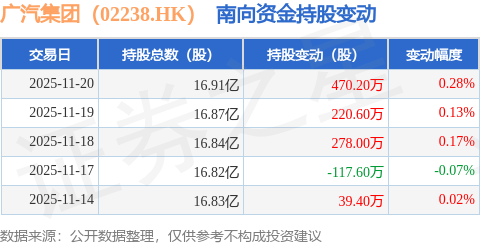
Core Viewpoint - Southbound funds have significantly increased their holdings in GAC Group, indicating strong investor interest and confidence in the company [1][2]. Group 1: Southbound Fund Activity - On November 20, southbound funds increased their holdings by 4.702 million shares of GAC Group (02238.HK) [1]. - Over the past five trading days, there were four days of net increases, totaling 8.906 million shares [1]. - In the last 20 trading days, there were 15 days of net increases, amounting to 54.2024 million shares [1]. - As of now, southbound funds hold 1.691 billion shares of GAC Group, representing 60.11% of the company's total issued ordinary shares [1]. Group 2: Company Overview - GAC Group is primarily engaged in the automotive and related businesses, including research and development, manufacturing of vehicles (cars and motorcycles), parts, trade, mobility, energy and ecology, internationalization, and financial investments [2]. - The company operates through two segments: the automotive and related trade segment, which includes the production and sale of various passenger and commercial vehicles, automotive parts, and related trade [2]. - The other segment mainly involves the production and sale of motorcycles, automotive financial insurance, other financial services, and investment activities [2].
华为 “五界”“两境”
Shang Hai Zheng Quan Bao· 2025-11-20 15:09
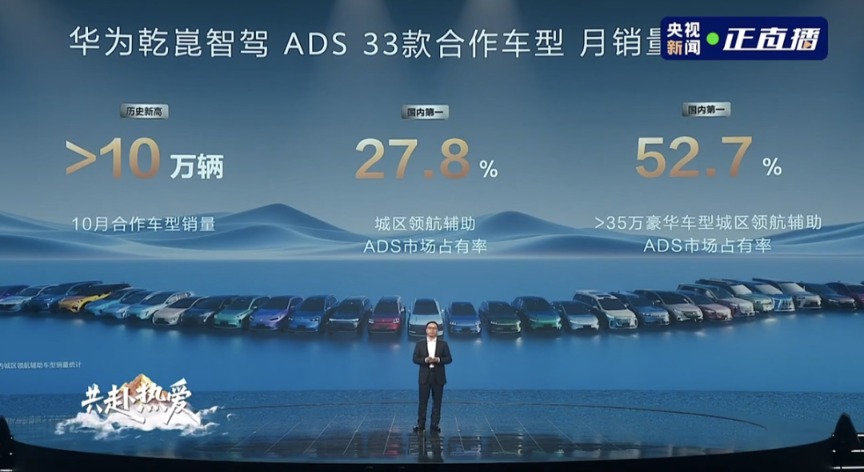
Core Insights - Huawei is building a robust smart connected vehicle ecosystem through its "QianKun" intelligent automotive solution, without manufacturing cars itself [1] - The "2025 Huawei QianKun Ecosystem Conference" showcased new brands like "Yijing" and "Qijing," alongside existing partnerships with brands such as Avita and Audi, enhancing Huawei's automotive ecosystem [1] - Huawei's QianKun intelligent driving solution has captured over 50% market share in the high-end segment priced above 350,000 yuan, with cumulative assisted driving mileage exceeding 5.8 billion kilometers [1][7] Market Performance - As of October, Huawei's QianKun intelligent driving system (ADS) has become the preferred choice for users, with key metrics leading the domestic market: 5.81 billion kilometers of assisted driving, 20 million instances of parking assistance, and a monthly active user rate of 95.2% [7] - The market share for urban navigation assistance (NCA) in the ADS segment reached 27.8%, surpassing the combined share of the second and third competitors, while the share in the luxury segment (over 350,000 yuan) stands at 52.7% [7] Product Development - Huawei's QianKun ADS Pro's urban navigation assistance feature will be available for models priced at 150,000 yuan and above starting in 2024, with over 20 new models expected to support this feature [8] - The new brand "Yijing," developed in collaboration with Dongfeng Motor, was officially announced at the conference, with the first model set to debut at the Beijing Auto Show in April 2024 [10][11] Strategic Partnerships - The partnership between Huawei and Dongfeng, which has lasted 15 years, aims to create a vehicle that exceeds user expectations and integrates seamlessly into daily life [10] - The "Qijing" brand, developed in collaboration with GAC Group, is positioned as a high-end smart electric vehicle brand, with two models expected to launch in 2026 [11]