
GIANT BIOGENE(02367)

Search documents
“胶原蛋白”之争:莫让科学探讨沦为无意义口水战
Xin Jing Bao· 2025-06-05 04:44
Core Viewpoint - The ongoing controversy surrounding the collagen product from Juzhibio's brand Kefu Mei highlights a significant conflict between two major players in the medical beauty industry, Juzhibio and Huaxi Biological, which may represent a deeper technical rivalry between recombinant collagen and hyaluronic acid [1][2]. Group 1: Company Actions and Responses - Juzhibio confirmed that its Kefu Mei Human-like recombinant collagen essence contains more than 0.1% recombinant collagen, countering claims made by beauty blogger "Big Mouth Doctor" that the actual content was only 0.0177% [1]. - Following the allegations, Huaxi Biological publicly supported the claims made by the beauty blogger, escalating the conflict between the two companies [1]. - The dispute has led to a series of emotional exchanges between the companies, with accusations of malicious competition and misinformation being exchanged [2]. Group 2: Consumer Concerns and Industry Implications - Consumers are primarily concerned about the quality and compliance of the medical beauty products rather than the corporate disputes, indicating a need for clarity and assurance regarding product safety [2]. - The controversy has overshadowed scientific standards, with conflicting reports and a lack of consensus on the testing methods used, leading to confusion among consumers [2][3]. - The ongoing conflict reflects deeper issues within the medical beauty industry, such as unclear product standards and marketing boundaries, which have allowed for such disputes to arise [3]. Group 3: Regulatory and Industry Response - The situation calls for neutral arbitration from regulatory bodies to investigate the claims and provide credible testing reports to resolve the dispute and restore consumer trust [2]. - The market regulatory authorities have issued guidelines to strengthen oversight of the medical beauty industry, aiming to address long-standing issues such as false advertising and lack of transparency [3]. - This public incident could serve as an opportunity for the industry to establish clearer standards and regulations, ultimately benefiting both the sector and consumers [3].

历时12天巨子生物披露检测结果,检测结果无盖章、无签名疑点重重
Sou Hu Cai Jing· 2025-06-05 02:18
Group 1 - The core viewpoint of the article is that Juzhi Biotechnology has disclosed the testing results of its recombinant collagen products, which have raised questions regarding the credibility and transparency of the results [2][3]. - Juzhi Biotechnology commissioned four testing institutions (A, B, C, D) to conduct qualitative and quantitative tests on multiple batches of its products, but did not disclose the names of these institutions [2]. - Testing results from institutions A, B, and C confirmed the presence of recombinant collagen in the product with a content greater than 0.1%, while institution D verified that sodium polyglutamate did not interfere with the detection results [2]. Group 2 - The testing results provided by Juzhi Biotechnology were only partial screenshots and lacked the names, stamps, or signatures of the testing institutions, raising doubts about the validity of the reports [3][4]. - The response from Dazui Doctor Yan Research Institute indicated skepticism towards Juzhi Biotechnology's disclosure, highlighting concerns about the lack of transparency in the testing process [5]. - Following the announcement, Juzhi Biotechnology's stock price fell by 1.8%, closing at 65.45 HKD per share, indicating market skepticism regarding the company's claims [5].

“大嘴博士”郝宇发文质疑巨子生物最新检测报告:为什么没有检测机构的名字和盖章?
Xin Lang Ke Ji· 2025-06-05 01:31
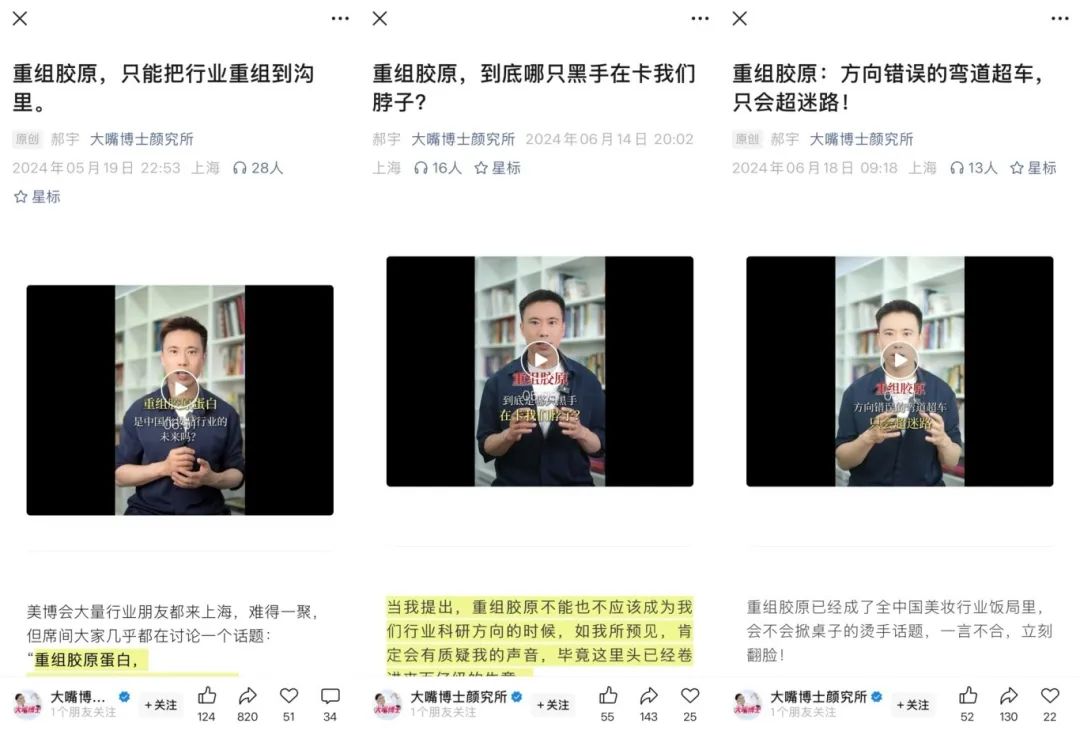
Core Viewpoint - The controversy surrounding the collagen products of Juzhi Biotechnology has intensified, with beauty blogger "Dr. Big Mouth" questioning the validity of the company's testing reports and the lack of transparency regarding the testing institutions involved [1][2]. Group 1: Company Response - Juzhi Biotechnology claims that multiple authoritative testing institutions have confirmed the presence of recombinant collagen in their products, specifically in the "Human-like Recombinant Collagen Essence" [1]. - The company asserts that the collagen content is greater than 0.1% and that the product has been sold out across various channels, countering claims of a "quiet removal" from the market [1]. Group 2: Critic's Concerns - The critic highlights four main doubts regarding the testing reports: 1. The use of different testing methods raises questions about the accuracy and consistency of results, particularly why a less precise method was used instead of a high-precision mass spectrometry method [2]. 2. The claim of 100% homology with human collagen is disputed, as the critic points out that the company's own patent indicates only 86% homology when using standard comparison methods [2]. 3. The absence of blank controls in the double biuret method testing is questioned, as it is unclear how the base components of the formula affect the results [2]. 4. The lack of names and seals from the testing institutions on the reports is criticized, suggesting that the reports lack credibility and transparency [2].
财经早报:523亿元!全国总价新地王诞生 多家A股公司筹划控制权变更
Xin Lang Zheng Quan· 2025-06-05 00:18
Group 1 - The Federal Reserve's Beige Book indicates a pessimistic economic outlook, with slight declines in economic activity reported across six Federal Reserve districts, while three districts remained stable and three showed slight growth [2] - Manufacturing activity has weakened, and consumer spending is inconsistent, with some businesses increasing purchases in anticipation of tariffs [2] - The residential real estate market is stable, but new housing starts and construction activities are stagnating or slowing in most regions [2] Group 2 - The trust industry in China is experiencing rapid growth, with total trust assets nearing 30 trillion yuan by the end of 2024, a year-on-year increase of over 20% [3] - Securities-related trusts are the main driver of this growth, with over 10 trillion yuan allocated to the securities market, accounting for nearly 50% of total trust assets [3] - Industry experts believe that under regulatory guidance, trust companies are actively transforming and enhancing their management capabilities, leading to more long-term capital entering the securities market [3] Group 3 - The number of global millionaires reached a new high of 23.4 million in 2024, a 2.6% increase from the previous year, driven by the growth of "super-rich" individuals with at least 30 million dollars [4] - These wealthy individuals are increasingly interested in alternative investments, allocating an average of 15% of their portfolios to private equity, cryptocurrencies, and other assets [4] Group 4 - The National Energy Administration of China has initiated pilot projects for the construction of a new power system, focusing on various technological and operational innovations [5][6] - The aim is to explore new technologies and models for power system construction, promoting breakthroughs in the sector [5][6] Group 5 - The trust theme ETFs have seen significant inflows, with some funds experiencing nearly a fourfold increase in scale due to the suspension of trading for certain stocks [7] - This surge in interest is attributed to investors seeking alternatives amid the suspension of stocks related to a merger and acquisition event [7] Group 6 - A new land price record was set in Shanghai, with a total transaction price of 52.3 billion yuan for a redevelopment project, marking the highest total price for land in the country [8] - Shanghai Real Estate Group has acquired 13 plots of land this year, totaling 80.48 billion yuan, establishing itself as the largest landowner in Shanghai [8] Group 7 - A wave of control changes is occurring among A-share listed companies, with multiple firms announcing plans for control changes [9] Group 8 - The stock market is witnessing a "transformation bull" trend, driven by policies aimed at debt resolution, demand stimulation, and asset price stabilization [15] - The influx of new and long-term capital into the market is at a historical turning point, with key drivers being the decline in risk-free rates and a systemic reduction in risk perception [15]






郝宇再质疑:巨子生物的报告无检测机构名字和盖章,双缩脲法测试没测空白对照
Cai Jing Wang· 2025-06-05 00:07
Group 1 - The beauty blogger "Dr. Big Mouth" (Hao Yu) raised questions about the testing results released by Giant Bio, specifically regarding the choice of testing methods and the accuracy of the results [1] - Concerns were expressed about the discrepancy between the claimed 100% homology of recombinant collagen with human collagen and the actual 86% homology based on Giant Bio's own patent [1] - The blogger highlighted the lack of a blank control in the biuret test, which is crucial for accurately measuring the presence of recombinant collagen in the formulation [1] Group 2 - Recently, the international testing company SGS declined a testing request from the blogger's team, citing the controversial nature of the tests and a desire to avoid involvement [2] - The blogger criticized SGS for its decision to return the testing request, arguing that testing institutions should uphold social responsibility beyond profit motives [2] - In response to Giant Bio's statement about the availability of its products, the blogger encouraged legal entities to collect samples for future consumer protection efforts [2]
可复美重组胶原蛋白之争,公关带你吃最全的瓜
3 6 Ke· 2025-06-04 23:27
Core Viewpoint - The controversy surrounding the collagen products from Juzi Biotechnology has escalated into a public relations battle, primarily initiated by Dr. Hao Yu, a skincare influencer and former chemist, who accused the company of serious fraud regarding their recombinant collagen products [1][2][4]. Group 1: Key Players - Dr. Hao Yu, known as "Big Mouth Doctor," is a skincare influencer with millions of followers and a background in chemistry, having worked in cosmetic research for 19 years [2]. - Juzi Biotechnology is a biotech company specializing in the beauty industry, known for its recombinant collagen products, which have seen a significant market cap drop of over 100 billion, leaving it with a valuation of around 700 billion [2]. - Huaxi Biotechnology, a leading player in the A-share medical beauty sector, primarily focuses on hyaluronic acid products [3]. Group 2: Allegations and Responses - Dr. Hao Yu has accused Juzi Biotechnology of serious fraud, claiming that their recombinant collagen is undetectable, marking his second round of accusations [4][11]. - In response to the allegations, Juzi Biotechnology quickly issued a consumer notice denying all accusations of fraud and asserting that their products contain collagen levels above 0.1% [13][14]. - Juzi Biotechnology stated that they conducted multiple tests to confirm the collagen content and promised to release third-party testing results to alleviate consumer concerns [14]. Group 3: Testing Methods and Controversies - Dr. Hao Yu utilized High-Performance Liquid Chromatography (HPLC) for his testing, which he claims provides a more accurate measurement of collagen content compared to Juzi's methods [16][19]. - Juzi Biotechnology's testing method was revealed to be the Biuret test, which Dr. Hao Yu criticized for potentially yielding inflated results [32][36]. - The lack of standardized testing methods for recombinant collagen has been highlighted as a significant issue, leading to confusion and disputes over product efficacy [19][20]. Group 4: Market and Consumer Reactions - The public reaction has been mixed, with some consumers expressing outrage over potential deception, while others remain supportive of Juzi Biotechnology [45][48]. - The controversy coincided with a major shopping event, leading to increased consumer anxiety regarding the products [11]. - The involvement of various influencers and the emergence of coordinated online narratives have raised questions about the authenticity of public sentiment and potential manipulation [50][51]. Group 5: Regulatory and Industry Implications - The incident has drawn attention from regulatory bodies, with local market supervision authorities beginning to investigate the claims and counterclaims made by both parties [91]. - A high-profile seminar on testing methods for recombinant collagen was held, featuring prominent experts, indicating the industry's recognition of the need for clearer standards [57][60]. - The ongoing dispute may lead to broader discussions about product transparency and consumer protection within the beauty and biotech industries [84][92].
普京与特朗普通话超1小时,聚焦俄机场遭袭等问题;经济前景悲观!美联储最新报告;湖南通报溶洞整治进展;惊现医院枕套!亚朵酒店致歉丨每经早参
Mei Ri Jing Ji Xin Wen· 2025-06-04 22:04
Market Overview - US stock indices closed mixed, with the Dow Jones down 0.22%, Nasdaq up 0.32%, and S&P 500 up 0.01% [2] - Major tech stocks showed varied performance, with Meta rising over 3% and Tesla falling over 3% [2] - The Nasdaq Golden Dragon China Index rose 2.04%, with notable gains in Chinese stocks like NIO and Alibaba [2] European Market - Major European indices closed higher, with Germany's DAX up 0.7%, France's CAC40 up 0.58%, and the UK's FTSE 100 up 0.16% [3] Urban Renewal Support - The central government plans to allocate over 20 billion yuan to support urban renewal actions in 20 cities, including Beijing and Tianjin, to address infrastructure shortcomings [4] AI Industry Development - The Ministry of Industry and Information Technology is focusing on promoting the AI industry and its integration into new industrialization, emphasizing a collaborative approach to strategy and policy implementation [5] New Power System Initiatives - The National Energy Administration announced pilot projects for new power system construction, focusing on various innovative technologies and models [6] Autonomous Driving Standards - A proposal for a mandatory national standard on safety requirements for intelligent connected vehicle driving assistance systems is under consideration [7] Virtual Asset Derivatives in Hong Kong - The Hong Kong Securities and Futures Commission is considering introducing virtual asset derivatives trading for professional investors, aiming to enhance market product offerings [8] HPV Vaccine Approval - China's first nine-valent HPV vaccine has been approved for market release, breaking a long-standing foreign monopoly [9] Quantum Communication Breakthrough - A Chinese research team has successfully completed module-level verification of a star-ground quantum direct communication system, marking a significant advancement in quantum communication technology [10] Economic Outlook - The Federal Reserve's latest Beige Book indicates a slight decline in US economic activity, with rising policy uncertainty and inflationary pressures affecting businesses and consumers [11] Tesla Sales Decline - Tesla's sales in China for May fell by 15% year-on-year, amidst a broader increase in the new energy vehicle market [26]






可复美检测结果出炉:有胶原蛋白,“大嘴博士”再次质疑
Nan Fang Du Shi Bao· 2025-06-04 13:33
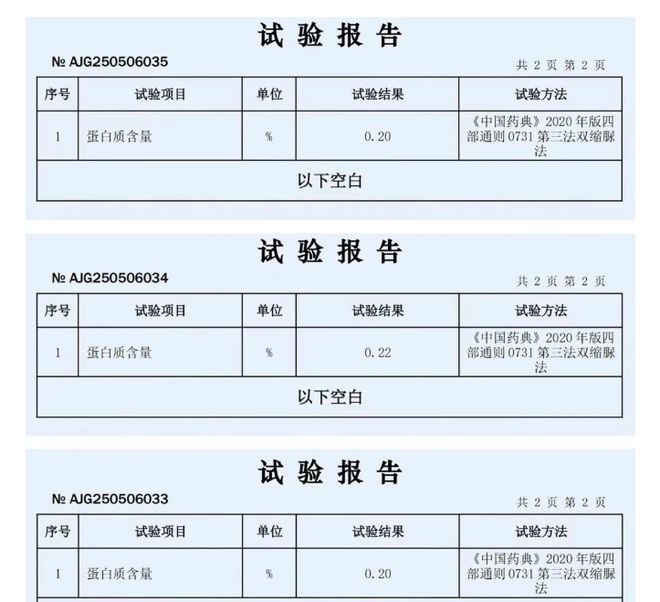
Core Viewpoint - The controversy surrounding the collagen content in the product "Kefumei" from Giant Biological has raised significant consumer and investor concerns, with ongoing debates about the accuracy of testing methods and results [1][10]. Group 1: Testing Results - Giant Biological confirmed that the "Kefumei Human-like Recombinant Collagen Essence" contains recombinant collagen, with content levels greater than 0.1% as per third-party testing [2][10]. - The testing utilized two methods: LC-MS/MS for qualitative analysis and the Biuret method for quantitative analysis, with results showing collagen content of 0.2%, 0.22%, and 0.2% across three batches [2][8]. - A subsequent test on one batch indicated a collagen content of 0.17%, confirming that the product meets the stated requirements [8][9]. Group 2: Consumer Concerns and Responses - The initial claim by beauty blogger "Big Mouth Doctor" suggested that the actual collagen content was only 0.0177%, leading to widespread skepticism about the product's integrity [10][11]. - Giant Biological emphasized that there is no misleading advertising and that the product has been properly tested, countering claims of "quietly delisting" the product due to sales issues [10][11]. - The company expressed concern over consumer anxiety caused by misinformation and reiterated its commitment to transparency and product integrity [10][11]. Group 3: Industry Reactions - Huaxi Biological publicly supported the claims made by "Big Mouth Doctor," indicating that they have conducted their own evaluations and testing of the product [11][14]. - Huaxi Biological criticized Giant Biological for alleged unethical marketing practices and indicated readiness to engage in a public discourse regarding product integrity [14][15].
巨子生物公布最新检测结果:相关产品胶原蛋白含量均大于0.1%,1.0版本因售罄陆续下架
2 1 Shi Ji Jing Ji Bao Dao· 2025-06-04 11:44
Core Viewpoint - The latest developments in the competition between Juzi Bio and Huaxi have emerged, focusing on the testing results of their collagen products and addressing concerns regarding product integrity and consumer misinformation [1]. Group 1: Testing Results - Juzi Bio announced the testing results for its products, confirming the presence of recombinant collagen in both the Human-like Recombinant Collagen Essence (Kefumei Collagen Stick 1.0) and the Recombinant Collagen Essence Liquid (Kefumei Collagen Stick 2.0) [2][3]. - For the Kefumei Collagen Stick 1.0, tests conducted at multiple institutions showed that the recombinant collagen content was greater than 0.1% [2]. - The company utilized LC-MS/MS for qualitative analysis and confirmed that the sodium polyglutamate used in the products did not interfere with the detection results [2][6]. Group 2: Product Integrity and Market Position - Juzi Bio emphasized that its products genuinely contain recombinant collagen and refuted claims of false advertising or misleading consumers [5]. - The Kefumei Collagen Stick 2.0 was launched on April 16, and the 1.0 version is being phased out due to stock depletion, countering rumors of a stealthy withdrawal from the market [5]. - The names of the testing institutions were not disclosed in the public report, with the company indicating that they are referenced as letters (A, B, C, D) for confidentiality [6].
可复美:不存在网传“虚假宣传、误导消费者”行为
news flash· 2025-06-04 11:42
Core Viewpoint - The company, Juzi Biotechnology, clarified that its product, Kefu Mei, contains genuine recombinant collagen and denied allegations of false advertising and misleading consumers [1] Group 1 - Juzi Biotechnology announced the testing results of its recombinant collagen products through Kefu Mei's Weibo account [1] - The company stated that since April 16, the Kefu Mei Collagen Stick 2.0 has been launched, while the previous version, Kefu Mei Collagen Stick 1.0, has been sold out and is being phased out [1] - There is no truth to the rumors regarding the "quiet removal" of the Kefu Mei products, as some channels still have inventory available for sale [1]