
GIANT BIOGENE(02367)

Search documents
缔造巨子生物“神话”,陕西首富发家史大揭秘
2 1 Shi Ji Jing Ji Bao Dao· 2025-06-04 00:31
Core Insights - The article discusses the rise of a family business empire valued at over 80 billion, founded by a couple who transitioned from academia to entrepreneurship, highlighting their journey and strategies in the collagen industry [1] Group 1: Company Background - Fan Daidi, born in 1966, became China's first female PhD in biochemical engineering and returned to Northwest University to lead research in human-derived collagen after visiting MIT in 2000 [2] - In 2000, her husband, Yan Jianya, left his stable job to start a business, establishing Xi'an Juzhi Biological Gene Technology Co., Ltd. in an 18-square-meter office, marking the beginning of their family business empire [2] Group 2: Business Development - The turning point for Juzhi Biological came in 2009 with the launch of their first commercial brand, Keli Jin, and the establishment of Xi'an Chuangke Village, which became a major distributor for the company [3] - The company adopted a tiered agency model, allowing individuals to become distributors for a fee, which significantly increased their customer base and sales [3] - From 2019 to 2021, Xi'an Chuangke Village contributed 52.2%, 49.3%, and 29.3% to Juzhi Biological's revenue, respectively, before the company shifted focus to online sales [3][4] Group 3: Revenue Growth and Market Position - By 2021, online direct sales accounted for 41.5% of total revenue, showcasing a significant shift in sales strategy [5] - On November 11, 2021, Juzhi Biological's brand Kefu Mei achieved over 100 million in sales within 13 minutes, marking a peak moment for the company [6] - The company's revenue grew from 957 million in 2019 to 5.538 billion in 2024, with a compound annual growth rate of 42% and a gross margin of 87.2% [6] Group 4: IPO and Leadership Transition - In 2022, the company went public in Hong Kong, becoming the first listed company in the collagen restructuring sector [7] - In 2023, Fan Daidi stepped down as executive director, passing the leadership to their daughter, Yan Yubo, raising questions about the next generation's ability to lead [8] Group 5: Challenges and Controversies - The company faces challenges such as high marketing costs, dependency on a single brand (Kefu Mei), and controversies regarding product integrity and compliance with industry standards [8] - From 2022 to 2024, Kefu Mei accounted for 68.2%, 79.1%, and 87.04% of total revenue, indicating a heavy reliance on this brand [8] - Reports of banned substances in Kefu Mei and allegations of product authenticity have emerged, highlighting the need for clearer industry standards [8][9]
两位女首富的商战升级!华熙生物回应近期与巨子生物风波;小米汽车业务预计今年三四季度实现盈利;王自如账号更名王自如AI丨邦早报
创业邦· 2025-06-04 00:00
Group 1 - The competition between two female billionaires in the medical beauty industry is intensifying, with Huaxi Biological and Juzhi Biological exchanging heated statements regarding the composition of collagen products [3] - Huaxi Biological accused an unnamed company of using online marketing tactics and threatened to disclose testing results if issues are not addressed [3] - Juzhi Biological responded by criticizing Huaxi Biological for making malicious accusations and emphasized the distinction between collagen and "recombinant" collagen [3] Group 2 - Xiaomi's founder Lei Jun announced that the pricing for the new Xiaomi YU7 will be determined 1-2 days before its sale, and the automotive business is expected to achieve profitability in Q3 or Q4 of this year [3][4] - Xiaomi has invested a total of 3.5 billion yuan in the development of intelligent driving for the YU7, positioning itself as a leader in the industry [4] Group 3 - NIO is undergoing organizational changes to enhance operational efficiency, with a focus on careful evaluation of R&D projects to ensure only necessary initiatives are pursued [8] - The company has implemented a more rigorous project approval process, resulting in only about half of the 500 proposed projects being approved [8] Group 4 - The sales revenue of Pang Donglai Group has exceeded 10.176 billion yuan as of June 2, 2025, with the supermarket segment generating the highest sales of approximately 5.566 billion yuan [6] - Neta Auto has been fined 33,000 yuan for violating labor protection regulations, highlighting compliance issues within the automotive sector [6] Group 5 - The global smartphone market has seen a growth slowdown, with only a 0.2% increase in Q1 2025, totaling 296.9 million units shipped [19] - Samsung leads the market with 60.5 million units shipped, followed by Apple with 55 million units, and Xiaomi with 41.8 million units, maintaining a 14% market share [20]







可复美成分争议持续发酵,巨子生物市值蒸发超200亿港元,回应第三方检测进度
Xin Hua Cai Jing· 2025-06-03 11:34
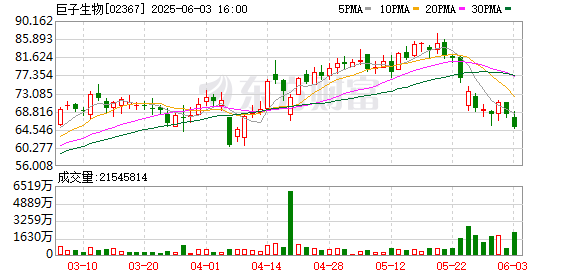
Core Viewpoint - The controversy surrounding the skincare brand "可复美" has led to a significant decline in the stock price of its parent company, 巨子生物, which has dropped 23% in just 10 trading days, resulting in a market value loss of over 21.2 billion HKD [2]. Group 1: Company Response and Actions - 巨子生物 announced on May 24 that it had commissioned multiple authoritative third-party testing agencies to verify the collagen content in its "重组胶原蛋白" products, but has yet to release the results [2]. - The company's IR department stated that the testing process is ongoing and results will be reported to the public as soon as they are available [2]. Group 2: Market and Competitive Dynamics - The controversy began when beauty blogger "大嘴博士" publicly questioned the actual collagen content in 可复美's core product, revealing it to be only 0.0177%, which contradicted the product's marketing claims [3]. - 巨子生物 responded to the allegations by asserting that the claims were "seriously inaccurate" and released self-test results showing collagen content exceeding 0.1% [3]. - The situation has been complicated by the involvement of competitor 华熙生物, which publicly supported the claims made by 大嘴博士, indicating a long-standing rivalry between the two companies [4]. - 华熙生物 has faced pressure in the market as its core product, "玻尿酸," has seen declining interest, while 巨子生物's "重组胶原蛋白" products have gained popularity, contributing to its rapid growth in both performance and market valuation [4].
“汝求战,便得战!”
Guan Cha Zhe Wang· 2025-06-03 10:03
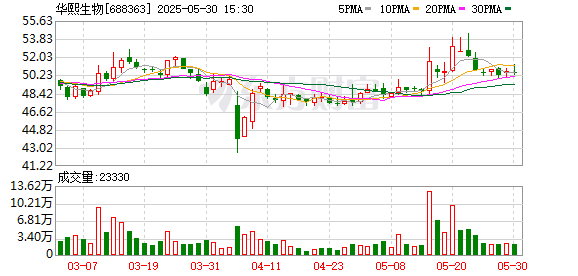
Core Viewpoint - The conflict between Huaxi Biological and Juzi Biological has escalated into a public confrontation over product integrity and industry standards, with both companies making serious allegations against each other regarding the authenticity of their products and testing methods [1][3][16]. Group 1: Company Actions and Statements - Huaxi Biological announced a capital relationship with Dr. Hao Yu, holding 32.4% of the shares in his company, and positioned it as an important member of the "Huaxi ecosystem," promising technical support and personal protection [1][6]. - Huaxi's statement accused Juzi Biological of manipulating public opinion and demanded that they address product integrity issues, threatening to disclose third-party testing evidence if they do not comply [1][7]. - Juzi Biological quickly countered by claiming that the testing agency used by Dr. Hao had not authorized him to use their report and accused Huaxi of maliciously distorting facts [9][12]. Group 2: Market Reactions and Financial Implications - Following the public dispute, Juzi Biological's stock price fell over 4.69%, while Huaxi Biological's stock rose by 6.94%, indicating market concerns about Juzi's upcoming performance during the critical "618" shopping festival [2][12]. - Juzi's flagship product, "Collagen Stick," is projected to generate 3.6 billion yuan in revenue in 2024, raising concerns about the impact of the ongoing controversy on consumer trust and potential sales [2][14]. - In contrast, Huaxi Biological reported a revenue decline of 11.61% year-on-year for 2024, with a net profit drop of 70.59%, highlighting the financial pressures both companies are facing [15]. Group 3: Industry Context and Future Outlook - The dispute reflects a broader competition between two technological routes in the medical beauty industry: the hyaluronic acid camp represented by Huaxi Biological and the recombinant collagen camp represented by Juzi Biological [14][16]. - The market for collagen-based skincare products is expected to surpass that of hyaluronic acid by 2026, with a compound annual growth rate of 52.6%, attracting numerous companies to enter the sector [14]. - The ongoing conflict may lead to increased scrutiny from regulatory bodies, as the lack of clear testing standards for recombinant collagen has resulted in divergent claims from both companies [9][11].
“一个真正的商战”,医美巨头华熙生物、巨子生物矛盾激化 “大嘴博士”回应巨子生物最新声明:不认同
Mei Ri Jing Ji Xin Wen· 2025-06-02 15:51
Core Viewpoint - The ongoing public dispute between Huaxi Biological and Juzhi Biological highlights the competitive tension in the aesthetic medicine industry, particularly regarding hyaluronic acid and recombinant collagen products [3][10]. Group 1: Company Statements - Huaxi Biological issued a statement on June 1, 2023, supporting beauty blogger Dr. Hao Yu, criticizing an unnamed company for using "internet water army" tactics and threatening to disclose testing results if issues are not addressed [3][4]. - Juzhi Biological responded later that day, accepting an apology from the testing agency used by Dr. Hao Yu but asserting that they would pursue legal action against those spreading false information [3][8]. - Dr. Hao Yu contested Juzhi Biological's claims, stating that the testing agency's statement did not include an apology and questioned why Juzhi had not released its own testing results after ten days [9][10]. Group 2: Market Dynamics - The dispute is rooted in a broader competition for market share between hyaluronic acid and recombinant collagen, with Huaxi Biological's performance declining alongside the perception of hyaluronic acid as "outdated" [10]. - Huaxi Biological's revenue from functional skincare products, which include recombinant collagen, has seen significant declines of 18.45% and 31.62% in 2023 and 2024, respectively, while Juzhi Biological's "Kefumei" brand has shown strong growth with revenues of 27.88 billion and 45.4 billion in the same years [11]. - The pricing landscape for aesthetic products indicates that domestic hyaluronic acid is positioned at the lower end of the market, with prices ranging from approximately 1,000 to 2,000 yuan per unit, while recombinant collagen is priced higher, around 3,000 yuan [13][14]. Group 3: Industry Trends - The aesthetic medicine market is experiencing a shift with the introduction of new injectable materials, which has led to a decrease in hyaluronic acid's market share from 42% in 2021 to an estimated 36% in 2024 [16]. - The emergence of new materials, such as hydroxyapatite and PDRN solutions, is expected to further challenge the dominance of hyaluronic acid, although its unique properties may still provide competitive advantages [16][17].

两大医美巨头隔空“喊话”!华熙生物力挺“大嘴博士”,巨子生物深夜回应
Bei Jing Shang Bao· 2025-06-02 11:02
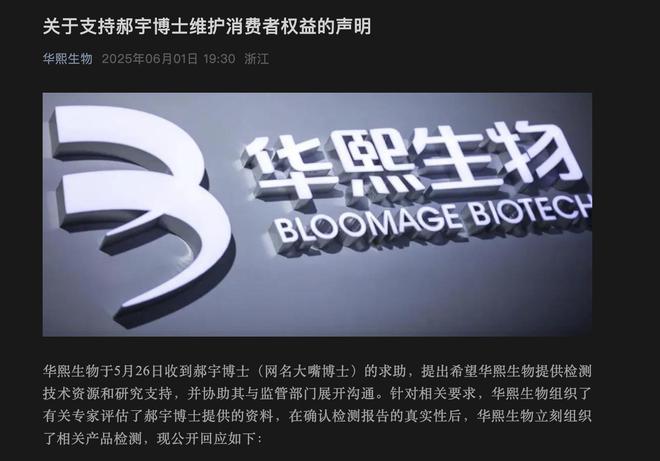
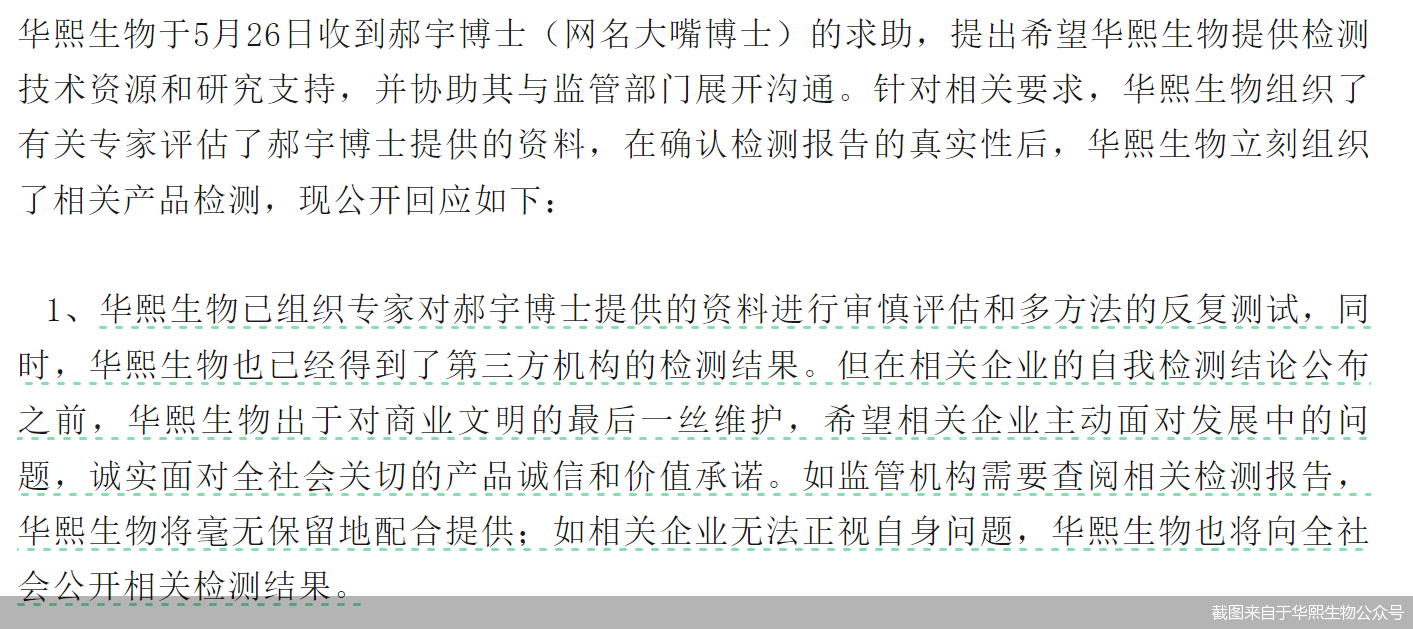
Core Viewpoint - The dispute over the ingredients in medical beauty products is escalating, particularly between Huaxi Biological and Juzhi Biological, with accusations of misleading information and legal threats being exchanged [1][5][6]. Group 1: Company Statements - Huaxi Biological issued a statement supporting Dr. Hao Yu, indicating that they had confirmed the authenticity of the testing reports and would cooperate with regulatory bodies if needed [2][3]. - Huaxi Biological accused Juzhi Biological of using online marketing tactics to undermine competition and suggested that they are prepared for a "real business war" [1][4]. - Juzhi Biological responded by stating that they would pursue legal action against those spreading false information and emphasized their commitment to consumer interests [1][5]. Group 2: Product Controversy - Dr. Hao Yu claimed that the product "Kefumei" from Juzhi Biological contained only 0.0177% of recombinant collagen, which does not meet regulatory standards for labeling as a non-trace component [3]. - Huaxi Biological highlighted that their products have the highest number of medical device certifications in the industry, asserting that there is no evidence to support the safety of recombinant collagen over hyaluronic acid [4]. Group 3: Financial Performance - Juzhi Biological reported significant revenue growth from 2022 to 2024, with revenues of 2.364 billion, 3.524 billion, and 5.539 billion yuan, and net profits of 1.002 billion, 1.452 billion, and 2.062 billion yuan respectively [6]. - In contrast, Huaxi Biological experienced a decline in both revenue and net profit for 2024, with revenues of approximately 5.371 billion yuan (down 11.61%) and net profits of about 174 million yuan (down 70.59%), marking their worst performance since going public [7]. Group 4: Market Reaction - Following the controversy, Juzhi Biological's stock price fell by 18.07% from its peak on May 20, closing at 68.25 HKD per share on June 2, reflecting market concerns over the ongoing disputes [6].
争议升级!两家上市公司深夜互相“喊话”,巨子生物股价受挫
2 1 Shi Ji Jing Ji Bao Dao· 2025-06-02 10:24
Core Viewpoint - The ongoing dispute between Hyaluronic Acid and recombinant collagen has gained significant attention, particularly involving major players in the medical aesthetics industry, Huaxi Biological and Juzhi Biological, leading to market volatility and investor caution [1][8]. Company Responses - Huaxi Biological expressed support for Dr. Hao Yu, emphasizing the importance of consumer rights and the integrity of product testing, while also indicating that they have conducted thorough evaluations of the claims made by Dr. Hao [2][5]. - Juzhi Biological issued a statement condemning Huaxi Biological's accusations as malicious and unfounded, highlighting their commitment to consumer trust and the integrity of their products [2][3]. Market Reaction - Following the controversy, Juzhi Biological's stock price fell over 5.6% on June 2, closing at 68.25 HKD per share, with a market capitalization of 731 billion HKD, reflecting investor concerns about the ongoing dispute [1][8]. Testing and Standards - The testing report that Dr. Hao Yu referenced was clarified by the testing agency, stating it was not legally valid for public proof and lacked comprehensive methodology, which raised questions about the reliability of the results [3][7]. - The lack of unified testing standards in the recombinant collagen industry has been highlighted as a significant issue, contributing to consumer distrust and regulatory challenges [7][9]. Industry Implications - The incident has exposed vulnerabilities in the regulatory framework and testing standards for the recombinant collagen sector, prompting discussions about the need for clearer guidelines and industry standards [7][9]. - The National Medical Products Administration has initiated the development of industry standards for recombinant collagen testing, indicating a move towards greater regulatory oversight [7].
舆论战升级!巨子生物深夜回应,华熙生物力挺美妆博主
第一财经· 2025-06-02 05:15
Core Viewpoint - The controversy surrounding the collagen content in the product "Collagen Stick" from the brand Kefu Mei, owned by Giant Biological (02367.HK), has intensified due to allegations of misleading advertising and low actual collagen levels compared to what is claimed [1][4]. Group 1: Controversy and Responses - Beauty blogger "Big Mouth Doctor" (Hao Yu) claims that the actual collagen content in Kefu Mei's product is only 0.0177%, significantly lower than the advertised "≥0.1%" [4][5]. - Giant Biological issued a statement acknowledging an apology from the testing agency used by "Big Mouth Doctor" and stated that they are pursuing legal action against those spreading false information [3][6]. - The company has sent products to multiple testing agencies for verification, but results are still pending due to the complexity of the testing process [3][6]. Group 2: Financial Performance and Market Impact - Giant Biological has shown steady revenue growth from 2020 to 2024, with revenues increasing from 1.19 billion to 5.54 billion yuan, and net profits rising from 826 million to 2.06 billion yuan [6]. - The Kefu Mei brand accounted for 82% of Giant Biological's total revenue in 2024, with its revenue reaching 4.54 billion yuan [6]. - The ongoing controversy coincides with the 618 e-commerce promotion period, raising concerns among industry experts about potential impacts on Giant Biological's performance [6]. Group 3: Industry Context and Competitor Actions - Competitors like Huaxi Biological (688363.SH) and Jinbo Biological (832982.BJ) have higher R&D expenditure ratios at 8.68% and 4.94%, respectively, compared to Giant Biological's 1.9% [7]. - Huaxi Biological publicly supported "Big Mouth Doctor" and has conducted its own testing on the allegations, emphasizing the importance of product integrity and transparency [10][11]. - Huaxi Biological has criticized the overhyped claims surrounding recombinant collagen, suggesting that such narratives lack scientific backing and may mislead consumers [11].

涉事检测机构道歉?华熙生物力挺大嘴博士,监管部门介入
Nan Fang Du Shi Bao· 2025-06-02 05:12
Core Viewpoint - The conflict between Huaxi Biological (688363.SH) and Juzhi Biological (02367.HK) is escalating from subtle accusations to open confrontation, with both companies making public statements regarding the controversy surrounding the "Kefumei" product and its alleged lack of added recombinant collagen [2][3][8]. Group 1: Huaxi Biological's Position - Huaxi Biological publicly supports Dr. Hao Yu, stating that his company, Shanghai Liuyue Medical Technology Service Co., is an important member of the Huaxi ecosystem, and they will provide legal protection [2][4]. - The company claims to have conducted thorough evaluations and multiple tests on the materials provided by Dr. Hao, and has obtained results from third-party institutions [4][7]. - Huaxi Biological accuses Juzhi Biological of engaging in malicious competition and using online tactics to undermine its reputation, asserting that they are prepared for a transparent business battle [7][8]. Group 2: Juzhi Biological's Response - Juzhi Biological asserts that it received an apology from the testing agency used by Dr. Hao, which clarified that it never authorized the use of the test report and demanded that Dr. Hao cease using it to avoid public misinformation [2][8]. - The company emphasizes that the testing report's results are influenced by various factors and should only be considered as reference values, indicating that the methodology used was flawed [8][12]. - Juzhi Biological expresses shock and disappointment at Huaxi Biological's accusations, labeling them as malicious and harmful to consumer trust in domestic brands [13][14].
“成分争议”风波持续发酵,两大医美龙头再次发声
Guang Zhou Ri Bao· 2025-06-02 05:01
Core Viewpoint - The ongoing controversy regarding the authenticity of collagen content in the "可复美胶原棒" product has sparked significant industry attention, with both 华熙生物 and 巨子生物 responding to the allegations made by 郝宇 and the testing institution involved [1][2]. Group 1: Company Responses - 华熙生物 issued a statement supporting 郝宇, indicating that they have conducted thorough evaluations and testing of the claims made against their products, and are willing to cooperate with regulatory bodies regarding the testing results [1]. - 巨子生物's 可复美 brand acknowledged the apology from the testing institution used by 郝宇 but stated their intention to pursue legal action against those spreading false information [2][3]. Group 2: Industry Implications - The dispute highlights the growing scrutiny within the medical aesthetics industry regarding product integrity and consumer trust, as both companies emphasize their commitment to transparency and consumer rights [2].