
GIANT BIOGENE(02367)

Search documents
华熙VS巨子的生物战,已经打到了「滴血验胶原」
3 6 Ke· 2025-06-09 04:58
Core Viewpoint - The ongoing public dispute between two major players in the beauty industry, Huaxi Biological and Juzhi Biological, has escalated into a fierce battle over allegations of fraud and market manipulation, significantly impacting their market positions and stock prices [1][4][34]. Group 1: Background and Timeline - The conflict began on May 17 when Huaxi Biological publicly criticized several brokerage reports that favored Juzhi Biological's products, suggesting they misled the market [5][6]. - On May 24, beauty influencer Hao Yu accused Juzhi Biological of fraud regarding its "collagen stick" product, claiming the actual collagen content was only 0.0177%, far below the labeled 0.1% [16][17]. - Following these allegations, Juzhi Biological issued a rebuttal, presenting an internal quality inspection report to counter the fraud claims [18][19]. Group 2: Market Impact - Since the dispute began, Huaxi Biological's stock price has increased by approximately 6.8%, while Juzhi Biological's stock has seen a cumulative decline of 25.20%, resulting in a market value loss of over 16 billion HKD [34]. - The consumer market has also reacted, with Juzhi Biological's product ranking dropping significantly on e-commerce platforms, indicating a shift in consumer perception [36]. Group 3: Industry Dynamics - The conflict highlights a broader competition between two factions in the beauty industry: the hyaluronic acid camp represented by Huaxi Biological and the recombinant collagen camp led by Juzhi Biological [39]. - The rise of recombinant collagen products has been attributed to a lack of standardized regulations and testing methods, allowing companies like Juzhi Biological to capitalize on marketing without stringent scientific backing [41]. - In contrast, Huaxi Biological has faced significant challenges, with its market value plummeting from 140 billion to 26.1 billion, while Juzhi Biological's market capitalization has surged by 230% since its IPO [37].


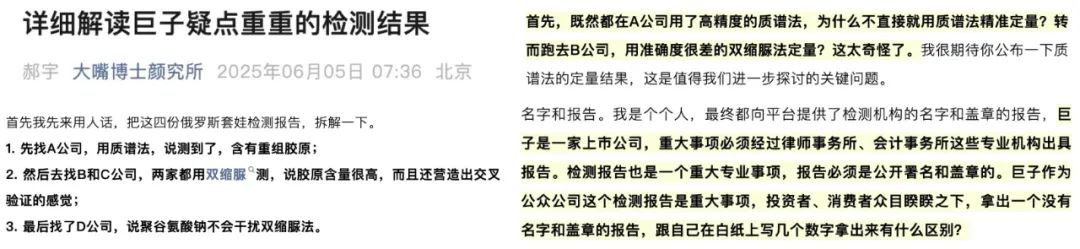
巨子生物(02367.HK):公司控股股东Juzi Holding计划自本公告日期起三至六个月内增持本公司股份, 增持金额不低于港币2亿元。
news flash· 2025-06-09 04:35
巨子生物(02367.HK):公司控股股东Juzi Holding计划自本公告日期起三至六个月内增持本公司股份, 增持金额不低于港币2亿元。 ...
巨子华熙鏖战:美妆行业自我造神的反噬
2 1 Shi Ji Jing Ji Bao Dao· 2025-06-06 10:43
Core Viewpoint - The ongoing controversy surrounding the collagen content claims by Juzhi Biotechnology highlights a deeper crisis of trust within the skincare industry, exacerbated by a lack of transparency and regulatory standards [1][2][3]. Group 1: Industry Trust Issues - The dispute over ingredient authenticity has revealed significant gaps in consumer trust and industry standards, with companies often engaging in "black box" practices that obscure the true efficacy of their products [3][4]. - The skincare sector is facing a crisis where consumers are increasingly skeptical of scientific claims, demanding transparency and accountability from brands [3][10]. Group 2: Regulatory and Market Dynamics - Recent events, including a fine imposed on CSS for false advertising, illustrate the consequences of misleading marketing practices, with penalties disproportionately affecting downstream partners rather than brands [6][9]. - The market for soluble collagen and other active ingredients is experiencing explosive growth, with a reported 106.93% increase in soluble collagen registrations, indicating a shift in consumer preferences towards these components [6][9]. Group 3: Ingredient Efficacy and Marketing Practices - The industry is grappling with two main issues: the imbalance in quantifying ingredient efficacy and the use of "shadow ingredients" to mislead consumers about product value [7][8]. - Companies are often reducing the actual amounts of active ingredients to cut costs, leading to a significant disparity between product claims and actual performance, which undermines consumer trust [7][8]. Group 4: Future Opportunities and Challenges - The lack of standardized testing methods and regulatory frameworks is creating a fragmented market where companies can exploit loopholes, leading to a potential collapse of consumer confidence [10][11]. - The need for an open and transparent verification platform is critical for establishing trust and setting future industry standards, as current practices are failing to meet consumer expectations [10][11].
港股收盘(06.06) | 恒指收跌0.48% 有色、创新药走高 快手-W(01024)逆市涨超8%
智通财经网· 2025-06-06 08:57
Market Overview - The Hong Kong stock market indices collectively declined, with the Hang Seng Index stopping a three-day rise, closing down 0.48% at 23,792.54 points, with a total turnover of HKD 235.62 billion [1] - The Hang Seng China Enterprises Index fell 0.63% to 8,629.75 points, and the Hang Seng Tech Index also dropped 0.63% to 5,286.52 points [1] - For the week, the Hang Seng Index rose 2.16%, the China Enterprises Index increased by 2.34%, and the Tech Index gained 2.25% [1] Blue Chip Performance - Kuaishou-W (01024) continued its upward trend, rising 8.44% to HKD 59.1, contributing 22.8 points to the Hang Seng Index [2] - The annualized revenue run rate for Kuaishou's AI product exceeded USD 100 million as of March, with monthly payments surpassing RMB 100 million in April and May [2] - Other blue-chip stocks included CSPC Pharmaceutical Group (01093) up 12.72%, Hansoh Pharmaceutical (03692) up 2.84%, while SMIC (00981) fell 4.85% and Trip.com Group (09961) dropped 3.31% [2] Sector Highlights - Large tech stocks generally declined, with Xiaomi down over 2% and Alibaba down over 1%, while Kuaishou rose over 8% [3] - Precious metals saw gains, with China Silver Group rising 26% and silver prices reaching a 13-year high, driven by industrial demand [3] - The innovative drug sector saw gains, with CSPC Pharmaceutical up 12.72% and other biotech firms also performing well, indicating a positive outlook for the sector [4] Stablecoin Sector - The stablecoin sector experienced a pullback after Circle's successful NYSE listing, with China Everbright Holdings (00165) dropping 17.2% [5] - The Hong Kong government announced the implementation of the Stablecoin Regulation on August 1, 2025, which aims to reshape the regulatory framework for stablecoins [6] Automotive Sector - Automotive stocks declined, with XPeng Motors (09868) down 1.77% and Great Wall Motors (02333) down 1.76% [6] - Concerns over a price war in the automotive industry were raised, with profit margins for the sector declining [6] Notable Stocks - WanGuo Gold Group (03939) reached a new high, rising 11.73% to HKD 30, supported by positive mining contracts [7] - Xinyi Energy (03868) increased by 7.07% as it submitted listing materials for a solar power infrastructure REIT in China [8] - Juzhibio (02367) faced pressure, down 3.04%, amid ongoing controversies regarding its product composition [9]

排队IPO的潮玩公司,神话和泡沫共存丨南财号联播
2 1 Shi Ji Jing Ji Bao Dao· 2025-06-06 08:37
Group 1 - The "National Subsidy" for home appliances in Chongqing has been suspended, with the first round of subsidy funds fully utilized, leading to a halt in qualification code applications [1] - The ongoing dispute between Huaxi Biological and Juzhi Biological regarding the content of collagen products continues, with both parties refusing to back down, resulting in a persistent trust crisis [1] - A public feud between Elon Musk and Donald Trump has led to a significant drop in Tesla's market value, evaporating over $150 billion (approximately 1.09 trillion RMB) in a single night [1] - Procter & Gamble announced plans to cut 7,000 non-manufacturing jobs over the next two years, representing about 15% of such positions, with expected pre-tax costs of $1 billion to $1.6 billion [1] Group 2 - The toy company market is experiencing a mix of myth and bubble, with concerns about the commercial viability and competitive advantages of companies like TOPTOY and 52TOYS as they prepare for IPOs [2] - White Elephant instant noodles, previously celebrated as a symbol of domestic products, faces backlash due to trademark issues, which may undermine its brand image and consumer trust [3] - The 2025 Guangdong-Hong Kong-Macao Greater Bay Area Auto Show has seen record attendance, with over 180,000 visitors on the first day and an expected total of 450,000 attendees, marking a 27.84% increase from the previous year [3] - The "618" shopping festival is generating mixed reactions from consumers, with some expressing resistance to purchasing despite the ongoing promotions on major e-commerce platforms [3]



巨子生物旗下产品可复美成分引争议 9个交易日市值蒸发逾160亿港元
Xin Hua Wang· 2025-06-06 06:58
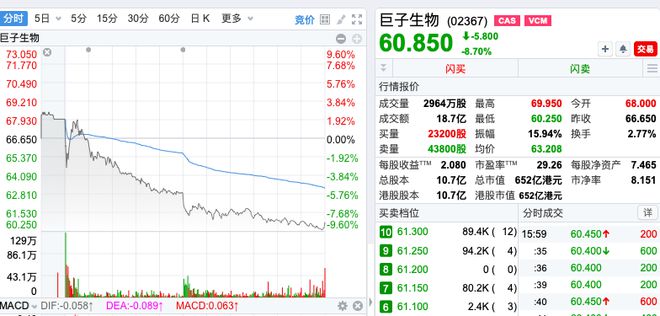
Core Viewpoint - The controversy surrounding the product "Kefumei" from Giant Biological has intensified, with the company defending its product's integrity against allegations of false advertising and insufficient collagen content [1][2]. Company Overview - Giant Biological, established in 2000, went public on the Hong Kong Stock Exchange in 2022 and specializes in skin care products featuring recombinant collagen as a key active ingredient [2]. - The company owns several brands, with "Kefumei" and "Kelin" being its core products [2]. Financial Performance - In 2024, Giant Biological reported revenue of 5.539 billion yuan, a year-on-year increase of 57.17%, and a net profit attributable to shareholders of 2.062 billion yuan, up 42.06% [2]. - The "Kefumei" brand generated revenue of 4.542 billion yuan in 2024, reflecting a 62.9% year-on-year growth, increasing its share of the company's total revenue from 79.1% to 82% [2]. Industry Context - The recombinant collagen industry is experiencing growth, while the hyaluronic acid sector, represented by Huaxi Biological, is facing challenges, including declining revenue and profits [2][3]. - Huaxi Biological reported a revenue drop of 4.45% in 2023, with a further decline of 11.61% in 2024, alongside a significant decrease in net profit [3]. Market Reaction - Following the controversy, Giant Biological's stock price fell by 8.70% to 60.85 HKD per share, with a total market value of approximately 65.165 billion HKD, and a cumulative decline of 25.20% over nine trading days [3].
商战双方最新回应,华熙生物:反对成分“名称游戏”
news flash· 2025-06-06 05:26
Core Viewpoint - The ongoing dispute regarding the ingredient content of collagen protein products between companies is highlighted, with Huaxi Biological opposing the notion of "name games" in the industry [1] Group 1: Company Responses - Juzhi Biological disclosed testing results from four different institutions, all indicating ingredient content greater than 0.1%, while denying any allegations of "false advertising" [1] - Huaxi Biological emphasized the need for collaboration among testing institutions, professionals, and media to ensure industry safety and prosperity, criticizing the manipulation of standards by certain companies and scholars [1] Group 2: Industry Concerns - The statement from Huaxi Biological pointed out that the safety of the industry is compromised when individual companies and biased scholars manipulate discussions to create standards that benefit a few at the expense of overall industry development [1] - The company warned against using "standard disputes" and "business wars" to obscure fundamental product safety and value commitments [1]
“商战”波及股票?检测结果发布后,巨子生物股价“狂泻”!
Nan Fang Du Shi Bao· 2025-06-05 12:14
Core Viewpoint - The controversy surrounding the collagen content in the product from Giant Bio (02367.HK) continues despite the release of test results, which confirmed the presence of recombinant collagen protein in their product, but raised further questions about the testing methods used [1][4][6]. Group 1: Test Results and Controversy - Giant Bio announced that their product, the Human-like Recombinant Collagen Essence, contains recombinant collagen protein with a content greater than 0.1% [1][4]. - The testing involved multiple methods, including LC-MS/MS for qualitative analysis and the Biuret method for quantitative analysis, but the choice of methods has been criticized for lacking consistency [5][6]. - The release of the test results led to a significant drop in Giant Bio's market value, with a loss exceeding 60 billion HKD in a single day [4][7]. Group 2: Market Competition - The ongoing dispute over collagen and hyaluronic acid is viewed as a commercial battle between Giant Bio and Huaxi Biological, both competing for market share in the beauty and skincare sector [2][10]. - Huaxi Biological has publicly criticized Giant Bio, suggesting that the latter has been using aggressive marketing tactics without scientific backing [10]. - The market dynamics are further complicated by the upcoming peak sales season, with both companies vying for consumer attention [2][10]. Group 3: Industry Standards - The controversy highlights the lack of unified testing standards in the recombinant collagen industry, leading to significant discrepancies in test results from different institutions [6]. - The National Medical Products Administration is set to establish industry standards for the detection of recombinant collagen in cosmetics by 2025 [6].
三个医美女首富争霸,日子都不好过
创业家· 2025-06-05 10:06
Core Viewpoint - The article discusses the escalating conflict between two major companies in the medical beauty industry, Huaxi Biological and Juzhi Biological, highlighting the competitive dynamics and market implications of their rivalry, particularly in the context of collagen products and consumer trust [3][4][19]. Group 1: Company Conflict - The conflict between Huaxi Biological and Juzhi Biological has intensified, with accusations of potential fraud being exchanged publicly [3][4]. - Huaxi Biological's sales and stock prices have declined since 2021, while Juzhi Biological's collagen products have seen significant market success [4][19]. - The public dispute has drawn attention to the market dynamics, with another company, Jinbo Biological, benefiting from the situation by avoiding direct confrontation and achieving substantial stock price increases [4][19]. Group 2: Market Dynamics - The market for recombinant collagen products is projected to grow significantly, with a compound annual growth rate of 44.93%, reaching 585.7 billion yuan by 2025 and 2.1938 trillion yuan by 2030 [28]. - Jinbo Biological reported a revenue of 1.443 billion yuan in 2024, a year-on-year increase of 84.92%, with a gross profit margin of 92.02% [28]. - The competitive landscape is shifting, with new materials and products emerging, potentially threatening the current market positions of Huaxi and Juzhi Biological [36][37]. Group 3: Key Individuals - Yang Xia, the owner of Jinbo Biological, has seen her wealth increase significantly due to the company's stock performance, solidifying her status as a prominent figure in the industry [30][29]. - The article notes the historical context of Huaxi Biological's rise and subsequent decline, contrasting it with the current successes of Juzhi and Jinbo Biological [34][35].

明星单品陷成分“罗生门”,巨子生物检测结果再引质疑
2 1 Shi Ji Jing Ji Bao Dao· 2025-06-05 07:05
Core Viewpoint - The ongoing controversy surrounding Giant Bio's collagen products has raised significant trust issues among investors and consumers, potentially impacting the company's brand reputation and financial performance [1][5]. Group 1: Company Response and Testing Results - Giant Bio has publicly stated that its products have passed regulatory checks and have undergone a three-tier verification system to ensure quality and safety [1][2]. - The company commissioned multiple authoritative testing agencies to conduct qualitative and quantitative analyses of its collagen products, adhering to industry standards [2][3]. - Despite the company's assertions, the testing methods and results have been questioned, particularly regarding the accuracy and consistency of the testing approaches used by different agencies [3][4]. Group 2: Market Impact and Financial Performance - The controversy has led to a decline in Giant Bio's stock price, which fell by 5.63% to HKD 62.9 per share, resulting in a market capitalization of HKD 673.6 billion [1]. - The sales of the company's flagship product, the collagen stick, have been substantial, with over 515 million units sold in three years, contributing significantly to revenue [5][6]. - Financial data indicates that Giant Bio's revenue has increased from CNY 2.375 billion in 2021 to CNY 5.539 billion in 2024, with net profit rising from CNY 1 billion to CNY 2.062 billion during the same period [6]. Group 3: Industry Challenges - The lack of standardized testing methods for recombinant collagen products has led to discrepancies in results from different testing institutions, exacerbating trust issues between brands and consumers [5]. - The ongoing debate over testing methods may serve as a catalyst for the establishment of industry standards, which are currently being developed by regulatory authorities [5].