MEITUAN(03690)

Search documents
聚焦:春运火热开启;千问春节30亿免单,即时零售竞争再加码:交通运输行业周报(20260202-20260208)
Huachuang Securities· 2026-02-08 10:25
Investment Rating - The report maintains a "Recommend" rating for the aviation sector, highlighting opportunities in the industry [2][3]. Core Insights - The Spring Festival travel rush has begun, with air passenger volume averaging 2.313 million per day, up 5.5% year-on-year, while railway passenger volume averaged 11.792 million, down 0.7% [1][10]. - The report emphasizes the competitive landscape in instant retail, particularly with the launch of the "30 Billion Free Order" campaign by Qianwen, which saw over 10 million orders in just 9 hours [2][35]. - The report identifies key players in the aviation sector, including China National Airlines, Southern Airlines, and Eastern Airlines, as well as low-cost carriers like Spring Airlines, which are expected to benefit from high price elasticity and operational efficiency [2][34]. Industry Data Tracking - Air cargo: The outbound air cargo price index at Pudong Airport increased by 5.3% week-on-week and 8.9% year-on-year as of February 2 [7][44]. - Shipping: VLCC freight rates increased by 2%, while the BDI decreased by 10% and SCFI decreased by 4% [7][48]. - The report highlights the expected compound annual growth rate (CAGR) of approximately 3% for aircraft imports over the next three years, indicating a supply constraint in the aviation sector [31][32]. Investment Recommendations - The report suggests focusing on "performance elasticity" and "dividend value" as key investment themes for the transportation sector in 2026 [7][31]. - It recommends leading companies in express logistics, such as Zhongtong and Yuantong, as well as the instant retail leader Shunfeng Tongcheng, which is expected to benefit from rapid growth and low valuation [7][31]. - The report also highlights the importance of dividend-paying assets, recommending Sichuan Chengyu and China Merchants Port for their stable performance and potential for dividend increases [7][31].



聚焦:春运火热开启;千问春节30亿免单,即时零售竞争再加码:交通运输行业周报(20260202-20260208)-20260208
Huachuang Securities· 2026-02-08 09:30
Investment Rating - The report maintains a "Recommend" rating for the aviation sector, highlighting potential opportunities in the industry [2][3]. Core Insights - The Spring Festival travel rush has begun, with air passenger volume averaging 2.313 million per day, up 5.5% year-on-year, while railway passenger volume averaged 11.792 million, down 0.7% year-on-year [1][10]. - The report emphasizes the competitive landscape in instant retail, particularly with the launch of the "30 Billion Free Order" campaign by Qianwen, which saw over 10 million orders in just 9 hours [2][35]. - The report identifies key players in the aviation sector, including China National Airlines, Southern Airlines, and Eastern Airlines, as well as low-cost carriers like Spring Airlines, which are expected to benefit from high price elasticity and operational efficiency [2][34]. Industry Data Tracking - Air freight rates at Pudong Airport increased by 5.3% week-on-week and 8.9% year-on-year as of February 2 [7][44]. - The VLCC freight rate rose by 2% week-on-week, while the BDI decreased by 10% [7][48]. - The report highlights the growth potential in the express logistics sector, particularly for leading companies like Zhongtong and Yuantong, as well as the promising outlook for instant retail leader SF Express [7][31]. Investment Recommendations - The report suggests focusing on "performance elasticity" and "dividend value" as key investment themes for the transportation sector in 2026 [7][31]. - It recommends continued investment in the aviation sector due to expected low growth in aircraft supply and a projected 5% increase in passenger numbers [2][31]. - The report also emphasizes the importance of dividend assets, recommending companies like Sichuan Chengyu and China Merchants Port for their stable performance and potential for increased dividends [7][31].

美团鲸吞叮咚买菜!7亿美元“捡漏”千仓网络,生鲜大战提前终局?
Jing Ji Guan Cha Wang· 2026-02-08 08:38
Core Insights - Meituan has acquired Dingdong Maicai's entire business in China for an initial price of $717 million, marking a significant shift in the fresh food e-commerce landscape and the end of its independent era [2][9] Group 1: Acquisition Details - The acquisition involves over 1,000 front warehouses and 7 million monthly purchasing users, integrating Dingdong Maicai's supply chain into Meituan's operations [2][4] - Dingdong Maicai will become a wholly-owned subsidiary of Meituan, with its financial performance incorporated into Meituan's financial statements [2] - The deal includes a dynamic pricing mechanism, allowing the final price to be adjusted based on audited financial metrics at the time of closing [6][10] Group 2: Strategic Objectives - The strategic goal of the acquisition is to enhance Meituan's infrastructure in the instant retail sector, shifting competition from user acquisition to efficiency in physical networks and supply chains [3][9] - Dingdong Maicai has established a vertically integrated supply chain with over 85% of its fresh products sourced directly, which will bolster Meituan's operational capabilities [4] Group 3: Financial Performance - Dingdong Maicai reported a pre-tax net profit of 38.882 billion yuan for 2024, with a total merchandise transaction volume growth rate of only 0.1% year-on-year, indicating a stagnation in growth [4] Group 4: Industry Impact - The acquisition is expected to reshape the competitive landscape of the instant retail industry, with a predicted market share distribution of 5:4:1 among Meituan, Alibaba, and JD [9] - The focus of competition is shifting from user subsidies and traffic acquisition to the efficiency of infrastructure, with factors like warehouse density and supply chain responsiveness becoming critical [9][10] - This acquisition signifies the end of the independent development phase for fresh food e-commerce, as major players consolidate their positions [9][10]




王兴的成全,让梁昌霖成为唯一从生鲜电商全身而退的男人
3 6 Ke· 2026-02-08 06:05
Core Insights - The article discusses the acquisition of Dingdong Maicai's China business by Meituan for approximately $717 million, marking a significant event in the fresh e-commerce sector where few companies exit gracefully [1][6] - Dingdong Maicai's survival and eventual acquisition highlight the challenges and fierce competition in the fresh e-commerce market, where many players have failed [2][10] Industry Overview - The fresh e-commerce sector has seen over 4,000 players, with a high failure rate; only 1% of companies achieved profitability by 2015 [7][10] - The market dynamics shifted as capital investment waned, revealing the importance of profitability over mere scale [3][14] Company Journey - Dingdong Maicai, founded in 2017, faced significant challenges, including a near bankruptcy experience in 2018, but managed to survive by avoiding aggressive expansion [9][11] - The company adopted a cautious approach, focusing on profitability rather than rapid growth, which became crucial for its survival [3][15] Strategic Shifts - After a successful IPO in 2021, Dingdong Maicai initially aimed for expansion but quickly shifted to prioritize efficiency amid changing market conditions [13][15] - The company began to pivot towards becoming a food company, launching its own brand products, which contributed to profitability in 2023 [21][22] Competitive Landscape - The fresh e-commerce market remains highly competitive, with major players like Hema and JD Fresh intensifying their efforts, leading to price wars and market share battles [20][24] - Dingdong Maicai's strategic retreat to core profitable regions reflects the ongoing challenges in maintaining a competitive edge in a crowded market [18][20] Acquisition Implications - The acquisition by Meituan allows for rapid scale and strategic positioning in the market, leveraging Dingdong Maicai's established network and user base [27][28] - This move underscores the trend of consolidation in the fresh e-commerce sector, where only a few players can effectively manage the complexities of the business [27][28]

OpenClaw突然大火,美团元老王慧文再发创业英雄帖
Di Yi Cai Jing Zi Xun· 2026-02-08 05:14
Core Insights - OpenClaw has gained significant attention, with investors and entrepreneurs eager to engage in its development, marking a shift from a personal open-source project to a commercial venture [4] - The rapid growth of OpenClaw, evidenced by its GitHub stars increasing from 100,000 to 171,000, indicates a burgeoning interest in the AI domain [4] - The project has validated three key directions: transforming AI from merely answering questions to executing tasks, enabling the addition of skills through plugins, and allowing persistent operation with memory management [5] Group 1 - OpenClaw's evolution from Clawdbot to its current name reflects its journey through legal challenges and its increasing popularity in the AI space [4] - The project has attracted significant developer interest, accumulating hundreds of thousands of contributors in a short time, which enhances its ecosystem [5] - Potential entrepreneurial directions identified include integrating OpenClaw with smart glasses and creating AI agents for real-world tasks, indicating a trend towards practical applications of AI [5][6] Group 2 - Industry experts emphasize that understanding user needs and effectively integrating AI capabilities into workflows will be crucial for success in the AI era [6] - There are concerns regarding OpenClaw's safety, technical design flaws, and ethical implications, suggesting that while it shows promise, it may still be perceived as a "toy" rather than a fully functional tool [6] - The feedback from industry professionals highlights the need for improved human-computer interaction and infrastructure development to support AI agents [6]

科技周报|苹果CEO库克谈退休、马云现身阿里千问春节项目组
第一财经网· 2026-02-08 03:36
Group 1 - Apple CEO Tim Cook discussed retirement and succession planning, emphasizing the importance of leadership in preparing for the future [2] - Cook's comments come amid speculation about his retirement as he turns 65, with the company needing a leader who can innovate or manage effectively [2] - The competition among Tencent, Alibaba, and Baidu has intensified with a combined investment of over 4.5 billion yuan in AI-driven red envelope campaigns for the upcoming Spring Festival [2][3] Group 2 - Panasonic announced potential layoffs of up to 12,000 employees as part of a structural reform, with a significant drop in sales and net profit reported [5] - The company aims to restructure its organization and focus on customer value creation while transitioning to a sustainable business model [5] Group 3 - Meituan completed the acquisition of Dingdong Maicai for approximately 7.17 billion yuan, reinforcing its commitment to the grocery retail sector [8] - This acquisition is part of Meituan's strategy to enhance its presence in the instant retail market, competing against Alibaba and JD.com [8] Group 4 - Amazon reported a net sales increase of 24% for its AWS segment, with a projected capital expenditure of $200 billion for 2026, driven by strong demand and opportunities in AI and other advanced technologies [9] - The company anticipates robust long-term investment returns from this significant capital allocation [9] Group 5 - Alibaba's founder Jack Ma was seen at the company's Spring Festival project team, indicating the high stakes of the ongoing AI competition [10] - Alibaba's investment of 3 billion yuan in its Spring Festival campaign marks the largest in its history, highlighting its commitment to leveraging AI as a key entry point [10] Group 6 - MiHoYo issued a new anti-fraud notice, revealing multiple internal cases and a blacklist of suppliers, reflecting a growing trend of transparency in the gaming industry [14] - The company has previously reported similar cases, indicating a focus on addressing corruption within its supply chain and marketing operations [14] Group 7 - Haier Group reported a global revenue of 426.8 billion yuan for 2025, with a focus on AI applications and the establishment of various ecological platforms [15] - The company is prioritizing new business areas such as robotics, renewable energy, and automotive ecosystems alongside its traditional smart home and health sectors [15]



详解美团7亿美元收购叮咚公告:丑话说前面,是一种高级的智慧
创业邦· 2026-02-08 03:32
Core Viewpoint - Meituan announced the acquisition of Dingdong Maicai's China business for an initial price of $717 million, marking a strategic shift in the ongoing instant retail battle in China [5][6]. Group 1: Acquisition Strategy - Meituan's management initially deemed Dingdong Maicai and Pupu Supermarket as non-viable acquisition targets but later shifted to a defensive acquisition strategy to prevent competitors like JD from gaining an advantage [5][6]. - The acquisition aims to consolidate Meituan's position as the leader in China's fresh retail sector by integrating Dingdong into its existing operations [5][6]. Group 2: Structural Concerns - The acquisition involves a complex multi-tiered corporate structure, with Dingdong Cayman Limited as the parent company and Dingdong BVI as the target for acquisition, which holds most of the Chinese operations [10][12]. - Meituan is only acquiring the Chinese business, leaving Dingdong's international operations intact for future growth opportunities [9][10]. Group 3: Cash Management - Dingdong has over $430 million in cash, which poses a challenge for Meituan. The agreement allows Dingdong to withdraw up to $280 million in cash before the acquisition is finalized, ensuring that Meituan only pays for the operational business [14][16]. - The total acquisition price of $717 million is effectively net of the cash that Dingdong can withdraw, making it a strategic financial maneuver [16]. Group 4: Transition Period - The acquisition process includes a transition period where Dingdong will continue to operate under its management until the deal is finalized, raising concerns about potential conflicts of interest [20][21]. - A "lockbox mechanism" is established to prevent any financial mismanagement during this period, ensuring that any losses incurred will be deducted from the final purchase price [21]. Group 5: Exclusivity and Termination Clauses - The agreement includes a "no-shop" clause, preventing Dingdong from seeking alternative acquisition offers during the transition period, ensuring that Meituan has exclusive rights to the acquisition [24]. - Termination fees are outlined, with Meituan liable for $150 million if it fails to complete the acquisition due to its own reasons, while Dingdong would owe $75 million if it fails to meet conditions necessary for the deal [28][30]. Group 6: Non-Competition Agreement - A non-competition clause is included, preventing Dingdong's founder from engaging in similar business activities in Greater China for five years post-acquisition, protecting Meituan from potential competition from the acquired entity [31]. Group 7: Tax Considerations - The final payment structure includes a 10% holdback until all applicable taxes related to the transaction are settled, ensuring that Meituan is not liable for any unforeseen tax liabilities post-acquisition [34][35].
200亿元,全国社保基金再落一子 | 融中投融资周报
Sou Hu Cai Jing· 2026-02-08 02:54
Group 1 - The Hubei Social Security Science and Technology Equity Investment Fund has been established with an initial scale of 20 billion yuan, focusing on industries such as optoelectronic information, automotive manufacturing, and life health in Hubei [2] - The Jiading Future Industry Fund, with a total scale of 800 million yuan, aims to support early-stage investments in disruptive technologies across five core sectors [2] - The Guangdong Hengjian Investment Holding Company has launched the Nanyue Green Beauty Ecological Investment Fund, the first provincial-level government investment fund focused on ecological construction, with an initial scale of 2 billion yuan [3] Group 2 - The Yanming Lake Fund, established to support the commercialization of technology from Yanshan University, has a registered capital of 10.2 million yuan and focuses on hard technology fields [4] - Waymo has completed a new funding round of 16 billion dollars, achieving a post-money valuation of 126 billion dollars, with significant backing from major investment firms [4][5] - SpaceX announced a stock-based acquisition of AI company xAI, resulting in a combined valuation of 1.25 trillion dollars, with SpaceX valued at 1 trillion dollars and xAI at 250 billion dollars [5][6] Group 3 - Meituan is set to acquire 100% of Dingdong Maicai's China business for approximately 717 million dollars, enhancing its instant retail capabilities [7] - AI startup ElevenLabs has raised 500 million dollars in funding, achieving a valuation of 11 billion dollars, with a significant increase from its previous funding round [7]


美团-W(03690.HK):拟收购叮咚买菜 夯实前置仓赛道竞争力
Ge Long Hui· 2026-02-07 22:51
Group 1 - The core value of Dingdong Maicai lies in its strong customer loyalty among high-value households in the Jiangsu, Zhejiang, and Shanghai regions, a robust fulfillment network, and an efficient supply chain focused on quality fresh produce [1][2] - Meituan's acquisition of Dingdong Maicai is expected to enhance its supply chain capabilities, product offerings in fresh produce, and support the expansion of its front warehouse network in East China [2] - The acquisition is seen as a strategic move to strengthen Meituan's competitive position in the increasingly fierce instant retail market, potentially improving overall industry operational efficiency and profit margins in the long term [2] Group 2 - The initial cost of the acquisition is set at $717 million, with a potential additional withdrawal of up to $280 million, contingent on maintaining a minimum net cash balance of $150 million for Dingdong [1] - If the transaction is not completed within 12 months, the agreement may be terminated, which could incur a termination fee of $150 million or $75 million [1] - Meituan maintains its revenue and net profit forecasts for 2025, 2026, and 2027, with a target price of HKD 125, reflecting a 33% upside potential [2]
美团买下叮咚买菜中国区业务,生鲜电商“独立玩家”为何出局?
Sou Hu Cai Jing· 2026-02-07 14:51
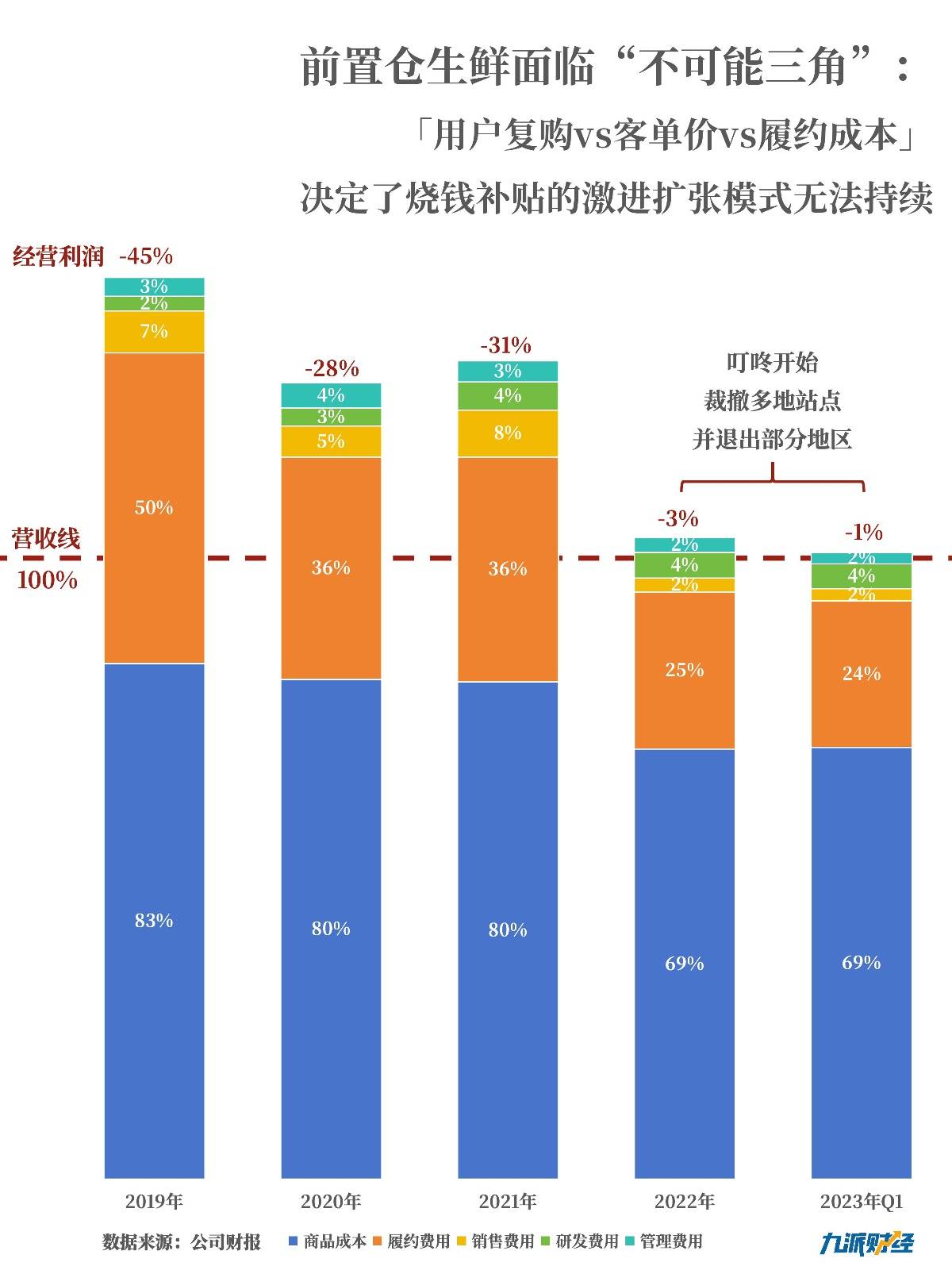
Core Viewpoint - The article discusses the challenges and strategies of fresh food e-commerce companies, particularly focusing on the contrasting business models of Dingdong Maicai and other competitors in the market, highlighting the shift from a scale-focused approach to a more efficient, localized strategy. Group 1: Business Model Challenges - The front warehouse model for fresh food was initially deemed unable to break the "impossible triangle" of balancing user scale, average order value, and fulfillment costs [1] - Daily Fresh, the pioneer of the front warehouse model, failed due to unsustainable cash-burning subsidy strategies [1] Group 2: Dingdong Maicai's Strategy - Dingdong Maicai's CEO emphasized that the key to evaluating a business model is its ability to meet user needs and adapt to consumer behavior trends [4] - The company shifted its strategy in August 2021 from "scale first, efficiency second" to "efficiency first, scale second," focusing on refined operations [4] - Dingdong Maicai has closed over 100 stations in various cities and has concentrated on expanding its network in East China, with over 60% of new warehouses located in county-level cities in the Jiangsu-Zhejiang-Shanghai region [4] Group 3: Product and Service Focus - In early 2025, Dingdong Maicai implemented a "4G strategy" focusing on "good users, good products, good services, and good mindset," aiming to enhance customer loyalty and increase average order value [5] - The company maintains a SKU count below 3,000, with 37.2% of "good product" SKUs contributing 44.7% of GMV [5] - Dingdong Maicai's operational efficiency has improved, reducing overall loss rates from 5% to 1.5%, significantly lower than the industry average of 8% [5] Group 4: Competitive Landscape - Dingdong Maicai's success in the East China market demonstrates its business model's viability, but it faces challenges from major internet platforms that dominate the instant retail space [8] - A report indicated that Dingdong's user profile differs from those of Meituan and Taobao, suggesting potential for solidifying its market position through differentiated products and services [9] - The competitive landscape intensified with the entry of Taobao Flash Purchase, which significantly increased online order volumes for competitors like Hema and Xiaoxiang Supermarket [10] Group 5: Acquisition Considerations - A source close to Meituan suggested that acquiring Dingdong Maicai would serve as a strategic defense, as Meituan's capabilities surpass those of Dingdong [12] - The integration of Dingdong's resources could provide Meituan with valuable infrastructure in East China, a region where it has been relatively weak [12]