
CICC(03908)

Search documents
2026年1-2月IPO中介机构排名(A股)
Sou Hu Cai Jing· 2026-02-27 03:49
Summary of Key Points Core Viewpoint - In the first two months of 2026, the A-share market saw a total of 17 new listed companies, marking a 31% increase compared to the same period last year, with total fundraising reaching 13.946 billion yuan, up 118.25% year-on-year [1]. Group 1: New Listings and Fundraising - A total of 17 new companies were listed in January and February 2026, including 4 on the Shanghai Main Board, 4 on the Sci-Tech Innovation Board, 1 on the Shenzhen Main Board, and 8 on the Beijing Stock Exchange [1]. - The net fundraising amount for these new listings was 13.946 billion yuan, significantly higher than the 6.390 billion yuan raised in the same period last year [1]. Group 2: Underwriting Institutions Performance - Eleven underwriting institutions participated in the IPOs of the 17 new companies, with China International Capital Corporation (CICC) leading with 4 deals [2]. - Other notable institutions included Guotou Securities, Dongwu Securities, and CITIC Securities, each handling 2 deals [2][3]. Group 3: Legal Services Performance - Nine law firms provided legal services for the IPOs, with Shanghai Jintiancheng and Beijing Zhonglun both ranking first, each handling 4 cases [5]. - Beijing Kangda followed with 3 cases, while several other firms contributed to the total of 17 cases [5][7]. Group 4: Accounting Firms Performance - Seven accounting firms provided auditing services for the IPOs, with Rongcheng and Lixin both leading with 4 cases each [8]. - Tianjian handled 3 cases, while Xinyong Zhonghe and Zhonghui each managed 2 cases [8][10].



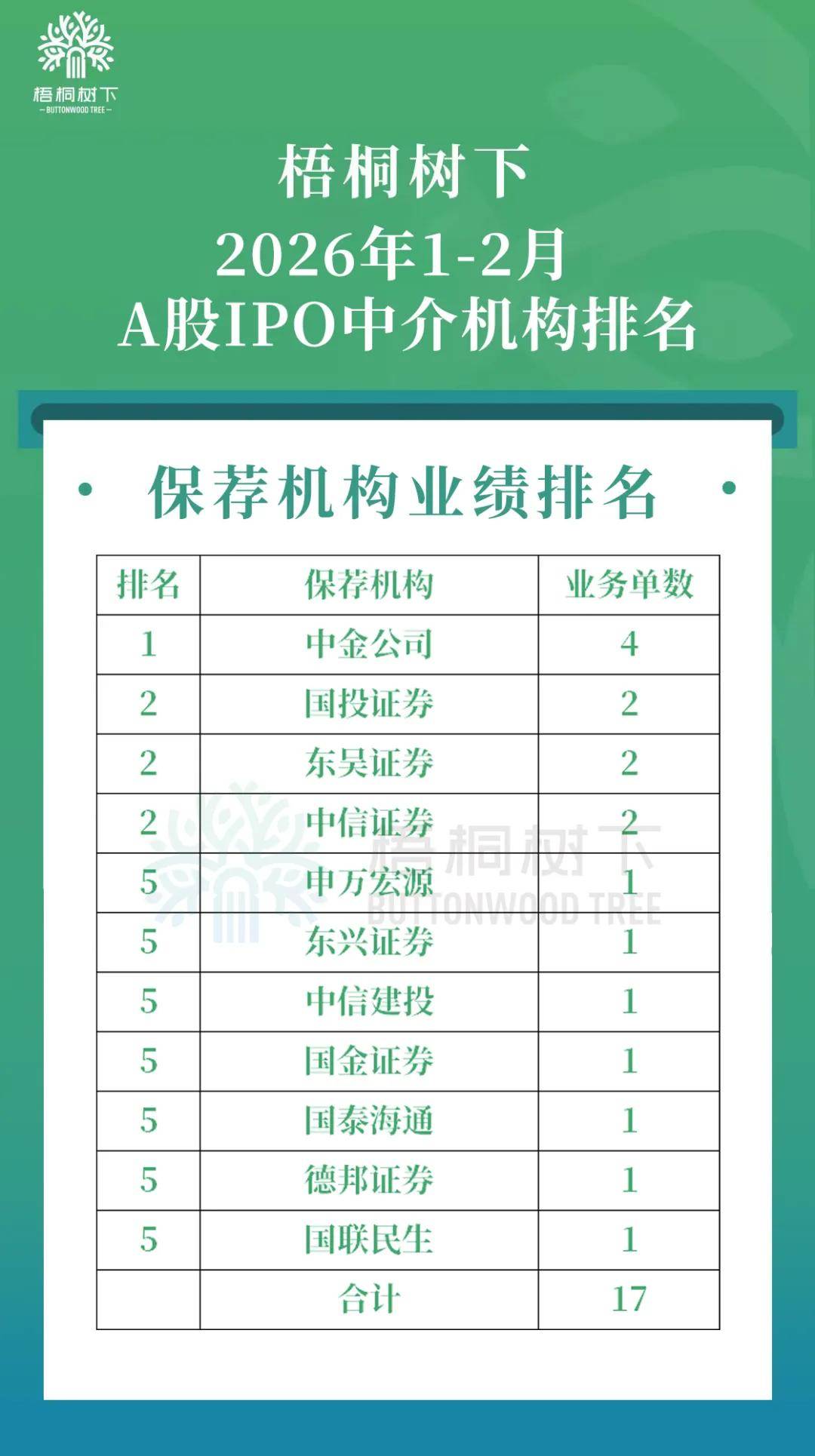
2026年1-2月IPO中介机构排名(A股)
梧桐树下V· 2026-02-27 03:33
Summary of Key Points Core Viewpoint - In the first two months of 2026, the A-share market saw a total of 17 new listed companies, marking a 31% increase compared to the same period last year, with a net fundraising amount of 13.946 billion yuan, up 118.25% year-on-year [1]. Group 1: Underwriting Institutions Performance Ranking - A total of 11 underwriting institutions were involved in the IPO business for the 17 new listed companies [2]. - China International Capital Corporation (CICC) ranked first with 4 deals, while Guotai Junan Securities, Dongwu Securities, and CITIC Securities each handled 2 deals [3][4]. Group 2: Law Firms Performance Ranking - Nine law firms provided legal services for the 17 new listed companies during the same period [5]. - Shanghai Jintiancheng and Beijing Zhonglun ranked first, each with 4 deals, followed by Beijing Kangda with 3 deals [6][8]. Group 3: Accounting Firms Performance Ranking - Seven accounting firms provided auditing services for the 17 new listed companies [9]. - Rongcheng and Lixin both ranked first with 4 deals each, while Tianjian had 3 deals, and Xinyong Zhonghe and Zhonghui each had 2 deals [10][12].

2026年国际货币秩序重构仍是全球资产主线 | 券商晨会
Sou Hu Cai Jing· 2026-02-27 01:37
Group 1 - The restructuring of the international monetary order will remain a key theme for global assets in 2026, with trends supporting a bull market for Chinese stocks and gold, and favoring Chinese stocks over US stocks [1] Group 2 - In the domestic blood products industry, the proportion of domestic albumin batch approvals is increasing, with stable performance in albumin, immunoglobulin, and fibrinogen approvals expected in 2025 [2] - The growth rate of approvals for VIII factor and PCC is rapid, while the approvals for certain products like immunoglobulin are also showing good growth [2] - Companies are focusing on the development of recombinant products and new immunoglobulins, with ongoing research and development efforts [2] - The blood products industry in 2026 should focus on plasma station expansion, industry mergers and acquisitions, and progress in new product development [2] Group 3 - The insurance sector is expected to continue benefiting from strict regulations and a competitive environment over the next 3-5 years, leading to increased market share concentration among major players [3] - The low interest rate environment is driving savings deposits towards insurance companies, creating a win-win situation for banks, insurance companies, and customers, which is likely to persist long-term [3] - There is high certainty for growth in policy sales, investment income, and profits in 2026, especially given the low base in 2025, with recent adjustments in AI narratives providing investment opportunities [3]



中金公司:2026年国际货币秩序重构仍是全球资产主线
Sou Hu Cai Jing· 2026-02-27 00:20
Core Viewpoint - The restructuring of the international monetary order will remain a key theme for global assets in 2026, with support for a bull market in Chinese stocks and gold, and an expectation that Chinese stocks will outperform U.S. stocks [1] Group 1: Market Trends - 2025 is expected to be a year of accelerated restructuring of the international monetary order, continuing into 2026 [1] - The "new order" of monetary restructuring will not happen overnight, and the global reassessment of capital is a process that is still strengthening, favoring a slow bull market [1] - The revaluation of Chinese assets is still ongoing [1] Group 2: U.S. Monetary Policy - The "WASH shock" is anticipated to influence the Federal Reserve's easing policies, with current political, economic, and market constraints suggesting that aggressive balance sheet reduction is not feasible [1] - The WASH shock may lead to interest rate cuts by the Federal Reserve that exceed market expectations, but it will not reverse the decline in the Fed's credibility and the safety of dollar assets [1] Group 3: Investment Recommendations - The company recommends an overweight position in Chinese stocks and gold, a benchmark allocation in commodities, U.S. stocks, and U.S. Treasuries, and an underweight position in Chinese government bonds [1]
中金缪延亮:2026年市场共识与分歧——国际货币秩序重构视角
中金点睛· 2026-02-27 00:09
Group 1 - In 2025, global asset dynamics shifted significantly, with the US dollar depreciating and non-US assets outperforming dollar-denominated assets. Gold saw its largest annual increase in 40 years, rising by 67% [3][10] - The major asset classes in 2025 included a notable performance from gold, which was the best performer, followed by emerging market stocks, which rose by 31%, and Chinese stocks, with the A-share ChiNext index increasing by nearly 50% [3][5] - The report identifies two core themes: the weakening of the dollar typically correlates with strong performances from gold and non-US assets, and the AI technology revolution has driven significant gains in both US and Chinese tech sectors [3][10] Group 2 - The restructuring of the international monetary order has led to a recovery in risk premiums for Chinese markets, with growth and small-cap stocks outperforming [5][10] - The report outlines four new paradigms for the revaluation of Chinese assets, emphasizing the tech sector's recovery, accelerated entry of long-term funds into the A-share market, the ongoing "asset scarcity" phenomenon, and the increasing influence of southbound capital on Hong Kong stocks [8][10] - The report suggests that the current bull market in Chinese stocks is driven by a combination of the weakening dollar and a reversal in innovation narratives, with a focus on sectors benefiting from AI advancements [10][30] Group 3 - Three major market consensus points have emerged: the continuation of bull markets in A-shares and Hong Kong stocks, the ongoing bull market in gold, and the potential underperformance of US stocks compared to Chinese assets [10][11] - The report critiques popular explanations for these consensus points, arguing that they often overlook deeper structural changes in the international monetary order and the dynamics of capital flows [11][14] - The report emphasizes that the underlying logic of the restructuring of the international monetary order is more influential than short-term market fluctuations or national economic fundamentals [11][14] Group 4 - The essence of the restructuring of the international monetary order is the declining safety of US dollar assets, particularly US Treasuries, which have seen a decrease in their perceived safety premium [14][18] - Factors driving this restructuring include the US's own debt issues, the impact of Trump's policies, and the resilience of the Chinese economy, which has been recognized for its innovation capabilities [14][18] - The report notes a trend of capital returning to domestic markets, particularly in China, as investors seek to reallocate their assets amid a changing global landscape [25][26] Group 5 - The report suggests that the bull market in gold is likely to continue, driven by the ongoing restructuring of the international monetary order and the increasing demand for gold as a safe asset [31][32] - It highlights that global central banks have significantly increased their gold holdings, indicating a shift towards "de-dollarization" [31][32] - The report also discusses the potential for US stocks to underperform non-US equities, attributing this to the changing dynamics of global capital flows and the relative valuation of assets [34][36] Group 6 - The report identifies three key market divergences: the pace of the A-share bull market, the potential impact of the "Walsh shock" on US dollar liquidity, and the risk of an AI bubble [36][46] - It argues that the current conditions favor a "slow bull" market for A-shares, supported by new economic drivers and a more balanced investment ecosystem [38][40] - The report assesses the potential for the AI sector to continue driving productivity improvements, while also acknowledging concerns about high valuations and the risk of creative destruction within the tech industry [51][55]

中金公司:科技领域仍是资金重点配置的方向
Xin Lang Cai Jing· 2026-02-26 11:29
Core Viewpoint - The report from CICC indicates that the market's steady upward trend is expected to continue, supported by positive policies, reform expectations, synchronized liquidity easing cycles, and demand driven by the AI technology revolution and energy transformation [1] Group 1: Market Trends - The market is anticipated to benefit from a combination of favorable policies and reform expectations [1] - The synchronization of domestic and international liquidity easing cycles is expected to support market stability [1] Group 2: Investment Focus - The technology sector remains a key focus for capital allocation, particularly in the AI industry chain [1] - Recommended areas for investment include optical communication and cloud computing infrastructure [1] - On the application side, attention is advised for robotics, intelligent driving, and consumer electronics [1]
券商国际业务系列专题之一:赋能金融强国,券商国际业务迎新篇
GUOTAI HAITONG SECURITIES· 2026-02-26 11:11
Investment Rating - The report assigns an "Accumulate" rating for the industry [4]. Core Insights - The international business of securities firms has become a significant growth driver, with contributions to overall profits increasing from 0.7% in 2018 to 8.2% in the first half of 2025 [15]. - The strategic importance of international business has risen, with major Chinese securities firms increasing capital investments in their international subsidiaries [17]. - The internationalization of securities firms is essential for building a world-class investment bank and enhancing capital allocation and asset pricing power in global markets [30]. Summary by Sections 1. Recent Trends in International Business - International business has become a key focus for securities firms, primarily serving the needs of clients "going out" and "bringing in" [7]. - The revenue from international business for 18 listed securities firms reached CNY 49.57 billion in 2024, a year-on-year increase of 43% [8]. - The net profit from international subsidiaries of these firms totaled CNY 13.75 billion in 2024, reflecting a year-on-year growth of 239% [13]. 2. The Necessity of Internationalization - The internationalization of securities firms aligns with the trend of Chinese enterprises expanding globally, necessitating enhanced financial services [22]. - Historical examples from leading global investment banks like Goldman Sachs and Morgan Stanley illustrate the importance of internationalization for growth and competitiveness [26]. 3. Current Focus Areas in International Business - The majority of international business is driven by investment income, with wealth management and investment banking also showing growth potential [3]. - There is a growing demand for cross-border wealth management services among Chinese residents, which could become a new growth engine for international business [3]. - The increasing frequency of overseas financing and cross-border mergers and acquisitions by Chinese companies highlights the need for robust investment banking services [3]. 4. Future Prospects of International Business - The international business of securities firms is expected to become a major direction for expansion, especially as domestic fixed-income self-operated businesses face challenges [44]. - The international business is characterized by higher leverage and return on equity (ROE), which could drive improvements in overall profitability for leading firms [48].

锦欣康养,来自四川成都,递交IPO招股书,拟赴香港上市,中金公司、广发证券联席保荐
Xin Lang Cai Jing· 2026-02-26 09:52
Core Viewpoint - Jinxin Eldercare Industry Group Limited is preparing for an IPO on the Hong Kong Stock Exchange, reporting a 31% year-on-year decline in net profit, with a focus on its leadership in the eldercare service market in China [1][11]. Company Overview - Jinxin Eldercare was established in 2012 and is a leader in the institutional eldercare service market, providing a range of services through a network of medical and eldercare facilities [2][15]. - The company ranks first among major players in China's institutional eldercare service industry, with an 85% occupancy rate for elderly residents with mobility impairments in medical-elderly integrated facilities [2][19]. Business Operations - Jinxin Eldercare operates 23 medical-elderly integrated facilities, offering comprehensive services including accommodation, professional care, nutritional management, social and cultural activities, medical services, rehabilitation, and on-demand services [3][16]. - The company reviews its service pricing every six months, with standard fees including bed fees, care fees, and meal fees [4][17]. Financial Performance - For the fiscal year ending December 31, 2023, Jinxin Eldercare reported revenues of RMB 488.5 million and a net profit of RMB 27.1 million, with projected revenues of RMB 604.8 million for 2024 [11][23]. - The company’s net profit for the first nine months of 2025 is estimated at RMB 26.1 million, reflecting a decline compared to previous periods [11][23]. Shareholder Structure - Jinxin Investment holds a controlling stake of 68.60% in Jinxin Eldercare, with various entities and individual shareholders involved [19][20]. Management Team - The board of directors consists of 10 members, including three executive directors: Mr. Zhong Yong (Chairman), Mr. Yan Yun (Vice Chairman), and Mr. Yuan Jingtao (CEO) [8][22].
招商证券拟1.48亿元出售深圳五处不动产;腾讯再减持中金公司H股|券商基金早参
Mei Ri Jing Ji Xin Wen· 2026-02-26 02:58
Group 1 - Tencent has reduced its stake in CICC by selling 650,000 H-shares at an average price of 21.4688 HKD, raising approximately 13.95 million HKD, totaling 5.29 billion HKD in cash since July 2025 [1][2] - Tencent's initial investment in CICC dates back to September 2017, when it acquired 207.5 million H-shares at a subscription price of 13.8 HKD per share, totaling 28.64 billion HKD [1] - Despite the ongoing sell-off, CICC's fundamentals remain unchanged, and Tencent's exit strategy is seen as controlled, reflecting a shift in asset allocation rather than a fundamental issue with CICC [2] Group 2 - China Merchants Securities is selling five properties in Shenzhen for approximately 148 million RMB, a move aimed at optimizing asset allocation and improving operational efficiency [3][4] - The sale is part of a broader trend among securities firms to divest or lease old properties, with several firms, including Hongta Securities and Huaxi Securities, also engaging in similar asset management strategies [3] - The transaction is expected to have a minimal impact on net profit, as the firm anticipates a net profit of 12.3 billion RMB in 2025, indicating a focus on asset revitalization rather than immediate financial gain [3][4] Group 3 - The public fund industry has seen a significant influx of capital, with new fund issuance surpassing 200 billion RMB this year, indicating a strong market sentiment [4] - The trend of "10 billion funds" becoming commonplace suggests a robust appetite for equity investments, with many funds exceeding 5 billion RMB in size [4] - The concentration of funds towards high-performing fund managers is expected to enhance market efficiency and support the valuation recovery of core assets [4]

腾讯再出手减持中金公司H股 近7个月套现超5亿港元
Cai Jing Wang· 2026-02-26 01:55
Group 1 - Tencent has reduced its stake in CICC by selling 650,000 H-shares at an average price of 21.4688 HKD, cashing out approximately 13.95 million HKD [1] - Since July 2025, Tencent has conducted seven rounds of share reductions, totaling 24.84 million shares sold and generating 529 million HKD in cash [2] - After the latest reduction, Tencent holds 95.16 million H-shares, representing 4.99% of CICC's H-shares, thus no longer required to disclose further changes in shareholding [2] Group 2 - Alibaba is also gradually exiting its position as a major shareholder in CICC, having reduced its stake from 6.85% to 3.83% after selling 57.5 million H-shares in May 2025 [3] - Despite the exit of major internet companies, foreign institutions are increasing their interest in CICC, with the Brunei Investment Agency becoming the 9th largest shareholder with a 0.21% stake [3] - CICC is expected to achieve a net profit of 8.542 billion to 10.535 billion RMB for the fiscal year 2025, reflecting a year-on-year increase of 50% to 85% [3]
