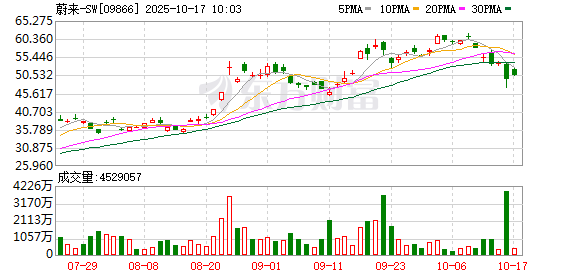
NIO(09866)

Search documents
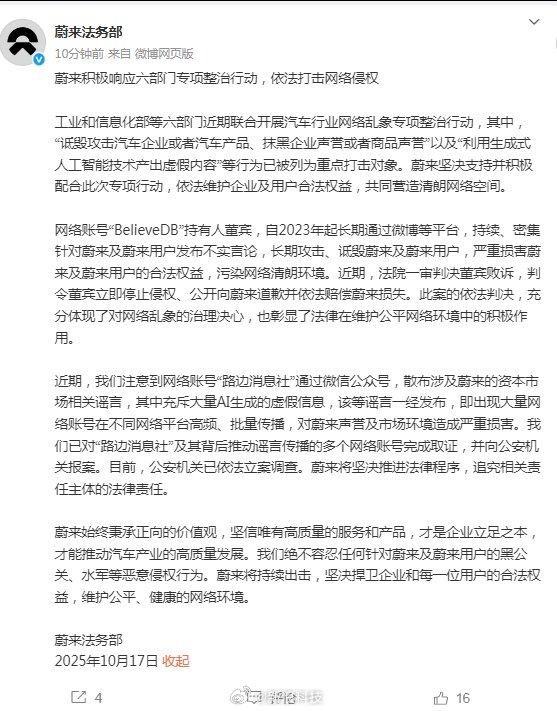
蔚来法务部 :积极响应六部门专项整治行动,依法打击网络侵权
Xin Lang Cai Jing· 2025-10-17 05:59
Core Viewpoint - NIO actively supports a special rectification action initiated by six departments to combat online infringement and misinformation in the automotive industry [1] Group 1: Company Response - NIO's legal department announced its commitment to cooperate with the special action aimed at addressing online chaos in the automotive sector [1] - The company emphasizes the importance of protecting both corporate and user rights in the digital space [1] Group 2: Industry Context - The joint action by the Ministry of Industry and Information Technology and five other departments targets behaviors such as defaming automotive companies or products and generating false content using AI technology [1] - The initiative aims to create a clearer and more trustworthy online environment for the automotive industry [1]

蔚来支持六部门整治汽车网络乱象
Xin Lang Ke Ji· 2025-10-17 05:44
Core Viewpoint - NIO supports a recent initiative by six government departments to combat online misconduct in the automotive industry, focusing on actions that defame companies or products and the use of generative AI to produce false content [1][2]. Group 1: Government Action - The Ministry of Industry and Information Technology and five other departments have launched a special campaign to address online chaos in the automotive sector, targeting behaviors such as defamation and the generation of false content using AI [1][2]. - NIO is actively cooperating with this initiative to protect the legal rights of the company and its users, aiming to create a clearer online environment [1][2]. Group 2: Legal Actions - A recent court ruling found an individual, Dong Bin, guilty of spreading false statements about NIO and its users, ordering him to cease infringement, publicly apologize, and compensate NIO for damages [2]. - NIO has gathered evidence against another account, "Lubei News Agency," which has been disseminating rumors related to NIO's capital market, and has reported this to law enforcement for investigation [3]. Group 3: Company Values and Commitment - NIO emphasizes its commitment to high-quality service and products as the foundation for its business and the advancement of the automotive industry [3]. - The company will not tolerate malicious actions such as black public relations or paid internet commentators targeting NIO and its users, and it will continue to pursue legal actions to defend its rights [3].

异动盘点1017|老铺黄金再涨超3%,加密货币概念股集体走低;台积电跌超1%,禾赛跌超1%
贝塔投资智库· 2025-10-17 04:00
Group 1: Hong Kong Stock Market - Changfei Optical Fiber Cable (06869) fell over 4%, down more than 40% from its September peak due to declining fiber optic prices and shareholder sell-offs [1] - Solar stocks continued to decline, with Fuyao Glass (03606) down over 3%, New Special Energy (01799) down over 5%, Xinyi Solar (00968) down over 5%, and Folaite Glass (06865) down over 4%. Rumors about the establishment of a polysilicon storage platform were found to be untrue, and future installation demand remains to be observed [2] Group 2: US Stock Market - United Airlines (UAL.US) fell 5.63% after reporting third-quarter revenue slightly below market expectations [3] - TSMC (TSM.US) decreased by 1.60%, with Q3 net profit reaching a record high of 452.3 billion New Taiwan dollars [3] - Micron Technology (MU.US) rose 5.52% as Morgan Stanley upgraded its rating from "hold" to "buy" [4] Group 3: Technology and Innovation - Google (GOOGL.US) increased by 0.17% after launching a new video generation model, Veo 3.1, which improved audio output and editing control [4] - Thermo Fisher Scientific (TMO.US) rose 1.69% as it collaborates with OpenAI to enhance drug development speed and success rates [4] Group 4: Other Notable Movements - DoorDash (DASH.US) fell 2.18% after announcing a partnership with Waymo to launch autonomous delivery services [5] - Derin Holdings (01709) rose over 3% after signing a strategic cooperation agreement with Antalpha to promote digital asset business [5] - NIO-SW (09866) increased over 2% after responding to a lawsuit from a Singapore sovereign wealth fund, stating that the allegations have no factual basis [5]





天猫“双11”首次全面落地AI,恒生科技ETF天弘(520920)上市七日大幅“吸金”超13亿元
2 1 Shi Ji Jing Ji Bao Dao· 2025-10-17 03:45
Group 1 - The Hong Kong stock market opened lower, with the Hang Seng Tech ETF Tianhong (520920) down 1.8% as of the report, showing a premium trading clearly during the session [1] - Despite fluctuations since its listing on September 30, the Hang Seng Tech ETF Tianhong has attracted significant capital inflow, accumulating over 1.3 billion yuan in net inflow over 7 trading days as of October 16 [1] - The Hang Seng Tech ETF closely tracks the Hang Seng Tech Index, which consists of the top 30 Hong Kong stocks related to technology, covering sectors such as information technology, consumer discretionary, and communication services [1] Group 2 - The investment value of Hong Kong tech stocks has risen under the AI wave, with the global AI computing power industry chain continuing to improve [2] - There is a pressing demand for domestic technology autonomy, positioning the Hong Kong tech sector as a core asset hub for domestic AI, benefiting directly from industry development trends [2] - Southbound capital has seen a net inflow exceeding 1 trillion yuan this year, with increased allocation to Hong Kong stocks providing ample liquidity support for the tech sector [2]

股价一度涨超6%,蔚来回应被起诉
Xin Lang Cai Jing· 2025-10-17 03:34
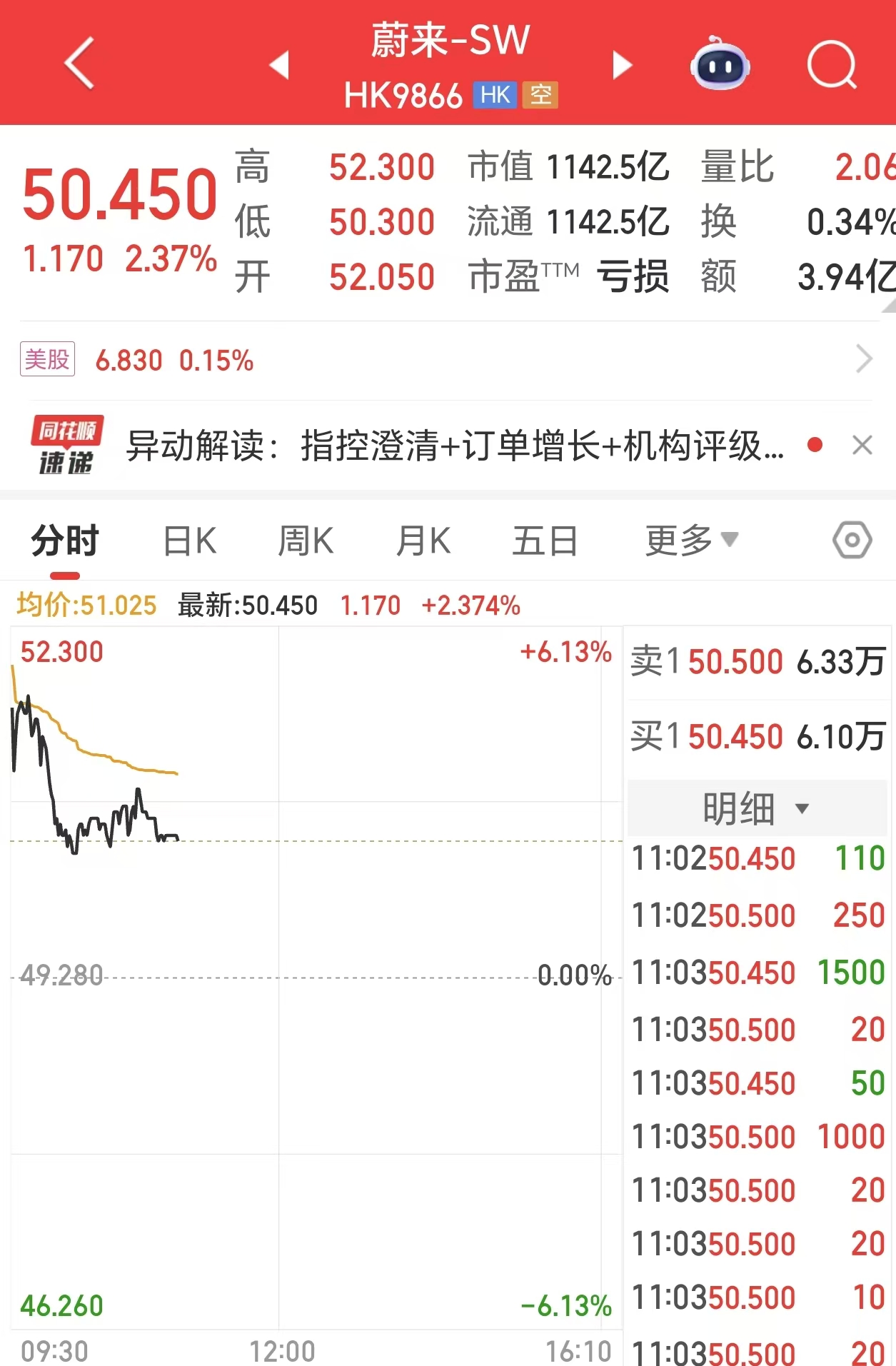
Core Viewpoint - NIO's stock experienced significant volatility following a lawsuit from Singapore's sovereign wealth fund, GIC Private Limited, alleging securities fraud related to inflated revenues and profits through a partnership with Wuhan Weinan Battery Asset Co., Ltd [5][7]. Group 1: Stock Performance - On October 17, NIO's stock opened with a surge, reaching a peak increase of over 6%, before settling at a 2.37% rise, priced at HKD 50.45 per share, with a market capitalization of HKD 114.25 billion [1]. - Following the lawsuit news, NIO's stock dropped by 8.99% to close at HKD 49.28 per share [5]. Group 2: Legal Issues - GIC Private Limited filed a lawsuit against NIO and its executives in a U.S. court, claiming that the company misled investors, resulting in financial losses for GIC [5]. - The lawsuit is linked to allegations made by Grizzly Research LLC in June 2022, which accused NIO of financial manipulation to inflate its earnings [5][7]. Group 3: Financial Performance - NIO reported total revenue of RMB 19.01 billion for Q2 2025, reflecting a year-on-year growth of 9.0%, with a net loss attributable to shareholders of RMB 5.14 billion, a slight decrease of 0.29% year-on-year [8]. - For the first half of the year, NIO's total revenue reached RMB 31.043 billion, up 13.49% year-on-year, while the net loss attributable to shareholders was RMB 12.032 billion, narrowing by 15.87% year-on-year [8].
蔚来回应虚增收入起诉:2022年已完成独立调查,无事实依据
Xin Jing Bao· 2025-10-17 03:32
新京报贝壳财经讯(记者白昊天)10月16日,蔚来汽车针对新加坡政府投资公司(GIC)起诉蔚来一事进行 回应,称本案件不是新发生的事件,并非针对蔚来近期经营状况,源于2022年6月做空机构灰熊(Grizzly Research LLC)在一份做空报告中对蔚来的不实指控。该报告并无依据,包含许多错误、无根据的推测 以及误导性结论。为保护全体股东权益,2022年8月,公司董事会独立委员会在第三方国际律所和法证 会计师事务所的协助下,针对做空报告完成了独立内部调查,相关指控均无事实依据。 近日,GIC指控蔚来通过与其合作伙伴共同成立的武汉蔚能电池资产有限公司虚增收入和利润,误导投 资者,导致GIC遭受投资损失。 ...
港股新能源车板块午后走低,蔚来-SW跌超8%
Xin Lang Cai Jing· 2025-10-17 03:05
(来源:科创100ETF基金) 港股新能源车板块午后走低,蔚来-SW跌超8%,小鹏汽车-W跌超4%,小米集团-W跌超3%,长城汽车 (601633)、零跑汽车跟跌。 ...

港股速报|蔚来最新回应 股价高开超5%
Mei Ri Jing Ji Xin Wen· 2025-10-17 02:58
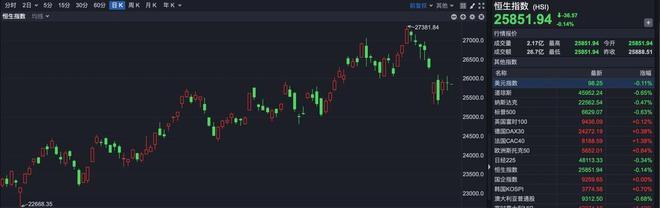
Market Overview - The Hong Kong stock market is experiencing weak fluctuations, with the Hang Seng Index at 25,851.94 points, down 36.57 points or 0.14% [1] - The Hang Seng Technology Index is reported at 5,999.48 points, down 4.08 points or 0.07% [2] Company Focus - NIO (09866.HK) has officially responded to a lawsuit from Singapore's Government Investment Corporation (GIC), which accuses NIO of inflating revenue and profits through a partnership with Wuhan WeNeng Battery Asset Co., misleading investors and causing financial losses [4] - NIO stated that the lawsuit is not a new event and stems from a 2022 short-seller report by Grizzly Research, which the company claims contains numerous inaccuracies and misleading conclusions [4] - Following the news, NIO's stock initially dropped over 13%, closing with an 8.99% decline, but rebounded by over 5% in early trading the next day [4] Sector Performance - In the market, technology stocks are mostly declining, with JD.com down nearly 0.5%, while Alibaba, Tencent, and Meituan experienced slight pullbacks [5] - Gold stocks are performing well, with Zijin Mining rising over 5%, and other gold companies like Tongguan Gold and Zhaojin Mining increasing by over 3% [5] - The innovative drug sector continues to rise, with Hansoh Pharmaceutical gaining over 3% [5] Market Outlook - Analysts predict a strong performance for the Hong Kong stock market starting in 2025, with the Hang Seng Index expected to rise by 31% and the Hang Seng Technology Index by 40%, driven by structural improvements in market earnings [6] - Continuous inflow of capital and a potential interest rate cut cycle by the Federal Reserve are expected to enhance market liquidity, promoting corporate buybacks and IPO activity [6] - The Hang Seng Index is anticipated to fluctuate between 24,500 and 26,500 points in the fourth quarter, with a long-term bullish outlook [6] - Short-term market conditions suggest a lack of clear positive catalysts, leading to potential continued fluctuations around key levels, with a strategy of "buying low, not chasing high" recommended [6]
恒生科技指数跌幅扩大至2%,蔚来盘初逆势上涨
Mei Ri Jing Ji Xin Wen· 2025-10-17 02:07
Core Viewpoint - The Hong Kong stock market is experiencing a collective decline, particularly in the Hang Seng Technology Index, which has dropped over 2%, with significant weakness observed in tech stocks [1] Group 1: Market Performance - The Hang Seng Technology Index ETF (513180) is following the index's downward trend, with major holdings like Horizon Robotics, Huahong Semiconductor, and SMIC leading the decline, while NIO and Haier Smart Home show gains, with NIO rising over 4.5% at one point [1] - As of October 16, the latest valuation (PETTM) of the Hang Seng Technology Index ETF (513180) is 22.88 times, which is at approximately the 28.79% valuation percentile since the index's inception, indicating that over 70% of the time, valuations have been higher than the current level [1] Group 2: Legal Issues and Company Response - The Singapore Government Investment Corporation (GIC) has filed a lawsuit against NIO, alleging that the company inflated revenue and profits, misleading investors and causing GIC to incur investment losses [1] - NIO's stock fell nearly 9% by the end of trading on the previous day, and the company responded by stating that the lawsuit is not a new issue but stems from a short-selling report released by Grizzly Research in 2022, asserting that an independent internal investigation found no factual basis for the allegations [1] Group 3: Investment Opportunities - The Hang Seng Technology Index remains in a historically undervalued range, with characteristics such as high elasticity and high growth potential, suggesting greater upward momentum [1] - Investors without a Hong Kong Stock Connect account may consider using the Hang Seng Technology Index ETF (513180) to gain exposure to core Chinese AI assets [1]
港股蔚来高开超5%
Mei Ri Jing Ji Xin Wen· 2025-10-17 02:03
Core Insights - NIO-SW shares in Hong Kong opened with a rebound of over 5% after a nearly 9% decline the previous day [2] Company Summary - NIO-SW experienced a significant drop of nearly 9% in the previous trading session [2] - The stock showed a strong recovery with an opening increase of over 5% on October 17 [2]