XPENG(09868)

Search documents
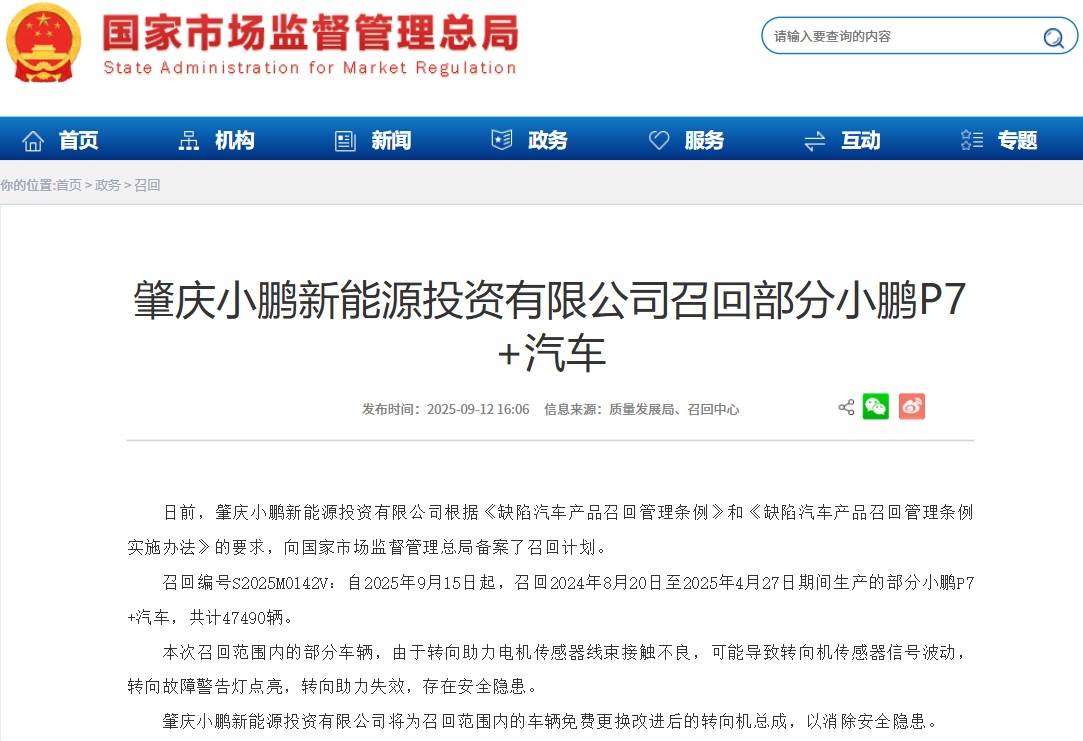
转向机故障终有说法!小鹏汽车主动召回部分P7+,专家:车企应建立“用户运营+质量监控”双通道
Mei Ri Jing Ji Xin Wen· 2025-09-13 11:32
Group 1 - The core point of the news is that Xiaopeng Motors has initiated a recall of 47,490 units of its P7+ model due to potential steering system failures caused by a faulty sensor harness [1][2][3] - The recall will begin on September 15, and the company will replace the steering assembly for free to eliminate safety risks [1][3] - The recall process was delayed due to the need for a comprehensive plan and the time required to manufacture the new steering components [2][4] Group 2 - Some P7+ owners reported steering issues, including failures while driving at high speeds, raising safety concerns [3][4] - The recall has garnered significant media attention compared to other automakers, indicating a heightened public interest in new energy vehicle recalls [5][6] - Analysts suggest that new energy vehicles often incorporate advanced technologies, which can lead to unique issues that consumers may find concerning [6][8] Group 3 - The recall highlights the broader issue within the new energy vehicle industry, where there is often a focus on technology and performance at the expense of quality and safety [4][9] - Experts emphasize the importance of a robust after-sales service system for effective recall management, especially for companies that primarily sell online [9] - The proactive approach of Xiaopeng Motors in addressing the recall is seen as a responsible action compared to companies that may conceal defects [4][5]

雷军突曝:已发起诉讼!网友:真的很生气
Zhong Guo Ji Jin Bao· 2025-09-13 11:17
Group 1 - The core issue of black public relations affecting companies like Xiaomi, Xpeng, NIO, and Deep Blue has been highlighted, with legal actions initiated against numerous accounts involved in spreading false information [2][3] - Xiaomi's CEO Lei Jun stated that the legal department has gathered evidence from hundreds of accounts and initiated dozens of lawsuits this year, with multiple cases currently under investigation [3] - The report revealed that a car blogger with 600,000 followers charges between 18,000 to 38,000 yuan for promotional videos, indicating the financial incentives behind such black PR activities [2] Group 2 - Lei Jun emphasized the similarity in tactics used to defame car companies, including AI-generated false content and negative commentary before new product launches [2][3] - A joint action by six departments aims to combat black public relations and requires online platforms to enhance their ability to identify and manage accounts using generative AI technology for malicious purposes [3]



雷军突曝:已发起诉讼!网友:真的很生气
中国基金报· 2025-09-13 11:12
Group 1 - The core issue highlighted is the prevalence of black public relations (PR) tactics targeting automotive companies, specifically Xiaomi, Xiaopeng, NIO, and Deep Blue, with a focus on the use of AI-generated defamatory content and coordinated smear campaigns [2][3][4] - Xiaomi's CEO Lei Jun stated that the legal department has collected evidence from hundreds of accounts and initiated dozens of lawsuits this year, indicating a significant crackdown on these malicious activities [4] - The report mentions specific pricing for promotional content by automotive influencers, with fees ranging from 18,000 yuan for short videos to 38,000 yuan for longer content, showcasing the financial incentives behind such practices [2] Group 2 - A notable case cited is the incident involving a video claiming that a Xiaomi car's door could not be opened after a collision, which led to the arrest of the involved influencer and the suspension of their account since November 18, 2024 [3] - Lei Jun emphasized the similarity in tactics used against various automotive companies, including the use of AI to generate false narratives and the manipulation of online comments to discredit products before their launch [3][4] - The joint action by six government departments aims to combat black PR and online manipulation, urging platforms to enhance their monitoring and control over AI-generated content and malicious online activities [4]
针对黑公关,雷军已发起诉讼
第一财经· 2025-09-13 10:23
Core Viewpoint - The article discusses the issue of "black public relations" targeting several automotive companies, including Xiaomi, Xiaopeng, NIO, and Deep Blue, highlighting the use of AI-generated defamatory content and coordinated smear campaigns against these companies [1] Group 1 - The article mentions that the methods used to defame the companies are highly similar, involving AI-generated rumors, abusive comments towards car owners, and negative press releases before new product launches [1] - It is noted that certain platforms exhibit different traffic patterns based on the positive or negative framing of the same content [1] - The legal department of the company has collected evidence from hundreds of accounts this year and has initiated dozens of lawsuits, with multiple cases currently under investigation [1]
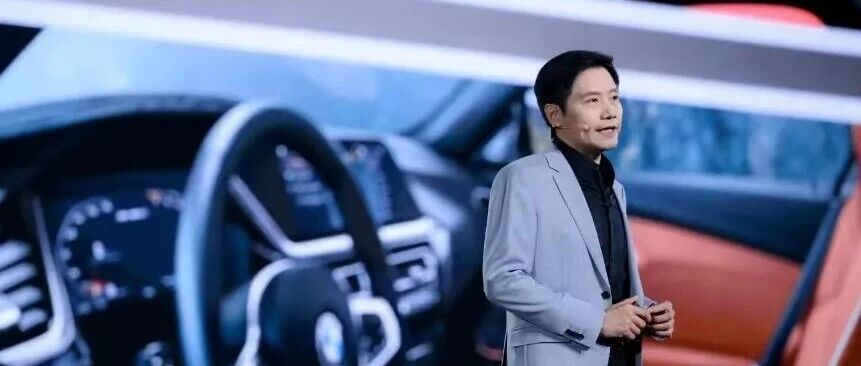
雷军:已发起诉讼
财联社· 2025-09-13 10:07
Core Viewpoint - The article discusses the issue of "black public relations" affecting several automotive companies, including Xiaomi, Xiaopeng, NIO, and Deep Blue, highlighting the use of AI-generated defamatory content and coordinated smear campaigns against these companies [1][3]. Group 1 - The methods used to defame the automotive companies are highly similar, involving AI-generated rumors, abusive comments towards car owners, and negative press releases before new product launches [1][3]. - The legal department of the companies has collected evidence from hundreds of accounts and initiated dozens of lawsuits, with multiple cases currently under investigation [2][3]. - A joint action by six government departments aims to combat black public relations and online manipulation, requiring internet platforms to enhance their identification and control of AI-generated content and malicious actors [3].
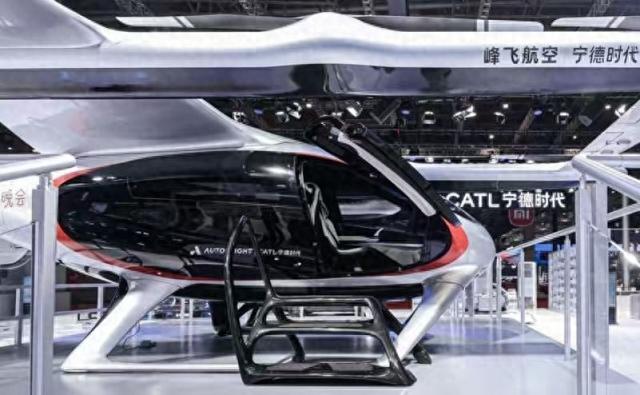
飞行汽车2035年产业规模可达1万亿元!与智能汽车产业重合度达70%
Hua Xia Shi Bao· 2025-09-13 09:38
Group 1 - The 21st China Automotive Industry Development (Teda) International Forum highlighted the importance of flying cars and eVTOLs in building a new ecosystem for integrated air-ground transportation [2][3] - The forum reached three consensus agreements focusing on emerging industries, carbon cycle ecology, and digital intelligence, with the first consensus emphasizing the need for a low-altitude economic industry system [2][3] - The low-altitude economy is seen as a crucial aspect of new aviation, encompassing drones, eVTOLs, and flying cars, which are expected to alleviate urban traffic congestion and expand urban transportation space [3][4] Group 2 - Numerous automotive companies are entering the low-altitude economy sector, transforming into integrated transportation service providers, with examples including XPeng Motors and Chery [4][5] - The flying car industry is rapidly advancing, with several companies like Geely and GAC Group making significant progress in testing and certification of their flying car models [5][6] - The integration of low-altitude economy and automotive technology is essential, with a reported 70% overlap in the industrial chain between flying cars and traditional electric vehicles [6][7] Group 3 - The collaboration between automotive and aviation sectors is driven by technological integration, focusing on power systems, auxiliary driving, and manufacturing systems [6][7] - Companies are leveraging existing automotive supply chains to reduce manufacturing costs and improve product quality, with over 80% supply chain reuse and over 90% localization reported [7][8] - The low-altitude economy market is projected to reach 10 trillion yuan by 2040, with flying cars expected to account for approximately one-third of this market by 2035 [9]



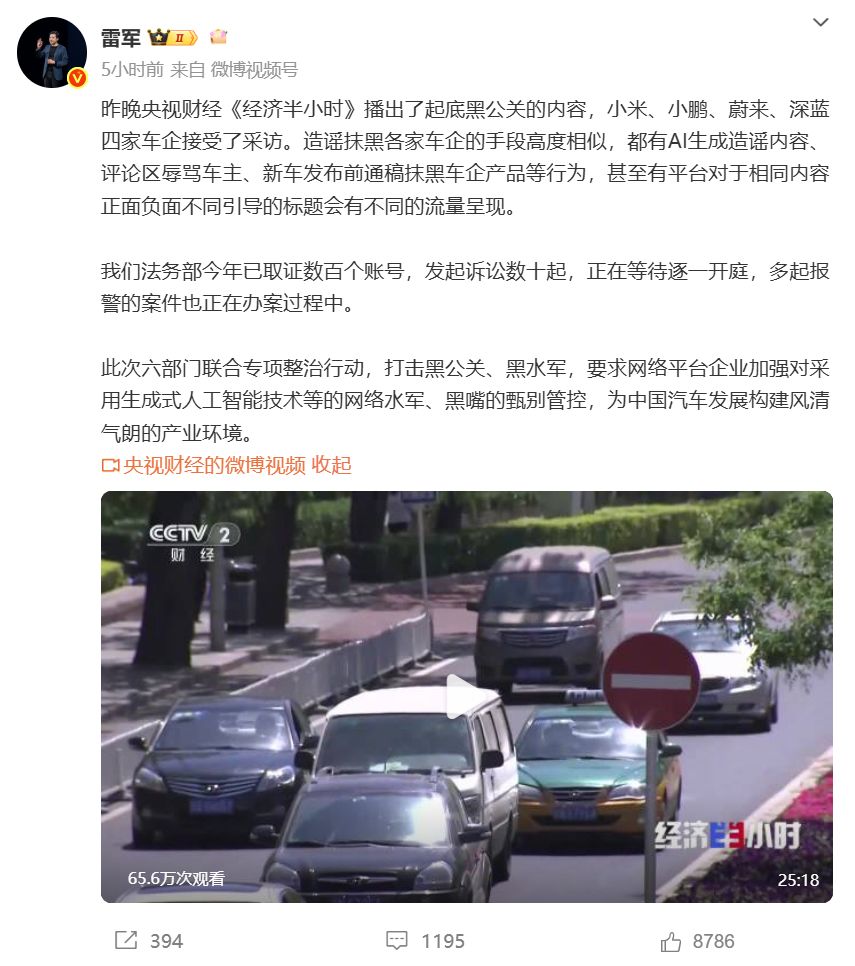
雷军:法务部今年已取证数百个账号,发起诉讼数十起!
Mei Ri Jing Ji Xin Wen· 2025-09-13 08:44
Core Viewpoint - The article discusses the issue of black public relations and online smear campaigns targeting several automotive companies in China, including Xiaomi, Xpeng, NIO, and Li Auto, highlighting the coordinated efforts by these companies to combat misinformation and protect their brand integrity [1][4][11]. Group 1: Company Responses - Xiaomi's legal department has collected evidence against hundreds of accounts and initiated multiple lawsuits in response to the smear campaigns, which involve AI-generated false content and targeted harassment [1]. - Xpeng Motors has actively responded to the Ministry of Industry and Information Technology's initiative to combat online chaos in the automotive industry, emphasizing the protection of its legal rights [4]. - NIO has reported that a specific account has published thousands of defamatory statements against the company and its users, leading to a court ruling for the removal of the content and compensation for damages [11]. Group 2: Legal Actions and Court Rulings - The Guangzhou Internet Court ruled in favor of Xpeng Motors, ordering a company to delete infringing content and issue a public apology for damages caused [4]. - Li Auto's legal team has identified multiple accounts spreading false information about its products, including fabricated complaints and misleading claims about the performance of its upcoming model, the i6 [8]. - Legal actions have been taken against various MCN organizations and accounts involved in disseminating defamatory content against NIO and other companies, with ongoing monitoring and evidence collection [11][13]. Group 3: Industry-Wide Initiative - A joint initiative by six government departments aims to crack down on black public relations and online misinformation in the automotive sector, requiring platforms to enhance their monitoring and control over AI-generated content and malicious accounts [1][4]. - The automotive industry is facing significant challenges from organized smear campaigns that disrupt market order and harm consumer rights, prompting companies to take legal and administrative actions [8][11].

从中国到澳洲,新能源汽车“维修权”之争
Jing Ji Guan Cha Wang· 2025-09-13 08:38
Core Viewpoint - Chinese electric vehicle manufacturers are facing accusations of repair monopolies in Australia, which has sparked discussions about the implications for both consumers and the industry [2][6]. Group 1: Accusations and Market Dynamics - The Australian Automotive Service and Repair Authority (AASRA) has reported that five Chinese EV companies, including BYD and Xpeng, are delaying and restricting consumers' access to non-authorized repair services, which limits competition and consumer choice [2][6]. - The repair market for electric vehicles is currently dominated by manufacturers, leading to high maintenance costs and limited options for consumers [4][9]. - The core issue lies in the closed service model of these companies, which contrasts with Australian regulations that require manufacturers to provide essential repair data to independent service providers [6][8]. Group 2: Legal and Regulatory Context - The Australian Competition and Consumer Commission (ACCC) enforces the Motor Vehicle Service and Repair Information Scheme (MVIS), which mandates that manufacturers must share diagnostic software and technical data with independent repair shops [6][8]. - Violations of this scheme can result in significant fines, with a recent example being Honda, which was fined AUD 18,780 for not providing flexible subscription options [6]. Group 3: Industry Perspectives and Future Outlook - Industry experts emphasize the need for a balanced approach that allows for safety while promoting fair competition in the repair market [9]. - The current situation reflects a clash between domestic practices of authorized service models and the regulatory environment in international markets, highlighting the importance of adapting business models for global expansion [8][9]. - There is a call for collaboration among manufacturers, independent repair shops, regulatory bodies, and insurance companies to create a more open and competitive aftermarket ecosystem [9].



小米、蔚来、小鹏多家车企高管共同抵制「黑公关」,李斌:有人嚣张的说赔给你,你找我来拿
Xin Lang Ke Ji· 2025-09-13 08:13
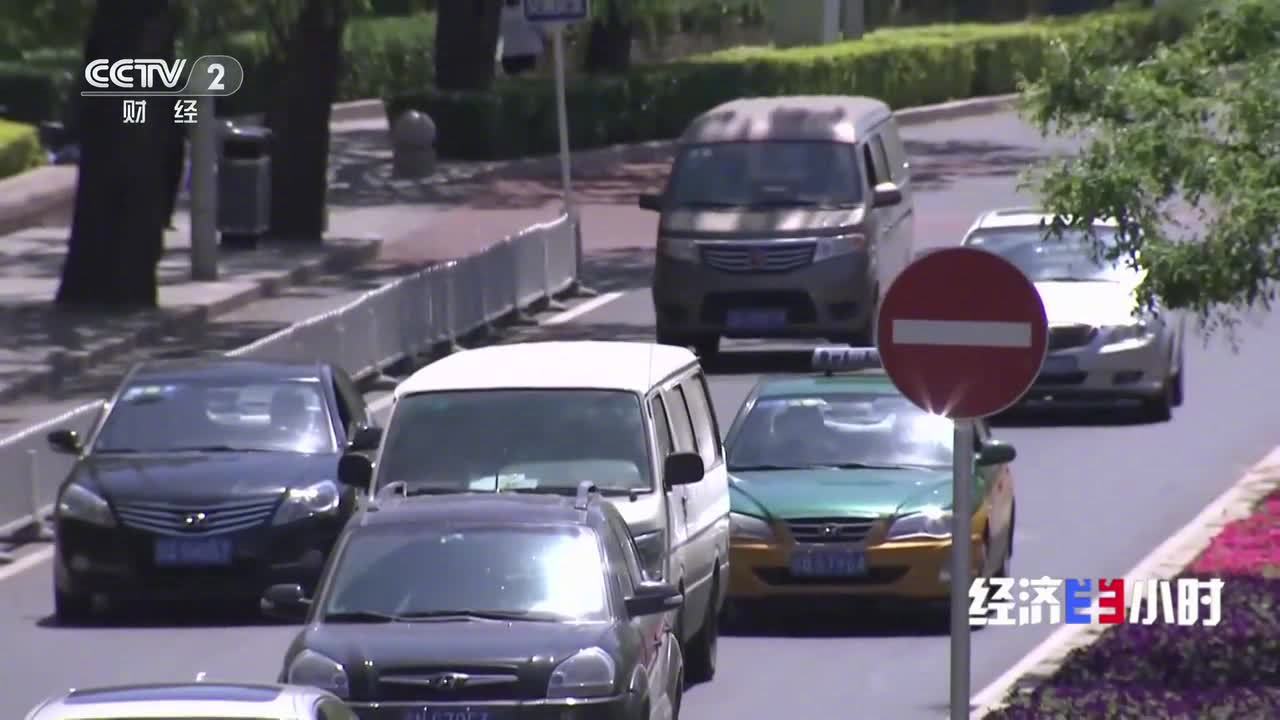
Core Viewpoint - The investigation by "Economic Half Hour" highlights the issue of "black public relations" in the electric vehicle industry, where false information is spread to damage company reputations, indicating a need for stronger regulatory measures and industry cooperation [1]. Group 1: Industry Perspectives - NIO's chairman Li Bin emphasized the low investment cost of black PR operations compared to the high costs of vehicle development, which involves significant resources and manpower [1]. - Changan Automobile's vice president, Deng Chenghao, stated that while constructive criticism is welcome, malicious attacks that distort facts are harmful and should be opposed [1]. - Xiaomi Automobile's vice president, Li Xiaoshuang, called for increased penalties for black PR activities to raise the costs associated with such actions [1]. Group 2: Regulatory Actions - The Ministry of Industry and Information Technology, along with five other departments, announced a three-month nationwide campaign to address online chaos in the automotive industry [1]. - Xiaopeng Motors' vice president, Zheng Yeqing, pointed out the challenges of civil litigation against black PR, suggesting that measures like account bans could serve as more effective deterrents [1].
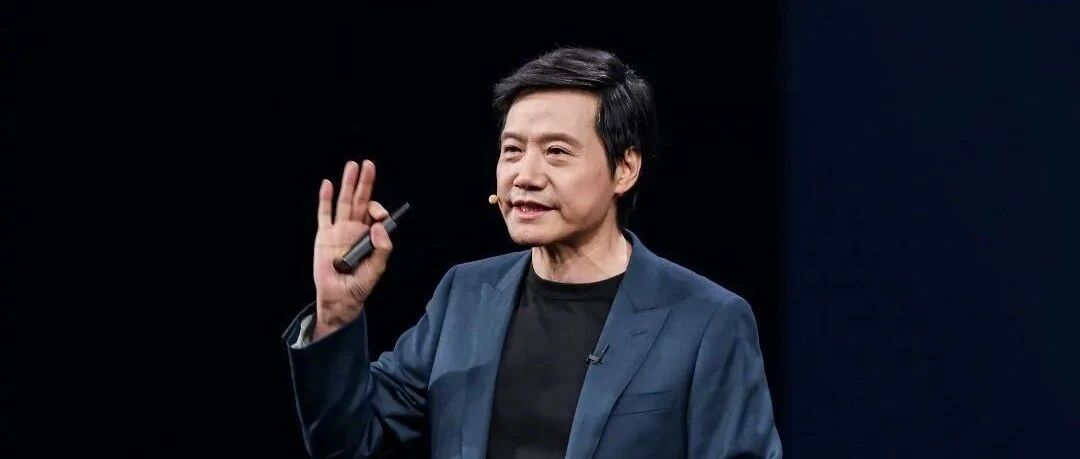
雷军回应“汽车黑公关”:小米法务部今年已取证数百个账号、发起诉讼数十起,正等待逐一开庭
Xin Lang Cai Jing· 2025-09-13 06:05
Core Viewpoint - The article discusses the issue of "black public relations" targeting various car companies, highlighting the legal actions taken by Xiaomi against malicious online activities [1][2]. Group 1: Legal Actions - Xiaomi's legal department has collected evidence from hundreds of accounts this year and has initiated dozens of lawsuits, which are currently awaiting court hearings [1][2][4]. - Multiple cases reported to the authorities are also under investigation [2][4]. Group 2: Industry Context - The report from CCTV Finance revealed that several car companies, including Xiaomi, Xiaopeng, NIO, and Deep Blue, have been targeted by similar smear tactics, including AI-generated false content and derogatory comments against car owners [2][4]. - A joint action by six departments aims to combat black public relations and online manipulation, requiring internet platforms to enhance their identification and control of malicious actors using generative AI technology [2][4].