XPENG-W(09868)

Search documents
港股异动 | 小鹏汽车-W(09868)涨近4% 2026款小鹏P7将于本周五登陆欧洲市场
智通财经网· 2026-01-06 03:25
据悉,作为小鹏汽车首款面向全球发布的车型,新款小鹏P7+采用全球统一的生产与安全标准,将于 2026年1月8日在中国上市,并于1月9日在欧洲上市。日前,2026款小鹏P7+和小鹏G7相继亮相,新车定 档1月8日正式上市。两款新车均将推出增程动力车型,并将升级第二代VLA辅助驾驶大模型和三颗图 灵AI芯片,算力达到2250TOPS,硬件支持更高级别的辅助驾驶能力。 智通财经APP获悉,小鹏汽车-W(09868)涨近4%,截至发稿,涨3.85%,报79.6港元,成交额5.58亿港 元。 消息面上,1月5日,小鹏汽车-W宣布,2026款小鹏P7+车型已在奥地利格拉茨工厂顺利完成试装,目前 中奥团队正协同推进后续研发与生产流程,全力保障高质量交付。据介绍,该工厂拥有百年制造积淀和 超过300万辆整车量产经验,是全球最大且唯一生产梅赛德斯-奔驰G级车型的制造商。 ...
中国汽车-重估拐点框架:2026 年增长放缓背景下的资本支出扩张与竞争-China Automobiles_ Revisiting inflection framework_ Capex expansion & competition amid slowing growth into 2026
2026-01-06 02:23
Summary of China Automobiles Conference Call Industry Overview - The China automobile industry is experiencing a cyclical assessment regarding overcapacity and competition, particularly as growth is expected to slow into 2026 [1] - Government subsidies and anti-involution policies have been implemented to stabilize pricing and profitability within the industry [1] Key Financial Metrics - OEMs raised a total of **US$15.6 billion (Rmb111 billion)** through equity issuance in 2025, facilitating new product investments and market competition [1][31] - OEM combined capital expenditure (capex) increased by **31% year-over-year** in Q3 2025, although this was a moderation from **66% year-over-year** in Q2 2025 [4][7] - Industry cash profit (EBITDA) declined by **10% year-over-year** in Q3 2025, compared to a **1% decline** in Q2 2025 [4][24] Market Dynamics - In 2026, **119 new NEV models** are expected to be launched, with domestic passenger vehicle growth projected to slow to **-2%** and new energy vehicle (NEV) growth at **+11% year-over-year** [2] - Exports are anticipated to be a bright spot, with overseas markets poised for NEV mass adoption [2] Competitive Landscape - Managements of various OEMs remain optimistic about their individual company growth despite a conservative outlook for the overall auto industry in 2026 [4][18] - The majority of OEMs are still above cash cost levels, indicating that industry consolidation may be prolonged due to less concern over cash positions [18][19] Company-Specific Insights - **BYD** and **XPeng** are highlighted as better positioned for overseas exposure, with expanding sales networks and new export models [2] - **Li Auto** plans to launch facelift models and increase R&D expenses while focusing on overseas markets [36] - **Nio** aims for a monthly sales volume of **50,000 units** in 1H26, driven by new model launches and improved pricing strategies [38] - **SAIC** targets **1 million units** in sales for 2026, with a focus on new model launches and cost-cutting measures [36] - **GAC** aims to increase export volume to **250,000 units** in 2026, up from **130,000 units** in 2025 [36] Investment Considerations - The effectiveness of government subsidies is expected to weaken, with a projected **15%** stimulation effectiveness in 2026, leading to an estimated **1.8 million** units of stimulated demand [51] - Domestic NEV retail sales volume is forecasted at **14 million** units in 2026, reflecting an **11% year-over-year** increase [52] - Export volume for passenger vehicles is expected to reach **7.4 million** units in 2026, with NEV exports projected to grow by **35% year-over-year** [53] Conclusion - The China automobile industry is at a critical juncture with intensifying competition and a shift towards overseas markets. Companies are focusing on cost control, R&D investments, and expanding their international presence to navigate the challenges ahead [18][35]


港股小鹏汽车-W涨超3%
Mei Ri Jing Ji Xin Wen· 2026-01-06 02:08
每经AI快讯,小鹏汽车-W(09868.HK)涨超3%,截至发稿涨3.2%,报79.1港元,成交额2.08亿港元。 ...
港股异动 | 小鹏汽车-W(09868)涨超3% 新款小鹏P7+和G7将于本周上市
智通财经网· 2026-01-06 01:56
智通财经APP获悉,小鹏汽车-W(09868)涨超3%,截至发稿,涨3.2%,报79.1港元,成交额2.08亿港 元。 消息面上,1月5日,小鹏汽车宣布,2026款小鹏P7+车型已在奥地利格拉茨工厂顺利完成试装,目前中 奥团队正协同推进后续研发与生产流程,全力保障高质量交付。作为小鹏汽车首款面向全球发布的车 型,新款小鹏P7+采用全球统一的生产与安全标准,将于2026年1月8日在中国上市,并于1月9日在欧洲 上市。此前小鹏汽车宣布,1月8日,小鹏的产品大幕正式开启。新款小鹏P7+和G7正式开启"一车双能 时代"。 ...
小鹏汽车-W涨超3% 新款小鹏P7+和G7将于本周上市
Zhi Tong Cai Jing· 2026-01-06 01:55
小鹏汽车-W(09868)涨超3%,截至发稿,涨3.2%,报79.1港元,成交额2.08亿港元。 消息面上,1月5日,小鹏汽车宣布,2026款小鹏P7+车型已在奥地利格拉茨工厂顺利完成试装,目前中 奥团队正协同推进后续研发与生产流程,全力保障高质量交付。作为小鹏汽车首款面向全球发布的车 型,新款小鹏P7+采用全球统一的生产与安全标准,将于2026年1月8日在中国上市,并于1月9日在欧洲 上市。此前小鹏汽车宣布,1月8日,小鹏的产品大幕正式开启。新款小鹏P7+和G7正式开启"一车双能 时代"。 ...
智通港股沽空统计|1月6日
智通财经网· 2026-01-06 00:28
Group 1 - The top short-selling ratios are led by China Resources Beer (100.00%), BYD Company (100.00%), and Xiaomi Group (75.49%) [1][2] - The highest short-selling amounts are recorded for Ping An Insurance (2.081 billion), Alibaba (1.871 billion), and Xiaomi Group (1.624 billion) [1][2] - The highest deviation values are for BYD Company (43.54%), CIFI Holdings (39.74%), and Xiaomi Group (34.28%) [1][2] Group 2 - The top short-selling amounts table shows Ping An Insurance at 2.081 billion, Alibaba at 1.871 billion, and Xiaomi Group at 1.624 billion [2] - The top short-selling ratios table lists China Resources Beer and BYD Company both at 100.00%, followed by Xiaomi Group at 75.49% [2] - The top short-selling deviation values table highlights BYD Company with a deviation of 43.54%, followed by CIFI Holdings at 39.74% and Xiaomi Group at 34.28% [2]




小鹏汽车-W(09868):港股研究|公司点评|小鹏汽车-W(09868.HK):小鹏汽车2025年12月销量点评:总交付3.75万辆,同环比增长,X9交付强势
Changjiang Securities· 2026-01-05 23:30
Investment Rating - The investment rating for the company is "Buy" and it is maintained [6]. Core Insights - The company delivered a total of 37,508 vehicles in December 2025, representing a year-on-year increase of 2.2% and a month-on-month increase of 2.1% [2][4]. - For the entire year of 2025, the company achieved cumulative deliveries of 429,000 vehicles, marking a significant year-on-year growth of 125.9% [2][4]. - The launch of the new X9 model has been particularly strong, with 5,424 units delivered in December, achieving a month-on-month increase of 68% and a year-on-year increase of 289% [6]. - The company is expected to continue its growth trajectory with new models like the P7+ and G7 set to be released, enhancing its sales cycle [6]. - The overseas market has also shown promising growth, with 45,000 vehicles delivered internationally in 2025, reflecting a year-on-year increase of 96% [6]. - The company anticipates Q4 2025 deliveries to be between 125,000 and 132,000 units, which would represent a year-on-year growth of 36.6% to 44.3% [6]. Summary by Relevant Sections Sales Performance - December 2025 deliveries totaled 37,508 vehicles, with a year-on-year growth of 2.2% and a month-on-month growth of 2.1% [2][4]. - Cumulative deliveries for 2025 reached 429,000 vehicles, up 125.9% year-on-year [2][4]. New Product Launches - The X9 model has seen strong performance, with December deliveries reaching 5,424 units, marking a record for the model [6]. - Upcoming releases of the P7+ and G7 models are expected to further boost sales [6]. International Expansion - The company delivered 45,000 vehicles in international markets in 2025, a 96% increase year-on-year [6]. - The company has established a presence in 60 countries and regions globally, with local production in Malaysia starting in December 2025 [6]. Future Outlook - The company is positioned for significant revenue growth, with projected revenues of approximately 75.1 billion and 112.1 billion for 2025 and 2026, respectively [6]. - The anticipated price-to-sales ratios for 2025 and 2026 are 1.8 and 1.2, respectively, supporting the "Buy" rating [6].
智驾系列-2026迎-城区智驾-平权
2026-01-05 15:42
Summary of Conference Call Records Industry Overview - The focus is on the autonomous driving industry, particularly the trend towards urban autonomous driving democratization by 2026, with companies like BYD leading the charge [1][5]. Key Points and Arguments - **Urban Autonomous Driving Democratization**: - BYD is expected to increase the sales proportion of high-end urban autonomous driving models from 10% in 2025 to around 40% in 2026 [1][9]. - Other companies such as Chery and Geely, along with joint venture brands, are anticipated to follow suit [1][9]. - **Growth in Autonomous Logistics and Mining**: - Companies like New Stone and White Rhino are projected to experience rapid growth in autonomous logistics by 2026, with significant revenue potential [1][7]. - Companies like Xidi Zhijia and Zhongyou Technology are showing promising commercialization progress in mining automation [1][7]. - **Technological Synergy**: - There is a strong correlation between autonomous driving technology and robotics, with companies developing algorithms for autonomous driving also having competitive advantages in robotics [1][8]. - **Hardware Solutions for Cost Reduction**: - To achieve broader urban autonomous driving capabilities, companies need to adjust hardware solutions to lower costs, with solutions like cockpit integration being explored [1][10]. - **Autonomous Driving Chip Market Growth**: - The autonomous driving chip market is expected to grow rapidly, with Horizon Robotics projected to sell approximately 2 million low-end chips and 2 million G6M high-performance chips by the end of 2025, generating around 3.5 billion RMB in revenue [1][11]. Potential Companies in Investment Directions - **Core Algorithms and Chips**: - Companies such as Horizon Robotics, Xiaopeng Motors, and Li Auto are highlighted as having strong potential in core algorithms and chips [4]. - **Steering and Braking Control**: - Zhejiang Shibao, Nissin, and Wanlong Magnetic Plastic are noted for their performance in steering control, while Bertley and Asia-Pacific Holdings are recognized in braking control [4]. - **RoboTaxi and L4 Operators**: - Companies like WeRide, Pony.ai, and Qianli Technology are noted for their strong technical capabilities and potential for rapid fleet expansion in the RoboTaxi and L4 autonomous driving sectors [4]. Additional Important Insights - **Impact of Urban Autonomous Driving on User Experience**: - The democratization of urban autonomous driving is crucial as it allows more users to experience the benefits of smart driving technology beyond just highway scenarios [5]. - **Localization of Tesla's FSD in China**: - Tesla is accelerating its localization efforts in China by recruiting HPC talent to enhance its FSD system's performance on local roads [3][12][13]. - **Robot Taxi Developments**: - Tesla has introduced a cleaning fee policy for its Robot Taxi service, indicating preparations for large-scale deployment in multiple cities by 2026 [3][14]. - **Integration of Language Models in Autonomous Driving**: - The Grok model is being integrated with Tesla's FSD, allowing for enhanced interaction and environmental feedback, with further developments expected in future versions [3][15]. - **Waymo's Innovations**: - Waymo is integrating its Gemini language model into its autonomous taxi service, showcasing the potential for combining language and driving models [16]. - **Future Influences on Autonomous Driving Technology**: - The development of autonomous driving technology will depend on the integration of large language models and physical world understanding, alongside ongoing industry innovations [17].

降息,突发重磅!美股、黄金全线飙升!中概股突变!什么情况?
Xin Lang Cai Jing· 2026-01-05 15:06
本周,美国将迎来重磅数据发布的一周,周五,美国12月季调后非农就业人数、失业率及新屋开工数据 集体公布,从就业和房地产两个维度把脉美国经济,美联储明年政策路径基本敲定。 炒股就看金麒麟分析师研报,权威,专业,及时,全面,助您挖掘潜力主题机会! 美联储方面对降息又有新的表态。 1月5日,美股三大指数集体高开。明星股英特尔一度涨逾5%。标普500能源板块创下一年多来最高水 平,最新上涨2.4%。 中概股方面,纳斯达克中国金龙指数突然大幅回调,截至发稿跌约1.2%,个股方面,网易跌超4%,百 度、小鹏汽车跌近4%。中概股今日出现回调或因此前跳空大涨,上一个交易日,纳斯达克中国金龙指 数跳空大涨逾4%。 晚间,受地缘政治紧张等因素影响,黄金与白银继续飙涨,截至发稿,现货黄金上涨超2%,现货白银 涨逾4%。 美联储方面,2026年FOMC票委、明尼阿波利斯联储主席卡什卡利周一发表了对降息前景的中性表态, 他认为,美国的基准利率可能已接近"中性水平",未来的货币政策将取决于经济数据的走向。 卡什卡利指出,尽管过去两年市场一直预期经济会放缓,但美国经济表现出的韧性远超预期。 他认为,这说明目前的货币政策对经济的抑制作用并不 ...


造车新势力2025生死局:零跑交付59万辆成黑马,蔚小理加速转型
2 1 Shi Ji Jing Ji Bao Dao· 2026-01-05 14:59
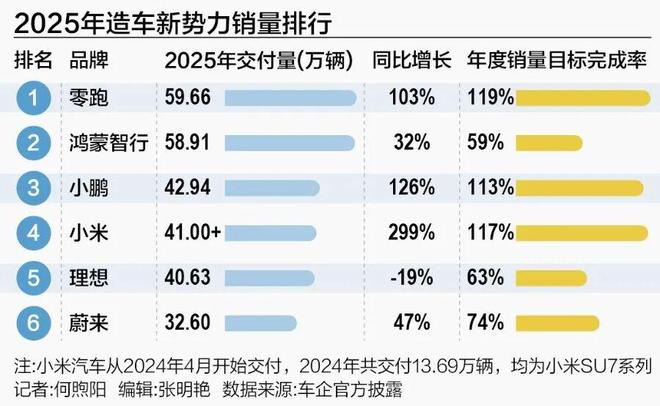
Core Insights - The 2025 new energy vehicle market has shown a stark polarization, with new entrants like "Honglingmi" (Hongmeng Zhixing, Leap Motor, Xiaomi) rapidly gaining market share while established players like NIO and Li Auto struggle to maintain their positions [1][4] Group 1: Market Performance - Leap Motor achieved the highest sales among new forces with 596,600 units delivered in 2025, marking a 103% year-on-year growth and exceeding its annual sales target by 19% [2][4] - Hongmeng Zhixing followed closely with 589,100 units delivered, a 32% increase, although it did not meet its annual sales target [2][6] - Xiaomi delivered over 410,000 units, achieving a remarkable 299% growth and surpassing its sales target by 17% [2][5] - NIO and Li Auto faced challenges, with NIO delivering 326,000 units (47% of its target) and Li Auto delivering 406,300 units, a 19% decline from the previous year [2][10] Group 2: Strategic Developments - Leap Motor's success is attributed to its focus on in-house research and development, establishing 17 component factories and achieving a parts-sharing rate of 88% across its models, which helps maintain competitive pricing [5][6] - Xiaomi's strategy leverages its consumer electronics background, emphasizing user engagement and ecosystem integration, which has proven effective in rapidly building market presence [6][8] - Hongmeng Zhixing is diversifying its product range to reduce reliance on its flagship model, with new models achieving significant sales growth [6][8] Group 3: Challenges and Future Outlook - Leap Motor must prove its capabilities in the high-end market while addressing its shortcomings in smart technology investments [7][8] - Xiaomi faces potential backlash from its strong personal branding and must navigate user sentiment carefully following safety incidents [8] - The traditional leaders, NIO and Li Auto, are undergoing painful transformations, with NIO focusing on operational efficiency and product refinement, while Li Auto is struggling with declining sales and competition from new entrants [10][17] Group 4: Industry Dynamics - The market is witnessing a brutal elimination process, with companies like Neta facing bankruptcy and others like WM Motor and HiPhi attempting to revive their operations amid financial difficulties [19][20] - The competition is shifting towards a focus on systemic capabilities, where companies that can balance technology development, product iteration, and operational efficiency will thrive [24][25]