BIDU(09888)

Search documents
两个月回撤超15%!恒科指数长期逻辑不改,市场关注AI落地效果
Zheng Quan Shi Bao· 2025-11-19 23:48
Core Viewpoint - Since 2025, the Hong Kong stock market, led by technology and innovative pharmaceuticals, has experienced a bull market, with the Hang Seng Index rising over 30% and the Hang Seng Tech Index exceeding 50%. However, since October, the Hang Seng Tech Index has seen a significant pullback of over 15% in less than two months, with a recent streak of four consecutive declines. Analysts believe that this short-term adjustment does not alter the long-term investment logic for leading tech stocks in Hong Kong, especially with the gradual implementation of AI technologies by companies like Tencent and Alibaba, which is expected to drive a second growth phase for internet enterprises. The long-term investment value of the Hang Seng Tech Index remains promising due to valuation advantages, funding support, and AI-driven industrial upgrades [1][3][4]. Group 1: Market Performance - Before October, Hong Kong tech stocks were performing well, with 9 out of 30 constituents of the Hang Seng Tech Index rising over 100%, and the top performer, Hua Hong Semiconductor, increasing nearly 270%. Other notable stocks like Tencent, Baidu, and Xiaomi also saw gains exceeding 50%, while only Meituan and Haier Smart Home experienced declines, with Meituan dropping over 30% [1][2]. - After October, the situation changed dramatically, with only 4 stocks rising, while 7 stocks fell over 20%, including Li Auto and Sunny Optical Technology, which both dropped over 27%. Tencent and Meituan also saw declines of around 5% [2]. Group 2: Fund Flows and Market Sentiment - There has been a noticeable outflow of southbound funds from certain Hang Seng Tech constituents, with Alibaba experiencing the highest net sell-off of 2.5 billion HKD, followed by Li Auto and Sunny Optical Technology with net sell-offs of 1.2 billion HKD and several hundred million HKD, respectively [2]. - The recent downturn in the Hang Seng Tech Index is attributed to three main factors: excessive prior gains leading to profit-taking, the U.S. imposing tariffs and tightening software export controls, and a mini-crash in U.S. AI stocks resulting in a significant drop in global tech risk appetite [2][3]. Group 3: Long-term Investment Logic - Despite short-term volatility, the long-term investment logic for the Hang Seng Tech Index remains intact, as it comprises internet giants and companies in semiconductors and electric vehicles that are considered scarce assets for both domestic and global investors [3][4]. - Analysts suggest that the current valuation of the Hang Seng Index and Hang Seng Tech Index is still significantly lower than their peaks in 2021, indicating potential for recovery and growth in the coming years [3]. Group 4: AI and Market Revaluation - The market is increasingly focused on the tangible effects of AI implementation, moving from a narrative-driven approach to one that emphasizes financial performance. Companies like Tencent and Alibaba are seeing revenue growth attributed to AI applications, with Tencent reporting a 15% year-on-year revenue increase and Alibaba planning substantial investments in AI and cloud infrastructure [5][6]. - The structural revaluation driven by AI and robotics is expected to benefit comprehensive platforms like Tencent, Alibaba, and Baidu, while smaller companies lacking their own ecosystems may face marginalization during the global de-bubble process [6].




【早报】英伟达,业绩全面超预期;中金公司,拟收购两家上市券商
财联社· 2025-11-19 23:10
Industry News - CICC, Dongxing Securities, and Xinda Securities announced a major asset restructuring plan, with CICC planning to absorb Dongxing and Xinda through a share exchange, leading to a trading suspension [4] - The price of Flash memory wafers has increased significantly, with the highest rise reaching 38.46% as of November 19 [5] - The semiconductor industry is expected to see a 50% increase in memory prices by the second quarter of 2026 due to critical chip shortages [6] - The Ministry of Agriculture and Rural Affairs and the Xinjiang government issued a plan to modernize agricultural facilities, aiming to upgrade 30,000 acres by the end of 2028 [4] Company News - Nvidia reported Q3 revenue of $57.01 billion, a 62% year-over-year increase, and provided a Q4 revenue outlook of approximately $65 billion, exceeding market expectations [16] - Kuaishou Technology's Q3 revenue reached 35.55 billion yuan, a 14.2% year-over-year increase, with adjusted net profit growing by 26.3% [7] - Huaneng Group announced a collaboration with a major automotive manufacturer for a smart cockpit project worth 4.2 billion yuan [10] - Baidu disclosed its AI business revenue for Q3, showing over 50% growth, with AI cloud revenue increasing by 33% [18]





智通ADR统计 | 11月20日
智通财经网· 2025-11-19 22:42
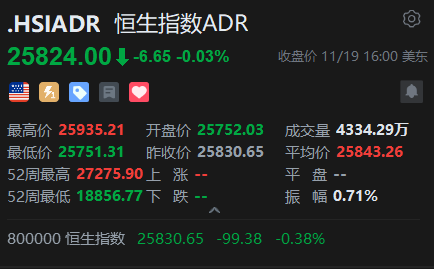
Market Overview - The Hang Seng Index (HSI) closed at 25,824.00, down by 6.65 points or 0.03% as of November 19, 16:00 Eastern Time [1] - The index's highest price during the day was 25,935.21, while the lowest was 25,751.31, with a trading volume of 43.34 million shares [1] Major Blue-Chip Stocks Performance - HSBC Holdings closed at HKD 107.800, down by HKD 1.800 or 1.64% compared to the previous close [2][3] - Tencent Holdings closed at HKD 622.500, down by HKD 1.000 or 0.16% [3] - Alibaba Group (ADR) saw an increase, closing at HKD 156.400, up by HKD 1.800 or 1.16% [3] - Xiaomi Group closed at HKD 38.820, down by HKD 1.960 or 4.81% [3] - AIA Group closed at HKD 77.950, down by HKD 0.600 or 0.76% [3] Stock Price Changes - The stock prices of major companies showed mixed results, with some experiencing declines while others saw slight increases [2][3] - Notable declines included Kuaishou Technology, which closed at HKD 63.500, down by HKD 1.150 or 1.78% [3] - Ctrip Group saw an increase, closing at HKD 574.500, up by HKD 10.000 or 1.77% [3]


内化AI能力,加快形成新质生产力
Ren Min Ri Bao· 2025-11-19 21:57
Group 1 - The core theme of the "14th Five-Year Plan" is to promote high-quality development, with a focus on accelerating high-level technological self-reliance and developing new productive forces, particularly through artificial intelligence (AI) [1] - China has made significant breakthroughs in AI infrastructure and large models, achieving a global second position in computing power and developing widely praised foundational models like DeepSeek and Wenxin [1] - The integration of AI capabilities across various industries is essential for driving high-quality development, helping both the smart industry to grow and traditional industries to upgrade [1] Group 2 - Innovative applications of AI technologies such as digital humans, code intelligence, and autonomous driving have shown positive results in various scenarios, enhancing operational efficiency [2] - The "14th Five-Year Plan" emphasizes the deep integration of technological and industrial innovation, advocating for the construction and opening of application scenarios to leverage AI's advantages in cost reduction and profit enhancement [2] - The potential for AI to empower key industries like mining, chemicals, light industry, and shipbuilding is vast, as China is the only country with a complete range of industrial categories [2] Group 3 - The improvement of the autonomous control level in the industrial chain relies on providing better solutions in areas like production scheduling and resource optimization, with algorithms like "Famu" focusing on finding global optimal solutions [3] - There is a pressing need to explore new organizational and management models that facilitate human-machine collaboration in the context of systemic and structural changes brought by AI [3] - Companies must integrate AI capabilities into every aspect of production, operation, and service to seize opportunities in the digital economy and AI development [3] Group 4 - Baidu, as one of the earliest and most comprehensive investors in AI in China, is committed to leading this transformation by enhancing intelligent infrastructure and developing cutting-edge model technologies [4] - The company aims to build a more open industrial ecosystem to help various industries internalize AI capabilities and accelerate their intelligent transformation, contributing to China's high-quality economic development [4]
热门中概股收盘多数下跌
Mei Ri Jing Ji Xin Wen· 2025-11-19 21:26
Core Viewpoint - The majority of popular Chinese concept stocks closed lower, with the Nasdaq Golden Dragon China Index declining by 1.53% [1] Group 1: Stock Performance - Pinduoduo fell by over 1% [1] - NetEase dropped by over 4% [1] - JD.com and Baidu both decreased by over 1% [1] - Xpeng experienced a decline of over 6% [1] - Li Auto, NIO, and Bilibili each fell by over 3% [1]


These Chinese Tech Stocks Crushed Q3 EPS Expectations
ZACKS· 2025-11-19 21:25
Core Insights - The market is anticipating Nvidia's Q3 report while several Chinese tech firms have reported impressive quarterly results, indicating potential for further upside in these stocks [1] Company Summaries Baidu (BIDU) - Baidu's Q3 results exceeded expectations, driven by AI-driven businesses such as AI Cloud and robotaxi services, which offset traditional advertising weaknesses [2] - Baidu's Q3 earnings per share (EPS) were $1.56, beating expectations of $1.20 by 30%, despite a decline from $2.37 in the same quarter last year [4] - Baidu trades at approximately $115 with a forward P/E ratio of 16X, making it more attractive compared to Alphabet, which trades at 27X forward earnings [3][4] PDD Holdings (PDD) - PDD Holdings, benefiting from China's large population, reported Q3 EPS of $2.96, surpassing estimates of $2.21 by nearly 34% [5] - The company operates both domestic (Pinduoduo) and international (Temu) shopping platforms, making it a significant player in the e-commerce sector [5] Trip.com (TCOM) - Trip.com, recognized as China's largest online travel company, reported Q3 EPS of $3.87, exceeding expectations of $1.15 by 236% [6] - The strong performance is attributed to a surge in international travel demand, recovery in domestic travel, and effective cost management [6] Market Outlook - Following the significant Q3 earnings beats, EPS revisions for these tech stocks are expected to rise, indicating potential for further growth [7] - The recent pullback in Chinese equities has created attractive entry points for long-term investors [7]

百度集团-SW(9888.HK):AI业务线展现强劲增长势头
Ge Long Hui· 2025-11-19 21:08
Core Insights - Baidu Group reported a total revenue of 31.2 billion yuan in Q3 2025, a year-on-year decline of 7.1%, which was better than the expected decline of 8.6%, primarily due to strong growth in AI cloud revenue and a less severe drop in core advertising revenue [1] - The company disclosed three major AI business lines, collectively generating approximately 10 billion yuan in revenue, accounting for about 40% of Baidu's core total revenue, with a robust year-on-year growth exceeding 50% [1] - The non-GAAP net profit for Q3 2025 was 3.8 billion yuan, with a non-GAAP net profit margin of 12.1%, surpassing the expected 8.6% [1] Baidu Core Business - Baidu's core revenue decreased by 7.0% to 24.7 billion yuan in Q3 2025, better than the expected decline of 8.7%, mainly driven by rapid growth in AI cloud revenue [2] - Advertising revenue fell by 18% to 15.3 billion yuan, influenced by the AI search transformation, with 70% of mobile search result pages containing AI-generated content by the end of October [2] - Non-advertising revenue increased by 21% to 9.3 billion yuan, with AI cloud revenue also growing by 21% to 6.2 billion yuan, and subscription revenue from AI high-performance infrastructure surged by 128% [2] New AI Business Lines - The newly disclosed AI business lines include: 1. Smart Cloud Infrastructure, generating 4.2 billion yuan in Q3 2025, up 33% year-on-year, with AI high-performance computing subscription revenue growing by 128% [2] 2. AI Applications, generating 2.6 billion yuan, with a year-on-year growth of 6% [2] 3. AI Native Marketing Services, generating 2.8 billion yuan, with a remarkable year-on-year growth of 262% [2] - Management anticipates accelerated growth for these three AI-enabled business lines in the future [2] Autonomous Driving - Baidu's autonomous driving service, "LuoBo Kuaipao," has expanded to cover 22 cities globally, achieving 100% unmanned operation in domestic cities [3] - In Q3 2025, the order volume for LuoBo Kuaipao reached 3.1 million, a year-on-year increase of 212% [3] - The management plans to continue rapid expansion of autonomous driving services while ensuring safety [3] Profit Forecast and Valuation - The company adjusted its non-GAAP net profit forecasts for 2025, 2026, and 2027, increasing by 19.7%, 1.6%, and decreasing by 1.4% to 19.4 billion, 21.5 billion, and 24.1 billion yuan respectively [3] - The valuation window has been shifted to 2026, with a target price of $243.2 for US stocks and HK$235.4 for Hong Kong stocks [3]
11.19日报
Ge Long Hui· 2025-11-19 19:49
Group 1: Xiaomi - Xiaomi's Q3 revenue reached 113.1 billion, a year-on-year increase of 22.3% but a quarter-on-quarter decrease of 2.4% [1] - Adjusted profit for the quarter was 11.3 billion, up 80.9% year-on-year [1] - Automotive revenue was 28.3 billion, showing a significant year-on-year growth of 207%, with a quarterly profit of 0.7 billion [1] - The performance in major appliances was disappointing, with a year-on-year decline of 15.7% and a quarter-on-quarter drop of 64.8% [1] - Current valuation estimates suggest Xiaomi's smartphone business could be valued at around 600 billion, while automotive and other IoT segments could add significant value [1] Group 2: Pinduoduo - Pinduoduo's Q3 revenue was 108.2 billion, marking a year-on-year increase of 9%, the first time it fell below 10% growth [2] - Net profit for the quarter was 29.3 billion, up 17% year-on-year, with over 400 billion in cash reserves [2] - Current market valuation stands at 180 billion, with a price-to-earnings ratio of 10 when excluding cash, indicating a potentially undervalued stock [2] - Concerns remain regarding the company's future dividend and buyback plans, leading to a significant drop in stock price [2] Group 3: Boss Zhipin - Boss Zhipin reported Q3 revenue of 2.16 billion, a year-on-year increase of 13.2%, with net profit reaching 0.687 billion, up 108% [3] - The substantial profit growth was attributed to reduced marketing expenses and the introduction of new paid services [3] - The company is viewed positively due to its ability to grow amidst challenging market conditions, suggesting strong potential for future performance [3] Group 4: Trip.com - Trip.com achieved Q3 revenue of 18.3 billion, reflecting a year-on-year increase of 16% [4] - International OTA bookings surged by 60% year-on-year, while inbound travel doubled, indicating robust recovery in travel demand [4] - The company's consistent performance and market position contribute to its stable stock price, making it a strong player in the travel industry [4] Group 5: Baidu - Baidu's Q3 revenue was 31.17 billion, a year-on-year decline of 7%, although AI business revenue grew by over 50% [5] - The mixed results raise questions about the company's overall performance and future outlook [5] Group 6: Google - Google's Gemini 3 Pro model achieved the highest score in model rankings, reinforcing its strong position in the AI sector [6] - Berkshire Hathaway's recent investment in Google indicates confidence in the company's long-term business viability [6] - Overall, the recent financial results of Chinese internet companies are not perceived as particularly poor, despite heightened market expectations [6]


These Analysts Revise Their Forecasts On Baidu After Q3 Earnings - Baidu (NASDAQ:BIDU)
Benzinga· 2025-11-19 19:20
Core Insights - Baidu, Inc. reported a revenue decline of 7% year-on-year for Q3, totaling $4.38 billion, which exceeded analysts' expectations of $4.31 billion [1] - The adjusted earnings per American Depositary Share (ADS) were $1.56, significantly higher than the forecast of 91 cents [1] Company Performance - CEO Robin Li emphasized strong growth in AI Cloud services as more enterprises adopt Baidu's AI products [2] - The Apollo Go service expanded its fully driverless ride-hailing operations, including a new launch in Switzerland, while maintaining high safety standards [2] - Revenue growth was noted from AI-native monetization tools such as agents and digital humans [2] Analyst Ratings and Price Targets - Goldman Sachs maintained a Buy rating and raised the price target from $154 to $155 [5] - Barclays also maintained an Equal-Weight rating, increasing the price target from $81 to $100 [5] - Benchmark maintained a Buy rating and raised the price target from $115 to $158 [5] - B of A Securities maintained a Buy rating with a price target increase from $100 to $151 [5] - Morgan Stanley maintained an Equal-Weight rating but lowered the price target from $140 to $130 [5]
These Analysts Revise Their Forecasts On Baidu After Q3 Earnings
Benzinga· 2025-11-19 19:20
Baidu, Inc. (NASDAQ:BIDU) reported a decline in revenue and negative free cash flow for the third quarter on Tuesday.The company reported quarterly revenue of $4.38 billion, a decline of 7% year-on-year (Y/Y), topping analysts' consensus estimate of $4.31 billion.Despite the revenue shortfall, Baidu's adjusted earnings per American Depositary Share (ADS) came in at $1.56, exceeding the forecast of 91 cents.CEO Robin Li highlighted strong momentum in AI Cloud as more enterprises adopt Baidu's AI products and ...