
TRIP.COM(09961)

Search documents
贵州约谈携程同程抖音美团飞猪五平台,要求整治价格乱象
Xin Lang Ke Ji· 2025-08-06 07:49
Core Viewpoint - The Guizhou Provincial Market Supervision Administration has conducted a meeting with five travel platform companies, including Ctrip, Tongcheng, Douyin, Meituan, and Fliggy, to enforce compliance with pricing laws and regulations, aiming to eliminate price irregularities and maintain a fair market environment [1] Regulatory Compliance - The meeting emphasized the need for strict adherence to the Price Law of the People's Republic of China, the Anti-Monopoly Law, and regulations against price fraud [1] - Companies were urged to strengthen self-discipline and compliance measures, and to conduct comprehensive self-inspections to prevent price fraud, price gouging, and collusion [1] Market Monitoring - The Guizhou Provincial Market Supervision Administration will closely monitor the competitive dynamics of the involved platform companies [1] - Companies that violate regulations or fail to rectify issues will face strict legal consequences, including public exposure of typical cases to deter non-compliance [1]




携程等5家涉旅平台企业被贵州约谈,要求不得干预商家定价
Nan Fang Du Shi Bao· 2025-08-06 07:00
Core Viewpoint - The Guizhou Provincial Market Supervision Administration has conducted a meeting with major travel platforms to address pricing irregularities and enforce compliance with relevant laws and regulations [1][2]. Group 1: Regulatory Actions - The meeting involved companies such as Ctrip, Tongcheng, Douyin, Meituan, and Fliggy, emphasizing the need to adhere to the Price Law, Anti-Monopoly Law, and regulations against price fraud [1]. - The administration highlighted issues such as "choose one from two," manipulation of merchant pricing through technology, contract breaches, price fraud, and price gouging [1]. Group 2: Specific Incidents - Ctrip has faced criticism for requiring hotels to use a tool called "Price Adjustment Assistant," which allegedly allows the platform to modify room prices without merchant consent, impacting their profits [1]. - This action has raised concerns about Ctrip potentially abusing its market dominance and infringing on merchants' pricing autonomy [1]. Group 3: Future Oversight - The Guizhou Provincial Market Supervision Administration plans to closely monitor the competitive landscape of these platforms and will take strict legal action against those that violate regulations or fail to rectify issues [2]. - Additionally, a meeting was held to encourage travel associations to enhance compliance and self-regulation in pricing practices within the tourism industry [2].
携程、同程、抖音、美团、飞猪,被约谈!
券商中国· 2025-08-06 04:57
Core Viewpoint - The Guizhou Provincial Market Supervision Administration is taking strict measures against price irregularities in the tourism sector, emphasizing compliance with relevant laws and regulations to maintain a fair and orderly market environment [1][2][3]. Group 1: Regulatory Actions - On August 5, the Guizhou Provincial Market Supervision Administration held a meeting with major travel platforms, including Ctrip, Tongcheng, Douyin, Meituan, and Fliggy, to address potential violations such as "choose one from two," price manipulation, and price fraud [1]. - The administration has mandated these platforms to conduct self-inspections and rectify any illegal practices, including price gouging and abuse of market dominance [1][2]. - Future monitoring will focus on compliance, with severe penalties for non-compliance, including public exposure of typical cases [1]. Group 2: Industry Initiatives - The Guizhou Travel Agency Association and Guiyang Tourism Association have initiated a campaign to uphold price order during the summer tourism season, urging operators to adhere to principles of fairness and honesty [2]. - A joint statement from the Guizhou Homestay Association and the Guizhou Catering Industry Association has called for strict compliance with pricing laws, particularly against practices like temporary price hikes and misleading pricing [2]. Group 3: Legal Framework and Penalties - On July 31, the Guizhou Provincial Market Supervision Administration issued a reminder to the accommodation industry, emphasizing the need for transparent pricing and prohibiting unilateral contract cancellations or price increases after booking [3]. - Violations of the pricing regulations can result in fines up to 50,000 yuan for minor infractions, while serious offenses like price fraud can incur fines up to 500,000 yuan, and price gouging can lead to fines up to 3 million yuan [3].

贵州市场监管局约谈携程、同程、抖音、美团、飞猪,整治价格乱象
Xin Lang Cai Jing· 2025-08-06 04:11
Group 1 - The Guizhou Provincial Market Supervision Administration held a meeting with five travel platform companies, including Ctrip, Tongcheng, Douyin, Meituan, and Fliggy, to enforce compliance with pricing laws and regulations [1] - The meeting addressed potential issues such as "choose one from two," price manipulation through technology, contract breaches, price fraud, and price gouging, urging companies to strengthen self-regulation and compliance [1] - The administration will closely monitor the competitive landscape and take strict legal action against companies that violate regulations or fail to rectify issues [1] Group 2 - On July 31, the Guizhou Provincial Market Supervision Administration issued a reminder to the accommodation industry and third-party platforms to adhere to pricing laws, including clear pricing and prohibiting unilateral contract cancellations [2] - Penalties for violations include fines up to 5,000 yuan for minor infractions, up to 500,000 yuan for price fraud, and up to 3 million yuan for price gouging [2] - The China Tourism Research Institute predicts that domestic tourism during the summer of 2025 may exceed 2.5 billion trips, reaching 115% of 2019 levels, with overall summer consumption expected to reach 1.8 trillion yuan [2] Group 3 - As a popular summer travel destination, Guizhou's market supervision authority convened a meeting to standardize tourism pricing, with local industry associations advocating for self-regulation and fair pricing practices [3] - The Guizhou Provincial Tourism Association and other organizations emphasized the need for transparency in pricing and adherence to legal standards to combat issues like temporary price increases and misleading pricing [3] - The Guizhou Consumer Association urged consumers to pay attention to pricing information and for operators to implement clear pricing practices to foster a fair and trustworthy summer tourism environment [3]
携程、同程、抖音、美团、飞猪,集中被约谈!
Zhong Guo Ji Jin Bao· 2025-08-06 03:20
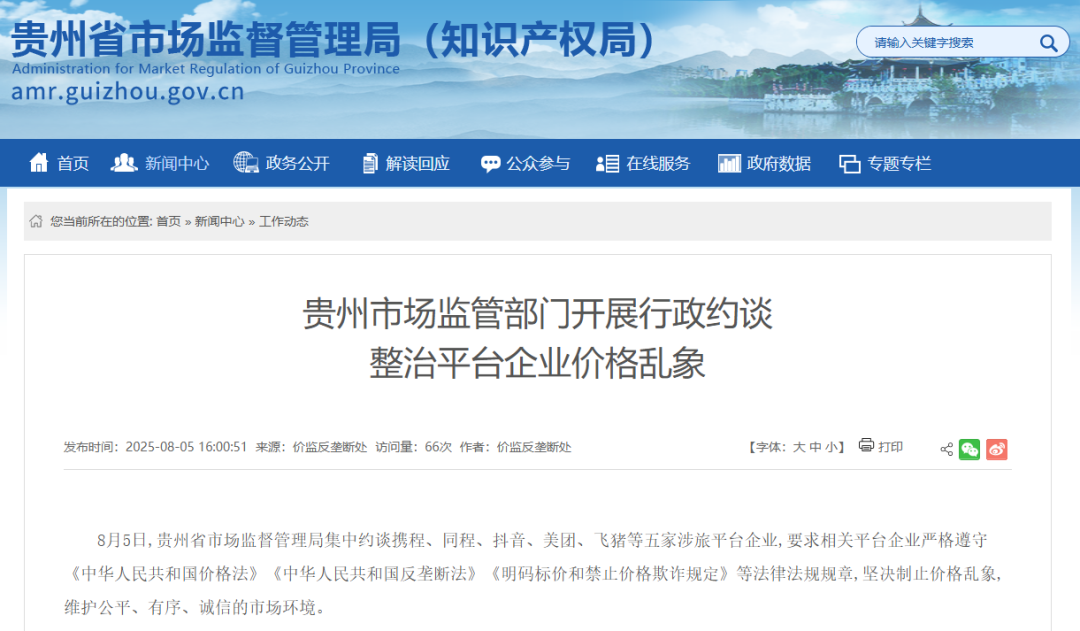
7月31日,贵州省市场监管局发布《关于规范"避暑季"住宿行业价格行为的提醒告诫函》,要求各住宿业及第三方平台经营者要严格遵守价格及相关法律 法规规定,合理制定住宿服务价格,诚信经营,不得扰乱住宿市场正常价格秩序。 贵州省市场监督管理局要求,相关平台企业严格遵守《中华人民共和国价格法》《中华人民共和国反垄断法》《明码标价和禁止价格欺诈规定》等法律法 规规章,坚决制止价格乱象,维护公平、有序、诚信的市场环境。 约谈会上,贵州省市场监管局针对相关平台企业可能存在的实施"二选一"、利用技术手段干预商家定价、订单生效后毁约或加价、价格欺诈、哄抬价格等 问题进行了通报,进一步提示了违法风险。 同时,贵州省市场监督管理局要求严格遵守相关法律法规,积极履行平台主体责任,切实加强自律和合规建设;立即开展全面自查自纠,禁止价格欺诈、 哄抬价格、价格串通,严禁滥用市场支配地位实施不公平高价、限定交易等违法行为,切实维护公平竞争的市场秩序。 贵州省市场监管局表示,下一步将对相关平台企业竞争态势保持密切关注,对顶风违法、整改不到位的平台企业及平台内经营者,将依法从严从快查处, 并公开曝光典型案例,形成有力震慑,坚决维护贵州省旅游市场良 ...
携程、同程、抖音、美团、飞猪,集中被约谈!
中国基金报· 2025-08-06 03:18
Core Viewpoint - The Guizhou Provincial Market Supervision Administration has conducted administrative talks with major travel platforms including Ctrip, Tongcheng, Douyin, Meituan, and Fliggy to address potential pricing irregularities and enforce compliance with relevant laws and regulations [2][3]. Group 1: Regulatory Actions - The Guizhou Provincial Market Supervision Administration has emphasized the need for strict adherence to laws such as the Price Law and Anti-Monopoly Law, urging platforms to eliminate pricing chaos and maintain a fair market environment [2][3]. - The administration has reported issues such as "choose one from two" practices, price manipulation, and price fraud among the platforms, highlighting the legal risks involved [3]. - A reminder letter was issued to the accommodation industry, mandating compliance with pricing laws and fair pricing practices to avoid disrupting the market order [4]. Group 2: Penalties and Compliance - Violations of the clear pricing regulations can result in fines of up to 5,000 yuan, while severe cases of price fraud can incur fines up to 500,000 yuan, and price gouging can lead to fines of up to 3 million yuan [6]. - The administration plans to closely monitor the competitive landscape of these platforms and will take strict actions against those that violate regulations, including public exposure of typical cases [3][6]. Group 3: Consumer Complaints and Issues - Since 2021, the Consumer Protection platform has received 8,386 complaints related to group tours, with 1,533 effective complaints reported by mid-2025 [6]. - The top eight online travel agencies (OTAs) with the highest complaint volumes include Ctrip, Fliggy, and Meituan, with issues primarily related to refund disputes and false advertising [7]. - The complaints indicate that refund disputes account for 23.40% and false advertising for 22.70% of the issues, with forced consumption complaints also being significant [7][8].


携程、同程、抖音、美团、飞猪被约谈
华尔街见闻· 2025-08-06 03:06
Core Viewpoint - The Guizhou market regulatory authority is taking action against price irregularities in the tourism sector, emphasizing compliance with relevant laws and regulations to maintain a fair market environment [1] Group 1: Regulatory Actions - Guizhou's market supervision department has conducted administrative talks with major travel platforms including Ctrip, Tongcheng, Douyin, Meituan, and Fliggy to address pricing issues [1] - The authority has highlighted potential violations such as "choose one from two," price manipulation through technology, contract breaches, price fraud, and price gouging [1] - Companies are required to conduct self-inspections and rectify any illegal practices, ensuring compliance with laws to maintain fair competition [1] Group 2: Price Behavior Guidelines - A reminder was issued to the accommodation industry to adhere to pricing laws and regulations, ensuring reasonable pricing and honest operations [2] - Clear and accurate pricing must be displayed prominently on promotional pages and in physical locations, with any price changes communicated to consumers promptly [3][4] - It is prohibited to impose additional charges beyond the advertised price or to cancel bookings without valid reasons [5][6] Group 3: Prohibited Practices - Third-party platforms are not allowed to unilaterally change the prices set by accommodation providers [7] - Misleading practices such as fabricating original prices, false discounts, and vague pricing are strictly forbidden [8] - Price gouging and collusion among operators to manipulate room prices are also prohibited [9][10]

携程、同程、抖音、美团、飞猪,被约谈
证券时报· 2025-08-06 02:30
Core Viewpoint - The article emphasizes the need to curb price irregularities in the tourism sector in Guizhou Province, highlighting the government's commitment to maintaining a fair and orderly market environment [2][3]. Group 1: Government Actions - The Guizhou Provincial Market Supervision Administration held a meeting with major travel platforms such as Ctrip, Tongcheng, Douyin, Meituan, and Fliggy, urging them to comply with relevant laws and regulations to prevent price irregularities [2]. - The administration reported potential issues such as "choose one from two," price manipulation through technology, and price fraud, and warned of legal risks associated with these practices [2]. - A follow-up will involve close monitoring of the competitive landscape, with strict penalties for non-compliance and public exposure of typical cases to deter violations [2]. Group 2: Industry Self-Regulation - Various tourism industry associations in Guizhou initiated a campaign to maintain price order during the summer season, advocating for self-discipline among operators [3]. - The Guizhou Travel Agency Association and Guiyang Tourism Association emphasized the importance of fair, legal, and honest pricing practices, particularly addressing issues like temporary price hikes and misleading pricing [3]. - The Guizhou Consumer Association urged consumers to pay attention to pricing information and called on operators to adhere to clear pricing standards to foster a trustworthy consumption environment [3]. Group 3: Regulatory Reminders - On July 31, the Guizhou Provincial Market Supervision Administration issued a reminder to the accommodation industry, stressing the need for compliance with pricing laws and regulations [4]. - The reminder included directives to ensure clear and truthful pricing, prohibiting unilateral contract cancellations and unauthorized price increases after booking [4]. - Penalties for violations include fines of up to 5,000 yuan for minor infractions, with more severe penalties for price fraud and collusion, reaching up to 500,000 yuan and 3 million yuan respectively [4].

整治平台企业价格乱象,贵州市场监管部门集中约谈携程、同程、抖音、美团、飞猪
Xin Lang Ke Ji· 2025-08-06 02:28
约谈会上,贵州省市场监管局针对相关平台企业可能存在的实施"二选一"、利用技术手段干预商家定 价、订单生效后毁约或加价、价格欺诈、哄抬价格等问题进行了通报,进一步提示了违法风险;要求相 关平台企业严格遵守相关法律法规,积极履行平台主体责任,切实加强自律和合规建设;立即开展全面 自查自纠,禁止价格欺诈、哄抬价格、价格串通、滥用市场支配地位等违法行为,切实维护公平竞争的 市场秩序。 据"贵州市场监管"公众号消息,8月5日下午,贵州省市场监督管理局集中约谈携程、同程、抖音、美 团、飞猪等五家涉旅平台企业,要求相关平台企业严格遵守《中华人民共和国价格法》《中华人民共和 国反垄断法》《明码标价和禁止价格欺诈规定》等法律法规规章,坚决制止价格乱象,维护公平、有 序、诚信的市场环境。 责任编辑:王翔 截至发稿,各平台尚无官方回应。 ...
携程、同程、抖音、美团、飞猪,被约谈
Xin Lang Cai Jing· 2025-08-06 01:47
智通财经记者 唐莹莹 消息显示,约谈会上,贵州省市场监管局针对相关平台企业可能存在的实施"二选一"、利用技术手段干 预商家定价、订单生效后毁约或加价、价格欺诈、哄抬价格等问题进行了通报,进一步提示了违法风 险;要求相关平台企业严格遵守相关法律法规,积极履行平台主体责任,切实加强自律和合规建设;立 即开展全面自查自纠,禁止价格欺诈、哄抬价格、价格串通、滥用市场支配地位等违法行为,切实维护 公平竞争的市场秩序。 编 消息指出,下一步,贵州省市场监管局将对相关平台企业竞争态势保持密切关注,对顶风违法,整改不 到位的平台企业及平台内经营者,将依法从严从快查处,并公开曝光典型案例,形成有力震慑,坚决维 护我省旅游市场良好秩序和消费者合法权益。 另据贵州省市场监督管理局8月5日的消息,近日,贵州省市场监管局召开规范旅游业价格秩序工作会 议,会上,贵州省内多家涉旅行业协会(商会)就维护贵州"避暑季"价格秩序发起倡议。 本 8月5日,据贵州省市场监督管理局(贵州省知识产权局)价监反垄断处发布的消息,8月5日下午,贵州 省市场监督管理局集中约谈携程、同程、抖音、美团、飞猪等五家涉旅平台企业,要求相关平台企业严 格遵守《中华人民 ...