POP MART(09992)

Search documents
泡泡玛特官宣欧洲总部落子英国伦敦
新华网财经· 2026-01-31 05:15
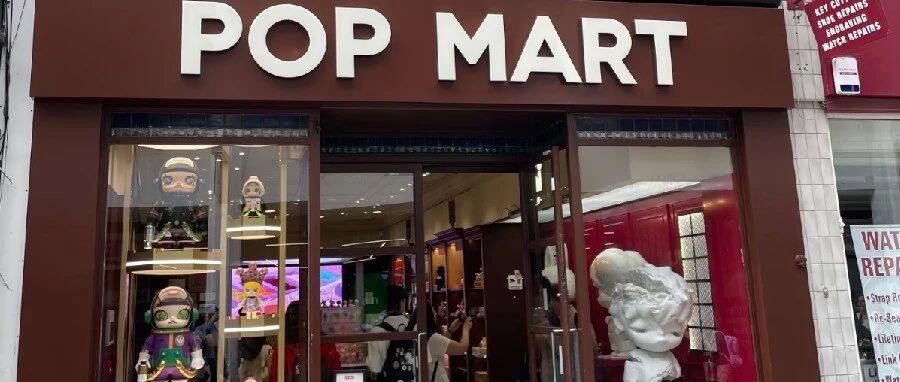
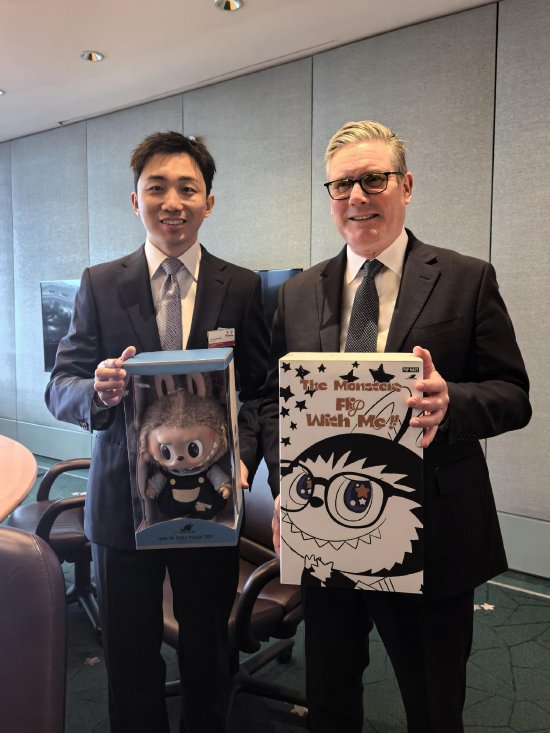
示意图。图源视觉中国 来源:澎湃新闻 关注" 新华网财经 "视频号 更多财经资讯等你来看 往期推荐 福耀科技大学50名大一学生被企业抢光?校长王树国回应 1月30日,在中英商务论坛上,包括 泡泡玛特 创始人、CEO王宁在内的多位企业家受邀参与"CEO圆桌会"闭门会谈,与英国首相基尔·斯 塔默进行会面。 会上,泡泡玛特宣布将伦敦定为欧洲总部所在地,未来将在英国新增伯明翰、卡迪夫及伦敦牛津街旗舰店等7家线下门店,同时计划在欧洲 各地拓展20家门店,相关投资将为英国创造超150个就业岗位。 男子用SIM卡炼出191克黄金,价值21万元?当事人最新回应 ...



泡泡玛特王宁受邀与英国首相进行会面,官宣欧洲总部落子英国伦敦
IPO早知道· 2026-01-31 05:04
截至目前,泡泡玛特已在英国开设14家门店。其中,泡泡玛特在伦敦这一英国首都及欧洲最大金融 中心开设有7家门店,并在曼彻斯特、伯明翰、牛顿、剑桥、利物浦等大城市均有布局,这在一定程 度上反映了泡泡玛特在英国当地的受欢迎程度。 计划在欧洲各地拓展20家门店。 本文为IPO早知道原创 作者| Stone Jin 微信公众号|ipozaozhidao 据IPO早知道消息,在1月30日举行的中英商务论坛上,包括泡泡玛特创始人、CEO王宁在内的多位 企业家受邀参与"CEO圆桌会"闭门会谈,与英国首相基尔·斯塔默进行会面。 会上, 泡泡玛特宣布将伦敦定为欧洲总部所在地,未来将在英国新增伯明翰、卡迪夫及伦敦牛津街 旗舰店等7家线下门店,同时计划在欧洲各地拓展20家门店 ,相关投资将为英国创造超150个就业 岗位。 王宁在与首相的会面中表示,伦敦作为全球创意生态核心,是品牌扎根欧洲、深耕全球市场的重要选 择。依托欧洲总部的设立,泡泡玛特将进一步整合全球创意资源,面向欧洲召集优秀艺术家展开深度 合作,持续挖掘IP创意价值,推动中外潮流文化的交流与融合。 值得注意的是,花旗最新发布的基于全球5国1501名消费者的调研报告显示,英国 ...
泡泡玛特官宣欧洲总部落子英国伦敦
Xin Lang Cai Jing· 2026-01-31 04:32
1月30日,在中英商务论坛上,包括泡泡玛特创始人、CEO王宁在内的多位企业家受邀参与"CEO圆桌 会"闭门会谈,与英国首相基尔·斯塔默进行会面。 会上,泡泡玛特宣布将伦敦定为欧洲总部所在地,未来将在英国新增伯明翰、卡迪夫及伦敦牛津街旗舰 店等7家线下门店,同时计划在欧洲各地拓展20家门店,相关投资将为英国创造超150个就业岗位。(智 通财经记者 吴雨欣) ...
泡泡玛特欧洲总部落子英国伦敦
Xin Lang Cai Jing· 2026-01-31 03:46
Core Viewpoint - Pop Mart has announced London as its European headquarters, aiming to expand its presence in the UK and Europe while fostering cultural exchange between China and the West [3][5]. Group 1: Company Expansion - Pop Mart plans to open 7 new physical stores in the UK, including flagship locations in Birmingham, Cardiff, and Oxford Street in London [3][5]. - The company aims to expand by opening 20 additional stores across Europe [3][5]. Group 2: Job Creation - The investment related to this expansion is expected to create over 150 jobs in the UK [3][5]. Group 3: Strategic Importance - The CEO of Pop Mart, Wang Ning, emphasized that London is a crucial hub for global creative ecosystems, making it an important choice for establishing a brand presence in Europe and deepening its global market engagement [3][5]. - The establishment of the European headquarters will enable Pop Mart to integrate global creative resources and collaborate with outstanding artists in Europe, enhancing the value of its intellectual property (IP) [3][5].
泡泡玛特是门玄学
3 6 Ke· 2026-01-30 08:06
Core Viewpoint - Pop Mart is experiencing a significant rebound in its stock price, with a 23% increase in a single week and a market capitalization returning to the 300 billion HKD range, driven by a large share buyback and successful new product launches [1][2] Group 1: Stock Performance and Market Reactions - The stock price of Pop Mart has shown extreme volatility, characterized by sharp rises and falls, with a 40% drop in the second half of the previous year despite strong performance [2][5] - The recent surge in stock price is attributed to a 3.5 billion HKD share buyback and the popularity of new products like the "PUCKY" electronic wooden fish [1][3] - Pop Mart's stock price reached a historical peak of 339.8 HKD per share in August, with a market capitalization exceeding 450 billion HKD, before experiencing a significant decline [8][10] Group 2: Market Position and Competitive Landscape - Pop Mart operates in a unique market space with no direct competitors globally, allowing it to easily attract market attention and capital with minimal actions [3][21] - The company has defined and cultivated the domestic trend toy market, maintaining a strong market position despite the lack of a mature valuation system for its products [3][26] - Competitors in the domestic and international markets lack the ability to create original IPs and are not positioned to challenge Pop Mart's dominance [17][19] Group 3: Emotional Value and Business Model - Pop Mart's business model is centered around emotional value rather than practical utility, making it difficult to establish a stable valuation [22][23] - The company's products cater to emotional needs, which are inherently unpredictable, leading to significant fluctuations in stock price based on market sentiment [25][26] - The market's response to Pop Mart's stock is driven by belief in the emotional resonance of its products, resulting in a binary reaction: rise when confidence is high, fall when doubts arise [4][26] Group 4: Future Outlook and Challenges - Despite the recent rebound, concerns remain about the sustainability of its product scarcity and the emergence of new phenomenon-level IPs [10][20] - The lack of a clear replacement for Pop Mart in the market raises questions about the long-term viability of its business model [20][21] - The company's ability to continue resonating with younger consumers will be crucial for maintaining investor confidence and market performance [27]

泡泡玛特盲盒遭撞脸,员工称“像孩子被偷走”!起诉获赔25万
Huan Qiu Wang· 2026-01-30 06:49
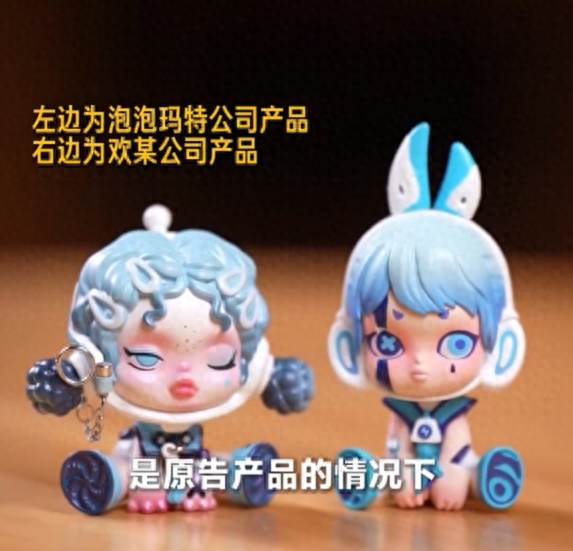
Core Viewpoint - The case involves a legal dispute between Pop Mart and Qianhai Huan Technology over alleged copyright infringement and unfair competition regarding similar toy designs, highlighting the challenges of intellectual property protection in the creative industry [1][3]. Group 1: Company Overview - Pop Mart's "Night City" blind box series gained popularity due to its unique design and artistic style, leading to the emergence of a similar product, "Friend Island," produced by Qianhai Huan Technology [1]. - The legal team at Pop Mart identified that multiple designs in "Friend Island" closely resembled those in "Night City," with only minor modifications in features and attire [1]. Group 2: Legal Proceedings - In October 2022, Pop Mart filed a lawsuit against Qianhai Huan Technology for copyright infringement and unfair competition in the Shenzhen Qianhai Cooperation Zone People's Court [3]. - A survey conducted by the court revealed that 61.8% of respondents mistakenly believed "Friend Island" was associated with Pop Mart, indicating consumer confusion [3]. - In December 2023, the court ruled that while there was no copyright infringement, Qianhai's product constituted unfair competition, resulting in a compensation order of over 250,000 yuan [3]. - Qianhai Huan Technology appealed the decision, arguing that "Friend Island" was an independent creation and that the court's survey was a legal error, but the Shenzhen Intermediate People's Court upheld the original ruling in July 2025 [3].
泡泡玛特20260129
2026-01-30 03:11
Summary of the Conference Call for Pop Mart Company Overview - **Company**: Pop Mart - **Industry**: Toy and Entertainment Key Points and Arguments Competitive Advantages - Pop Mart has established a unique dynamic barrier through aesthetic culture and top-tier artist resources, which are difficult to replicate [2][3] - The founder's aesthetic vision and deep connections with top artists are crucial to the company's success [2] - The company has successfully extended its reach into various top-tier circles across industries, occupying a significant position in the minds of key consumers, creating a competitive edge that is hard for other brands to match [2] Operational Mechanisms - Pop Mart has institutionalized its operational mechanisms across various aspects, including IP and brand management, product and content development, marketing and operations, store and amusement park management, and new product launches, forming deep operational barriers [2][3] Market Demand and Trends - Demand for trendy toys is driven by demographic changes, shifts in mass media, and consumer psychological needs, with the Kidult subculture becoming particularly prominent during economic downturns [2][6] - Current global systemic anxiety has extended the demand stickiness and lifecycle of trendy toys [2][6] Growth Strategy - The company plans to expand its retail footprint with approximately 600 new stores domestically and over 400 internationally, supported by IP licensing and cross-industry collaborations [2][10] - Product diversification and premiumization strategies are in place to increase average transaction value, with some products priced close to 20,000 RMB [2][13] Future Revenue Projections - For 2026, Pop Mart expects to achieve revenues between 37.5 billion to 68 billion RMB, with adjusted net profits projected between 12.3 billion to 22.6 billion RMB [7][8] Investment Value - The current stock price is considered to have a high safety margin compared to international giants, with a PE ratio significantly above 10, indicating attractive investment potential [5][8] International Market Development - As of mid-2025, overseas revenue was approximately 5.593 billion RMB, with an estimated overseas membership of about 44 million [12] - The company aims to replicate its domestic success in international markets, leveraging its established operational strategies [12] Product Innovation and Customer Engagement - Pop Mart is innovating through diverse product offerings, including figures, plush toys, and movable dolls, enhancing customer engagement and brand loyalty [13][19] - The company has seen significant growth in its membership base, with over 59 million members in mainland China by mid-2025 [11] Expansion into New Business Areas - The company is diversifying into amusement parks, gaming, and film, with notable collaborations such as the development of a movie with Sony Pictures [2][15][16] Artist Collaboration and Marketing - Pop Mart leverages collaborations with renowned artists and brands to enhance its market presence and consumer recognition [17][20] - The company has established a strong operational mechanism that allows for timely market responses and efficient product launches [19] Valuation Assessment - Based on historical valuation metrics of similar companies, Pop Mart is projected to achieve a market valuation of approximately 500 billion HKD by 2026, maintaining a buy rating [22]
智通港股沽空统计|1月30日
智通财经网· 2026-01-30 00:22
Group 1 - The core viewpoint of the articles highlights the short-selling activities of various companies, with specific focus on the short-selling ratios and amounts for leading firms in the market [1][2]. Group 2 - The top three companies by short-selling ratio are BYD Company Limited (95.08%), Lenovo Group Limited (85.25%), and Baidu Group (76.60%) [1]. - The highest short-selling amounts are recorded for China Ping An (1.88 billion), Xiaomi Group (1.086 billion), and Alibaba Group (1.062 billion) [2]. - The top three companies with the highest deviation values, indicating significant short-selling activity compared to their historical averages, are Baidu Group (39.38%), BYD Company Limited (35.91%), and Fuhong Hanlin (27.27%) [1][2].



智通ADR统计 | 1月30日
智通财经网· 2026-01-29 22:41
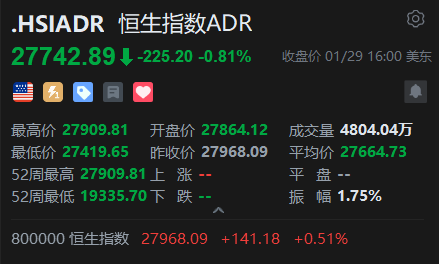
Market Overview - The Hang Seng Index (HSI) closed at 27,742.89, down by 225.20 points or 0.81% as of January 29, 16:00 Eastern Time [1] - The index reached a high of 27,909.81 and a low of 27,419.65 during the trading session, with an average price of 27,664.73 [1] - The 52-week high for the index is 27,909.81, while the 52-week low is 19,335.70 [1] Blue-Chip Stocks Performance - Most large-cap stocks experienced declines, with HSBC Holdings closing at HKD 138.219, up 0.45% compared to the Hong Kong close [2] - Tencent Holdings closed at HKD 619.286, down 0.44% from the Hong Kong close [2] Individual Stock Movements - Tencent Holdings (00700) latest price is HKD 622.000, with a slight increase of 1.000 or 0.16% [3] - Alibaba Group (09988) latest price is HKD 173.300, down by 0.200 or 0.12% [3] - HSBC Holdings (00005) latest price is HKD 137.600, up by 0.100 or 0.07% [3] - China Construction Bank (00939) latest price is HKD 8.160, up by 0.130 or 1.62% [3] - AIA Group (01299) latest price is HKD 90.950, up by 2.100 or 2.36% [3] - Xiaomi Group (01810) latest price is HKD 36.620, up by 0.300 or 0.83% [3] - NetEase (099999) latest price is HKD 206.600, down by 5.400 or 2.55% [3] - Meituan (03690) latest price is HKD 98.600, up by 0.250 or 0.25% [3] - Industrial and Commercial Bank of China (01398) latest price is HKD 6.640, up by 0.050 or 0.76% [3] - Hong Kong Exchanges and Clearing (00388) latest price is HKD 444.200, up by 5.000 or 1.14% [3] - Ping An Insurance (02318) latest price is HKD 73.300, up by 2.350 or 3.31% [3] - Baidu Group (09888) latest price is HKD 155.500, down by 0.600 or 0.38% [3] - China Bank (03988) latest price is HKD 4.760, up by 0.090 or 1.93% [3] - BYD Company (01211) latest price is HKD 101.800, down by 1.000 or 0.97% [3] - JD.com (09618) latest price is HKD 114.600, down by 1.700 or 1.46% [3] - Ctrip Group (09961) latest price is HKD 482.200, down by 13.200 or 2.66% [3]



2029年中国情绪经济规模将超4.5万亿
Di Yi Cai Jing Zi Xun· 2026-01-29 13:27
Group 1 - The recent local two sessions highlighted the emergence of "emotional economy," "self-pleasure economy," and related new consumption trends [2][3] - Various provincial government reports emphasized the development of new consumption models, including "emotional economy," "silver economy," and "first-release economy" [2][3] - The emotional economy is driven by consumers' willingness to spend on experiences that provide happiness, healing, and a sense of belonging, moving beyond traditional needs [3][4] Group 2 - The emotional economy market in China is projected to grow significantly, reaching 2.31 trillion yuan in 2024 and expected to exceed 4.5 trillion yuan by 2029 [4] - Local representatives are advocating for the development of emotional economy strategies, focusing on creating emotional resonance in consumption and integrating cultural elements into modern expressions [5] - Suggestions include the establishment of a comprehensive emotional economy development plan in Guizhou, targeting therapeutic consumption, experiential consumption, and cultural IP [5]