POP MART(09992)

Search documents
北水动向|北水成交净买入36.63亿 泡泡玛特时隔两年回购 北水抢筹超3亿港元
智通财经网· 2026-01-20 11:07
Group 1 - The core point of the news is that the Hong Kong stock market saw significant net buying from northbound capital, totaling HKD 36.63 billion, with Tencent, Meituan, and Xiaomi being the most purchased stocks [2][6] - Tencent Holdings (00700) had a net inflow of HKD 5.03 billion, with total buy and sell amounts of HKD 21.15 billion and HKD 16.12 billion respectively [3][5] - Meituan (03690) recorded a net inflow of HKD 3.19 billion, with total buy and sell amounts of HKD 5.98 billion and HKD 2.79 billion respectively [3][6] Group 2 - Semiconductor stocks showed divergence, with Hua Hong Semiconductor (01347) receiving a net inflow of HKD 2.45 billion, while SMIC (00981) faced a net outflow of HKD 7.17 billion [7] - The report from Open Source Securities indicated that TSMC raised its capital expenditure forecast significantly, reflecting strong long-term demand driven by AI [7] - Long-distance fiber optic cable stocks like Changfei Optical Fiber (06869) saw a net inflow of HKD 1.54 billion, supported by rising prices in the G.652.D fiber market [7] Group 3 - Xiaomi Group-W (01810) received a net inflow of HKD 3.95 billion, while China Mobile (00941) faced a net outflow of HKD 6.37 billion [8] - The report from Bank of America noted that the growth in metal demand is no longer cyclical, as economies are restructuring their energy infrastructure [8] - The sentiment around resource competition is affecting copper prices, which may remain volatile in the short term [8]





智通港股通活跃成交|1月20日
智通财经网· 2026-01-20 11:01
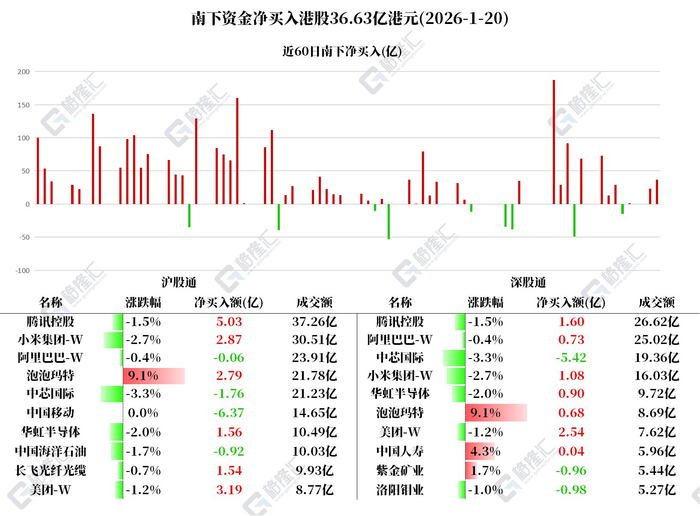
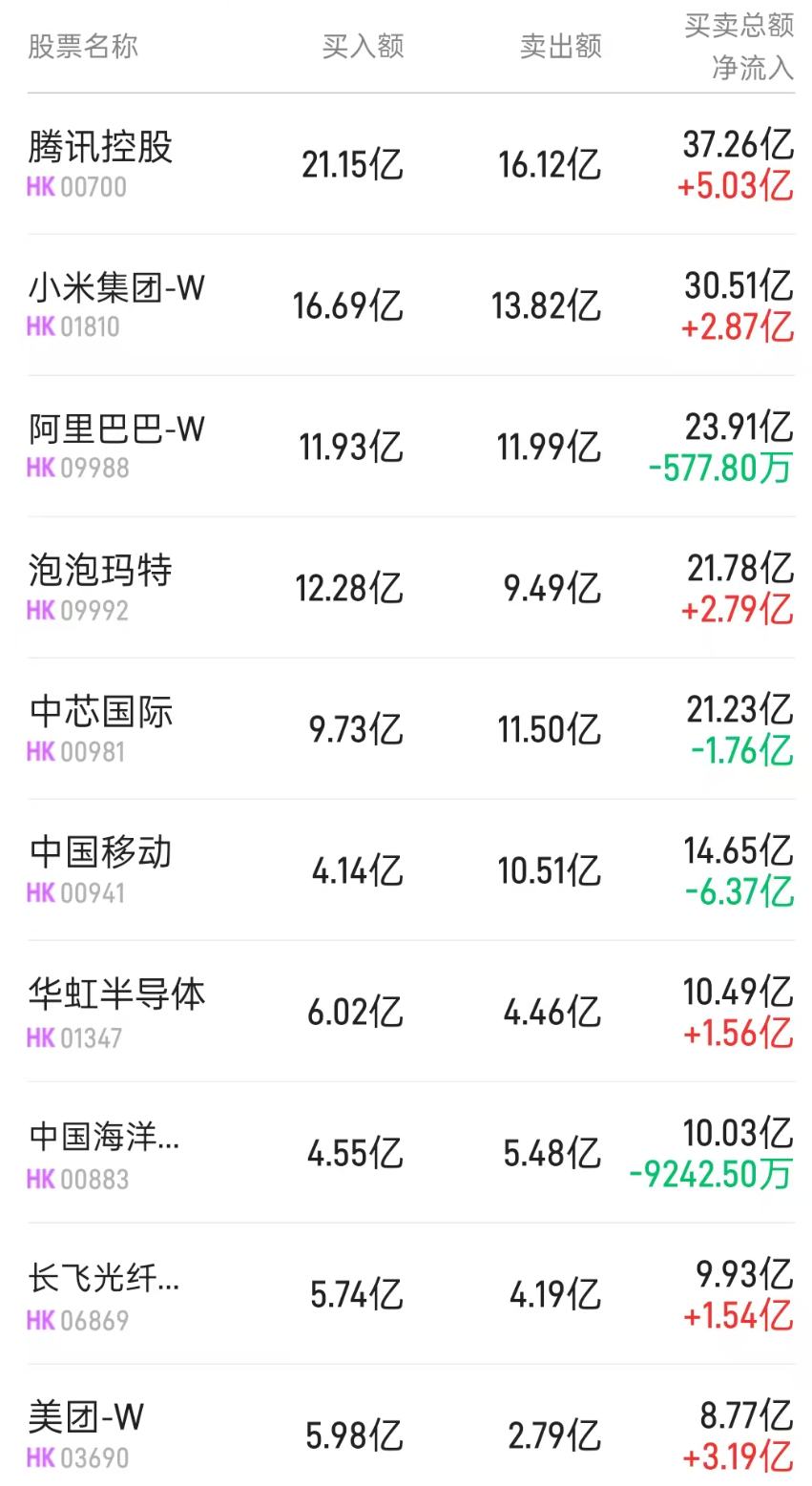
Core Insights - On January 20, 2026, Tencent Holdings (00700), Xiaomi Group-W (01810), and Alibaba-W (09988) were the top three companies by trading volume in the Southbound Stock Connect, with trading amounts of 3.726 billion, 3.051 billion, and 2.391 billion respectively [1] - In the Shenzhen-Hong Kong Stock Connect, Tencent Holdings (00700), Alibaba-W (09988), and SMIC (00981) led the trading volume, with amounts of 2.662 billion, 2.502 billion, and 1.936 billion respectively [1] Southbound Stock Connect Trading Activity - The top active companies in the Southbound Stock Connect included: - Tencent Holdings (00700) with a trading amount of 3.726 billion and a net buying amount of +0.503 billion [2] - Xiaomi Group-W (01810) with a trading amount of 3.051 billion and a net buying amount of +0.287 billion [2] - Alibaba-W (09988) with a trading amount of 2.391 billion and a net selling amount of -5.778 million [2] - Other notable companies included Pop Mart (09992) and SMIC (00981) with trading amounts of 2.178 billion and 2.123 billion respectively [2] Shenzhen-Hong Kong Stock Connect Trading Activity - The top active companies in the Shenzhen-Hong Kong Stock Connect included: - Tencent Holdings (00700) with a trading amount of 2.662 billion and a net buying amount of +0.160 billion [2] - Alibaba-W (09988) with a trading amount of 2.502 billion and a net buying amount of +7.257 million [2] - SMIC (00981) with a trading amount of 1.936 billion and a net selling amount of -5.420 billion [2] - Other notable companies included Xiaomi Group-W (01810) with a trading amount of 1.603 billion and a net buying amount of +0.108 billion [2]



泡泡玛特,逆市大涨!医药巨头,突传利好
Zhong Guo Ji Jin Bao· 2026-01-20 11:00
Group 1 - The core point of the news is that Pop Mart's stock surged over 9% due to a share buyback and positive outlook from Morgan Stanley, while the overall Hong Kong market experienced a decline [1][5][6] - Pop Mart's share price increased by 9.07%, closing at HKD 197.20 per share, with a trading volume of HKD 58.79 billion, ranking fourth among Hang Seng Index constituents [5][6] - The company repurchased 1.4 million shares on January 19 at a total cost of HKD 251 million, with plans to cancel the repurchased shares [5][6] Group 2 - Morgan Stanley's report predicts Pop Mart's net profit for 2025 to be RMB 12.6 billion, with an expected cash reserve of RMB 20 billion by the end of 2025, indicating strong financial resources for shareholder returns [6] - Heng Rui Medicine announced the approval of clinical trials for its new drug HRS-2141, aimed at treating type 2 diabetes, marking a significant step in its drug development pipeline [7][10] - The drug HRS-2141 is a fixed-dose combination formulation, with no similar drugs approved in the domestic and international markets, and the company has invested approximately RMB 5.4 million in its development so far [10][11]

泡泡玛特开盘涨超10%
Bei Jing Shang Bao· 2026-01-20 10:45
Core Viewpoint - Pop Mart's stock surged over 10% to HKD 199 on January 20, following the announcement of a share buyback program worth HKD 251 million to repurchase 1.4 million shares at a price range of HKD 177.7 to HKD 181.2 per share, marking the company's first buyback since the beginning of 2024 [1]. Group 1 - Pop Mart announced a share buyback program of HKD 251 million [1] - The company plans to repurchase 1.4 million shares [1] - The buyback price is set between HKD 177.7 and HKD 181.2 per share [1]
图解丨南下资金连续10日净买入腾讯,连续12日净卖出中国移动
Ge Long Hui A P P· 2026-01-20 10:07
Group 1 - Southbound funds net bought Hong Kong stocks worth HKD 3.663 billion today [1] - The top net purchases included Tencent Holdings at HKD 663 million, Meituan-W at HKD 573 million, and Xiaomi Group-W at HKD 395 million [1] - Continuous net buying trends were observed for Tencent over 10 days totaling HKD 10.62116 billion and Alibaba over 7 days totaling HKD 4.75655 billion [1] Group 2 - Southbound funds net sold shares of SMIC at HKD 717 million and China Mobile at HKD 637 million [1] - China Mobile has seen continuous net selling for 12 days, amounting to HKD 9.29936 billion [1] - Hua Hong Semiconductor and Xiaomi also experienced net buying trends over multiple days, with Hua Hong totaling HKD 1.33901 billion over 4 days and Xiaomi HKD 1.42914 billion over 3 days [1]
斥资2.51亿港元回购,泡泡玛特盘中涨超10%
Huan Qiu Lao Hu Cai Jing· 2026-01-20 10:04
Group 1 - The company announced a share buyback of 2.51 billion HKD for 1.4 million shares, with a buyback price range of 177.7 to 181.2 HKD per share [1] - The buyback is conducted under the authorization approved at the 2025 shareholder meeting, allowing for a maximum repurchase of approximately 134.3 million shares, with about 132.6 million shares remaining for future buybacks [1] - The repurchased shares will be fully canceled, reducing the total issued shares from 1.34294 billion to 1.34154 billion, representing 0.1042% of the shares before the buyback [1] Group 2 - The company's stock price has been in a downward trend since reaching a high of 339.8 HKD in late August 2025, but the buyback announcement led to a significant increase in stock price, rising over 10% during the day and closing at 197.2 HKD, a 9.07% increase [1] - The company has a history of share buybacks, having repurchased 34.3 million shares for 735 million HKD in 2022 and 19.9 million shares for approximately 371 million HKD in 2023, with buyback prices ranging from 16.94 to 20.60 HKD [2] - The company has shown significant revenue growth, with revenues of 4.617 billion, 6.301 billion, and 13.038 billion CNY from 2022 to 2024, representing year-on-year growth rates of 2.82%, 36.46%, and 106.92% respectively [2] Group 3 - In the first half of 2025, the company achieved revenues of 13.876 billion CNY, a year-on-year increase of 204.45%, and a net profit of 4.574 billion CNY, up 396.49% [3]
北水动向|北水成交净买入36.63亿 泡泡玛特(09992)时隔两年回购 北水抢筹超3亿港元
智通财经网· 2026-01-20 10:01
Core Viewpoint - The Hong Kong stock market experienced significant net inflows from northbound trading, with a total net buy of HKD 36.63 billion on January 20, 2023, indicating strong investor interest in certain stocks [1]. Group 1: Net Buying and Selling Activities - Tencent (00700) received the highest net buy of HKD 21.15 billion, with a total trading volume of HKD 37.26 billion, reflecting a net inflow of HKD 5.03 billion [2]. - Meituan-W (03690) saw a net buy of HKD 16.69 billion, with a total trading volume of HKD 30.51 billion, resulting in a net inflow of HKD 2.87 billion [2]. - Xiaomi Group-W (01810) had a net buy of HKD 3.95 billion, contributing to the overall positive sentiment in the tech sector [7]. - Conversely, SMIC (00981) faced the largest net sell of HKD 9.73 billion, with a total trading volume of HKD 21.23 billion, indicating a net outflow of HKD 1.76 billion [2]. - China Mobile (00941) also experienced significant net selling, with a net outflow of HKD 6.37 billion [7]. Group 2: Sector Insights and Market Trends - The technology sector, particularly companies like Tencent, Meituan, and Alibaba, is seeing increased investment interest, driven by expectations of growth in AI and cloud computing [4]. - The semiconductor sector showed divergence, with Hua Hong Semiconductor (01347) receiving a net buy of HKD 2.45 billion, while SMIC faced a net sell of HKD 7.17 billion, reflecting varying investor confidence [5]. - The optical fiber and cable industry is experiencing a price recovery, with Longi Optical Fiber (06869) receiving a net buy of HKD 1.54 billion, supported by rising market prices for G.652.D optical fibers [5]. - The mining sector, particularly Zijin Mining (02899) and Luoyang Molybdenum (03993), faced net selling pressures, attributed to changing market sentiments regarding metal demand and supply dynamics [6].
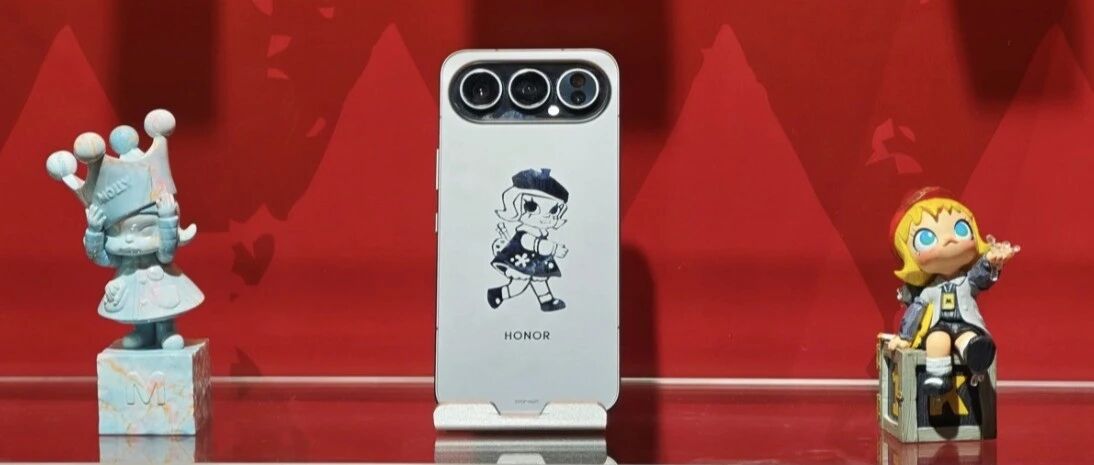
荣耀联名泡泡玛特推了款潮玩手机
第一财经· 2026-01-20 09:52
Group 1 - The core viewpoint of the article highlights the collaboration between Honor and Pop Mart, launching the "Honor 500 Pro MOLLY 20th Anniversary Limited Edition" smartphone, priced at 4,499 yuan, with a net price of 3,999 yuan after subsidies. The main differences from the regular version lie in design, system theme, boot animation, and packaging [2] - Pop Mart has previously collaborated with consumer electronics brands, but this partnership with Honor marks its most in-depth hardware collaboration to date, as it aims to accelerate cross-industry monetization around its core IP [2] - The collaboration occurs against a backdrop of a challenging Chinese smartphone market, where competition in the mainstream price segment is intensifying [2] Group 2 - According to IDC, China's smartphone market is projected to see an annual shipment of approximately 285 million units in 2025, reflecting a year-on-year decline of 0.6%, indicating a shift to a typical stock game phase [3] - As demand slows, upstream cost pressures are accumulating, with storage prices significantly rebounding since the second half of 2025, now accounting for 10% to 20% of smartphone hardware costs, a proportion that continues to rise [3] - Honor has made significant changes to its product lineup in recent months, including the reintroduction of the Honor WIN series targeting the gaming smartphone segment and the launch of a "Robot Phone" at CES, which integrates gimbal structures, imaging systems, and AI capabilities [3] Group 3 - The portable imaging device market is dominated by DJI, Insta360, and GoPro, prompting smartphone manufacturers to reintegrate gimbal, stabilization, tracking, and AI capabilities back into smartphones as a strategy to reclaim content entry points [4] - Compared to independent device manufacturers, smartphone companies still hold advantages in supply chain scale, channel coverage, and price bandwidth [4] Group 4 - In a market where expansion is challenging and cost curves are rising, manufacturers are finding it increasingly difficult to rely on conventional annual iterations to tell growth stories. Strategies such as collaborations with Pop Mart, reintroducing gaming product lines, and exploring imaging forms are being employed to seek market opportunities [5] - While these initiatives may not guarantee sales, the risk of remaining stagnant in the current industry environment is becoming increasingly pronounced [5]
港股收盘|恒指跌0.29% 泡泡玛特大涨9%
Di Yi Cai Jing· 2026-01-20 08:57
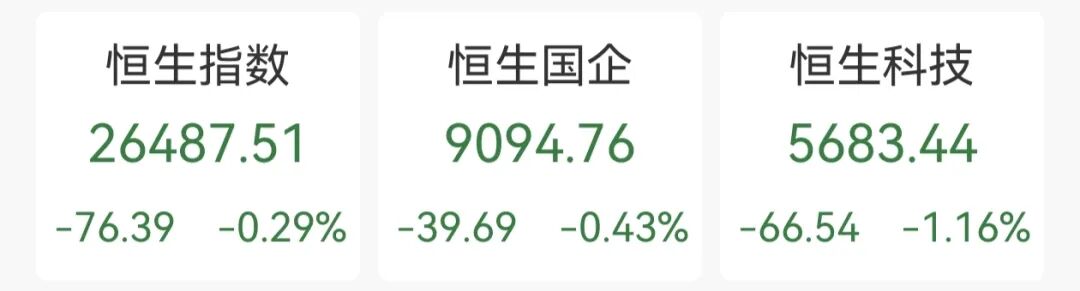
Market Overview - The Hang Seng Index closed at 26,487.51 points, down 0.29% [1] - The Hang Seng Tech Index closed at 5,683.44 points, down 1.16% [1] Sector Performance - Pharmaceutical and automotive stocks experienced significant declines, with WuXi AppTec falling over 4% and BYD Company dropping over 3% [1] - Gold stocks showed strong performance, with WanGuo Gold Group rising over 7% and Zijin Mining International increasing over 5% [1] Notable Individual Stocks - Pop Mart International rose over 9% [1] - Zhaoyi Innovation increased over 5% [1] - MINIMAX gained over 3% [1]
港股收盘 | 恒指收跌0.29% 黄金、消费股走高 泡泡玛特劲升9%领跑蓝筹
Zhi Tong Cai Jing· 2026-01-20 08:37
Market Overview - The Hong Kong stock market experienced fluctuations today, with all three major indices closing lower. The Hang Seng Index fell by 0.29% or 76.39 points to 26,487.51 points, with a total turnover of HKD 2,377.66 million. The Hang Seng China Enterprises Index decreased by 0.43% to 9,094.76 points, and the Hang Seng Tech Index dropped by 1.16% to 5,683.44 points [1] Blue Chip Performance - Pop Mart (09992) led the blue-chip stocks, rising by 9.07% to HKD 197.2, contributing 19.52 points to the Hang Seng Index. The company announced a share buyback of 1.4 million shares for HKD 2.51 million at prices between HKD 177.7 and HKD 181.2. Morgan Stanley noted that this buyback could attract more investors [2] - Other notable blue-chip performances included China Life (601628) (02628) up 4.31% to HKD 33.4, contributing 16.6 points, and China Resources Land (01109) up 3.71% to HKD 29.64, contributing 5.52 points. Conversely, WuXi AppTec (603259) (02359) fell by 4.13% to HKD 113.7, detracting 3.73 points, and SMIC (00981) dropped by 3.25% to HKD 74.5, detracting 18.11 points [2] Sector Highlights - The technology sector showed mixed results, with Baidu rising by 0.95% while Tencent fell over 1%. Gold stocks rebounded, with spot gold surpassing USD 4,700 for the first time, and consumer stocks gained traction due to favorable consumption policies. Notably, Pop Mart's buyback led to a price increase of over 10% [3] - Gold stocks saw a recovery, with Zijin Mining International (02259) up 5.47% to HKD 179.4, Chifeng Jilong Gold Mining (600988) (06693) up 3.6% to HKD 33.94, Shandong Gold Mining (600547) (01787) up 2.73% to HKD 43.7, and China National Gold International (600916) (02099) up 2.04% to HKD 195 [3] Real Estate Sector - The National Bureau of Statistics reported a 0.3% month-on-month decline in new residential sales prices in first-tier cities for December 2025, with the decline narrowing by 0.1 percentage points from the previous month. Shenwan Hongyuan believes that the real estate sector has undergone deep adjustments, and recent central government directives to stabilize the market may lead to positive policy changes [5] - The real estate sector showed positive performance, with China Overseas Land & Investment (00081) up 4.93% to HKD 2.13, and China Resources Land (01109) up 3.71% to HKD 29.64 [4][5] Insurance Sector - The insurance sector performed well, with China Pacific Insurance (00966) up 4.39% to HKD 23.8, China Life (02628) up 4.31% to HKD 33.4, and New China Life Insurance (601336) (01336) up 2.72% to HKD 62.35. Reports indicated that major insurance companies saw significant growth in premium income through bancassurance channels [4][5] Aviation Sector - The aviation sector continued its upward trend, with China Southern Airlines (600029) (01055) up 4.57% to HKD 6.18, China National Aviation (601111) (00753) up 3.91% to HKD 7.45, and Cathay Pacific (00293) up 1.63% to HKD 12.49. Analysts expect strong demand during the upcoming Spring Festival travel season, with improved ticket pricing and revenue management driving profitability [6] Notable Stock Movements - Youjia Innovation (02431) saw a significant increase of 7.21% to HKD 15.77 after signing a memorandum of understanding with India's Sterling Tools Ltd. to focus on the automotive market [7] - Nanshan Aluminum International (02610) reached a new high, rising 6.04% to HKD 71.95, as the company plans to initiate a 250,000-ton electrolytic aluminum project with an estimated investment of USD 436.6 million [8] - GigaDevice Semiconductor (603986) (03986) continued to rise by 5.52% to HKD 306, benefiting from a tight supply of memory chips [9] - Shanghai Petrochemical (600688) (00338) issued a profit warning, expecting a net loss of approximately RMB 1.289 billion to RMB 1.576 billion for the year ending December 31, 2025 [10]