Cambricon(688256)

Search documents
上证180指数上涨0.08%,上证180ETF指数基金(530280)实现4连涨
Sou Hu Cai Jing· 2026-01-21 01:55
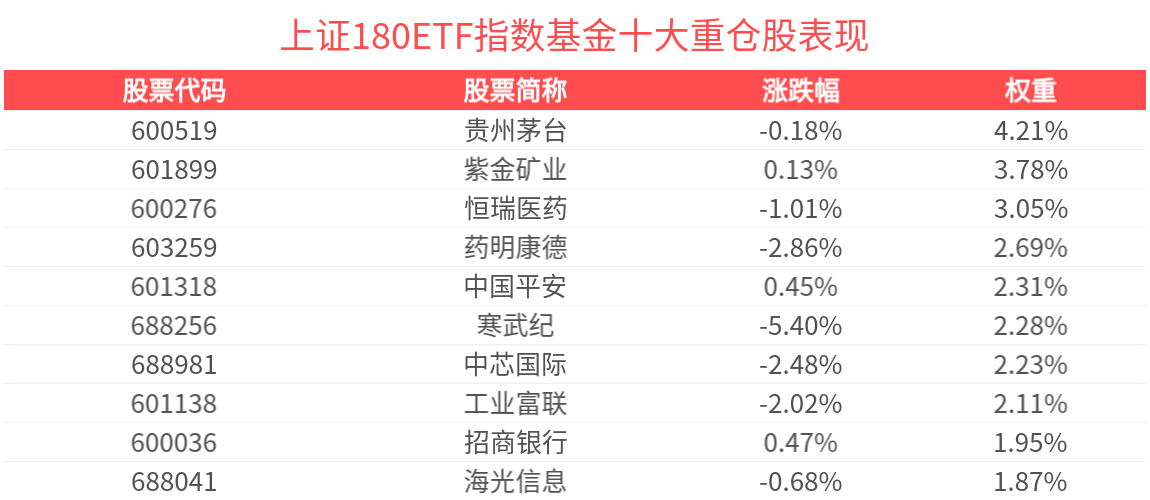
Core Viewpoint - The Shanghai 180 ETF Index Fund closely tracks the Shanghai 180 Index, which reflects the overall performance of 180 large-cap and liquid stocks in the Shanghai securities market [2] Group 1: Index Performance - As of January 20, 2026, the Shanghai 180 Index rose by 0.08%, with notable increases in constituent stocks such as China Chemical (+10.01%), China Power Construction (+7.02%), and Hengli Petrochemical (+6.62%) [1] - The Shanghai 180 ETF Index Fund achieved a four-day consecutive increase, with the latest price reported at 1.26 yuan [1] - The fund's average daily trading volume over the past year was 256.26 million yuan, with a turnover rate of 0.11% on January 20, 2026 [1] Group 2: Fund Metrics - The fund's Sharpe ratio since inception is 2.13, indicating a favorable risk-adjusted return [1] - The maximum drawdown for the fund year-to-date is 1.30%, with a relative benchmark drawdown of 0.06% [1] - The management fee for the fund is 0.15%, and the custody fee is 0.05% [1] Group 3: Top Holdings - As of December 31, 2025, the top ten weighted stocks in the Shanghai 180 Index account for 25.29% of the index, including Kweichow Moutai, Zijin Mining, and China Ping An [2] - The top ten stocks by weight are Kweichow Moutai (4.21%), Zijin Mining (3.78%), and China Ping An (2.31%), among others [3]






2026年第3周计算机行业周报:看好AI应用及国产算力两条主线-20260120
Changjiang Securities· 2026-01-20 14:11
Investment Rating - The report maintains a "Positive" investment rating for the software and services industry [7] Core Viewpoints - The report expresses optimism regarding AI applications and domestic computing power investment opportunities, highlighting the acceleration of AI applications and the potential for industry upgrades in the long term [6][40] - The introduction of the Universal Commerce Protocol (UCP) by Google is seen as a significant development that could reshape the e-commerce landscape, facilitating seamless transactions and enhancing user experience [21][24][28] - The report emphasizes the importance of data element value release in 2026, marking it as a pivotal year for the digital economy and data market reforms [30][35][38] Summary by Sections Market Performance - Last week, the computer sector experienced a high and then a pullback, with an overall increase of 4.14%, ranking first among major industries in the Yangtze River region, and accounting for 11.21% of total market turnover [2][4][15] Key Recommendations - The report recommends focusing on: 1. Domestic large model manufacturers 2. Major domestic cloud service providers 3. Vertical scenario agent manufacturers 4. The domestic computing power supply chain, particularly AI chip companies like Haiguang Information and Cambrian [6][40] AI and E-commerce Developments - The UCP aims to create a standardized communication framework for AI agents, merchants, and platforms, potentially transforming the e-commerce industry by reducing decision-making time and enhancing transaction efficiency [21][24][28] - The report notes that AI-assisted shopping is expected to become mainstream, with significant growth projected in the AI e-commerce market from 23.93 billion yuan in 2020 to 50.44 billion yuan by 2024, with a compound annual growth rate of 20.50% [29] Data Element Value Release - The report highlights that 2026 is designated as the "Year of Data Element Value Release," with a focus on market-oriented reforms and the establishment of data standards to facilitate the flow and utilization of data [30][35][38] - The establishment of a data property rights registration system is anticipated to enhance data circulation and unlock value within the data economy [37][38]



中国人工智能企业50强出炉,北京独占鳌头!
Bei Jing Ri Bao Ke Hu Duan· 2026-01-20 10:46
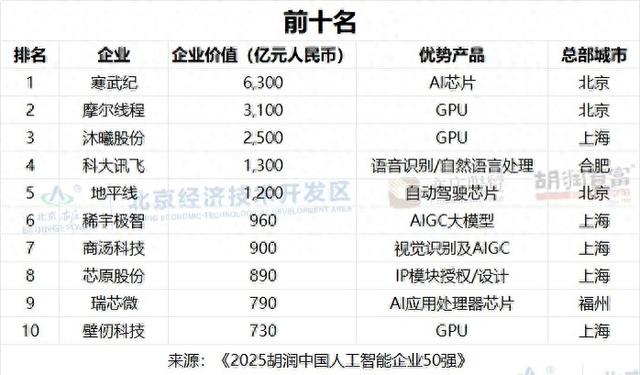
Core Insights - The HuRun Research Institute released the "2025 HuRun Future Unicorn: Global Gazelle Enterprises List" and the "2025 HuRun China AI Enterprises Top 50" in Beijing, highlighting the growth of AI companies in China [1] Group 1: AI Companies in China - The list of the top 50 AI companies in China features 19 companies from Beijing, leading the nation, with 16 of them located in Haidian District [1] - The ranking focuses on companies primarily engaged in AI computing power or algorithms, with valuations based on market capitalization as of January 9, 2026, for listed companies and estimates for unlisted companies [1] Group 2: Top AI Companies - The top three companies in the list are: - Cambricon Technologies with a valuation of 630 billion RMB, ranked first [2] - Moore Threads with a valuation of 310 billion RMB, ranked second [2] - Muxi Co., Ltd. with a valuation of 250 billion RMB, ranked third [2] - The top three companies are all related to AI chips, attributed to the tightening of high-end AI chip export controls by the U.S., prompting domestic advancements in computing power [2] Group 3: Focus on Large Models - Large models are a key focus area for AI companies in Beijing, with Zhipu AI recently recognized as the "world's first large model public company" [3] - Zhongguancun Science City is home to 16 of the 19 listed companies, reflecting the area's robust AI industry development supported by talent, computing power, and policy [3] Group 4: Global Gazelle Enterprises - The "2025 HuRun Future Unicorn: Global Gazelle Enterprises List" identifies San Francisco, Shanghai, Beijing, New York, Shenzhen, and London as the top five global "gazelle" cities [3] - China has 278 gazelle enterprises, ranking second globally, with an 8% increase from the previous year, and together with the U.S., they account for 71% of the total gazelle enterprises worldwide [3]


95只科创板股票跻身百元股阵营
Zheng Quan Shi Bao Wang· 2026-01-20 09:38
Core Insights - The average stock price of the Sci-Tech Innovation Board is 47.55 yuan, with 95 stocks priced over 100 yuan, and the highest priced stock is Cambrian-U at 1343.04 yuan, which fell by 5.40% today [1][2] Price Movements - Among the Sci-Tech Innovation Board stocks, 168 stocks rose while 425 stocks fell today. The average price of stocks over 100 yuan decreased by 1.17%, with 31 stocks increasing and 64 stocks decreasing [1][2] - Cambrian-U, the highest priced stock, closed at 1343.04 yuan, down 5.40%. Other notable stocks include SourceJet Technology at 712.68 yuan and Moer Technology-U at 615.21 yuan, both also experiencing declines [1][2] Premium Analysis - The latest closing prices of stocks over 100 yuan show an average premium of 516.60% compared to their issue prices, with the highest premiums seen in stocks like Shuangwei New Materials at 6145.49%, Anji Technology at 2172.49%, and Cambrian-U at 1985.79% [1] Industry Distribution - The stocks priced over 100 yuan are concentrated in the electronics, computer, and machinery equipment sectors, with 46, 13, and 11 stocks respectively [1] Capital Flow - The net outflow of main funds from stocks over 100 yuan today totaled 4.969 billion yuan, with notable net inflows into companies like Lanke Technology, Baiwei Storage, and Longxin Zhongke [2] - The total margin financing balance for stocks over 100 yuan is 126.021 billion yuan, with Cambrian-U, SMIC, and Haiguang Information having the highest financing balances [2]


电子行业今日跌1.23%,主力资金净流出183.94亿元
Zheng Quan Shi Bao Wang· 2026-01-20 08:43
Market Overview - The Shanghai Composite Index fell by 0.01% on January 20, with 20 industries rising, led by the oil and petrochemical sector with a gain of 1.74% and construction materials at 1.71% [1] - The telecommunications and defense industries experienced the largest declines, down 3.23% and 2.87% respectively [1] - The electronic industry also saw a decrease of 1.23% [1] Capital Flow Analysis - The main capital outflow from the two markets totaled 95.723 billion yuan, with 11 industries experiencing net inflows [1] - The banking sector led the net inflow with 1.472 billion yuan, resulting in a 0.80% increase, followed by the real estate sector with a 1.55% rise and a net inflow of 627 million yuan [1] - The power equipment industry had the highest net outflow, totaling 19.054 billion yuan, followed by the electronic industry with an outflow of 18.394 billion yuan [1] Electronic Industry Performance - The electronic industry saw a decline of 1.23%, with a total net outflow of 18.394 billion yuan [2] - Out of 476 stocks in the electronic sector, 160 stocks rose, 5 hit the daily limit up, while 314 stocks fell, with 1 hitting the daily limit down [2] - Notable inflows included Tongfu Microelectronics with a net inflow of 431 million yuan, followed by Lanke Technology and Wolong Nuclear Materials with inflows of 345 million yuan and 332 million yuan respectively [2] Top Gainers in Electronic Industry - The top gainers in the electronic sector included: - Tongfu Microelectronics: +5.85%, turnover rate 13.22%, net inflow 431.18 million yuan - Lanke Technology: +2.95%, turnover rate 5.44%, net inflow 345.32 million yuan - Wolong Nuclear Materials: +3.13%, turnover rate 15.24%, net inflow 332.48 million yuan [2] Top Losers in Electronic Industry - The top losers in the electronic sector included: - Shenghong Technology: -5.07%, net outflow -1.858 billion yuan - Cambricon Technologies: -5.40%, net outflow -1.703 billion yuan - Industrial Fulian: -2.02%, net outflow -1.021 billion yuan [3]



一个经济学家的2025年资本市场十大年度词汇
Xin Lang Cai Jing· 2026-01-20 08:11
Group 1: Tariffs and Global Market Dynamics - The concept of "reciprocal tariffs" continues to disrupt global capital markets, reflecting the interplay between major power competition and asset pricing [2][17] - The implementation of these tariffs by the Trump administration has led to significant inflationary pressures in the U.S., with household food costs rising and a technical bear market in U.S. stocks [2][17] - China's strategic response, including precise tariff adjustments and supply chain optimization, has stabilized its export share and accelerated high-end manufacturing [2][18] Group 2: Revaluation of Chinese Assets - The systematic revaluation of Chinese assets in 2025 is driven by deepening institutional reforms, technological breakthroughs, and an upgraded global role [3][19] - Institutional reforms are reshaping the capital market ecosystem, transitioning from a "scale-oriented" to a "quality-first" approach, enhancing policy consistency and attracting long-term capital [3][19] - Technological advancements, particularly in AI and high-end manufacturing, are creating a closed loop of "technological breakthroughs—commercial realization—capital feedback," leading to a systemic increase in asset profitability [3][19][20] Group 3: Gold Market Dynamics - The price of gold reached historical highs in 2025, reflecting a resurgence of "gold faith" in the capital market amid a restructuring of the global financial order [4][21] - The strength of gold is attributed to cracks in the U.S. dollar credit system, with political influences on Federal Reserve decisions undermining the dollar's status as a global public good [4][21] - The rise of gold tokens and the structural differentiation in investor behavior highlight the contrasting logics of "certainty defense" versus "growth speculation" [4][21] Group 4: Class Stabilization Funds - The introduction of class stabilization funds in China represents a significant governance innovation aimed at redefining capital market functions and correcting market failures [5][22] - These funds are designed to mitigate risks associated with asset price volatility, providing a dual protective mechanism through substantial capital reserves and market interventions [5][22] - The timely actions of these funds have effectively restored investor confidence and shifted market sentiment from pessimism to rational value assessment [5][22] Group 5: Inclusivity in Capital Markets - The concept of "capital market inclusivity" emerged as a core consensus in 2025, facilitating a multi-dimensional breakthrough in the "technology-industry-finance" ecosystem [6][24] - The establishment of the Sci-Tech Innovation Board has enabled the acceptance of unprofitable hard-tech companies, aligning capital with new productive forces [6][24] - Regulatory clarity and market-oriented principles have balanced government intervention with effective market operations, enhancing the capital foundation for industrial upgrades [6][24] Group 6: ETF Market Growth - The ETF market in 2025 reached nearly 60 trillion yuan, becoming the largest in Asia and symbolizing a significant ecological transformation in capital markets [7][25] - The rise of ETFs reflects an evolution in market efficiency, with their low management fees making them accessible to younger and smaller investors [7][25] - ETFs have also played a crucial role in stabilizing market expectations through strategic interventions by central financial authorities [7][25] Group 7: The Rise of "Han Wang" - The emergence of "Han Wang" as the new stock king in A-shares signifies a shift from consumption-driven to innovation-driven economic paradigms in China [8][27] - The rapid growth and profitability of Han Wang highlight the transition of the AI chip industry from technological challenges to commercial success [8][27] - This shift reflects a broader trend of capital markets transitioning from supporting traditional industries to empowering new productive forces [8][27] Group 8: Rare Earths as Strategic Assets - Rare earths have become a core focus in A-shares, driven by the convergence of resource revolutions and technological changes [9][29] - China's advancements in extraction technology and its dominance in global refining capacity underscore the strategic importance of rare earths in the tech revolution [9][29] - The complete industrial chain of rare earths positions China as a stabilizing force in key sectors like AI and renewable energy, enhancing its competitive edge [9][29][30] Group 9: Emotional Consumption Trends - "Emotional consumption" has emerged as a new mainline in A-share consumer sectors, reflecting a shift from material satisfaction to emotional value [10][30] - This trend is characterized by structural changes in consumer demand, with companies that resonate emotionally with consumers experiencing significant revenue growth [10][30] - The capital market's ability to capture this trend through differentiated valuation systems is crucial for the sustainable growth of the consumer sector [10][30] Group 10: Narrative Trading - "Narrative trading" has become a central symbol of ecological transformation in A-shares, intertwining behavioral finance with asset pricing [11][31] - This phenomenon has led to shifts in household asset allocation, with increased investments in thematic products driven by collective narratives [11][31] - The rise of narrative trading highlights the need for enhanced investor education to maintain market stability amid potential valuation bubbles [11][31]
科创板收盘播报:科创50指数跌1.58% 半导体类个股涨幅居前
Xin Hua Cai Jing· 2026-01-20 07:55
Core Viewpoint - The Sci-Tech Innovation 50 Index experienced a decline of 1.58% on January 20, closing at 1482.99 points, with a trading volume of approximately 97.76 billion yuan [1]. Group 1: Market Performance - The majority of stocks on the Sci-Tech Innovation Board fell, with 168 stocks rising and the average decline for 600 stocks being 1.19% [2]. - The average turnover rate for the stocks was 3.74%, with a total trading volume of 299.3 billion yuan and an average volatility of 5.18% [2]. Group 2: Sector Performance - Semiconductor and transportation equipment stocks showed active performance, while software services, biopharmaceuticals, and healthcare stocks had the largest declines [2]. Group 3: Individual Stock Performance - Zhongwei Semiconductor led the gainers with a rise of 19.99%, while Pinggao Co., Ltd. had the largest drop at 11.63% [3]. Group 4: Trading Volume - Cambricon Technologies had the highest trading volume at 11.95 billion yuan, while ST Pava had the lowest at 910.4 thousand yuan [4]. Group 5: Turnover Rate - Xinzhong Technology recorded the highest turnover rate at 22.82%, while Longteng Optoelectronics had the lowest at 0.23% [5].


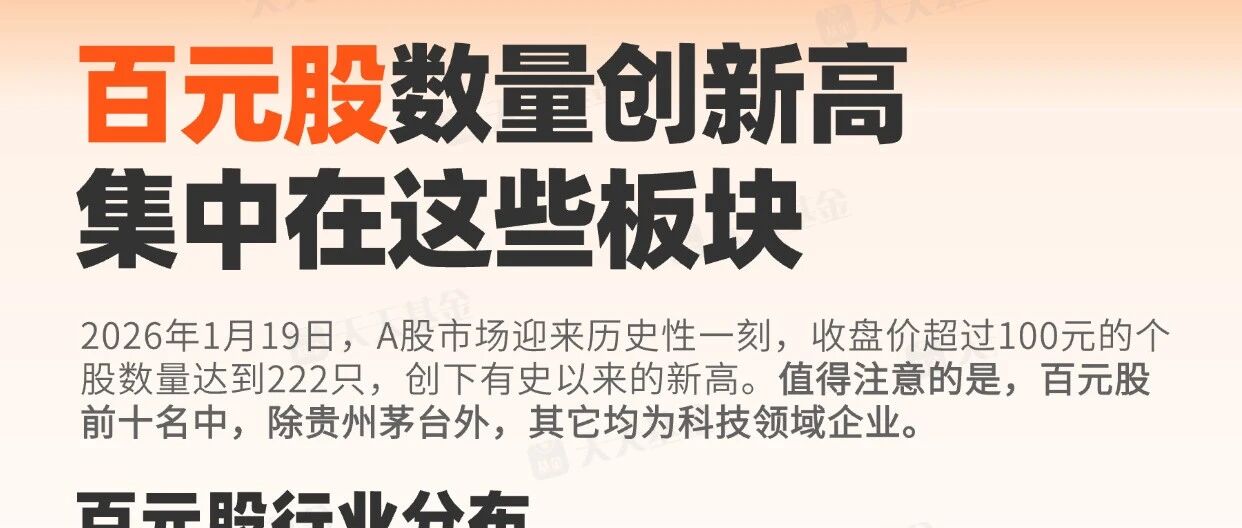
百元股数量创新高,集中在这些板块
天天基金网· 2026-01-20 07:07
Core Viewpoint - The A-share market has reached a historic milestone with the number of stocks closing above 100 yuan reaching 222, marking a new high in history, predominantly driven by technology companies, except for Kweichow Moutai [1][6]. Group 1: Distribution of Hundred Yuan Stocks - The electronic industry leads with 79 stocks, accounting for 35.59% of the total hundred yuan stocks. The machinery equipment industry has 26 stocks (11.71%), and the computer industry has 24 stocks (10.81%) [6]. Group 2: Top Ten Hundred Yuan Stocks - The top three stocks are: 1. Cambricon (寒武纪-U) with a closing price of 1419.66 yuan and a 2025 increase of 106.01% [3]. 2. Kweichow Moutai (贵州茅台) at 1376.00 yuan with a decrease of 6.29% [3]. 3. Source Code Technology (源杰科技) at 748.29 yuan with a remarkable increase of 379.34% [4]. Group 3: Market Trends and Future Outlook - The overall rise in the A-share market has led to a significant increase in the average stock price level, with the number of hundred yuan stocks surpassing 200 as of January 19, 2026 [6]. - Experts predict that the hundred yuan stock group will continue to expand due to ongoing trends in the technology industry and sustained inflow of long-term capital, although structural differentiation is expected to become more pronounced [6].



未知机构:建议关注国产芯片产业链H200受限智算服务器物料紧缺涨价利好国产芯片天风计-20260120
未知机构· 2026-01-20 02:45
Summary of Conference Call on Domestic Chip Industry Industry Overview - Focus on the domestic chip industry, particularly in relation to the H200 AI chip and the tight supply of materials for intelligent computing servers [1][2] Key Points and Arguments - **H200 Chip Export Regulations**: The U.S. government has relaxed export controls on the H200 chip but with stringent conditions. Exports to China must undergo compliance testing and the quantity obtained by mainland China and Macau cannot exceed 50% of the total purchased by U.S. clients [1][2] - **Impact on Domestic Chips**: The H200 chip is not expected to significantly impact domestic chip manufacturers due to differing use cases and ongoing policy support for local production [1][2] - **Supply Shortages in AI Chips**: Strong demand for overseas AI chips has led to supply shortages, particularly affecting server CPUs from AMD and Intel, which are experiencing inventory shortages and price increases of 10%-15% [1][2] - **Opportunities for Domestic Suppliers**: The supply chain shortages may benefit domestic chip suppliers, allowing them to increase prices or enter the supply chains of major domestic cloud service providers (CSPs) [1][2] Additional Important Information - **Key Domestic Chip Players**: - AI Chips: Haiguang Information, Cambricon, Huawei Chain, and Biren Technology - CPUs: Haiguang Information, with potential price increases or entry into major manufacturers' supply chains - Other server chips: Haiguang Information and Lanke Technology for PCIe switches, and Shengke Communication for switching chips [3][4] - **Increased Tender Demand**: The demand for tenders has significantly increased, indicating a robust market for domestic chip manufacturers despite the challenges posed by the H200 chip [4]


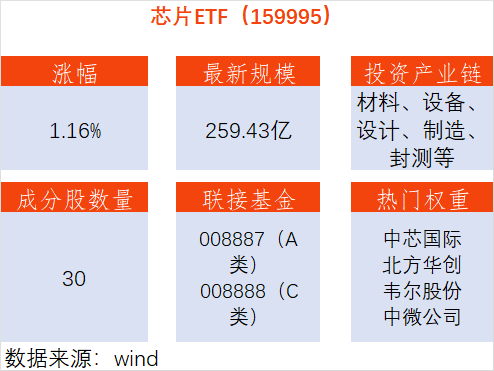
AI芯片需求旺盛推高封测价格,芯片ETF(159995.SZ)上涨1.16%,北京君正上涨6.08%
Mei Ri Jing Ji Xin Wen· 2026-01-20 02:05
Group 1 - The A-share market showed mixed performance on January 20, with the Shanghai Composite Index rising by 0.09%, driven by gains in real estate, building materials, and construction decoration sectors, while the comprehensive and communication sectors experienced declines [1] - The chip technology stocks performed strongly, with the chip ETF (159995.SZ) increasing by 1.16% as of 9:45 AM, and notable individual stock performances included Beijing Junzheng up by 6.08%, Longxin Zhongke up by 5.85%, and Lanke Technology up by 4.03% [1] Group 2 - The demand for AI chips and storage chips remains high, leading overseas storage manufacturers to allocate resources towards advanced packaging (such as HBM), which may tighten the testing capacity for standard storage chips [3] - Rising prices of raw materials such as gold, silver, and copper have significantly increased packaging costs, potentially leading to price hikes across the testing industry [3] - According to Open Source Securities, in a high-demand environment, testing companies may pass on cost pressures through price adjustments and improve profitability, while also optimizing product structures to focus on higher-margin businesses [3] - The chip ETF (159995) tracks the National Chip Index, comprising 30 leading companies in the A-share chip industry across materials, equipment, design, manufacturing, packaging, and testing, including SMIC, Cambricon, Changdian Technology, and Northern Huachuang [3]